

The DOI matches its Crossref record; 35 of the 35 references it cites were found in a registry or an index.
Double-adjustment in propensity score matching analysis: choosing a threshold for considering residual imbalance
Open accessAbstract
BACKGROUND: Double-adjustment can be used to remove confounding if imbalance exists after propensity score (PS) matching. However, it is not always possible to include all covariates in adjustment. We aimed to find the optimal imbalance threshold for entering covariates into regression. METHODS: We conducted a series of Monte Carlo simulations on virtual populations of 5,000 subjects. We performed PS 1:1 nearest-neighbor matching on each sample. We calculated standardized mean differences across groups to detect any remaining imbalance in the matched samples. We examined 25 thresholds (from 0.01 to 0.25, stepwise 0.01) for considering residual imbalance. The treatment effect was estimated using logistic regression that contained only those covariates considered to be unbalanced by these thresholds. RESULTS: We showed that regression adjustment could dramatically remove residual confounding bias when it included all of the covariates with a standardized difference greater than 0.10. The additional benefit was negligible when we also adjusted for covariates with less imbalance. We found that the mean squared error of the estimates was minimized under the same conditions. CONCLUSION: If covariate balance is not achieved, we recommend reiterating PS modeling until standardized differences below 0.10 are achieved on most covariates. In case of remaining imbalance, a double adjustment might be worth considering.
Overview
The claims and statistics of this paper haven’t been checked yet.
Run the check — free, no account needed. It reads the open-access text and checks the sources it cites.
Integrity signals
Registry
Cites
Statistics
Figures
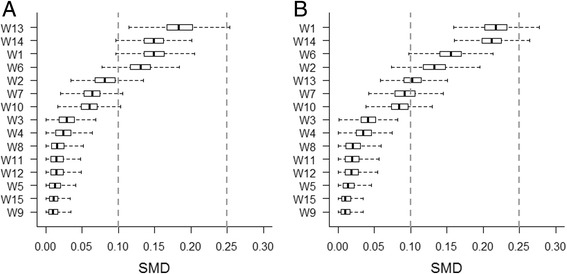
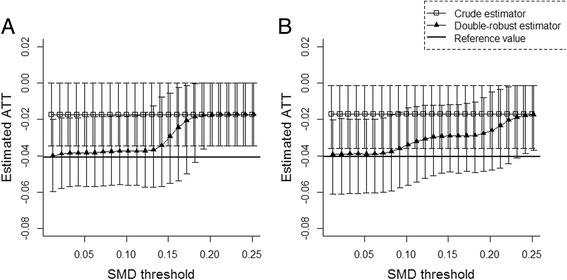
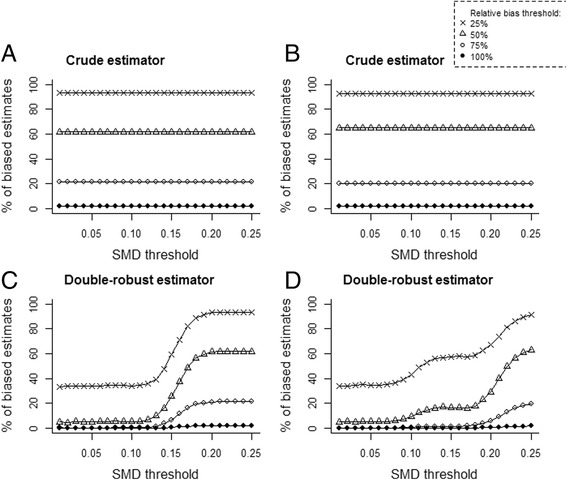
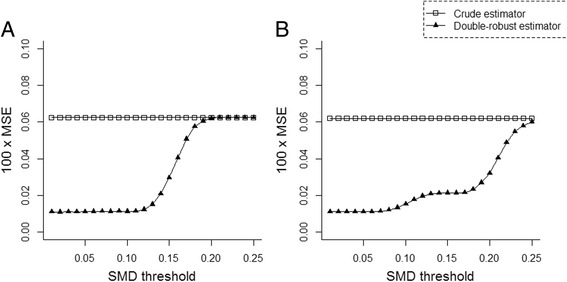
Verification
Claims the paper makes
The claims and statistics of this paper haven’t been checked yet.
Run the check — free, no account needed. It reads the open-access text and checks the sources it cites.
Claims other papers make about this one
Each is checked against this paper’s own text: does it say what the citing paper says it does?
The source backs part of the claim, not all of it — or backs it for a different population, condition or comparison.
In the citing paper
“residual imbalance was handled through double adjustment in the outcome analyses to achieve double robustness to potential model misspecification.46,47”
From Hysterectomy versus uterine preservation for pelvic organ prolapse surgery: a prospective cohort study (2025) · cites this paper as [47]
Experimental — accuracy not yet measured
Self-check
Percentages, sums and reported differences re-computed from the paper’s own numbers.
The self-check needs the paper’s full text.
Citations
Cites
The central role of the propensity score in observational studies for causal effects
ROSENBAUM, P. R., & RUBIN, D. B. (1983) · Biometrika · doi:10.1093/biomet/70.1.41 · Cited by 31,241
A simulation study of the number of events per variable in logistic regression analysis
Peduzzi, P., Concato, J., Kemper, E., Holford, T. R., & Feinstein, A. R. (1996) · Journal of Clinical Epidemiology · doi:10.1016/s0895-4356(96)00236-3 · Cited by 9,655
Austin, P. C. (2009) · Statistics in Medicine · doi:10.1002/sim.3697 · Cited by 6,758
Relaxing the Rule of Ten Events per Variable in Logistic and Cox Regression
Vittinghoff, E., & McCulloch, C. E. (2007) · American Journal of Epidemiology · doi:10.1093/aje/kwk052 · Cited by 4,359
Matching as Nonparametric Preprocessing for Reducing Model Dependence in Parametric Causal Inference
Ho, D. E., Imai, K., King, G., & Stuart, E. A. (2007) · Political Analysis · doi:10.1093/pan/mpl013 · Cited by 4,285
Lee, T. H.-Y., Marcantonio, E. R., Mangione, C. M., Thomas, E. J., Polanczyk, C. A., Cook, E. F., Sugarbaker, D. J., Donaldson, M. C., Poss, R., Ho, K. K. L., et al. (1999) · Circulation · doi:10.1161/01.cir.100.10.1043 · Cited by 3,749
Variable Selection for Propensity Score Models
Brookhart, M. A., Schneeweiss, S., Rothman, K. J., Glynn, R. J., Avorn, J., & Stürmer, T. (2006) · American Journal of Epidemiology · doi:10.1093/aje/kwj149 · Cited by 2,336
Peduzzi, P., Concato, J., Feinstein, A. R., & Holford, T. R. (1995) · Journal of Clinical Epidemiology · doi:10.1016/0895-4356(95)00048-8 · Cited by 2,154
Lunceford, J. K., & Davidian, M. (2004) · Statistics in Medicine · doi:10.1002/sim.1903 · Cited by 1,676
Bias-Corrected Matching Estimators for Average Treatment Effects
Abadie, A., & Imbens, G. W. (2011) · Journal of Business & Economic Statistics · doi:10.1198/jbes.2009.07333 · Cited by 1,416
Normand, S. T., Landrum, M. B., Guadagnoli, E., Ayanian, J. Z., Ryan, T. J., Cleary, P. D., & McNeil, B. J. (2001) · Journal of Clinical Epidemiology · doi:10.1016/s0895-4356(00)00321-8 · Cited by 1,244
Austin, P. C., Grootendorst, P. V., & Anderson, G. M. (2006) · Statistics in Medicine · doi:10.1002/sim.2580 · Cited by 1,138
Devereaux, P. J., Chan, M. T. V., Alonso‐Coello, P., Walsh, M., Berwanger, O. B., Villar, J. C., Wang, C. Y., Garutti, R. I., Jacka, M. J., Sigamani, A., et al. (2012) · JAMA · doi:10.1001/jama.2012.5502 · Cited by 1,102
Self-citationA comparison of 12 algorithms for matching on the propensity score
Austin, P. C. (2014) · Statistics in Medicine · doi:10.1002/sim.6004 · Cited by 1,085
Myocardial Injury after Noncardiac Surgery
Botto, F. O., Alonso‐Coello, P., Chan, M. T. V., Villar, J. C., Xavier, D., Srinathan, S. K., Guyatt, G. H., Cruz, P., Graham, M. M., Wang, C. Y., et al. (2014) · Anesthesiology · doi:10.1097/aln.0000000000000113 · Cited by 1,043
Self-citation8. Misunderstandings Between Experimentalists and Observationalists About Causal Inference
Imai, K., King, G., & Stuart, E. A. (2008) · Yale University Press eBooks · doi:10.1111/j.1467-985x.2007.00527.x · Cited by 925
Pearse, R. M., Harrison, D. A., MacDonald, N., Gillies, M., Blunt, M. C., Ackland, G. L., Grocott, M. P. W., Ahern, A., Griggs, K., Scott, R. A., et al. (2014) · JAMA · doi:10.1001/jama.2014.5305 · Cited by 864
Austin, P. (2010) · American Journal of Epidemiology · doi:10.1093/aje/kwq224 · Cited by 670
Austin, P. C. (2007) · Journal of Thoracic and Cardiovascular Surgery · doi:10.1016/j.jtcvs.2007.07.021 · Cited by 589
The Bias Due to Incomplete Matching
Rosenbaum, P. R., & Rubin, D. B. (1985) · Biometrics · doi:10.2307/2530647 · Cited by 532
The Bias Due to Incomplete Matching
Rosenbaum, P. R. (2006) · Cambridge University Press eBooks · doi:10.1017/cbo9780511810725.020 · Cited by 422
Fluvastatin and Perioperative Events in Patients Undergoing Vascular Surgery
Schouten, O., Boersma, E., Hoeks, S. E., Benner, R., van Urk, H., van Sambeek, M. R. H. M., Verhagen, H. J. M., Khan, N. A., Dunkelgrun, M., Bax, J. J., et al. (2009) · New England Journal of Medicine · doi:10.1056/nejmoa0808207 · Cited by 374
Collins, P. G. S., Reitsma, J. B., Altman, D. G., & Moons, K. G. M. (2015) · Journal of Clinical Epidemiology · doi:10.1016/j.jclinepi.2014.11.010 · Cited by 336
Austin, P. C., & Stuart, E. A. (2015) · Statistical Methods in Medical Research · doi:10.1177/0962280215584401 · Cited by 327
Evaluating uses of data mining techniques in propensity score estimation: a simulation study
Setoguchi, S., Schneeweiß, S., Brookhart, M. A., Glynn, R. J., & Cook, E. F. (2008) · Pharmacoepidemiology and Drug Safety · doi:10.1002/pds.1555 · Cited by 265
Ali, M. S., Groenwold, R. H. H., Belitser, S. V., Pestman, W. R., Hoes, A. W., Roes, K. C. B., de Boer, A., & Klungel, O. H. (2014) · Journal of Clinical Epidemiology · doi:10.1016/j.jclinepi.2014.08.011 · Cited by 222
Invited commentary: understanding bias amplification.
Pearl, J. (2011) · American Journal of Epidemiology · doi:10.1093/aje/kwr352 · Cited by 197
Austin, P. C. (2008) · Pharmacoepidemiology and Drug Safety · doi:10.1002/pds.1674 · Cited by 188
Propensity scores in intensive care and anaesthesiology literature: a systematic review
Gayat, É., Pirracchio, R., Resche‐Rigon, M., Mebazaa, A., Mary, J., & Porcher, R. (2010) · Intensive Care Medicine · doi:10.1007/s00134-010-1991-5 · Cited by 139
Estimating the effect of treatment on binary outcomes using full matching on the propensity score
Austin, P. C., & Stuart, E. A. (2015) · Statistical Methods in Medical Research · doi:10.1177/0962280215601134 · Cited by 130
Optimal full matching for survival outcomes: a method that merits more widespread use
Austin, P. C., & Stuart, E. A. (2015) · Statistics in Medicine · doi:10.1002/sim.6602 · Cited by 115
Measuring balance and model selection in propensity score methods
Belitser, S. V., Martens, E. P., Pestman, W. R., Groenwold, R. H. H., de Boer, A., & Klungel, O. H. (2011) · Pharmacoepidemiology and Drug Safety · doi:10.1002/pds.2188 · Cited by 107
Double propensity-score adjustment: A solution to design bias or bias due to incomplete matching
Austin, P. C. (2014) · Statistical Methods in Medical Research · doi:10.1177/0962280214543508 · Cited by 93
Caruana, E., Chevret, S., Resche‐Rigon, M., & Pirracchio, R. (2015) · Journal of Clinical Epidemiology · doi:10.1016/j.jclinepi.2015.04.009 · Cited by 18
Research works printed but not linked: 1
- Ho DE, Imai K, King G, Stuart EA. Matching as nonparametric preprocessing for reducing model dependence in parametric causal inference. Polit Anal. 2006;15(3):199–236.
Cited by
Sorted by citations
Effectiveness of Covid-19 Vaccines in Ambulatory and Inpatient Care Settings
Thompson, M. G., Stenehjem, E. A., Grannis, S. J., Ball, S. W., Naleway, A. L., Ong, T. C., DeSilva, M. B., Natarajan, K., Bozio, C. H., Lewis, N., et al. (2021) · New England Journal of Medicine · doi:10.1056/nejmoa2110362 · Cited by 467
Technology readiness levels for machine learning systems
Lavin, A., Lee, C. M., Visnjic, A., Ganju, S., Newman, D. J., Ganguly, S., Lange, D., Baydin, A. G., Sharma, A., Gibson, A., et al. (2022) · Nature Communications · doi:10.1038/s41467-022-33128-9 · Cited by 247
Doumouras, A. G., Wong, J. A., Paterson, J. M., Lee, Y., Sivapathasundaram, B., Tarride, J.-E., Thabane, L., Hong, D., Yusuf, S., & Anvari, M. (2021) · Circulation · doi:10.1161/circulationaha.120.052386 · Cited by 209
Ali, M. S., Prieto-Alhambra, D., Lopes, L. C., Ramos, D., Bispo, N., Ichihara, M. Y., Pescarini, J. M., Williamson, E., Fiaccone, R. L., Barreto, M. L., et al. (2019) · Frontiers in Pharmacology · doi:10.3389/fphar.2019.00973 · Cited by 200
Català, M., Mercadé‐Besora, N., Kolde, R., Trinh, N. T., Roel, E., Burn, E., Rathod‐Mistry, T., Kostka, K., Man, W. Y., Delmestri, A., et al. (2024) · The Lancet Respiratory Medicine · doi:10.1016/s2213-2600(23)00414-9 · Cited by 179
Metadata
- Authors
- Nguyen, T.-L., Collins, G. S., Spence, J., Daurès, J.-P., Devereaux, P. J., Landais, P., & Le Manach, Y.
- Affiliations
- Université de Montpellier (FR)
- Population Health Research Institute (CA)
- Venue
- BMC Medical Research Methodology
- Published
- 2017-04-28
- Volume
- 17
- Issue
- 1
- Pages
- 78-78
- ISSN
- 1471-2288 (ISSN-L)
- PMC
- PMC5408373
- OpenAlex
- W2609185034
- Cited by
- 512
- References
- 35
- Citations by year
- 2026: 65 · 2025: 79 · 2024: 76 · 2023: 76 · 2022: 86 · 2021: 61 · 2020: 32 · 2019: 19 · 2018: 12 · 2017: 5
- FWCI
- 12.93
- Type
- journal article
- Language
- en
- Open access
- gold
- doi.org
- Licence
- cc-by
- Locations
- BMC Medical Research Methodology (publishedVersion, cc-by)
- Europe PMC (PubMed Central) (publishedVersion, cc-by)
- PubMed Central (publishedVersion, cc-by)
- PubMed (publishedVersion)
- University of Birmingham Research Portal (University of Birmingham) (publishedVersion, other-oa)
- HAL (submittedVersion, cc-by)
- DOAJ (DOAJ: Directory of Open Access Journals) (submittedVersion, cc-by-sa)
- Funders
- None
- Topics
- Physical Sciences › Mathematics › Statistics and Probability › Advanced Causal Inference Techniques
- Physical Sciences › Mathematics › Statistics and Probability › Statistical Methods in Clinical Trials
- Physical Sciences › Mathematics › Statistics and Probability › Statistical Methods in Epidemiology
- Keywords
- propensity score matching, standardized mean difference, covariate balance, regression adjustment, confounding, nearest neighbor matching, treatment effect estimation, mean squared error
- MeSH terms
- Algorithms, Computer Simulation, Humans, Monte Carlo Method, Models, Statistical, Bias, Logistic Models, Propensity Score
About these checks
Registry, retraction, Cites and statistics results are computed, not judged, with one exception: a printed reference that no index lists is read once by a model before it counts as a citation error. Claims are extracted by a model and kept only when their quote appears verbatim in the text; each cited source is then checked, with a model’s help, for whether it says what the claim relies on. Those verdicts can be wrong — read the claim’s quote and the cited source before relying on one.
Statistics and arithmetic are recomputed, not judged.
Confidence bands are shown only for fields calibrated on our annotated test set. None is calibrated yet, so no band is shown.
What counts as a claim ›How we measure confidence ›How we check this ›
Are you an author, or do you see a problem with this page? Request a review
