

The DOI matches its Crossref record; 26 of the 27 references it cites were found in a registry or an index.
Assessing the quality of health research from an Indigenous perspective: the Aboriginal and Torres Strait Islander quality appraisal tool
Open accessAbstract
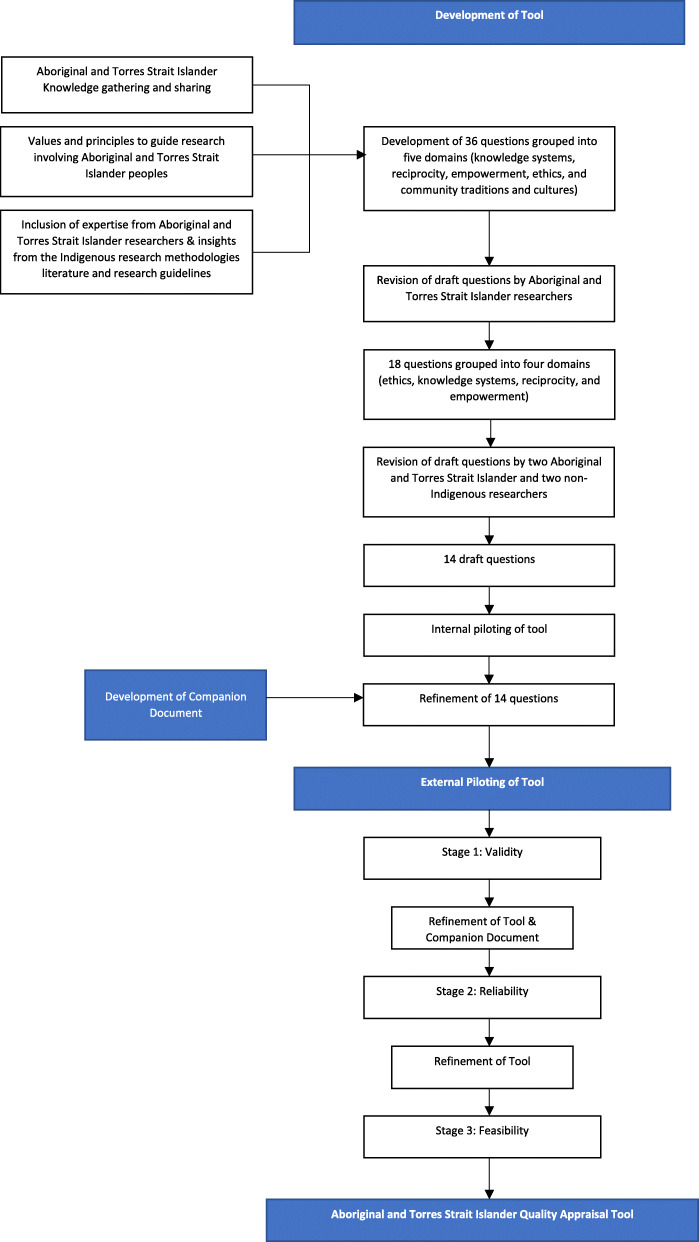
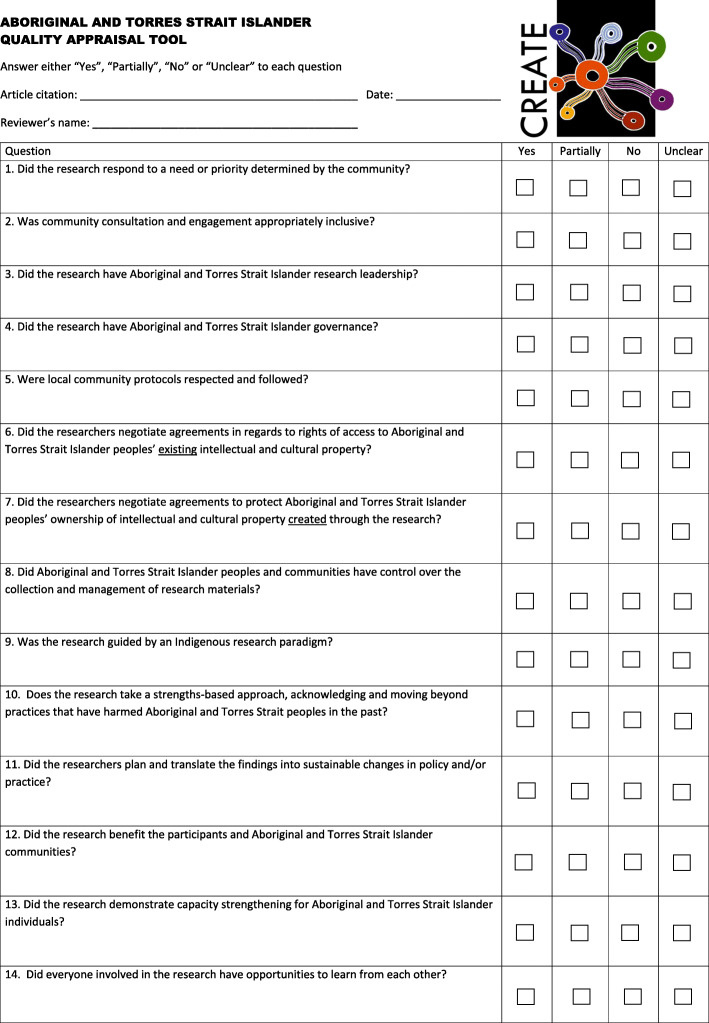
Background: The lack of attention to Indigenous epistemologies and, more broadly, Indigenous values in primary research, is mirrored in the standardised critical appraisal tools used to guide evidence-based practice and systematic reviews and meta-syntheses. These critical appraisal tools offer no guidance on how validity or contextual relevance should be assessed for Indigenous populations and cultural contexts. Failure to tailor the research questions, design, analysis, dissemination and knowledge translation to capture understandings that are specific to Indigenous peoples results in research of limited acceptability and benefit and potentially harms Indigenous peoples. A specific Aboriginal and Torres Strait Islander Quality Appraisal Tool is needed to address this gap. Method: The Aboriginal and Torres Strait Islander Quality Appraisal Tool (QAT) was developed using a modified Nominal Group and Delphi Techniques and the tool’s validity, reliability, and feasibility were assessed over three stages of independent piloting. National and international research guidelines were used as points of reference. Piloting of the Aboriginal and Torres Strait Islander QAT with Aboriginal and Torres Strait Islander and non-Indigenous experts led to refinement of the tool. Results: The Aboriginal and Torres Strait Islander QAT consists of 14 questions that assess the quality of health research from an Aboriginal and Torres Strait Islander perspective. The questions encompass setting appropriate research questions; community engagement and consultation; research leadership and governance; community protocols; intellectual and cultural property rights; the collection and management of research material; Indigenous research paradigms; a strength-based approach to research; the translation of findings into policy and practice; benefits to participants and communities involved; and capacity strengthening and two-way learning. Outcomes from the assessment of the tool’s validity, reliability, and feasibility were overall positive. Conclusion: This is the first tool to appraise research quality from the perspective of Indigenous peoples. Through the uptake of the Aboriginal and Torres Strait Islander QAT we hope to improve the quality and transparency of research with Aboriginal and Torres Strait Islander peoples, with the potential for greater improvements in Aboriginal and Torres Strait Islander health and wellbeing.
Overview
The claims and statistics of this paper haven’t been checked yet.
Run the check — free, no account needed. It reads the open-access text and checks the sources it cites.
Integrity signals
Registry
Cites
Statistics
Figures
Verification
Claims the paper makes
The claims and statistics of this paper haven’t been checked yet.
Run the check — free, no account needed. It reads the open-access text and checks the sources it cites.
Claims other papers make about this one
Each is checked against this paper’s own text: does it say what the citing paper says it does?
The source backs part of the claim, not all of it — or backs it for a different population, condition or comparison.
In the citing paper
“The Indigenous Quality Assessment Tool (IQAT) is a standardized instrument that examines research pertaining to Indigenous peoples (Harfield et al., 2020).”
From Indigenous Autism in Canada: A Scoping Review (2024) · cites this paper as Harfield et al., 2020
Experimental — accuracy not yet measured
Self-check
Percentages, sums and reported differences re-computed from the paper’s own numbers.
The self-check needs the paper’s full text.
Citations
Cites
8 Decolonizing Methodologies: Research and Indigenous Peoples
Smith, L. T. (2024) · Multilingual Matters eBooks · doi:10.21832/9781800418868-012 · Cited by 9,766
(2008) · Cross Connect (Southern Cross University) · Cited by 3,517
Qualitative Research: Consensus methods for medical and health services research
Jones, J., & Hunter, D. (1995) · BMJ · doi:10.1136/bmj.311.7001.376 · Cited by 3,471
Group Techniques for Program Planning: A Guide to Nominal Group and Delphi Processes
(1976) · The Journal of Applied Behavioral Science · doi:10.1177/002188637601200414 · Cited by 2,815
Decolonizing Methodologies: Research and Indigenous Peoples
Crothers, C. H. G. (2013) · Ethnic and Racial Studies · doi:10.1080/01419870.2013.800575 · Cited by 1,912
Rigney, L. (1999) · Wicazo Sa Review · doi:10.2307/1409555 · Cited by 1,089
The Declaration on the Rights of Indigenous Peoples
(2020) · ANU Press eBooks · doi:10.2307/j.ctv186grnt.6 · Cited by 673
Indigenous Research Methods: A Systematic Review
Drawson, A. S., Toombs, E., & Mushquash, C. J. (2017) · International Indigenous Policy Journal · doi:10.18584/iipj.2017.8.2.5 · Cited by 315
Indigenous Peoples, Poverty, and Development
Hall, G. H. (2012) · Cambridge University Press eBooks · doi:10.1017/cbo9781139105729 · Cited by 234
State of the World’s Indigenous Peoples
(2019) · State of the world's indigenous peoples · doi:10.18356/532f27ac-en · Cited by 200
Research works printed but not linked: 14
- Stubhben JD. Native Americans and political participation: a reference handbook. Santa Babara: ABC-CLIO; 2006.
- Canadian Institute of Health Research. CIHR guidelines for Health Research involving aboriginal people. Ottawa: Canadian Institutes of Health Research; 2007.
- Health Research Council of New Zealand. In: Purnel, editor. Guidelines for researchers on Health Research involving Máori. Auckland: Health Research Council of New Zealand; 2010.
- National Health and Medical Research Council. Values and ethics: guidelines for ethical conduct in aboriginal and Torres Strait islander Health Research. Canberra: Commonwealth of Australia; 2003.
- National Health and Medical Research Council. National Statement on ethical conduct in human research (updated May 2015). Canberra: Commonwealth of Australia; 2007.
- Australian Institute of Aboriginal and Torres Strait Islander Studies, The Lowitja Institute. Researching right way: aboriginal and Torres Strait islander Health Research ethics: a domestic and international review. Melbourne: Cooperative Research Centre for Aboriginal and Torres Strait Islander Health; 2013.
- Saini M. A systematic review of Western and aboriginal research designs : assessing validation to explore compatability and convergence. In. Prince George: National Collaborating Centre for Aboriginal Health; 2012.
- Human Rights and Equal Opportunity Commission. Chapter 3: the Northern Territory 'Emergency Response' intervention - a human rights analysis - part 1. The little children are sacred report and the announcement of the 'emergency measures'. In: Social Justice Report. Sydney: Paragon Australasia Group; 2007. p. 197–329.
- Indigenous Peoples' Health Research Centre. The ethics of research involving indigenous peoples - report of the indigenous Peoples' Health Research Centre to the interagency advisory panel of research ethics. Saskatchewan: Indigenous Peoples' Health Research Centre; 2004.
- Sherwood J. Do no harm: decolonising aboriginal health research. Sydney: University of New South Wales; 2010.
- Guy T, Fuller D, Pletsch C. Asset mapping: a handbook. Ottowa: Canadian Rural Partnership; 2002.
- King R, Brown A. Next steps for aboriginal Health Research: exploring how research can improve the health and wellbeing of aboriginal people in South Australia - final report in. Adelaide: Aboriginal Health Council of South Australia; 2015.
- UNESCO. Learning and knowing in indigenous societies today. Paris: UNESCO; 2009.
- MacLean S, Ritte R, Thorpe A, Ewen S, Arabena K. Assessing compliance with aboriginal and Torres Strait islander health research guidelines within systematic reviews. Austr Indigenous Health Bull. 2015;15(4):1–5.
Cited by
Sorted by citations
Kennedy, M., Maddox, R., Booth, K., Maidment, S., Chamberlain, C., & Bessarab, D. (2022) · International Journal for Equity in Health · doi:10.1186/s12939-022-01738-w · Cited by 224
Reporting and conducting patient journey mapping research in healthcare: A scoping review
Davies, E. L., Bulto, L. N., Walsh, A., Pollock, D., Langton, V. M., Laing, R. E., Graham, A., Arnold‐Chamney, M., & Kelly, J. (2023) · Journal of Advanced Nursing · doi:10.1111/jan.15479 · Cited by 211
Lin, C. Y., Sánchez, A. L., Boyling, E., & Barnabe, C. C. M. (2020) · BMJ Open · doi:10.1136/bmjopen-2020-039736 · Cited by 74
One Health in Indigenous Communities: A Critical Review of the Evidence
Riley, T., Anderson, N. E., Lovett, R. W., Meredith, A. L., Cumming, B., & Thandrayen, J. (2021) · International Journal of Environmental Research and Public Health · doi:10.3390/ijerph182111303 · Cited by 68
Christidis, R., Lock, M., Walker, T., Egan, M., & Browne, J. (2021) · International Journal for Equity in Health · doi:10.1186/s12939-021-01551-x · Cited by 57
Metadata
- Authors
- Harfield, S., Pearson, O., Morey, K., Kite, E., Canuto, K., Glover, K., Gomersall, J. S., Carter, D., Davy, C., Aromataris, E., & Braunack-Mayer, A.
- Affiliations
- South Australian Health and Medical Research Institute (AU)
- The University of Adelaide (AU)
- Corresponding author
- Harfield, Stephen
- ORCID
- Venue
- BMC Medical Research Methodology
- Published
- 2020-04-10
- Volume
- 20
- Issue
- 1
- Pages
- 79-79
- ISSN
- 1471-2288 (ISSN-L)
- PMC
- PMC7147059
- OpenAlex
- W3015992259
- Cited by
- 313
- References
- 27
- Citations by year
- 2026: 40 · 2025: 56 · 2024: 70 · 2023: 56 · 2022: 50 · 2021: 33 · 2020: 7
- FWCI
- 20.21
- Type
- journal article
- Language
- en
- Open access
- gold
- doi.org
- Locations
- BMC Medical Research Methodology (publishedVersion, cc-by)
- PubMed Central (publishedVersion, cc-by)
- PubMed (publishedVersion)
- ResearchOnline - JCU (James Cook University) (submittedVersion)
- Research Online (University of Wollongong) (submittedVersion)
- Adelaide Research & Scholarship (AR&S) (University of Adelaide) (submittedVersion, cc-by)
- DOAJ (DOAJ: Directory of Open Access Journals) (submittedVersion, cc-by-sa)
- Figshare (submittedVersion)
- Funders
- National Health and Medical Research Council (NHMRC No 1061242)
- Topics
- Social Sciences › Health › Indigenous Health, Education, and Rights
- Health Sciences › Health Professions › General Health Professions › Health Sciences Research and Education
- Social Sciences › Decision Sciences › Statistics, Probability and Uncertainty › Meta-analysis and systematic reviews
- Keywords
- Aboriginal and Torres Strait Islander health, Indigenous research paradigm, critical appraisal tools, research quality assessment, Indigenous epistemologies, community participation, community protocols, knowledge translation, capacity building, two-way learning
- MeSH terms
- Australian Aboriginal and Torres Strait Islander Peoples, Australia, Chronic Disease, Health Services Research, Health Services, Indigenous, Humans, Reproducibility of Results, Native Hawaiian or Other Pacific Islander
About these checks
Registry, retraction, Cites and statistics results are computed, not judged, with one exception: a printed reference that no index lists is read once by a model before it counts as a citation error. Claims are extracted by a model and kept only when their quote appears verbatim in the text; each cited source is then checked, with a model’s help, for whether it says what the claim relies on. Those verdicts can be wrong — read the claim’s quote and the cited source before relying on one.
Statistics and arithmetic are recomputed, not judged.
Confidence bands are shown only for fields calibrated on our annotated test set. None is calibrated yet, so no band is shown.
What counts as a claim ›How we measure confidence ›How we check this ›
Are you an author, or do you see a problem with this page? Request a review
