

Design and statistical analysis reporting among interrupted time series studies in drug utilization research: a cross-sectional survey
Open accessThe DOI matches its Crossref record; 34 of the 34 references it cites were found in a registry or an index.
Abstract
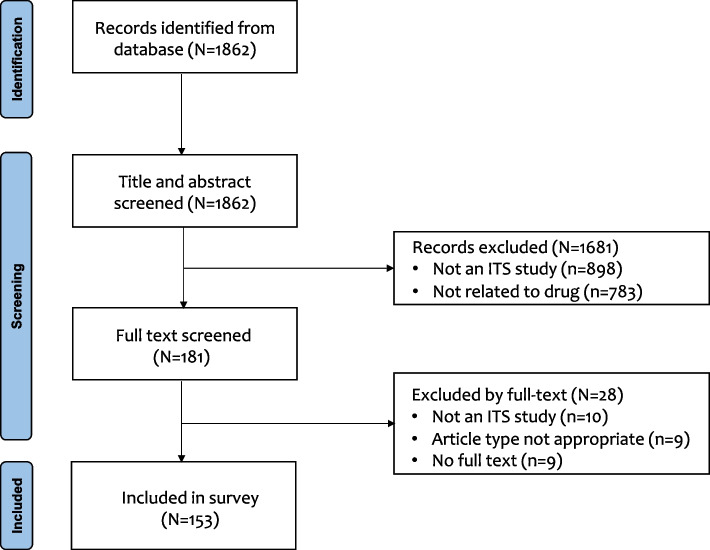
Introduction: Interrupted time series (ITS) design is a commonly used method for evaluating large-scale interventions in clinical practice or public health. However, improperly using this method can lead to biased results. Objective: To investigate design and statistical analysis characteristics of drug utilization studies using ITS design, and give recommendations for improvements. Methods: A literature search was conducted based on PubMed from January 2021 to December 2021. We included original articles that used ITS design to investigate drug utilization without restriction on study population or outcome types. A structured, pilot-tested questionnaire was developed to extract information regarding study characteristics and details about design and statistical analysis. Results: We included 153 eligible studies. Among those, 28.1% (43/153) clearly explained the rationale for using the ITS design and 13.7% (21/153) clarified the rationale of using the specified ITS model structure. One hundred and forty-nine studies used aggregated data to do ITS analysis, and 20.8% (31/149) clarified the rationale for the number of time points. The consideration of autocorrelation, non-stationary and seasonality was often lacking among those studies, and only 14 studies mentioned all of three methodological issues. Missing data was mentioned in 31 studies. Only 39.22% (60/153) reported the regression models, while 15 studies gave the incorrect interpretation of level change due to time parameterization. Time-varying participant characteristics were considered in 24 studies. In 97 studies containing hierarchical data, 23 studies clarified the heterogeneity among clusters and used statistical methods to address this issue. Conclusion: The quality of design and statistical analyses in ITS studies for drug utilization remains unsatisfactory. Three emerging methodological issues warranted particular attention, including incorrect interpretation of level change due to time parameterization, time-varying participant characteristics and hierarchical data analysis. We offered specific recommendations about the design, analysis and reporting of the ITS study.
Overview
The claims and statistics of this paper haven’t been checked yet.
Free: it reads the open-access text and checks the first 5 claims that cite a source we can check. Create a free account to check every claim.
Integrity signals
Registry
Cites
Statistics
Figures
Verification
Claims the paper makes
The claims and statistics of this paper haven’t been checked yet.
Free: it reads the open-access text and checks the first 5 claims that cite a source we can check. Create a free account to check every claim.
Claims other papers make about this one
Each is checked against this paper’s own text: does it say what the citing paper says it does?
The check wasn’t confident either way, so it gives no verdict — never disputed.
In the citing paper
“In virtual care models, structured triage protocols and decision support tools may further enable safe task delegation [25].”
From Telemedicine implementation and healthcare utilization in Rwanda: interrupted time series of Babyl digital health services from 2015 to 2024 (2026) · cites this paper as [25]
Experimental — accuracy not yet measured
Self-check
Percentages, sums and reported differences re-computed from the paper’s own numbers.
The self-check needs the paper’s full text.
Citations
Cites
Segmented regression analysis of interrupted time series studies in medication use research
Wagner, A. K., Soumerai, S. B., Zhang, F., & Ross-Degnan, D. (2002) · Journal of Clinical Pharmacy and Therapeutics · doi:10.1046/j.1365-2710.2002.00430.x · Cited by 3,279 · cited 2×
“The definition of ITS study was followed as the previous methodological studies, as “a time series of a particular outcome of interest is used to establish an underlying trend, which is ‘interrupted’ by an intervention at a known point in time” [4, 5].”
BackgroundMethodInterrupted time series regression for the evaluation of public health interventions: a tutorial
Lopez Bernal, J., Cummins, S., & Gasparrini, A. (2016) · International Journal of Epidemiology · doi:10.1093/ije/dyw098 · Cited by 3,049
Use of Interrupted Time Series Analysis in Evaluating Health Care Quality Improvements
Penfold, R. B., & Zhang, F. (2013) · Academic Pediatrics · doi:10.1016/j.acap.2013.08.002 · Cited by 1,150
Time series regression studies in environmental epidemiology
Bhaskaran, K., Gasparrini, A., Hajat, S., Smeeth, L., & Armstrong, B. (2013) · International Journal of Epidemiology · doi:10.1093/ije/dyt092 · Cited by 1,150
Kontopantelis, E., Doran, T., Springate, D. A., Buchan, I., & Reeves, D. (2015) · BMJ · doi:10.1136/bmj.h2750 · Cited by 1,001 · cited 2×
“The ITS method might be affected by time-varying confounding, which may result in a misleading finding [5, 6].”
BackgroundMethodThe use of controls in interrupted time series studies of public health interventions
Lopez Bernal, J., Cummins, S., & Gasparrini, A. (2018) · International Journal of Epidemiology · doi:10.1093/ije/dyy135 · Cited by 559
Jandoc, R., Burden, A. M., Mamdani, M., Lévesque, L. E., & Cadarette, S. M. (2015) · Journal of Clinical Epidemiology · doi:10.1016/j.jclinepi.2014.12.018 · Cited by 474
Zhang, F., Wagner, A. K., & Ross-Degnan, D. (2011) · Journal of Clinical Epidemiology · doi:10.1016/j.jclinepi.2011.02.007 · Cited by 291
Quasi-experimental study designs series—paper 4: uses and value
Bärnighausen, T., Tugwell, P., Røttingen, J.-A., Shemilt, I., Rockers, P., Geldsetzer, P., Lavis, J., Grimshaw, J., Daniels, K., Brown, A., et al. (2017) · Journal of Clinical Epidemiology · doi:10.1016/j.jclinepi.2017.03.012 · Cited by 240
A methodological framework for model selection in interrupted time series studies
Lopez Bernal, J., Soumerai, S., & Gasparrini, A. (2018) · Journal of Clinical Epidemiology · doi:10.1016/j.jclinepi.2018.05.026 · Cited by 239
Hategeka, C., Ruton, H., Karamouzian, M., Lynd, L. D., & Law, M. R. (2020) · BMJ Global Health · doi:10.1136/bmjgh-2020-003567 · Cited by 237
Hudson, J., Fielding, S., & Ramsay, C. R. (2019) · BMC Medical Research Methodology · doi:10.1186/s12874-019-0777-x · Cited by 216
Turner, S., Karahalios, A., Forbes, A. B., Taljaard, M., Grimshaw, J., & McKenzie, J. E. (2021) · BMC Medical Research Methodology · doi:10.1186/s12874-021-01306-w · Cited by 204
Ewusie, J. E., Soobiah, C., Blondal, E., Beyene, J., Thabane, L., & Hamid, J. S. (2020) · Journal of Multidisciplinary Healthcare · doi:10.2147/jmdh.s241085 · Cited by 190
Turner, S. L., Karahalios, A., Forbes, A. B., Taljaard, M., Grimshaw, J. M., Cheng, A. C., Bero, L., & McKenzie, J. E. (2020) · Journal of Clinical Epidemiology · doi:10.1016/j.jclinepi.2020.02.006 · Cited by 140
Hawley, S. J., Ali, M. S., Berencsi, K., Judge, A., & Prieto‐Alhambra, D. (2019) · Clinical Epidemiology · doi:10.2147/clep.s176723 · Cited by 120
Quasi-experimental study designs series—paper 1: introduction: two historical lineages
Bärnighausen, T., Røttingen, J., Rockers, P. C., Shemilt, I., & Tugwell, P. (2017) · Journal of Clinical Epidemiology · doi:10.1016/j.jclinepi.2017.02.020 · Cited by 102
Xiao, H., Augusto, O., & Wagenaar, B. H. (2021) · International Journal of Epidemiology · doi:10.1093/ije/dyaa148 · Cited by 102
A robust interrupted time series model for analyzing complex health care intervention data
Cruz, M., Bender, M., & Ombao, H. (2017) · Statistics in Medicine · doi:10.1002/sim.7443 · Cited by 97
Wettermark, B., Elseviers, M. M., Almarsdóttir, A. B., Andersen, M. T., Benkő, R., Bennie, M., Eriksson, I., Godman, B., Krska, J., Poluzzi, E., et al. (2016) · Wiley eBooks · doi:10.1002/9781118949740 · Cited by 93
Bernal, J. L., Cummins, S., & Gasparrini, A. (2020) · International Journal of Epidemiology · doi:10.1093/ije/dyaa118 · Cited by 84
Analysing Interrupted Time Series with a Control
Bottomley, C., Scott, J. A. G., & Isham, V. (2019) · Epidemiologic Methods · doi:10.1515/em-2018-0010 · Cited by 79
Zombré, D., Allegri, M. D., & Ridde, V. (2017) · Social Science & Medicine · doi:10.1016/j.socscimed.2017.02.027 · Cited by 66
Jiang, H., Feng, X., Lange, S., Tran, A., Manthey, J., & Rehm, J. T. (2022) · BMC Medical Research Methodology · doi:10.1186/s12874-022-01716-4 · Cited by 53
Peek, N. B., Gude, W. T., Keers, R. N., Williams, R., Kontopantelis, E., Jeffries, M., Phipps, D. L., Brown, B. C., Avery, A. J., & Ashcroft, D. M. (2020) · PLoS Medicine · doi:10.1371/journal.pmed.1003286 · Cited by 42
Liu, W., Ye, S., BARTON, B. A., Fischer, M. A., Lawrence, C. E., Rahn, E. J., Danila, M. I., Saag, K. G., Harris, P. A., Lemon, S. C., et al. (2019) · Contemporary Clinical Trials Communications · doi:10.1016/j.conctc.2019.100474 · Cited by 38
Segmented Regression in an Interrupted Time Series Study Design
Schober, P. R., & Vetter, T. R. (2021) · Anesthesia & Analgesia · doi:10.1213/ane.0000000000005269 · Cited by 24
Korevaar, E., Karahalios, A., Turner, S., Forbes, A. B., Taljaard, M., Cheng, A. C., Grimshaw, J. M., Bero, L., & McKenzie, J. E. (2022) · Journal of Clinical Epidemiology · doi:10.1016/j.jclinepi.2022.01.010 · Cited by 21
MultiCenter Interrupted Time Series Analysis: Incorporating Within and Between-Center Heterogeneity
Ewusie, J. E., Thabane, L., Beyene, J., Straus, S. E., & Hamid, J. S. (2020) · Clinical Epidemiology · doi:10.2147/clep.s231843 · Cited by 9
Bazo‐Alvarez, J. C., Morris, T. P., Carpenter, J. R., & Petersen, I. (2021) · Clinical Epidemiology · doi:10.2147/clep.s314020 · Cited by 9
Fukuma, S., Ikenoue, T., Yamada, Y., Saito, Y., Green, J., Nakayama, T., & Fukuhara, S. (2020) · Journal of Epidemiology · doi:10.2188/jea.je20200181 · Cited by 7
Ewusie, J. E., Beyene, J., Thabane, L., Straus, S. E., & Hamid, J. S. (2021) · The International Journal of Biostatistics · doi:10.1515/ijb-2020-0046 · Cited by 6
Simple Interrupted Time‐Series Designs
(2011) · Wiley series in probability and statistics · doi:10.1002/9781118067475.ch18 · Cited by 5
Nichols, J., Mamdani, M., Gomes, T., Shah, B. R., Casey, C. G., & Yu, C. H. Y. (2020) · Canadian Journal of Diabetes · doi:10.1016/j.jcjd.2020.11.008 · Cited by 3
Cited by
Murray, L., Carroll, J., & Tyson, J. (2025) · Animals · doi:10.3390/ani15111584 · Cited by 7
Shimada, H., Mizuno, K., & Kawakami, K. (2026) · American Journal of Nephrology · doi:10.1159/000550435 · Cited by 2
Rahman, L., Goutam, A., Masud, S. B., Eva, F. N., Mostofa, M. M., Islam, T., & Hawlader, M. D. H. (2026) · BMC Infectious Diseases · doi:10.1186/s12879-026-12632-z · Cited by 2
Rubuga, F. K., Absolomon, G., Uhawenimana, T. C., Nsaba-Uwera, Y. D., Muhire, J., Hagenimana, J. D., Nyabyenda, E. C., Irakiza, P., Semakula, M., Remera, E., et al. (2026) · BMC Primary Care · doi:10.1186/s12875-026-03179-8 · Cited by 1
“In virtual care models, structured triage protocols and decision support tools may further enable safe task delegation [25].”
Kamgang, P. G., Beauregard, M.-È., Zhou, Z., Kiely, M., & Brousseau, N. (2025) · Human Vaccines & Immunotherapeutics · doi:10.1080/21645515.2025.2565925
Metadata
- Authors
- Zhang, Y., Ren, Y., Huang, Y., Yao, M., Jia, Y., Wang, Y., Mei, F., Zou, K., Tan, J., & Sun, X.
- Affiliations
- Sichuan University (CN)
- National Medical Products Administration (CN)
- Corresponding author
- Tan, Jing
- Sun, Xin
- Venue
- BMC Medical Research Methodology
- Published
- 2024-03-09
- Volume
- 24
- Issue
- 1
- Pages
- 62-62
- ISSN
- 1471-2288 (ISSN-L)
- PMC
- PMC10924989
- OpenAlex
- W4392622368
- Cited by
- 7
- References
- 34
- Citations by year
- 2026: 5 · 2025: 2
- FWCI
- 2.41
- Type
- journal article
- Language
- en
- Open access
- gold
- doi.org
- Licence
- cc-by
- creativecommons.org/licenses/by/4.0 (tdm)
- creativecommons.org/licenses/by/4.0 (vor)
- Locations
- BMC Medical Research Methodology (publishedVersion, cc-by)
- PubMed Central (publishedVersion, cc-by)
- PubMed (publishedVersion)
- DOAJ (DOAJ: Directory of Open Access Journals) (submittedVersion, cc-by-sa)
- Funders
- National Natural Science Foundation of China (72004149)
- China Postdoctoral Science Foundation (2022M72010)
- National Science Fund for Distinguished Young Scholars, China (82225049)
- Fundamental Research Funds for the Central public welfare research institutes, China (2020YJSZX-3)
- Sichuan Provincial Central Government Guides Local Science and Technology Development Special Project, China (2022ZYD0127)
- Topics
- Physical Sciences › Mathematics › Statistics and Probability › Advanced Causal Inference Techniques
- Physical Sciences › Mathematics › Statistics and Probability › Statistical Methods in Clinical Trials
- Social Sciences › Decision Sciences › Statistics, Probability and Uncertainty › Meta-analysis and systematic reviews
- Keywords
- interrupted time series design, medication use, methodological quality, statistical analysis reporting, autocorrelation, non-stationarity, seasonal variation, hierarchical data, cluster heterogeneity, missing data, reporting guidelines
- MeSH terms
- Cross-Sectional Studies, Drug Utilization, Humans, Public Health, Research Design, Interrupted Time Series Analysis
About these checks
Registry, retraction, Cites and statistics results are computed, not judged, with one exception: a printed reference that no index lists is read once by a model before it counts as a citation error. Claims are extracted by a model and kept only when their quote appears verbatim in the text; each cited source is then checked, with a model’s help, for whether it says what the claim relies on. Those verdicts can be wrong — read the claim’s quote and the cited source before relying on one.
Statistics and arithmetic are recomputed, not judged.
Confidence bands are shown only for fields calibrated on our annotated test set. None is calibrated yet, so no band is shown.
What counts as a claim ›How we measure confidence ›How we check this ›
Are you an author, or do you see a problem with this page? Request a review
Data sources
Bibliographic data: Semantic Scholar, OpenAlex, Crossref.
Contains information from the Semantic Scholar Academic Graph Datasets, made available under the ODC Attribution License (ODC-BY 1.0).
Semantic Scholar’s data is described in: Kinney, R., et al. (2023). The Semantic Scholar Open Data Platform. arXiv:2301.10140.
