

Patients’ health literacy and health behaviour assessment in primary health care: evidence from a cross-sectional survey
Open accessThe DOI matches its Crossref record; 19 of the 19 references it cites were found in a registry or an index.
Abstract
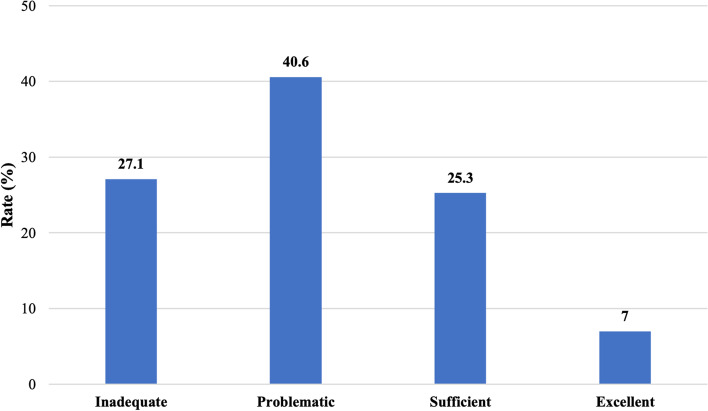
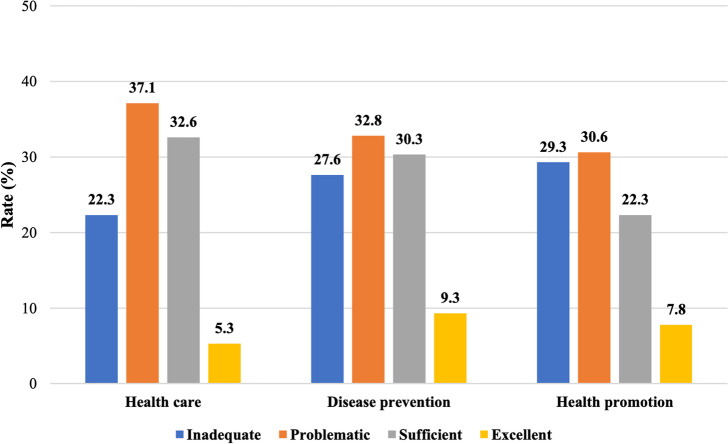
Background: Health literacy is defined as a person's ability to find, understand, and use health-related information when making health-related decisions. Patients with lower health literacy more frequently face difficulties when they have health issues or need medical help. Such patients are less likely to visit health care facilities and receive less help, which subsequently leads to higher hospitalization and mortality rates. Patients with better health literacy skills pay more attention to their health behaviours. Methods: This is a cross-sectional survey conducted in two primary health care centres—one public and one private—in Lithuania. The study enrolled patients who were visiting family physicians (n = 399). The study used the Health Literacy Survey European Questionnaire (HLS-EU-Q47). Calculation of means and two independent samples were used for statistical analysis, and a correlation coefficient was calculated. Results: The majority (40.6%) of respondents had problematic health literacy, while only 7% had excellent health literacy. Better health literacy was observed among younger patients (aged below 30 years), residing in urban areas, having higher education, and living with a partner. Inadequate or problematic health literacy was noted among 83.6% of respondents aged 59 years and older; similar rates were also observed among patients with basic or primary education (76.1%), secondary education (76.6%), and divorced patients (86%). Respondents with better health literacy also had better health behaviours (p < 0.05). Conclusions: Health literacy is influenced by age, residence, education, and family status. Patients with better health literacy also reported better health behaviours.
Overview
The claims and statistics of this paper haven’t been checked yet.
Free: it reads the open-access text and checks the first 5 claims that cite a source we can check. Create a free account to check every claim.
Integrity signals
Registry
Cites
Statistics
Figures
Verification
Claims the paper makes
The claims and statistics of this paper haven’t been checked yet.
Free: it reads the open-access text and checks the first 5 claims that cite a source we can check. Create a free account to check every claim.
Claims other papers make about this one
Each is checked against this paper’s own text: does it say what the citing paper says it does?
The cited source says what the claim attributes to it.
In the citing paper
“Inadequate or problematic health literacy was noted among 83.6% of respondents aged 59 years and older.”
From Improving health literacy using the power of digital communications to achieve better health outcomes for patients and practitioners. (2023) · cites this paper as [14]
The cited source says what the claim attributes to it.
In the citing paper
“Šulinskaitė et al. (14) examined health literacy in a cross-sectional survey conducted in Lithuania which showed 40.6% of respondents had problematic health literacy.”
From Improving health literacy using the power of digital communications to achieve better health outcomes for patients and practitioners. (2023) · cites this paper as [14]
In the citing paper
“Similar rates were also observed among patients with basic or primary education (76.1%), secondary education (76.6%) and divorced patients (86%).”
From Improving health literacy using the power of digital communications to achieve better health outcomes for patients and practitioners. (2023) · cites this paper as [14]
In the citing paper
“Respondents with better health literacy also had better health behaviours (p < 0.05).”
From Improving health literacy using the power of digital communications to achieve better health outcomes for patients and practitioners. (2023) · cites this paper as [14]
Self-check
Percentages, sums and reported differences re-computed from the paper’s own numbers.
The self-check needs the paper’s full text.
Citations
Cites
Health literacy and public health: A systematic review and integration of definitions and models
Sørensen, K., Van den Broucke, S., Fullam, J., Doyle, G., Pelikan, J., Slonska, Z., Brand, H., & (HLS-EU) Consortium Health Literacy Project European (2012) · BMC Public Health · doi:10.1186/1471-2458-12-80 · Cited by 6,213 · cited 3×
“They also tend to understand the information provided by health care professionals more easily, are more likely to change lifestyle habits and more consciously try to sustain good health [7, 13].”
BackgroundMethodHealth Literacy: A Prescription to End Confusion
Committee on Health Literacy, Board on Neuroscience and Behavioral Health, & Institute of Medicine (2004) · doi:10.17226/10883 · Cited by 3,444
Health literacy in Europe: Comparative results of the european health literacy survey (HLS-EU)
Sørensen, K., Pelikan, J. M., Röthlin, F., Ganahl, K., Slonska, Z., Doyle, G., Fullam, J., Kondilis, B., Agrafiotis, D., Uiters, E., et al. (2015) · The European Journal of Public Health · doi:10.1093/eurpub/ckv043 · Cited by 2,651 · cited 1×
“Low health literacy negatively affects patients’ health, health-related behaviour, and the usage of health care resources [11].”
BackgroundAustralian Journal of Advanced Nursing
(2020) · Australian journal of advanced nursing · doi:10.37464/2020 · Cited by 1,596
Sørensen, K., Van den Broucke, S., Pelikan, J. M., Fullam, J., Doyle, G., Slonska, Z., Kondilis, B., Stoffels, V., Osborne, R. H., & Brand, H. (2013) · BMC Public Health · doi:10.1186/1471-2458-13-948 · Cited by 1,241 · cited 1×
“The scores were then categorized based on the HLS-EU Consortium methodology into four groups [7]: below 26 points – inadequate, 26–33 points – problematic, 34–42 points – sufficient, and above 42 points – excellent [15, 16].”
MethodHealth Literacy and Older Adults: A Systematic Review
Chesser, A. K., Keene Woods, N., Smothers, K., & Rogers, N. (2016) · Gerontology and Geriatric Medicine · doi:10.1177/2333721416630492 · Cited by 398
Patient health literacy and participation in the health‐care process
Ishikawa, H., & Yano, E. (2008) · Health Expectations · doi:10.1111/j.1369-7625.2008.00497.x · Cited by 326 · cited 2×
“Discussion Improvement of health literacy may also improve a patient’s health condition, disease control and prevention [9].”
BackgroundProtheroe, J., Whittle, R., Bartlam, B., Estacio, E. V., Clark, L., & Kurth, J. (2017) · Health Expectations · doi:10.1111/hex.12440 · Cited by 274 · cited 1×
“Low health literacy affects the quality of life as well as life expectancy and premature death [8, 9].”
BackgroundHealth Literacy in the German Population
Schaeffer, D., Berens, E.-M., & Vogt, D. (2017) · Deutsches Ärzteblatt international · doi:10.3238/arztebl.2017.0053 · Cited by 233 · cited 1×
“They also tend to understand the information provided by health care professionals more easily, are more likely to change lifestyle habits and more consciously try to sustain good health [7, 13].”
BackgroundFriis, K., Lasgaard, M., Rowlands, G., Osborne, R. H., & Maindal, H. T. (2016) · Journal of Health Communication · doi:10.1080/10810730.2016.1201175 · Cited by 228 · cited 2×
“Researchers in Denmark also supported these trends – based on general health literacy, the most common is the problematic level, and the least common is the excellent level of health literacy [19].”
Background
Cited by
Fitzpatrick, P. J. (2023) · Frontiers in Digital Health · doi:10.3389/fdgth.2023.1264780 · Cited by 416
“Š ulinskait ė et al. (14) examined health literacy in a cross-sectional survey conducted in Lithuania which showed 40.6% of respondents had problematic health literacy.”
BackgroundInfluentialZhu, X., Zhang, Y., Zhu, Y., Guo, Y., Zhang, Y., & Wen, B. (2024) · BMC Public Health · doi:10.1186/s12889-024-18557-z · Cited by 16
“Previous studies on individual health have primarily concentrated on analyzing the health level of a certain group of people and its influencing factors [25, 26].”
BackgroundSundler, A. J., Hedén, L., Holmström, I. K., van Dulmen, S., Bergman, K., Östensson, S., & Östman, M. (2023) · BMC Family Practice · doi:10.1186/s12875-023-02208-0 · Cited by 15
“Patients with higher levels of health literacy report better health behaviors [18], and efforts to improve health communication among healthcare providers are hence needed [19].”
BackgroundLiu, Y., Guo, Y., Yan, X., Ding, R., Tan, H., Wang, Y., Wang, X., & Wang, L. (2023) · BMJ Open · doi:10.1136/bmjopen-2022-071051 · Cited by 14
Tunç, T., DEMİRCİ, H. F., & ERMİŞ, A. (2025) · BMC Public Health · doi:10.1186/s12889-025-22123-6 · Cited by 13
“For example, individuals with low health literacy are generally less likely to participate in preventive health measures, which may increase their likelihood of experiencing adverse health outcomes [19].”
Šukys, S., Kuzmarskiene, G., & Motiejūnaitė, K. (2024) · Healthcare · doi:10.3390/healthcare12242585 · Cited by 12
Physical Education Teachers’ Health Literacy: First Evidence from Lithuania
Šukys, S., Trinkūnienė, L., & Tilindienė, I. (2024) · Healthcare · doi:10.3390/healthcare12131346 · Cited by 10
“This questionnaire has also been used in health literacy studies in Lithuania [57,58].”
MethodCourel‐Ibáñez, J., Prieto‐Moreno, R., Briones‐Vozmediano, E., Ariza‐Vega, P., Angevare, S., Antón, J., Bini, I., Clemente, D., Correia, M., Costello, W., et al. (2024) · Annals of the Rheumatic Diseases · doi:10.1136/ard-2024-226448 · Cited by 10
“40 41 Thus, the task force suggests to consider providing patient education in these areas as the starting point of transitional care.”
An Assessment of Health Behaviours in Primary Care Patients: A Cross-Sectional Study
Gawłowska, B., & Chawłowska, E. (2024) · Healthcare · doi:10.3390/healthcare12141405 · Cited by 7
Mohamed-Yassin, M.-S., Daher, A. M., Ramli, A. S., Ramli, N. F., & Baharudin, N. (2023) · Scientific Reports · doi:10.1038/s41598-023-47242-1 · Cited by 6
“The internal consistency reliability for knowledge of HL questions was 0.76 (Kuder-Rich-ardson 20).”
BackgroundResultInfluentialSinha, A., Renu, R., Kar, A., Karkhanis, P., Singarajipura, A., Adepu, R., Mishra, B. K., Basu, A., Potty, R. S., Kumaraswamy, K., et al. (2023) · Research Square · doi:10.21203/rs.3.rs-3083635/v1 · Cited by 5
Chen, Y., & Zuo, X. (2025) · BMC Health Services Research · doi:10.1186/s12913-025-12993-2 · Cited by 4
Basnet, R., & Pyakurel, C. K. (2024) · Journal of Technical and Vocational Education and Training · doi:10.3126/tvet.v18i1.62747 · Cited by 4
Health Literacy: The Most Neglected Essential Human Quality
Mohiuddin, A. K. (2023) · South Asian Research Journal of Applied Medical Sciences · doi:10.36346/sarjams.2023.v05i01.002 · Cited by 4
“Age, place of residence, education, and family status all have an impact on health literacy [15].”
MULTIDIMENSIONAL VIEW OF THE HEALTH LITERACY LEVEL OF ADULT PATIENTS IN PRIMARY HEALTHCARE
Cavalcanti, E. D. O., Mariano, E. A., Machado, M. E., Santos, G. H. D. S., Mendes, H. D. C., Silva, I., Dias, M. D. C. F., & Paranaguá, T. T. D. B. (2024) · Texto & Contexto - Enfermagem · doi:10.1590/1980-265x-tce-2024-0082en · Cited by 3
Cavalcanti, E. D. O., Mariano, E. A., Machado, M. E., Santos, G. H. D. S., Mendes, H. D. C., Silva, I., Dias, M. D. C. F., & Paranaguá, T. T. D. B. (2024) · Texto & Contexto - Enfermagem · doi:10.1590/1980-265x-tce-2024-0082pt · Cited by 3
Gülşen, M., Uludağ, C. B., & Binokay, H. (2025) · BMC Public Health · doi:10.1186/s12889-025-25784-5 · Cited by 3
Courel‐Ibáñez, J., Prieto‐Moreno, R., Briones‐Vozmediano, E., Ariza‐Vega, P., Angevare, S., Antón, J., Bini, I., Clemente, D., Correia, M., Costello, W., et al. (2025) · Annals of the Rheumatic Diseases · doi:10.1016/j.ard.2025.01.017 · Cited by 3
Syed, M. A., Alnuaimi, A. S., & Syed, M. A. (2026) · BMC Health Services Research · doi:10.1186/s12913-025-13919-8 · Cited by 2
“Main findings of the study Globally, countries are making efforts towards improving HL rates, however they are falling short of achieving sufficient results [67].”
Damar, M., Pinto, A. D., Hosseini, B., da Trindade, T. G., Aydın, Ö., Erenay, F. S., & Cali, Ü. (2026) · Atención Primaria · doi:10.1016/j.aprim.2025.103441 · Cited by 2
Low Health Literacy (LHL): A Devious Enemy of Patient Treatment Adherence
Mohiuddin, A. K. (2023) · Mathews Journal of Psychiatry & Mental Health · doi:10.30654/mjpmh.10038 · Cited by 2
Teamwork Competencies and Their Influence on Health Literacy and Other Health Variables
Portela-Pino, I., Sal-de-Rellán, A., & Portela, L. L. (2023) · Health Education & Behavior · doi:10.1177/10901981231207079 · Cited by 2
“In addition, the military are favored by various factors that affect the self-perception of health, such as age, place of residence, education and family situation (Šulinskaitė et al., 2022).”
BackgroundSelected Determinants of Health Behaviors of Primary School Teachers in the Kalisz County in Poland
Kmieć, K., & Pikala, M. (2023) · Journal of Health Study and Medicine · doi:10.2478/jhsm-2023-0019 · Cited by 1
Ahmadyar, K., Szypula, J., Bogosian, A., & Tapper, K. (2025) · JMIR mhealth and uhealth · doi:10.2196/65260 · Cited by 1
“Health literacy encompasses skills in understanding and applying information about health issues [46], and higher levels have been associated with better health behaviors [47].”
Larsson, M., Gillsjö, C., Sundberg, A., Zakrisson, M., & Eriksson, I. (2025) · Scandinavian Journal of Caring Sciences · doi:10.1111/scs.70141 · Cited by 1
“A patient's health literacy level relates to factors such as age, place of residence, and level of education [40].”
Spatial patterns and socio-environmental determinants of gonorrhea incidence in China
Hu, K., Yang, X., Cai, Y. C., Li, C., Zhang, X., Xiao, D., & Yu, M. (2025) · Frontiers in Public Health · doi:10.3389/fpubh.2025.1698923 · Cited by 1
“Demographic analyses reveal that areas with elevated illiteracy rates, indicative of poorer health literacy, demonstrate significantly higher gonorrhea prevalence (6–8), with additional influences from gender ratio imbalances (2, 9, 10).”
Thew, H. Z., Yap, A. Q. R., Tan, T. Q., Goh, J. H., & Chen, T. C. (2025) · Springer eBooks · doi:10.1007/978-981-95-2175-3_4 · Cited by 1
Kobayashi, T., Sasaki, K., Tada, Y., Wada, Y., & Yokoyama, T. (2026) · Children · doi:10.3390/children13030390 · Cited by 1
Health and digital health literacy and self-rated health in migrants residing in Portugal
Machado, A. S., Godinho, C. I. A., Marques, M. J., & Dias, S. (2026) · Patient Education and Counseling · doi:10.1016/j.pec.2026.109596 · Cited by 1
Health Literacy: The Most Neglected Essential Human Quality
Mohiuddin, A. K. (2023) · doi:10.47363/jcbr/2023(5)155 · Cited by 1
Low Health Literacy (LHL): A Devious Enemy of Patient Treatment Adherence [Full Length Review]
Mohiuddin, A. K. (2023) · Zenodo (CERN European Organization for Nuclear Research) · doi:10.5281/zenodo.7627792
Mohiuddin, A. K. (2023) · American Journal of Biopharmacy and Pharmaceutical Sciences · doi:10.25259/ajbps_2_2023
Цецик, Я., Бабич, С., & Проказюк, І. (2024) · Наукові перспективи (Naukovì perspektivi) · doi:10.52058/2708-7530-2024-11(53)-408-424
Vol. 6, N.º 1, Jan-Jun 2025 - "Promoção e Divulgação da Radiologia"
Editorial, C. (2025) · ROENTGEN-Revista Científica das Técnicas Radiológicas · doi:10.46885/roentgen.v6i1.156
Pre-Hospital and Follow-Up Ultrasound Detection of Hydronephrosis and Perinephric Fluid
Miravent, S., Vaz, B. S., Figueiredo, T., Limon, J., Lobo, M. D., & Almeida, R. (2025) · ROENTGEN-Revista Científica das Técnicas Radiológicas · doi:10.46885/roentgen.v6i1.150
Percepção dos enfermeiros da estratégia saúde da família sobre letramento em saúde
da Silva, K. A., de Oliveira, V. R., Neto, J. C., Chaves, E. M. C., & Leite, J. C. D. S. (2025) · Revista de Enfermagem da UFSM · doi:10.5902/2179769288641
Study Title: Health Literacy: The Most Neglected Essential Human Quality
Mohiuddin, A. K. (2023) · Biomedical Journal of Scientific & Technical Research · doi:10.26717/bjstr.2023.48.007716
“Age, place of residence, education, and family status all have an impact on health literacy [15].”
BackgroundYulianti, Y., & Tresnawan, T. (2025) · Journal of Health and Nutrition Research · doi:10.56303/jhnresearch.v4i3.498
“Higher health literacy is directly correlated with improved health outcomes, as individuals with better health literacy are more likely to manage their health effectively and adhere to treatment plans (27,28).”
Fitzpatrick, P. J. (2025) · International Journal of Biomedical and Clinical Research · doi:10.59657/2997-6103.brs.25.048
Zhu, X., Zhang, Y., Zhu, Y., 郭友华, Zhang, Y., & Wen, B. (2024) · Figshare · doi:10.6084/m9.figshare.26710565
Mindfulness in Weight Management: Understanding Efficacy, Mechanisms of Action and Implementation
Ahmadyar, K. (2025) · City Research Online (City University London)
Carneiro, L. R. M. (2022) · Portuguese National Funding Agency for Science, Research and Technology (RCAAP Project by FCT)
Chen, Y.-J., Wu, M.-H., Yu, C., Huang, W.-C., Tung, L.-S., & Tsai, L.-M. (2026) · BMC Public Health · doi:10.1186/s12889-026-26406-4
“These domains represent critical targets for future interventions and align with international evidence indicating that health literacy encompasses more than functional knowledge, including cognitive, evaluative, and decision-making [31, 32].”
Health literacy of the Deaf community: a scoping review
Goh, K. S., Yau, R. C. C., Dharmapriya, T. M., Palanisamy, U. D., & Jacob, S. A. (2026) · The Journal of Deaf Studies and Deaf Education · doi:10.1093/jdsade/enag017
“…more adherent to their medication ( Kalichman et al., 2008; Osborn et al., 2011; Raehl et al., 2006), had better health behaviors, and were less likely to be involved in health-detrimental behaviors such as smoking and consuming alcohol regularly ( Liu et al., 2015; ˇ Sulinskait ˙e et al., 2022).”
Andres, M. J. D. (2026) · International Journal of Sustainability and Advanced Integrated Research · doi:10.65339/ijsair.v2.i2.513
“Health literacy has been shown to vary according to age, education, and family status (Šulinskaitė et al. (2022).”
Cavalcanti, E. D. O. (2025) · RIUnB Institutional Repository (University of Brasília)
Empowering Religious Leaders for Sustainable Prevention of Lifestyle-Related Diseases
Nugraheni, E. S., Silitonga, H. T. H., Handari, S. D., Mellyanawati, M., Nurhadi, S., Tantadiputra, J., & Maulana, R. H. I. (2026) · Buletin Poltanesa · doi:10.51967/tanesa.v27i1.3715
Health Literacy, Social Support and Quality of Life in Chinese Health Examination Population
Song, Y., Xie, W., Zhang, B., Hu, X., Wang, J., & Li, Q. (2026) · Healthcare · doi:10.3390/healthcare14142122
Skoss, R., Collins, R., Jacoby, P., Langdon, K., Nevill, T., Yeap, Z., Keeley, J., & Downs, J. A. (2026) · BMC Health Services Research · doi:10.1186/s12913-026-15340-1
“Similarly, recognition of health literacy strengths and gaps is important for health services to meet the diverse needs of the community [31], for example, informing how health professionals can adjust what they do to reflect the person’s knowledge and skill [27].”
Plain language in healthcare interpreting. Reflections from interpreter-mediated consultations
Aranda, C. Á. (2026) · Social Science & Medicine · doi:10.1016/j.socscimed.2026.119720
Dirican, O., Özkan, B., Bardak, G. D., Pota, A., Görgülügil, G. Z., & Öztaş, D. (2026) · Sağlıkta Performans ve Kalite Dergisi · doi:10.70915/spkd.1832113
Kristina, S. A., Ramadhani, A. I., Satibi, S., Wiedyaningsih, C., Endarti, D., Wahyuni, A., & Riewpaiboon, A. (2026) · Advances in health sciences research/Advances in Health Sciences Research · doi:10.2991/978-94-6239-762-0_4
Tural, E., & Alkan, S. E. (2026) · Healthcare · doi:10.3390/healthcare14183114
“…et al. reported that inadequate and problematic HL were predominant, whereas sufficient and excellent HL were more common among younger individuals, students, those living with a partner, and participants with higher educational levels; gender was not a significant determinant of HL [25].”
Developing a model for health literacy: The Health Literacy Spider Model
YAZICI, G., Ceylan, E., Akca, A., Karşıgil, P., Uysal, H. T., & Aysu, B. (2026) · Sağlık akademisyenleri dergisi/Sağlık akademisyenler dergisi · doi:10.52880/sagakaderg.1947952
Low Health Literacy (LHL): A Devious Enemy of Patient Treatment
Mohiuddin, A. K. (2023) · Budapest International Research in Exact Sciences (BirEx Journal) · doi:10.33258/birex.v5i1.7483
Sutandang, A. S. P., Arumsari, W., & Marchamah, D. N. S. (2026) · VISIKES Jurnal Kesehatan Masyarakat · doi:10.60074/visikes.v25i2.18140
Metadata
- Authors
- Šulinskaitė, K., Zagurskienė, D., & Blaževičienė, A.
- Affiliations
- Lithuanian University of Health Sciences (LT)
- Corresponding author
- Šulinskaitė, Kristina
- Venue
- BMC Primary Care
- Published
- 2022-09-05
- Volume
- 23
- Issue
- 1
- Pages
- 223-223
- ISSN
- 1471-2296 (ISSN-L)
- 2731-4553
- PMC
- PMC9446736
- OpenAlex
- W4294689765
- Cited by
- 42
- References
- 19
- Citations by year
- 2026: 12 · 2025: 9 · 2024: 10 · 2023: 10 · 2022: 1
- FWCI
- 8.61
- Type
- journal article
- Language
- en
- Open access
- gold
- doi.org
- Licence
- cc-by
- creativecommons.org/licenses/by/4.0 (tdm)
- creativecommons.org/licenses/by/4.0 (vor)
- Locations
- BMC Family Practice (publishedVersion, cc-by)
- PubMed Central (publishedVersion, cc-by)
- PubMed (publishedVersion)
- Lithuanian University of Health Sciences (submittedVersion, other-oa)
- DOAJ (DOAJ: Directory of Open Access Journals) (submittedVersion, cc-by-sa)
- Topics
- Health Sciences › Health Professions › General Health Professions › Health Literacy and Information Accessibility
- Health Sciences › Health Professions › General Health Professions › Patient-Provider Communication in Healthcare
- Health Sciences › Health Professions › General Health Professions › Interpreting and Communication in Healthcare
- Keywords
- health literacy, health behavior, primary care, general practitioners, HLS-EU-Q47, sociodemographic factors, age, educational attainment, marital status, urban-rural residence, Lithuania
- MeSH terms
- Cross-Sectional Studies, Humans, Primary Health Care, Surveys and Questionnaires, Health Behavior, Health Literacy
About these checks
Registry, retraction, Cites and statistics results are computed, not judged, with one exception: a printed reference that no index lists is read once by a model before it counts as a citation error. Claims are extracted by a model and kept only when their quote appears verbatim in the text; each cited source is then checked, with a model’s help, for whether it says what the claim relies on. Those verdicts can be wrong — read the claim’s quote and the cited source before relying on one.
Statistics and arithmetic are recomputed, not judged.
Confidence bands are shown only for fields calibrated on our annotated test set. None is calibrated yet, so no band is shown.
What counts as a claim ›How we measure confidence ›How we check this ›
Are you an author, or do you see a problem with this page? Request a review
Data sources
Bibliographic data: Semantic Scholar, OpenAlex, Crossref.
Contains information from the Semantic Scholar Academic Graph Datasets, made available under the ODC Attribution License (ODC-BY 1.0).
Semantic Scholar’s data is described in: Kinney, R., et al. (2023). The Semantic Scholar Open Data Platform. arXiv:2301.10140.
