

The DOI matches its Crossref record; 12 of the 12 references it cites were found in a registry or an index.
Comparing the effects of SMS-based education with group-based education and control group on diabetes management: a randomized educational program
Open accessAbstract
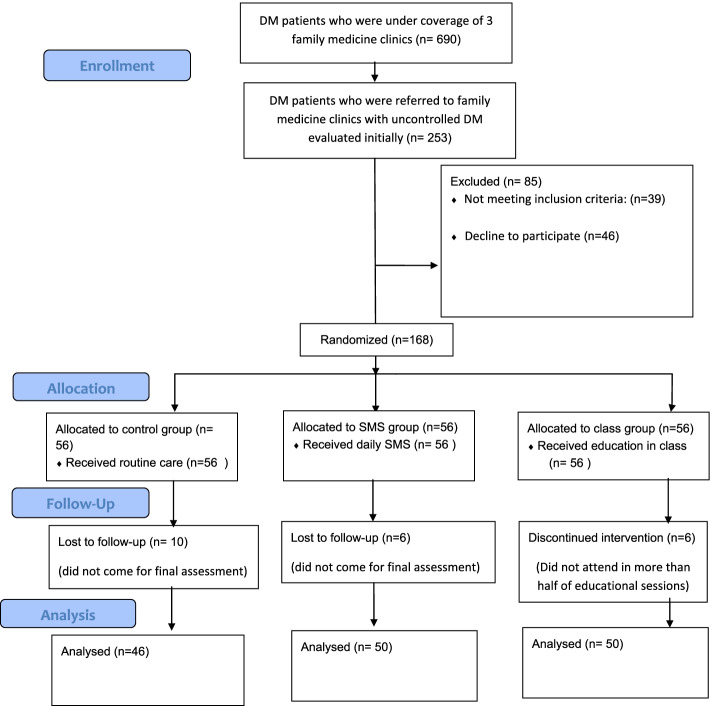
Background: The high prevalence of diabetes and the importance of long-term follow-up of these patients encourage finding an inexpensive and applicable educational method to control the disease. Distance education based on mobile technology and Short message service (SMS) can be an effective way to manage this disease by eliminating time and place limitations. Due to the world’s high penetration rate, SMS is one of the best ways to transfer information and health education. Objective: This study aimed to compare the effect of SMS- and group-based education in managing diabetes type 2 and compare them with a control group. Method: A total of 168 patients with diabetes type 2 under the coverage of three family physician clinics were randomly allocated into three groups. The education was conducted in 12 one-hour sessions once a week in the group-based arm, and a daily short message was sent to the participants in the SMS group. The control group also underwent routine care at the family physician clinic. The duration of the education was 3 months. At baseline and 3 months later, fasting blood sugar (FBS), 2 hours postprandial sugar (2hppBS), and HBA1c, as well as diabetes self-management questionnaire score (DSMQ), were measured. Results: The comparison of the three groups in terms of changes in FBS (P-value: 0.001), 2hppBS (8 P-value: < 0.001) and HbA1c (P-value: < 0.001) were significantly different after 3 months. In pairwise analysis, 2hppBS was the only significantly different parameter between the group- and SMS-based education (P-value: 0.035). Conclusion: Although the effect of both educational methods via SMS or group education was better than the control group in controlling diabetes, these two methods were not statistically different. Due to spending a lot of time and money on group-based education, it is better to replace it with education by SMS.
Overview
The claims and statistics of this paper haven’t been checked yet.
Run the check — free, no account needed. It reads the open-access text and checks the sources it cites.
Integrity signals
Registry
Cites
Statistics
Figures
Verification
Claims the paper makes
The claims and statistics of this paper haven’t been checked yet.
Run the check — free, no account needed. It reads the open-access text and checks the sources it cites.
Claims other papers make about this one
Each is checked against this paper’s own text: does it say what the citing paper says it does?
The cited source says what the claim attributes to it.
In the citing paper
“A total of 47 studies [25-71] reported data on the change in HbA1c levels between groups following telemedicine interventions, with 4 [26-29] studies including 2 types of telemedicine.”
Self-check
Percentages, sums and reported differences re-computed from the paper’s own numbers.
The self-check needs the paper’s full text.
Citations
Cites
Statistical Power Analysis for the Behavioral Sciences
Cohen, J. (2013) · doi:10.4324/9780203771587 · Cited by 25,373
The impact of mHealth interventions: systematic review of systematic reviews
Marcolino, M. S., Oliveira, J. A. Q., D'Agostino, M., Ribeiro, A. L., Alkmim, M. B. M., & Novillo-Ortiz, D. (2018) · JMIR mHealth and uHealth · doi:10.2196/mhealth.8873 · Cited by 1,163
Mobile Text Messaging for Health: A Systematic Review of Reviews
Hall, A. K., Cole-Lewis, H., & Bernhardt, J. M. (2015) · Annual Review of Public Health · doi:10.1146/annurev-publhealth-031914-122855 · Cited by 815
Schmitt, A., Gahr, A., Hermanns, N., Kulzer, B., Huber, J., & Haak, T. (2013) · Health and Quality of Life Outcomes · doi:10.1186/1477-7525-11-138 · Cited by 587
Dobson, R., Whittaker, R., Jiang, Y., Maddison, R., Shepherd, M., McNamara, C. M., Cutfield, R. G., Khanolkar, M., & Murphy, R. (2018) · BMJ · doi:10.1136/bmj.k1959 · Cited by 174
Shetty, A. S., Snehalatha, C., Nanditha, A., Raj, R. K. C., & Ramachandran, A. (2011) · PubMed · Cited by 128
Islam, S. M. S., Niessen, L. W., Ferrari, U., Ali, L., Seißler, J., & Lechner, A. (2015) · Diabetes Care · doi:10.2337/dc15-0505 · Cited by 103
Abaza, H., & Marschollek, M. (2017) · BMC Public Health · doi:10.1186/s12889-017-4973-5 · Cited by 82
Mehravar, F., Mansournia, M. A., Holakouie‐Naieni, K., Nasli‐Esfahani, E., Mansournia, N., & Almasi‐Hashiani, A. (2016) · Epidemiology and Health · doi:10.4178/epih.e2016004 · Cited by 53
Cost-effectiveness analysis of text messaging to support health advice for smoking cessation
Campos, R. C., Mar, J., Apiñaniz, A., de Lafuente, A. S., Parraza, N., Aizpuru, F., & Orive, G. (2021) · Cost Effectiveness and Resource Allocation · doi:10.1186/s12962-021-00262-y · Cited by 24
Promoting Self-Care in Patients with Type 2 Diabetes: Tele-Education
Parizad, N., Maslakpak, M. H., & Khalkhali, H. R. (2013) · Hakim Research Journal · Cited by 20
Designing patient education with distance learningPreprint
Franssen, B., Jafari, J., Zary, N., et al. (2015) · doi:10.7287/peerj.preprints.1143v2 · Cited by 3
Research works printed but not linked: 7
- Naghibi SA, Asghari M, Rostami F. Investigation the effect of education on self-care promotion in type 2 diabetic patients in noor health centers in 2015. J Health Res Commun. 2015;1(2):22–8.
- Rakel RE. Textbook of family medicine e-book. Elsevier Health Sciences; 2007.
- Firooz M, Hosseini SJ, Mazlom SR, Hasan Zadeh F, Kimiyaee SA. Self-care of patient with diabetes type II. J Sabzevar Univ Med Sci. 2016;22(6):1018–25.
- Shirazi M, Anousheh M, Rajab A. The effect of self care program education through group discussion method on knowledge and practice in diabetic adolescent girls referring to Iranian Diabetes Society. Iran J Med Educ. 2011;10(5):982–93.
- Zalak K, Kazemi Haki B, Matlabi H. Obstacles to self-care from the viewpoint of TypeII diabetic patients and guidelines to remove them. Jorjani Biomed J. 2012;1:30–7.
- Rahnavard S, Elahi N, Rokhafroz D, Hagighi MH, Zakerkish M. Comparison of the effect of group based and mobile based education on self-care behaviors in type ii diabetic patients. Iran J Diabetes Metab. 2019;18(2):55–63.
- Firooz M, Mazloom SR, Kimiae SA, Hasanzadeh F. Comparing the effect of group education versus group counseling for self-care on glycated-hemoglobin in patients with diabetes type II. J Mazandaran Univ Med Sci. 2015;25(124):26–36.
Cited by
Sorted by citations
Jiang, S., Gao, X., Diao, H., Zhang, Y., Lu, G., Liu, X., & Li, Y. (2026) · JMIR mHealth and uHealth · doi:10.2196/70429 · Cited by 6
“Among the 58 included studies, 4 [26-29] used 2 types of telemedicine interventions, leading to a total of 62 intervention groups.”
Metadata
- Authors
- Haghighinejad, H., Liaghat, L., Malekpour, F., Jafari, P., Taghipour, K., Rezaie, M., Jooya, P., Ghazipoor, H., & Ramzi, M.
- Affiliations
- Shiraz University (IR)
- Shiraz University of Medical Sciences (IR)
- Corresponding author
- Haghighinejad, Hourvash
- ORCID
- Venue
- BMC Primary Care
- Published
- 2022-08-19
- Volume
- 23
- Issue
- 1
- Pages
- 209-209
- ISSN
- 1471-2296 (ISSN-L)
- 2731-4553
- PMC
- PMC9389843
- OpenAlex
- W4292332809
- Cited by
- 11
- References
- 12
- Citations by year
- 2026: 1 · 2025: 6 · 2024: 2 · 2023: 2
- FWCI
- 2.87
- Type
- journal article
- Language
- en
- Open access
- gold
- doi.org
- Locations
- BMC Family Practice (publishedVersion, cc-by)
- PubMed Central (publishedVersion, cc-by)
- PubMed (publishedVersion)
- DOAJ (DOAJ: Directory of Open Access Journals) (submittedVersion, cc-by-sa)
- Funders
- Vice-Chancellor for Research, Shiraz University of Medical Sciences (1396-01-01-16699)
- Topics
- Health Sciences › Health Professions › General Health Professions › Mobile Health and mHealth Applications
- Health Sciences › Medicine › Endocrinology, Diabetes and Metabolism › Diabetes Management and Education
- Physical Sciences › Computer Science › Information Systems › Mobile Learning in Education
- Keywords
- type 2 diabetes, diabetes self-management education, mobile health, group education, glycemic control, HbA1c, fasting blood glucose, postprandial blood glucose, Diabetes Self-Management Questionnaire
- MeSH terms
- Diabetes Mellitus, Type 2, Glycated Hemoglobin, Humans, Surveys and Questionnaires, Random Allocation, Control Groups, Text Messaging
About these checks
Registry, retraction, Cites and statistics results are computed, not judged, with one exception: a printed reference that no index lists is read once by a model before it counts as a citation error. Claims are extracted by a model and kept only when their quote appears verbatim in the text; each cited source is then checked, with a model’s help, for whether it says what the claim relies on. Those verdicts can be wrong — read the claim’s quote and the cited source before relying on one.
Statistics and arithmetic are recomputed, not judged.
Confidence bands are shown only for fields calibrated on our annotated test set. None is calibrated yet, so no band is shown.
What counts as a claim ›How we measure confidence ›How we check this ›
Are you an author, or do you see a problem with this page? Request a review
