

Personal preferences of participation in fall prevention programmes: a descriptive study
Open accessThe DOI matches its Crossref record; 41 of the 41 references it cites were found in a registry or an index.
Abstract
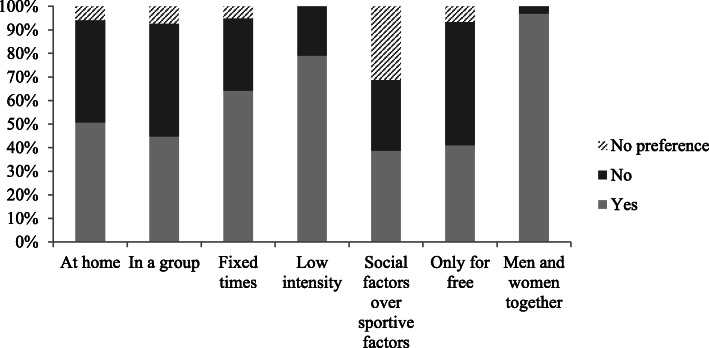
Background: Participation in fall prevention programmes is associated with lower risk of injurious falls among older adults. However participation rates in fall prevention interventions are low. The limited participation in fall prevention might increase with a preference based approach. Therefore, the aims of this study are to a) determine the personal preferences of older adults regarding fall prevention and b) explore the association between personal preferences and participation. Methods: We assessed the personal preferences of older adults and the association between their preferences, chosen programme and participation level. Nine different programmes, with a focus on those best matching their personal preferences, were offered to participants. Twelve weeks after the start of the programme, participation was assessed by questionnaire. Logistic regression was performed to test the association between preferences and participation and an ANOVA was performed to assess differences between the number of preferences included in the chosen programme and participation level. Results: Of the 134 participants, 49% preferred to exercise at home versus 43% elsewhere, 46% preferred to exercise alone versus 44% in a group and 41% indicated a programme must be free of charge while 51% were willing to pay. The combination of an external location, in a group and for a fee was preferred by 27%, whereas 26% preferred at home, alone and only for free. The presence of preferences or the extent to which the programme matched earlier preferences was not associated with participation. Conclusion: Despite the fact that preferences can vary greatly among older adults, local programmes should be available for at least the two largest subgroups. This includes a programme at home, offered individually and for free. In addition, local healthcare providers should cooperate to increase the accessibility of currently available group programmes.
Overview
The claims and statistics of this paper haven’t been checked yet.
Free: it reads the open-access text and checks the first 5 claims that cite a source we can check. Create a free account to check every claim.
Integrity signals
Registry
Cites
Statistics
Figures
Verification
Claims the paper makes
The claims and statistics of this paper haven’t been checked yet.
Free: it reads the open-access text and checks the first 5 claims that cite a source we can check. Create a free account to check every claim.
Claims other papers make about this one
Each is checked against this paper’s own text: does it say what the citing paper says it does?
The cited source says what the claim attributes to it.
In the citing paper
“A recent study showed that only half of the older adults were willing to pay for fall prevention programs [76], while chronic patients suffering from knee osteoarthritis may be willing to pay little money, with only 26% willing to pay more than €65 for six weeks of an evidence-based program and only 10% willing to pay more than €100 [77].”
From Key Factors Associated with Adherence to Physical Exercise in Patients with Chronic Diseases and Older Adults: An Umbrella Review (2021) · cites this paper as [76]
Self-check
Percentages, sums and reported differences re-computed from the paper’s own numbers.
The self-check needs the paper’s full text.
Citations
Cites
Interventions for preventing falls in older people living in the community
Gillespie, L. D., Robertson, M. C., Gillespie, W. J., Sherrington, C., Gates, S., Clemson, L., & Lamb, S. E. (2012) · Cochrane Database of Systematic Reviews · doi:10.1002/14651858.cd007146.pub3 · Cited by 3,966
Haagsma, J. A., Graetz, N., Bolliger, I., Naghavi, M., Higashi, H., Mullany, E. C., Abera, S. F., Abraham, J. P., Adofo, K., Alsharif, U., et al. (2016) · Injury Prevention · doi:10.1136/injuryprev-2015-041616 · Cited by 1,302
Self-citationExercise for preventing falls in older people living in the community
Sherrington, C., Fairhall, N. J., Wallbank, G. K., Tiedemann, A., Michaleff, Z. A., Howard, K., Clemson, L., Hopewell, S., & Lamb, S. E. (2019) · Cochrane Database of Systematic Reviews · doi:10.1002/14651858.cd012424.pub2 · Cited by 1,282
The epidemiology of falls and syncope
Rubenstein, L. Z., & Josephson, K. R. (2002) · Clinics in Geriatric Medicine · doi:10.1016/s0749-0690(02)00002-2 · Cited by 1,176
Exercise to prevent falls in older adults: an updated systematic review and meta-analysis
Sherrington, C., Michaleff, Z. A., Fairhall, N., Paul, S. S., Tiedemann, A., Whitney, J., Cumming, R. G., Herbert, R. D., Close, J. C. T., & Lord, S. R. (2017) · British Journal of Sports Medicine · doi:10.1136/bjsports-2016-096547 · Cited by 1,095
Tricco, A. C., Thomas, S. M., Veroniki, A. A., Hamid, J. S., Cogo, E., Strifler, L., Khan, P. A., Robson, R., Sibley, K. M., MacDonald, H., et al. (2017) · JAMA · doi:10.1001/jama.2017.15006 · Cited by 611
Falls prevention over 2 years: a randomized controlled trial in women 80 years and older
Campbell, A. (1999) · Age and Ageing · doi:10.1093/ageing/28.6.513 · Cited by 520
Hartholt, K. A., van Beeck, E. F., Polinder, S., van der Velde, N., van Lieshout, E. M. M., Panneman, M. J. M., van der Cammen, T. J. M., & Patka, P. (2011) · Journal of Trauma: Injury, Infection & Critical Care · doi:10.1097/ta.0b013e3181f6f5e5 · Cited by 485 · cited 1×
“Background Fall-related injuries have a substantial impact on the quality of life of individuals and on health care costs, making them a major public health problem [1, 2].”
BackgroundSelf-citationA risk model for the prediction of recurrent falls in community-dwelling elderly
Stalenhoef, P. A., Diederiks, J. P. M., Knottnerus, J. A., Kester, A. D. M., & Crebolder, H. F. J. M. (2002) · Journal of Clinical Epidemiology · doi:10.1016/s0895-4356(02)00502-4 · Cited by 480
Sherrington, C., Fairhall, N., Wallbank, G., Tiedemann, A., Michaleff, Z. A., Howard, K., Clemson, L., Hopewell, S., & Lamb, S. (2020) · British Journal of Sports Medicine · doi:10.1136/bjsports-2019-101512 · Cited by 381 · cited 1×
“However, potential reverse effects of daily participation are not taken into account with this classification, based on the little evidence that is available on this topic [47].”
Background
Cited by
Collado-Mateo, D., Lavín-Pérez, A. M., Peñacoba, C., Del Coso, J., Leyton-Román, M., Luque-Casado, A., Gasque, P., Fernández-del-Olmo, M. Á., & Amado-Alonso, D. (2021) · International Journal of Environmental Research and Public Health · doi:10.3390/ijerph18042023 · Cited by 791
“A recent study showed that only half of the older adults were willing to pay for fall prevention programs [76], while chronic patients suffering from knee osteoarthritis may be willing to pay little money, with only 26% willing to pay more than €65 for six weeks of an evidencebased program and only 10% willing to pay…”
BackgroundPettersson, B., Janols, R., Wiklund, M., Lundin‐Olsson, L., & Sandlund, M. (2021) · Journal of Medical Internet Research · doi:10.2196/26235 · Cited by 61
“Still, as also mentioned in this study, individuals might prefer to undertake fall prevention exercise in solitude [37], which may reduce the importance of supporting relatedness in that activity in contrast to autonomy and competence [18].”
BackgroundBates, A., Furber, S. E., Sherrington, C., van den Dolder, P., Ginn, K. A., Bauman, A. E., Howard, K., Kershaw, M., Franco, L., Chittenden, C., et al. (2022) · BMC Geriatrics · doi:10.1186/s12877-022-03050-2 · Cited by 35
“People who are older and at a higher risk of falls are more likely to prefer home-based exercise programs compared to group-based classes [11, 12].”
BackgroundWorum, H., Lillekroken, D., Roaldsen, K. S., Ahlsen, B., & Bergland, A. (2020) · BMC Public Health · doi:10.1186/s12889-020-09630-4 · Cited by 19
Kwon, J., Lee, Y., Young, T. A., Squires, H., & Harris, J. (2021) · BMC Health Services Research · doi:10.1186/s12913-021-07056-1 · Cited by 16
“should nevertheless note the wide diversity of motives/ preferences in the older population: one survey of 134 older persons, for example, found that 46% preferred to exercise alone versus 44% in a group [63].”
BackgroundChoi, J. E., Lee, S.-J., Park, E., Ku, S., Kim, S.-H., Yu, W., Jeong, E., Park, S., Park, Y., & Kim, S. R. (2024) · Journal of Nursing Scholarship · doi:10.1111/jnu.12964 · Cited by 12
Geriatric falls: an enormous economic burden compared to firearms
Zangbar, B., Rafieezadeh, A., Rodriguez, G., Kirsch, J. M., Shnaydman, I., Jose, A. M., Bronstein, M. E., & Prabhakaran, K. (2024) · Trauma Surgery & Acute Care Open · doi:10.1136/tsaco-2024-001492 · Cited by 12
“26 27 The data illuminates the need for comprehensive policies that cater to the unique healthcare needs of the elderly population.”
Backgroundvan Scherpenseel, M. C., van Veenendaal, L. J., Donné, L., Velde, S. J. T., & Ronteltap, A. (2023) · Frontiers in Public Health · doi:10.3389/fpubh.2023.1150659 · Cited by 12
Severance, J., Rivera-Torres, S., Cho, J., Hartos, J. L., Khan, A. S., & Knebl, J. A. (2022) · International Journal of Environmental Research and Public Health · doi:10.3390/ijerph19105903 · Cited by 11
Ong, R. H. S., Nurjono, M., Oh, H. C., Lien, C. T. C., Jumala, J., Teo, R. C. C., Gan, P., Kan, K. L. M., Rosle, L. F. B., Wee, M. K., et al. (2024) · Clinical Interventions in Aging · doi:10.2147/cia.s454043 · Cited by 9
“45 To address potential health disparities related to socio-economic status, subsidies based on means-testing should be made available to facilitate uptake of fall prevention programs.”
BackgroundRahimi, S., Khankeh, H. R., Ebadi, A., Mohammadian, B., Eghbali, M., & Habibzadeh, F. (2024) · PLoS ONE · doi:10.1371/journal.pone.0304320 · Cited by 7
Zanotto, A., Zanotto, T., Alexander, N. B., & Sosnoff, J. J. (2024) · BMC Geriatrics · doi:10.1186/s12877-024-05382-7 · Cited by 6
“The preference for individual training is in line with the results from Barmentloo et al. [32], who assessed personal preferences for fall prevention interventions in older adults and found that a larger proportion preferred to exercise alone versus in a group.”
ResultFrazer, S. W. T., van der Veen, R., Baan, A., Hermans, M., & Olij, B. F. (2021) · International Journal of Environmental Research and Public Health · doi:10.3390/ijerph18126360 · Cited by 6
“Furthermore, to be a programme with impact, exercise and fitness levels have to fit the participant [1,35].”
BackgroundSelf-citationOptimizing and Implementing a Community-Based Group Fall Prevention Program: A Mixed Methods Study
van Gameren, M., Voorn, P. B., Bosmans, J. E., Visser, B., Frazer, S. W. T., Pijnappels, M. A. G. M., & Bossen, D. (2024) · International Journal of Environmental Research and Public Health · doi:10.3390/ijerph21020162 · Cited by 3
“A group program can also improve quality of life and health effects [35,36].”
BackgroundAlbasha, N., Alruwaythi, S., AlDubayyan, L., Alasmari, A., Almutairi, W., Al-Juaid, M., & Alwhaibi, R. M. (2025) · BMC Geriatrics · doi:10.1186/s12877-025-06884-8 · Cited by 3
“Key staff-related barriers include inadequate geriatric education during professional training, lack of institutional policies supporting fall risk assessments, and time constraints that limit comprehensive patient evaluations [3– 5].”
Charmant, W. M., Jansen, S., van Schoor, N. M., de Vries, R., Nanayakkara, P. W. B., Willems, H. C., & van der Velde, N. (2026) · Age and Ageing · doi:10.1093/ageing/afag227 · Cited by 2
Reeck, N., Völkel, A., Mammes, M., Urbahn‐Schiefer, D., Reineking, B., Brushinski, E., Stuckenschneider, T., Zieschang, T., & Brütt, A. L. (2026) · BMJ Open · doi:10.1136/bmjopen-2025-106811 · Cited by 1
“50 51 These persons could benefit from digital interventions.”
Chye, A., Lung, T. W.-C., Delbaere, K., van Schooten, K. S., Taylor, M. E., Ambrens, M., Howard, K., & Angell, B. J. (2026) · BMC Geriatrics · doi:10.1186/s12877-026-07602-8 · Cited by 1
“Another study analysing personal preferences of older people for fall prevention programs found that location, exercising alone versus in a group and cost were important [8].”
InfluentialRegan, E. W., Cameron, K. A., Herrera-Venson, A. P., Juarez, G. A., Perera, S., Vincenzo, J. L., & Brach, J. S. (2025) · Journal of Aging and Health · doi:10.1177/08982643251327032
“Additionally, for the not at risk category, general group community exercise programs and home-based individual exercise programs could be considered, opening more possibilities to include a person ’ s preferences (Barmentloo et al., 2020).”
Kwon, J., Lee, Y., Young, T., Squires, H., & Harris, J. (2021) · Figshare · doi:10.6084/m9.figshare.16696659
Worum, H., Lillekroken, D., Roaldsen, K. S., Ahlsen, B., & Bergland, A. (2020) · Figshare · doi:10.6084/m9.figshare.13212802
Worum, H., Lillekroken, D., Roaldsen, K. S., Ahlsen, B., & Bergland, A. (2020) · Figshare · doi:10.6084/m9.figshare.13212799
Worum, H., Lillekroken, D., Roaldsen, K. S., Ahlsen, B., & Bergland, A. (2020) · Figshare · doi:10.6084/m9.figshare.13212796
Stanmore, E., Fisher, K., Dewick, P. M., Choi, N., & Munford, L. A. (2025) · doi:10.2196/preprints.84368
Risk Prediction and Interpretation for Fall Events Using Explainable AI and Large Language Models
Luo, J., Khani, M., Adams, J. A., Lü, Q., O’Connor, K. M., & Friedland, D. R. (2025) · International Conference on Medical and Health Informatics (ICMHI) · doi:10.1145/3761712.3761774
“However, despite recommendations for universal fall risk screening, the actual implementation of preventative interventions remains low [6, 7].”
Prevention of falls among older adults using digital technologies
Chan, K. O. W., & Wong, A. C. H. (2026) · Current Opinion in Epidemiology and Public Health · doi:10.1097/pxh.0000000000000065
Bates, A. K., Sherrington, C., Furber, S. E., Gilchrist, H., van den Dolder, P., Ginn, K., Bauman, A. E., Kershaw, M., Franco, L., Chittenden, C., et al. (2026) · PLoS ONE · doi:10.1371/journal.pone.0348567
van Scherpenseel, M., van Veenendaal, L., Donné, L., te Velde, S., Ronteltap, A., & FRIEND Research Group (2023) · doi:10.3389/fpubh.2023.1150659.s001
Metadata
- Authors
- Barmentloo, L. M., Olij, B. F., Erasmus, V., Smilde, D., Schoon, Y., & Polinder, S.
- Affiliations
- Erasmus MC (NL)
- Radboud University Medical Center (NL)
- Corresponding author
- Barmentloo, Lotte M.
- Venue
- BMC Geriatrics
- Published
- 2020-05-28
- Volume
- 20
- Issue
- 1
- Pages
- 185-185
- ISSN
- 1471-2318 (ISSN-L)
- PMC
- PMC7254764
- OpenAlex
- W3032442715
- Semantic Scholar
- 88b2957bd1bd063584f80e4f23f2e1d1b9a6cb6b
- Cited by
- 29
- References
- 41
- Citations by year
- 2026: 4 · 2025: 4 · 2024: 6 · 2023: 1 · 2022: 3 · 2021: 7 · 2020: 4
- FWCI
- 6.80
- Type
- journal article
- Language
- en
- Open access
- gold
- doi.org
- Licence
- cc-by
- creativecommons.org/licenses/by/4.0 (tdm)
- creativecommons.org/licenses/by/4.0 (vor)
- Locations
- BMC Geriatrics (publishedVersion, cc-by)
- PubMed Central (publishedVersion, cc-by)
- PubMed (publishedVersion)
- EUR Research Repository (Erasmus University Rotterdam) (submittedVersion, other-oa)
- RePub (Erasmus University Rotterdam) (submittedVersion, other-oa)
- DOAJ (DOAJ: Directory of Open Access Journals) (submittedVersion, cc-by-sa)
- Radboud Repository (Radboud University) (submittedVersion)
- Radboud Repository (Radboud University) (submittedVersion, other-oa)
- Funders
- Fonds NutsOhra (102385)
- Topics
- Health Sciences › Health Professions › Physical Therapy, Sports Therapy and Rehabilitation › Balance, Gait, and Falls Prevention
- Health Sciences › Medicine › Surgery › Hip and Femur Fractures
- Health Sciences › Medicine › Geriatrics and Gerontology › Frailty in Older Adults
- Keywords
- older adults, individual preferences, program participation, exercise preferences, home-based exercise, group exercise, injurious falls, willingness to pay
- MeSH terms
- Accidental Falls, Aged, Ethnicity, Exercise Therapy, Humans, Exercise
About these checks
Registry, retraction, Cites and statistics results are computed, not judged, with one exception: a printed reference that no index lists is read once by a model before it counts as a citation error. Claims are extracted by a model and kept only when their quote appears verbatim in the text; each cited source is then checked, with a model’s help, for whether it says what the claim relies on. Those verdicts can be wrong — read the claim’s quote and the cited source before relying on one.
Statistics and arithmetic are recomputed, not judged.
Confidence bands are shown only for fields calibrated on our annotated test set. None is calibrated yet, so no band is shown.
What counts as a claim ›How we measure confidence ›How we check this ›
Are you an author, or do you see a problem with this page? Request a review
Data sources
Bibliographic data: Semantic Scholar, OpenAlex, Crossref.
Contains information from the Semantic Scholar Academic Graph Datasets, made available under the ODC Attribution License (ODC-BY 1.0).
Semantic Scholar’s data is described in: Kinney, R., et al. (2023). The Semantic Scholar Open Data Platform. arXiv:2301.10140.
