

Comparison of bacterial culture with BioFire® FilmArray® multiplex PCR screening of archived cerebrospinal fluid specimens from children with suspected bacterial meningitis in Nigeria
Open accessThe DOI matches its Crossref record; 42 of the 42 references it cites were found in a registry or an index.
Abstract
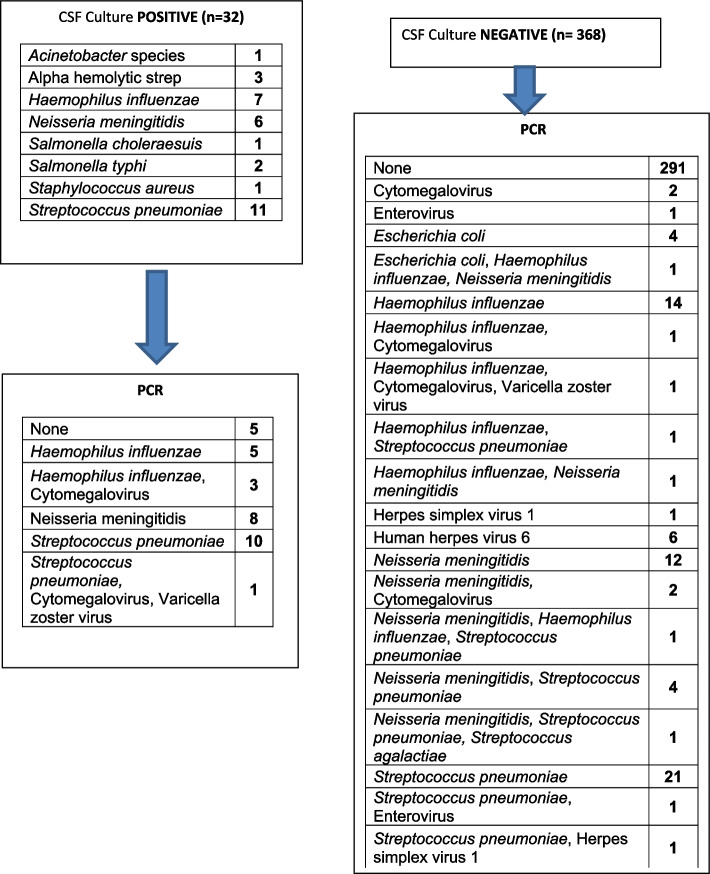
Background: Diagnosis of bacterial meningitis remains a challenge in most developing countries due to low yield from bacterial culture, widespread use of non-prescription antibiotics, and weak microbiology laboratories. The objective of this study was to compare the yield from standard bacterial culture with the multiplex nested PCR platform, the BioFire® FilmArray® Meningitis/Encephalitis Panel (BioFire ME Panel), for cases with suspected acute bacterial meningitis. Methods: Following Gram stain and bacterial culture on cerebrospinal fluid (CSF) collected from children aged less than 5 years with a clinical suspicion of acute bacterial meningitis (ABM) as defined by the WHO guidelines, residual CSF specimens were frozen and later tested by BioFire ME Panel. Results: A total of 400 samples were analyzed. Thirty-two [32/400 (8%)] of the specimens were culture positive, consisting of; three Salmonella spp. (2 Typhi and 1 non-typhi), three alpha hemolytic Streptococcu s, one Staphylococcus aureus, six Neisseria meningitidis, seven Hemophilus influenzae, 11 Streptococcus pneumoniae and 368 were culture negative. Of the 368 culture-negative specimens, the BioFire ME Panel detected at least one bacterial pathogen in 90 (24.5%) samples, consisting of S. pneumoniae, N. meningitidis and H. influenzae, predominantly. All culture positive specimens for H. influenzae, N. meningitidis and S. pneumoniae also tested positive with the BioFire ME Panel. In addition, 12 specimens had mixed bacterial pathogens identified. For the first time in this setting, we have data on the viral agents associated with meningitis. Single viral agents were detected in 11 (2.8%) samples while co-detections with bacterial agents or other viruses occurred in 23 (5.8%) of the samples. Conclusions: The BioFire® ME Panel was more sensitive and rapid than culture for detecting bacterial pathogens in CSF. The BioFire® ME Panel also provided for the first time, the diagnosis of viral etiologic agents that are associated with meningoencephalitis in this setting. Institution of PCR diagnostics is recommended as a routine test for suspected cases of ABM to enhance early diagnosis and optimal treatment.
Overview
The claims and statistics of this paper haven’t been checked yet.
Free: it reads the open-access text and checks the first 5 claims that cite a source we can check. Create a free account to check every claim.
Integrity signals
Registry
Cites
Statistics
Figures
Verification
Claims the paper makes
The claims and statistics of this paper haven’t been checked yet.
Free: it reads the open-access text and checks the first 5 claims that cite a source we can check. Create a free account to check every claim.
Claims other papers make about this one
Each is checked against this paper’s own text: does it say what the citing paper says it does?
The source backs part of the claim, not all of it — or backs it for a different population, condition or comparison.
In the citing paper
“CSF bacterial culture is positive in 8% of patients who have meningitis [10]”
From Clinical utility of a cerebrospinal fluid multiplex PCR meningitis/encephalitis panel in children: a retrospective review of positive results (2026) · cites this paper as [10]
Experimental — accuracy not yet measuredThe source backs part of the claim, not all of it — or backs it for a different population, condition or comparison.
In the citing paper
“The sensitivity of culture and Gram stain is variable according to type of organisms and demographics, but was reported to be 8% and 60%, respectively [10].”
From Clinical utility of a cerebrospinal fluid multiplex PCR meningitis/encephalitis panel in children: a retrospective review of positive results (2026) · cites this paper as [10]
Experimental — accuracy not yet measuredThe source backs part of the claim, not all of it — or backs it for a different population, condition or comparison.
In the citing paper
“Previous studies have similarly documented limitations in the panel’s pathogen spectrum, emphasizing that, despite its focus on the principal agents of community‐acquired meningitis, the ME panel should not be viewed as a substitute for conventional culture or broader diagnostic workups, particularly in individuals with implanted devices, neurosurgical interventions, or intensive care–related risk”
From Real‐World Evaluation of the BioFire FilmArray ME Panel: Diagnostic Accuracy and Clinical Utility (2026) · cites this paper as [24]
Experimental — accuracy not yet measuredThe source backs part of the claim, not all of it — or backs it for a different population, condition or comparison.
In the citing paper
“Frequent HHV-6 and Cytomegalovirus detection by FA-ME is reported by several authors, who in most cases considered them non-pathogenic due to their latency capacity and chromosomal integration (HHV-6), and non-significance in immunocompetent patients (Cytomegalovirus) [17, 20, 31, 34–36].”
From Clinical utility of the FilmArray® meningitis/encephalitis panel in children with suspected central nervous system infection in a low-resource setting – a prospective study in Southwestern Uganda (2025) · cites this paper as [34]
Experimental — accuracy not yet measured
Self-check
Percentages, sums and reported differences re-computed from the paper’s own numbers.
The self-check needs the paper’s full text.
Citations
Cites
Clinical features and prognostic factors in adults with bacterial meningitis
van de Beek, D., de Gans, J., Spanjaard, L., Weisfelt, M., Reitsma, J. B., & Vermeulen, M. (2004) · New England Journal of Medicine · doi:10.1056/nejmoa040845 · Cited by 1,639
Global epidemiology of meningococcal disease
Harrison, L. H., Trotter, C. L., & Ramsay, M. E. (2009) · Vaccine · doi:10.1016/j.vaccine.2009.04.063 · Cited by 755
Leber, A. L., Everhart, K., Balada-Llasat, J.-M., Cullison, J., Daly, J., Holt, S., Lephart, P., Salimnia, H., Schreckenberger, P. C., DesJarlais, S., et al. (2016) · Journal of Clinical Microbiology · doi:10.1128/jcm.00730-16 · Cited by 609
Corless, C. E., Guiver, M., Borrow, R., Edwards-Jones, V., Fox, A. J., & Kaczmarski, E. B. (2001) · Journal of Clinical Microbiology · doi:10.1128/jcm.39.4.1553-1558.2001 · Cited by 607 · cited 1×
“Nevertheless, there have been several reports of community acquired ABM with mixed bacterial agents in immunocompetent patients [37, 38].”
BackgroundAcute bacterial meningitis in infants and children
Kim, K. S. (2010) · The Lancet Infectious Diseases · doi:10.1016/s1473-3099(09)70306-8 · Cited by 454 · cited 1×
“Acute bacterial meningitis (ABM) is the most common infection of the central nervous system and remains a major cause of mortality and morbidity in several countries in sub-Saharan Africa [1–5].”
BackgroundAdvances in treatment of bacterial meningitis
van de Beek, D., Brouwer, M. C., Thwaites, G. E., & Tunkel, A. R. (2012) · The Lancet · doi:10.1016/s0140-6736(12)61186-6 · Cited by 336
Tansarli, G. S., & Chapin, K. C. (2020) · Clinical Microbiology and Infection · doi:10.1016/j.cmi.2019.11.016 · Cited by 263
Awofala, A. A., & Ogundele, O. E. (2018) · Saudi Journal of Biological Sciences · doi:10.1016/j.sjbs.2016.03.006 · Cited by 233 · cited 1×
“Malaria transmission is seasonal [19], and HIV prevalence among women attending antenatal clinic is 1.3% [20, 21].”
BackgroundInfluentialJerome, K. R., Huang, M.-L., Wald, A., Selke, S., & Corey, L. (2002) · Journal of Clinical Microbiology · doi:10.1128/jcm.40.7.2609-2611.2002 · Cited by 155 · cited 1×
“While our storage conditions for the CSF are deemed optimal, we are unable to guarantee absence of DNA degradation following prolonged specimen storage; although there are reports in the literature of specimens in storage for over three decades been screened for bacterial DNA yielding meaningful results [35, 36].”
Global research priorities for infections that affect the nervous system
John, C. C., Carabin, H., Montano, S. M., Bangirana, P., Zunt, J. R., & Peterson, P. K. (2015) · Nature · doi:10.1038/nature16033 · Cited by 152 · cited 1×
“The annual estimate for the burden of ABM is 1.2 million each year world-wide [6–8].”
BackgroundInfluentialPeltola, H. (2001) · Clinical Infectious Diseases · doi:10.1086/317534 · Cited by 144
Emergence of Epidemic Neisseria meningitidis Serogroup X Meningitis in Togo and Burkina Faso
Delrieu, I., Yaro, S., Tamekloe, T. A., Njanpop‐Lafourcade, B., Tall, H., Jaillard, P., Ouedraogo, M. S., Badziklou, K., Sanou, O., Drabo, A., et al. (2011) · PLoS ONE · doi:10.1371/journal.pone.0019513 · Cited by 135 · cited 1×
“Further, the sporadic and unpredictable outbreaks of meningococcal meningitis in Africa also contribute significantly to this burden both in children and adults [2, 9–11].”
BackgroundNeonatal meningitis in England and Wales: sequelae at 5 years of age
de Louvois, J., Halket, S., & Harvey, D. R. (2005) · European Journal of Pediatrics · doi:10.1007/s00431-005-1747-3 · Cited by 124 · cited 1×
“Acute bacterial meningitis (ABM) is the most common infection of the central nervous system and remains a major cause of mortality and morbidity in several countries in sub-Saharan Africa [1–5].”
BackgroundGessner, B. D., Mueller, J. E., & Yaro, S. (2010) · BMC Infectious Diseases · doi:10.1186/1471-2334-10-22 · Cited by 121 · cited 2×
“Where clinical outcome data is available, these polymicrobial ABM have been associated with high case fatality and neurological sequelae [40].”
BackgroundDiagnosis of acute bacterial meningitis in children at a district hospital in sub-Saharan Africa
Berkley, J. A., Mwangi, I., Ngetsa, C., Mwarumba, S., Lowe, B. S., Marsh, K., & Newton, C. R. J. C. (2001) · The Lancet · doi:10.1016/s0140-6736(00)04897-2 · Cited by 115 · cited 3×
“In most developing countries, microbiology diagnostic laboratories are poorly equipped, trained personnel are scarce and the turnaround time for these procedures are often suboptimal for optimizing patient care [14].”
BackgroundMethodInfluentialAcute Bacterial Meningitis in Infants and Children: Epidemiology and Management
Agrawal, S., & Nadel, S. (2011) · Pediatric Drugs · doi:10.2165/11593340-000000000-00000 · Cited by 99
Traoré, Y., Njanpop‐Lafourcade, B., Adjogble, K., Lourd, M., Yaro, S., Nacro, B., Drabo, A., du Châtelet, I. P., Mueller, J. E., Taha, M., et al. (2006) · Clinical Infectious Diseases · doi:10.1086/507339 · Cited by 93
HIV-Stigma in Nigeria: Review of Research Studies, Policies, and Programmes
Odimegwu, C. O., Akinyemi, J. O., & Alabi, O. O. (2017) · AIDS Research and Treatment · doi:10.1155/2017/5812650 · Cited by 83 · cited 1×
“Malaria transmission is seasonal [19], and HIV prevalence among women attending antenatal clinic is 1.3% [20, 21].”
BackgroundInfluentialBacterial meningitis in infants: the epidemiology, clinical features, and prognostic factors
Chang, C.-J., Chang, W., Huang, L., Huang, S., Chang, Y., Hung, P., Lu, C., Chang, C.-S., Cheng, B., Lee, P.-Y., et al. (2003) · Brain and Development · doi:10.1016/s0387-7604(03)00122-0 · Cited by 76
Community Acquired Bacteremia in Young Children from Central Nigeria- A Pilot Study
Obaro, S., Lawson, L., Essen, U., Ibrahim, K., Brooks, K., Otuneye, A., Shetima, D., Ahmed, P., Ajose, T., Olugbile, M., et al. (2011) · BMC Infectious Diseases · doi:10.1186/1471-2334-11-137 · Cited by 69
Self-citationOlorunsaiye, C. Z., & Degge, H. M. (2016) · Global Health Communication · doi:10.1080/23762004.2016.1206780 · Cited by 68 · cited 6×
“In Kano we enrolled children from Aminu Kano Teaching Hospital, Hasiya Bayero Paediatric Hospital, and Murtala Mohammed Specialist Hospital.”
BackgroundInfluentialMixed Infection in Adult Bacterial Meningitis
Chang, W., Lu, C., Huang, C., & Chuang, Y. (2000) · Infection · doi:10.1007/s150100050003 · Cited by 64 · cited 1×
“While our storage conditions for the CSF are deemed optimal, we are unable to guarantee absence of DNA degradation following prolonged specimen storage; although there are reports in the literature of specimens in storage for over three decades been screened for bacterial DNA yielding meaningful results [35, 36].”
Aetiology of neonatal sepsis in Nigeria, and relevance of Group b streptococcus: A systematic review
Medugu, N., Iregbu, K. C., Tam, P. I., & Obaro, S. (2018) · PLoS ONE · doi:10.1371/journal.pone.0200350 · Cited by 59 · cited 1×
“…with sepsis, appropriate treatment for sepsis may be inadequate for the accompanying ABM especially as the agents are generally different [13], hence the need for confirmatory diagnosis by the examination of cerebrospinal fluid (CSF) and identification of etiologic agent is essential to…”
BackgroundSelf-citationComparison of culture and PCR methods in the diagnosis of bacterial meningitis
Başpınar, E. Ö., Dayan, S., Bekçibaşı, M., Tekin, R., Ayaz, C., Deveci, Ö., & Hoşoğlu, S. (2017) · Brazilian Journal of Microbiology · doi:10.1016/j.bjm.2016.06.014 · Cited by 53 · cited 1×
“Multiplex polymerase chain reaction (PCR) is one such approach that can improve the detection of bacterial, viral, and fungal agents in the CSF through the detection of microbial nucleic acids, including from non-viable organisms [15, 16].”
BackgroundHanson, K. E. (2016) · Journal of Clinical Microbiology · doi:10.1128/jcm.01255-16 · Cited by 52 · cited 1×
“Molecular techniques are significantly more effective for establishing the etiologic diagnosis of pyogenic meningitis, although they cannot completely replace conventional tests given the need for bacteria isolation and susceptibility testing for the determination of optimal antibiotic choice for clinical management […”
BackgroundBoudet, A., Pantel, A., Carles, M.-J., Boclé, H., Charachon, S., Enault, C., Stéphan, R., Cadot, L., Lavigne, J.-P., & Marchandin, H. (2019) · PLOS ONE · doi:10.1371/journal.pone.0223887 · Cited by 49 · cited 1×
“During the past several years the BioFire ME Panel has been extensively evaluated across several developed country settings and has been widely adopted for routine diagnostics for suspected cases of ME [27– 30].”
BackgroundLehmann, D., Yeka, W., Rongap, T., Javati, A., Saleu, G., Clegg, A., Michael, A., Lupiwa, T., Omena, M., & Alpers, M. P. (1999) · Annals of Tropical Paediatrics · doi:10.1080/02724939992608 · Cited by 42 · cited 2×
“In the meningitis belt of Africa where outbreaks of meningococcal disease occur, these have been frequently associated with concurrent mini outbreaks of S. pneumoniae meningitis and in 2016 there was a predominant outbreak caused by S. pneumoniae sero-type 1 [41].”
BackgroundAssociation of the filmarray meningitis/encephalitis panel with clinical management
Nabower, A. M., Miller, S., Biewen, B., Lyden, E., Goodrich, N., Miller, A., Gollehon, N., Skar, G., & Snowden, J. (2019) · Hospital Pediatrics · doi:10.1542/hpeds.2019-0064 · Cited by 42
Improved Detection of Bacterial Central Nervous System Infections by Use of a Broad-Range PCR Assay
Meyer, T., Franke, G., Polywka, S. K. A., Lütgehetmann, M., Gbadamosi, J., Magnus, T., & Aepfelbacher, M. (2014) · Journal of Clinical Microbiology · doi:10.1128/jcm.00469-14 · Cited by 40 · cited 2×
“Although in recent years, PCR based testing has become more readily available at national reference laboratories in several countries within the meningitis belt of Africa, these focus primarily on the detection of bacterial pathogens and are often restricted to the meningitis season [11, 16].”
BackgroundMedugu, N., Tickler, I. A., Duru, C., Egah, R., James, A. O., Odili, V., Hanga, F., Olateju, E. K., Jibir, B. W., Ebruke, B. E., et al. (2023) · Scientific Reports · doi:10.1038/s41598-023-37621-z · Cited by 40 · cited 1×
“The enrollment sites at Federal Capital Territory (FCT) are as previously described [17, 18].”
MethodSelf-citationClinical predictors of bacterial meningitis in infants and young children in The Gambia
Weber, M. W., Herman, J. S., Jaffar, S. S., Usen, S., Oparaugo, A., Omosigho, C., Adegbola, R. A., Greenwood, B. M., & Mulholland, K. (2002) · Tropical Medicine & International Health · doi:10.1046/j.1365-3156.2002.00926.x · Cited by 39 · cited 2×
“While the diagnostic work-up typically starts with identification of classic symptoms, such as fever, head-ache, neck stiffness, these are largely unreliable in young children and therefore fraught with significant risk of missed diagnosis [12].”
BackgroundPrecit, M. R., Yee, R., Pandey, U., Fahit, M., Pool, C., Naccache, S. N., & Dien Bard, J. (2020) · Journal of Clinical Microbiology · doi:10.1128/jcm.01592-19 · Cited by 39 · cited 1×
“The scarcity of diagnostic laboratories in this region makes accurate diagnosis a challenge [12, 41] While we have limited outcome data, it is plausible that in this setting, mixed bacterial meningitis may be contributing significantly to adverse outcomes, and these are underestimated due to poor diagnostics [42].”
BackgroundChow, J., Uadiale, K., Bestman, A., Kamau, C., Caugant, D. A., Shehu, A., & Greig, J. E. (2016) · PLoS Currents · doi:10.1371/currents.outbreaks.06d10b6b4e690917d8b0a04268906143 · Cited by 38 · cited 2×
“Although in recent years, PCR based testing has become more readily available at national reference laboratories in several countries within the meningitis belt of Africa, these focus primarily on the detection of bacterial pathogens and are often restricted to the meningitis season [11, 16].”
BackgroundBårnes, G. K., Gudina, E. K., Berhane, M., Abdissa, A., Tesfaw, G., Abebe, G., Feruglio, S. L., Caugant, D. A., & Jørgensen, H. J. (2018) · BMC Infectious Diseases · doi:10.1186/s12879-018-3589-4 · Cited by 37 · cited 1×
“Virus was detected in 57% of the PCR positive samples, bacteria in 33% and fungi in 10% [31].”
BackgroundCailleaux, M., Pilmis, B., Mizrahi, A., Lourtet-Hascoet, J., Nguyen Van, J.-C., Alix, L., Couzigou, C., Vidal, B., Tattevin, P., & Le Monnier, A. (2020) · European Journal of Clinical Microbiology & Infectious Diseases · doi:10.1007/s10096-019-03724-7 · Cited by 36 · cited 1×
“During the past several years the BioFire ME Panel has been extensively evaluated across several developed country settings and has been widely adopted for routine diagnostics for suspected cases of ME [27– 30].”
BackgroundO’Brien, M. P., Francis, J. R., Marr, I. M., & Baird, R. W. (2018) · Pediatric Infectious Disease Journal · doi:10.1097/inf.0000000000001936 · Cited by 33
Simultaneous mixed bacterial meningitis in children
Herweg, J. C., Middelkamp, J. N., & Hartmann, A. F. (1963) · The Journal of Pediatrics · doi:10.1016/s0022-3476(63)80305-4 · Cited by 32 · cited 1×
“Most of the reports in the literature of polymicrobial ABM predates the widespread use of antibiotics, with prevalence ranging from 1–4%, predominantly affecting young children and the most frequent bacteria being H. influenzae [39, 40].”
BackgroundDowns, N. J., Hodges, G. R., & Taylor, S. A. (1987) · Clinical Infectious Diseases · doi:10.1093/clinids/9.4.693 · Cited by 26 · cited 1×
“Nevertheless, there have been several reports of community acquired ABM with mixed bacterial agents in immunocompetent patients [37, 38].”
BackgroundOlayemi, I. K., Ande, A. T., Ayanwale, A. V., Mohammed, A., Bello, I. M., Idris, B. E. M., Isah, B. A., Chukwuemeka, V. I., & Ukubuiwe, A. C. (2011) · Pakistan Journal of Biological Sciences · doi:10.3923/pjbs.2011.293.299 · Cited by 26 · cited 1×
“Malaria transmission is seasonal [19], and HIV prevalence among women attending antenatal clinic is 1.3% [20, 21].”
BackgroundInfluentialPapavasileiou, K., Papavasileiou, E., Tzanakaki, G., Voyatzi, A., Kremastinou, J., & Chatzipanagiotou, S. (2011) · Molecular Diagnosis & Therapy · doi:10.1007/bf03256400 · Cited by 22 · cited 1×
“The PCR system has a closed-tube detection format that can be used with a range of fluorescence detection chemistries including SYBR Green and EvaGreen dyes as well as flurogenic probe systems including Taqman probes [22, 23].”
MethodFilmArray Meningitis/Encephalitis (ME) panel in the diagnosis of bacterial meningitis
Domingues, R. B., Santos, M. V. D., Leite, F. B. V. D. M., & Senne, C. (2019) · The Brazilian Journal of Infectious Diseases · doi:10.1016/j.bjid.2019.10.008 · Cited by 17
Zhou, S.-F., Liu, A., Wang, C., Liang, Z., Zhou, Z.-W., Wang, L., Ma, Q., Wang, G., & Wang, Z. (2015) · Drug Design Development and Therapy · doi:10.2147/dddt.s82728 · Cited by 14 · cited 2×
“Other practical possibilities may include patients who present very early or have lower bacterial inoculum in CSF and thus more likely to have full recovery and less complications or are these false positive tests attributable to transient bacteria DNA in the blood stream following translocation from the sinuses or na…”
Background
Research works printed but not linked: 2
- https://pubmed.ncbi.nlm.nih.gov/27508101/. [cited 2023 Apr 15].
- https://pubmed.ncbi.nlm.nih.gov/30572843/. [cited 2023 Apr 15].
Cited by
Distinguishing community-acquired bacterial and viral meningitis: Microbes and biomarkers
Ivaska, L., Herberg, J., & Sadarangani, M. (2024) · Journal of Infection · doi:10.1016/j.jinf.2024.01.010 · Cited by 28
Current methods in the diagnosis of invasive meningococcal disease
Çiftçi, E., ÖCAL, D. N., Somer, A., Tezer, H., Yılmaz, D., Bozkurt, S., Dursun, O. U., Merter, Ş., & Dinleyici, E. Ç. (2025) · Frontiers in Pediatrics · doi:10.3389/fped.2025.1511086 · Cited by 17
Rasti, R., Kumbakumba, E., Nanjebe, D., Mlotshwa, P., Nassejje, M., Mzee, J., Businge, S., Akankwasa, G., Nyehangane, D., Gantelius, J., et al. (2025) · BMC Infectious Diseases · doi:10.1186/s12879-025-10732-w · Cited by 8
“Similarly in Nigeria, three instances of Salmonella species were only detectable through confirmatory testing by an alternative PCR panel [34].”
InfluentialMulticolor Amplification-Free RNA Detection with Cas13a and Cas13b
Shinoda, H., Makino, A., Yoshimura, M., Minagawa, N., Iida, T., Nakano, M., Noda, T., Toyoda, M., & Watanabe, R. (2026) · Analytical Chemistry · doi:10.1021/acs.analchem.5c06305 · Cited by 6
Clinical value of heparin-binding protein in adult bacterial intracranial infection
Guan, L., Wang, F., Chen, J., Xu, Y., Zhang, W., & Zhu, J. (2024) · Frontiers in Cellular and Infection Microbiology · doi:10.3389/fcimb.2024.1439143 · Cited by 6
Metadata
- Authors
- Obaro, S., Hassan-Hanga, F., Medugu, N., Olaosebikan, R., Olanipekun, G., Jibir, B., Gambo, S., Ajose, T., Duru, C., Ebruke, B., & Davies, H. D.
- Affiliations
- International Foundation Against Infectious Disease in Nigeria (NG)
- Aminu Kano Teaching Hospital (NG)
- Nile University of Nigeria (NG)
- Thomas Jefferson University (US)
- University of Nebraska Medical Center (US)
- Corresponding author
- Medugu, N.
- Venue
- BMC Infectious Diseases
- Published
- 2023-10-02
- Volume
- 23
- Issue
- 1
- Pages
- 641-641
- ISSN
- 1471-2334 (ISSN-L)
- PMC
- PMC10544496
- OpenAlex
- W4387262050
- Semantic Scholar
- 380edcbc6f5275aab6e4bbb580a99fb89aea67be
- Cited by
- 18
- References
- 42
- Citations by year
- 2026: 7 · 2025: 8 · 2024: 3
- FWCI
- 3.28
- Type
- journal article
- Language
- en
- Open access
- gold
- doi.org
- Licence
- cc-by
- creativecommons.org/licenses/by/4.0 (tdm)
- creativecommons.org/licenses/by/4.0 (vor)
- Locations
- BMC Infectious Diseases (publishedVersion, cc-by)
- PubMed Central (publishedVersion, cc-by)
- PubMed (publishedVersion)
- The Medicine Forum (submittedVersion, cc-by)
- DOAJ (DOAJ: Directory of Open Access Journals) (submittedVersion, cc-by-sa)
- Funders
- Biomeriux
- Topics
- Life Sciences › Immunology and Microbiology › Microbiology › Bacterial Infections and Vaccines
- Health Sciences › Medicine › Microbiology (medical) › Bacterial Identification and Susceptibility Testing
- Health Sciences › Medicine › Pediatrics, Perinatology and Child Health › Neonatal and Maternal Infections
- Keywords
- bacterial meningitis, acute bacterial meningitis, cerebrospinal fluid, nested multiplex PCR, bacterial culture, diagnostic sensitivity, viral meningitis, Neisseria meningitidis, Streptococcus pneumoniae, Haemophilus influenzae, children, Nigeria
- MeSH terms
- Bacteria, Cerebrospinal Fluid, Child, Encephalitis, Haemophilus influenzae, Humans, Meningitis, Neisseria meningitidis, Nigeria, Streptococcus pneumoniae, Meningitis, Bacterial, Multiplex Polymerase Chain Reaction
About these checks
Registry, retraction, Cites and statistics results are computed, not judged, with one exception: a printed reference that no index lists is read once by a model before it counts as a citation error. Claims are extracted by a model and kept only when their quote appears verbatim in the text; each cited source is then checked, with a model’s help, for whether it says what the claim relies on. Those verdicts can be wrong — read the claim’s quote and the cited source before relying on one.
Statistics and arithmetic are recomputed, not judged.
Confidence bands are shown only for fields calibrated on our annotated test set. None is calibrated yet, so no band is shown.
What counts as a claim ›How we measure confidence ›How we check this ›
Are you an author, or do you see a problem with this page? Request a review
Data sources
Bibliographic data: Semantic Scholar, OpenAlex, Crossref.
Contains information from the Semantic Scholar Academic Graph Datasets, made available under the ODC Attribution License (ODC-BY 1.0).
Semantic Scholar’s data is described in: Kinney, R., et al. (2023). The Semantic Scholar Open Data Platform. arXiv:2301.10140.
