

High cortisol levels are associated with oxidative stress and mortality in maintenance hemodialysis patients
Open accessThe DOI matches its Crossref record; 26 of the 26 references it cites were found in a registry or an index.
Abstract
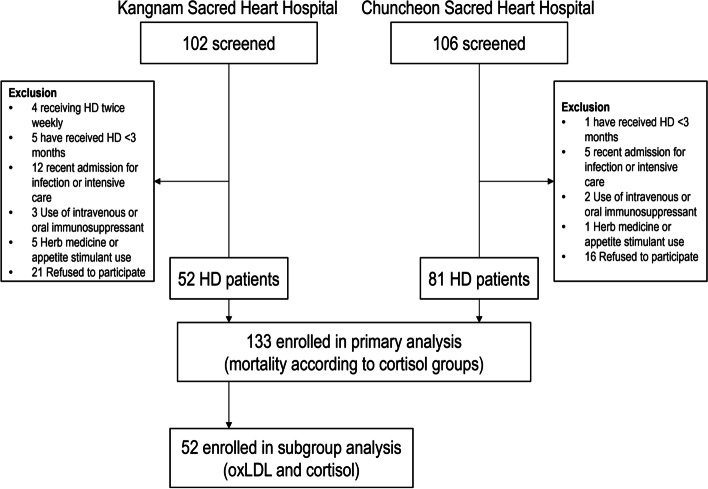
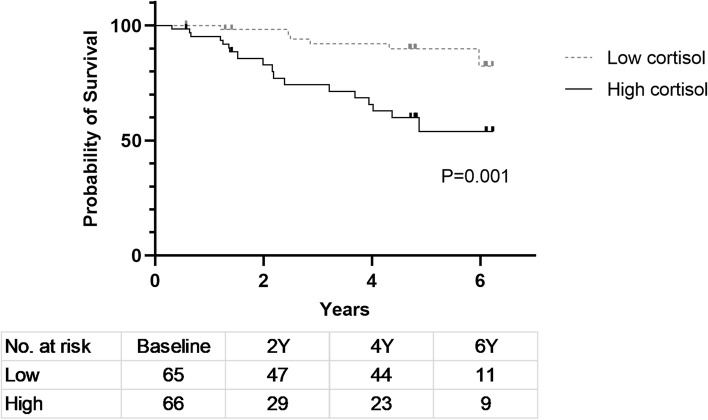
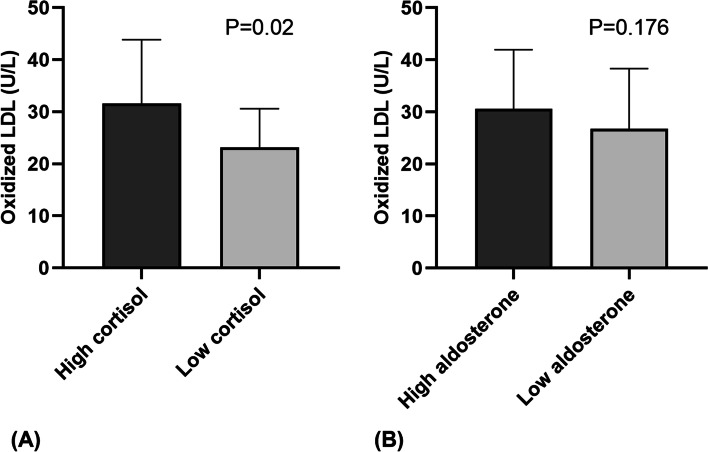
Background: Chronic stimulation of the mineralocorticoid receptor has been suggested as one of the potential causes of cardiovascular events and death in patients with end-stage renal disease. This observational cohort study was performed to demonstrate that serum cortisol might be a predictive marker for patient mortality and to evaluate its association with oxidized low-density lipoprotein (oxLDL) in hemodialysis (HD) patients. Methods: Patients receiving HD three times a week were screened for enrollment at two institutions. Baseline cortisol levels were measured before each HD session, and the patients were divided into two groups according to the median value of serum cortisol before analysis. The baseline characteristics and laboratory values of the high and low cortisol groups were compared. Serum cortisol, adrenocorticotropic hormone, renin, aldosterone, and oxLDL were measured in 52 patients to evaluate the effect of oxidative stress on serum cortisol levels. Results: A total of 133 HD patients were enrolled in this cohort study. Compared to the patients with low serum cortisol levels, the patients with high serum cortisol levels (baseline cortisol ≥ 10 μg/dL) showed higher rates of cardiovascular disease (59.7% vs. 39.4%, P=0.019) and left ventricular systolic dysfunction (LVSD) (25.9% vs. 8.0%, P=0.016). The patients in the high cortisol group demonstrated higher all-cause mortality than those in the low cortisol group. The serum cortisol level was an independent risk factor for patient mortality (hazard ratio 1.234, 95% confidence interval 1.022-1.49, P=0.029). Among the 52 patients with oxLDL measurements, oxLDL was an independent risk factor for elevated serum cortisol levels (Exp(B) 1.114, P=0.013) and LVSD (Exp(B) 12.308, P=0.045). However, plasma aldosterone levels did not affect serum cortisol levels. Conclusions: Serum cortisol is a useful predictive marker for all-cause death among patients receiving HD. OxLDL is an independent marker for elevated serum cortisol among HD patients.
Overview
The claims and statistics of this paper haven’t been checked yet.
Free: it reads the open-access text and checks the first 5 claims that cite a source we can check. Create a free account to check every claim.
Integrity signals
Registry
Cites
Statistics
Figures
Verification
Claims the paper makes
The claims and statistics of this paper haven’t been checked yet.
Free: it reads the open-access text and checks the first 5 claims that cite a source we can check. Create a free account to check every claim.
Claims other papers make about this one
Each is checked against this paper’s own text: does it say what the citing paper says it does?
The source backs part of the claim, not all of it — or backs it for a different population, condition or comparison.
In the citing paper
“Serum cortisol levels may rise significantly due to oxidative stress [84].”
From Chronic Stress-Associated Depressive Disorders: The Impact of HPA Axis Dysregulation and Neuroinflammation on the Hippocampus—A Mini Review (2025) · cites this paper as [84]
Experimental — accuracy not yet measured
Self-check
Percentages, sums and reported differences re-computed from the paper’s own numbers.
The self-check needs the paper’s full text.
Citations
Cites
Lang, R. M., Badano, L. P., Mor-Avi, V., Afilalo, J., Armstrong, A., Ernande, L., Flachskampf, F. A., Foster, E., Goldstein, S. A., Kuznetsova, T., et al. (2015) · Journal of the American Society of Echocardiography · doi:10.1016/j.echo.2014.10.003 · Cited by 12,362 · cited 1×
“Left ventricular hypertrophy (LVH) was defined as an LVMI of at least 115 g/m2 in men and 95 g/m2 in women [19].”
BackgroundChronic kidney disease and the risks of death, cardiovascular events, and hospitalization
Go, A. S., Chertow, G. M., Fan, D., McCulloch, C. E., & Hsu, C.-Y. (2004) · New England Journal of Medicine · doi:10.1056/nejmoa041031 · Cited by 11,369
Napoli, C., Quehenberger, O., De Nigris, F., Abete, P., Glass, C. K., & Palinski, W. (2000) · The FASEB Journal · doi:10.1096/fj.99-0986com · Cited by 199 · cited 1×
“OxLDL may accumulate within macrophages, which may enhance chemotactic activity and result in direct injury to endothelial cells [21].”
BackgroundReconsidering the Roles of the Mineralocorticoid Receptor
Funder, J. W. (2009) · Hypertension · doi:10.1161/hypertensionaha.108.119966 · Cited by 159 · cited 2×
“Since cortisol concentration may be elevated due to increased oxLDL and reduced 11βHSD2 enzyme activity in cardiac tissue, cardiac mineralocorticoid receptors may be activated mainly by cortisol [12].”
BackgroundYamaji, M., Tsutamoto, T., Kawahara, C., Nishiyama, K., Yamamoto, T., Fujii, M., & Horie, M. (2009) · Circulation: Heart Failure · doi:10.1161/circheartfailure.109.868513 · Cited by 119 · cited 3×
“In addition, previous studies have shown the harmful effect of serum cortisol in HD patients: HD patients with high serum cortisol levels had high rates of cardiovascular events and mortality [2, 13, 14].”
BackgroundResultSato, A., Funder, J. W., & Saruta, T. (1999) · American Journal of Hypertension · doi:10.1016/s0895-7061(99)00066-7 · Cited by 82 · cited 1×
“Some observational studies with a small number of HD patients showed a positive association [6, 7] while others reported a negative association [8–10] with cardiovascular outcome and mortality.”
ResultN'Gankam, V., Uehlinger, D. E., Dick, B., Frey, B. M., & Frey, F. J. (2002) · Kidney International · doi:10.1046/j.1523-1755.2002.00308.x · Cited by 81 · cited 2×
“However, the activity of 11βHSD2 decreases as renal function declines, and therefore, cortisol levels increase disproportionately compared to aldosterone levels [11].”
BackgroundEffect of lipoproteins on mesangial cell proliferation
Nishida, Y., Oda, H., & Yorioka, N. (1999) · Kidney International · doi:10.1046/j.1523-1755.1999.07113.x · Cited by 74
Samouilidou, E. C., Karpouza, A., Kostopoulos, V., Bakirtzi, T., Pantelias, K., Petras, D. I., Tzanatou-Exarchou, H., & Grapsa, E. J. (2011) · Renal Failure · doi:10.3109/0886022x.2011.641515 · Cited by 73 · cited 1×
“A previous study demonstrated that patients with end-stage renal disease have a nearly 10-fold elevation of oxLDL compared with healthy controls [20].”
BackgroundAldosterone and cortisol affect the risk of sudden cardiac death in haemodialysis patients
Drechsler, C., Ritz, E., Tomaschitz, A., Pilz, S., Schönfeld, S., Blouin, K., Bidlingmaier, M., Hammer, F., Krane, V., März, W., et al. (2012) · European Heart Journal · doi:10.1093/eurheartj/ehs361 · Cited by 70
Massy, Z. A., Kim, Y., Guijarro, C., Kasiske, B. L., Keane, W. F., & O’Donnell, M. P. (2000) · Biochemical and Biophysical Research Communications · doi:10.1006/bbrc.1999.1992 · Cited by 68
Aldosterone and Left Ventricular Remodeling
Colussi, G., Brosolo, G., Novello, M., Sechi, L. A., & Catena, C. (2015) · Hormone and Metabolic Research · doi:10.1055/s-0035-1565055 · Cited by 51
New Insights Into Lipid Metabolism in Chronic Kidney Disease
Kaysen, G. A. (2011) · Journal of Renal Nutrition · doi:10.1053/j.jrn.2010.10.017 · Cited by 47 · cited 1×
“The concentration of oxLDL is elevated in patients with chronic kidney disease in part because of the inability of high-density lipoprotein to reduce oxLDL and in part because of the increased LDL lifespan due to decreased renal clearance [15].”
BackgroundAldosterone, From (Patho)Physiology to Treatment in Cardiovascular and Renal Damage
Waanders, F., de Vries, L. V., van Goor, H., Hillebrands, J., Laverman, G. D., Bakker, S. J. L., & Navis, G. J. (2011) · Current Vascular Pharmacology · doi:10.2174/157016111796642689 · Cited by 43 · cited 1×
“Instead, the paradoxical effect of aldosterone on cardiovascular outcomes may be due to the dissociation of low circulating aldosterone levels and high tissue aldosterone levels [25].”
BackgroundSteigerwalt, S. P., Zafar, A., Mesiha, N., Gardin, J. M., & Provenzano, R. (2007) · American Journal of Nephrology · doi:10.1159/000100106 · Cited by 42 · cited 1×
“Some observational studies with a small number of HD patients showed a positive association [6, 7] while others reported a negative association [8–10] with cardiovascular outcome and mortality.”
ResultAldosterone and Mortality in Hemodialysis Patients: Role of Volume Overload
Hung, S. C., Lin, Y.-P., Huang, H.-L., Pu, H.-F., & Tarng, D. (2013) · PLoS ONE · doi:10.1371/journal.pone.0057511 · Cited by 28 · cited 1×
“Previous studies suggested that this paradoxical relationship might be due to the confounding effect of volume overload, inflammation, or protein energy malnutrition [9, 10].”
BackgroundKohagura, K., Higashiuesato, Y., Ishiki, T., Yoshi, S., Ohya, Y., Iseki, K., & Takishita, S. (2006) · Hypertension Research · doi:10.1291/hypres.29.597 · Cited by 21
Toida, T., Toida, R., Yamashita, R., Komiya, N., Uezono, S., Komatsu, H., Ishikawa, T., Kitamura, K., Sato, Y., & Fujimoto, S. (2019) · Cardiorenal Medicine · doi:10.1159/000496064 · Cited by 21 · cited 1×
“Left ventricular systolic dysfunction (LVSD) was defined as LVEF less than 50% [17].”
BackgroundRole of oxidized low-density lipoprotein in renal disease
Heeringa, P., & Tervaert, J. W. C. (2002) · Current Opinion in Nephrology & Hypertension · doi:10.1097/00041552-200205000-00004 · Cited by 20
Cortisol levels are associated with mortality risk in hemodialysis patients
Gracia-Iguacel, C., González‐Parra, E., Egido, J., Lindholm, B., Mahíllo, I., Carrero, J. J., & Ortíz, A. (2014) · Clinical Nephrology · doi:10.5414/cn108311 · Cited by 19 · cited 3×
“Another study showed that serum cortisol levels were associated with inflammation and low sodium levels, and high serum cortisol among HD patients resulted in high mortality [14].”
BackgroundResultLedda, A., González, M., Gulfo, J., Ludovico, I. D., Ramella, N. A., Toledo, J., Garda, H. A., Grasa, M., & Esteve, M. (2016) · Atherosclerosis · doi:10.1016/j.atherosclerosis.2016.04.020 · Cited by 19
Latest aspects of aldosterone actions on the heart muscle.
Κritis, A., Gouta, C. P., Liaretidou, E., & Kallaras, K. (2016) · PubMed · Cited by 14
Grotevendt, A., Wallaschofski, H., Reincke, M., Adolf, C., Quinkler, M. O., Nauck, M. A., Hoffmann, W. U., Rettig, R., & Hannemann, A. (2017) · Endocrine · doi:10.1007/s12020-017-1348-8 · Cited by 14
Modulation of Adrenal Aldosterone Release by Oxidative Modification of Low-Density Lipoprotein
Ansurudeen, I., Pietzsch, J., Graessler, J., Ehrhart‐Bornstein, M., Saha, S., Bornstein, S. R., & Kopprasch, S. (2010) · American Journal of Hypertension · doi:10.1038/ajh.2010.118 · Cited by 12 · cited 2×
“In addition, oxLDL may counteract aldosterone, resulting in low to normal plasma aldosterone levels in highly oxidative stress conditions [16].”
BackgroundAldosterone, mortality, cardiovascular events and reverse epidemiology in end stage renal disease
ElHafeez, S. A., Tripepi, G. L., Mallamaci, F., & Zoccali, C. (2015) · European Journal of Clinical Investigation · doi:10.1111/eci.12509 · Cited by 10
Choi, S. R., Lee, Y., Park, H. C., Kim, D. H., Cho, A., Kang, M.-K., & Choi, S. (2021) · PLoS ONE · doi:10.1371/journal.pone.0250653 · Cited by 10 · cited 1×
“(LVDD) was defined as an E/E’ ratio greater than 15 [18].”
BackgroundSelf-citation
Cited by
Lei, A. A., Phang, V. W. X., Lee, Y. Z., Kow, A. S. F., Tham, C. L., Ho, Y.-C., & Lee, M. T. (2025) · International Journal of Molecular Sciences · doi:10.3390/ijms26072940 · Cited by 207
“Serum cortisol levels may rise significantly due to oxidative stress [84].”
Self-citationCortisol excess in chronic kidney disease – A review of changes and impact on mortality
Sagmeister, M. S., Harper, L., & Hardy, R. (2023) · Frontiers in Endocrinology · doi:10.3389/fendo.2022.1075809 · Cited by 93
“While an association between CRP and cortisol in CKD is described in most studies, one study among haemodialysis patients found no statistically significant difference in CRP between patients with high versus low cortisol (87).”
BackgroundMethodInfluentialThe protective role of ginsenoside Rg3 in heart diseases and mental disorders
Shi, L., Luo, J., Wei, X., Xu, X., & Tu, L. (2024) · Frontiers in Pharmacology · doi:10.3389/fphar.2024.1327033 · Cited by 21
Enhancing Immune Protection in Hemodialysis Patients: Role of the Polymethyl Methacrylate Membrane
Franzin, R., Stasi, A., Caggiano, G., Squiccimarro, E., Losappio, V., Fiorentino, M., Alfieri, C., Stallone, G., Gesualdo, L., & Castellano, G. (2023) · Blood Purification · doi:10.1159/000529971 · Cited by 20
“Under circumstances of oxidative stress, LDL may be modi fi ed to oxidized LDL (oxLDL), which is highly atherogenic [31, 38, 39].”
BackgroundEl-Houseiny, W., AbdelMageed, M. A., Abd‐Elhakim, Y. M., Abdel‐Warith, A. A., Younis, E. M., Abd-Allah, N. A., Davies, S. J., El-Kholy, M. S., & Ahmed, S. (2023) · Aquaculture Reports · doi:10.1016/j.aqrep.2023.101576 · Cited by 16
Metadata
- Authors
- Kim, J., Yun, K.-S., Cho, A., Kim, D. H., Lee, Y.-K., Choi, M.-J., Kim, S.-H., Kim, H., Yoon, J.-W., & Park, H. C.
- Affiliations
- Hallym University (KR)
- Armed Forces Capital Hospital (KR)
- Corresponding author
- Park, Hayne C.
- ORCID
- Venue
- BMC Nephrology
- Published
- 2022-03-08
- Volume
- 23
- Issue
- 1
- Pages
- 98-98
- ISSN
- 1471-2369 (ISSN-L)
- PMC
- PMC8903641
- OpenAlex
- W4221024193
- Semantic Scholar
- 6606d73ac3f9c52f93cde97afdeb56349ae12a70
- Cited by
- 22
- References
- 26
- Citations by year
- 2026: 4 · 2025: 4 · 2024: 6 · 2023: 6 · 2022: 2
- FWCI
- 2.86
- Type
- journal article
- Language
- en
- Open access
- gold
- doi.org
- Licence
- cc-by
- creativecommons.org/licenses/by/4.0 (tdm)
- creativecommons.org/licenses/by/4.0 (vor)
- Locations
- BMC Nephrology (publishedVersion, cc-by)
- PubMed Central (publishedVersion, cc-by)
- PubMed (publishedVersion)
- DOAJ (DOAJ: Directory of Open Access Journals) (submittedVersion, cc-by-sa)
- Funders
- Hallym University
- Topics
- Health Sciences › Medicine › Nephrology › Dialysis and Renal Disease Management
- Health Sciences › Medicine › Endocrinology, Diabetes and Metabolism › Hormonal Regulation and Hypertension
- Health Sciences › Medicine › Endocrinology, Diabetes and Metabolism › Adrenal Hormones and Disorders
- Keywords
- serum cortisol, oxidative stress, oxidized LDL, maintenance hemodialysis, end-stage renal disease, all-cause mortality, cardiovascular disease, left ventricular systolic dysfunction, mineralocorticoid receptor, ACTH, aldosterone, predictive biomarkers
- MeSH terms
- Aldosterone, Female, Renal Dialysis, Humans, Hydrocortisone, Kidney Failure, Chronic, Male, Cohort Studies, Biomarkers, Oxidative Stress
About these checks
Registry, retraction, Cites and statistics results are computed, not judged, with one exception: a printed reference that no index lists is read once by a model before it counts as a citation error. Claims are extracted by a model and kept only when their quote appears verbatim in the text; each cited source is then checked, with a model’s help, for whether it says what the claim relies on. Those verdicts can be wrong — read the claim’s quote and the cited source before relying on one.
Statistics and arithmetic are recomputed, not judged.
Confidence bands are shown only for fields calibrated on our annotated test set. None is calibrated yet, so no band is shown.
What counts as a claim ›How we measure confidence ›How we check this ›
Are you an author, or do you see a problem with this page? Request a review
Data sources
Bibliographic data: Semantic Scholar, OpenAlex, Crossref.
Contains information from the Semantic Scholar Academic Graph Datasets, made available under the ODC Attribution License (ODC-BY 1.0).
Semantic Scholar’s data is described in: Kinney, R., et al. (2023). The Semantic Scholar Open Data Platform. arXiv:2301.10140.
