

Measuring the course of anxiety in women giving birth by caesarean section: a prospective study
Open accessThe DOI matches its Crossref record; 29 of the 29 references it cites were found in a registry or an index.
Abstract
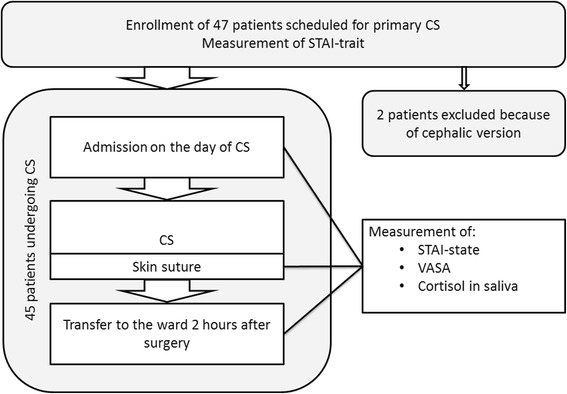
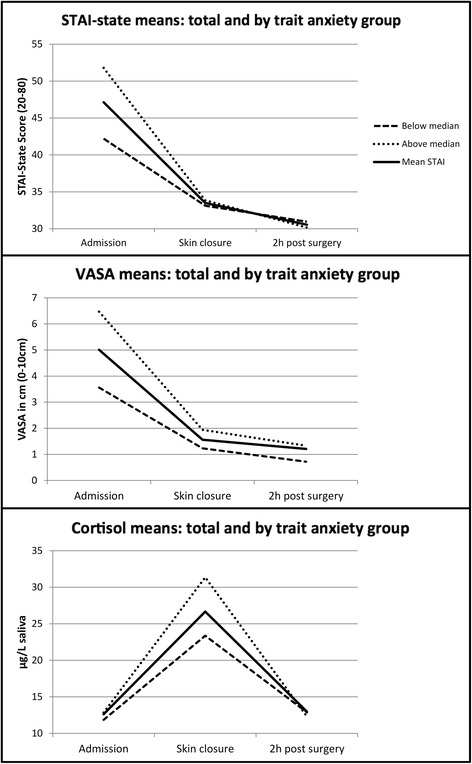
BACKGROUND: Women undergoing elective caesarean section experience anxiety. However, course, extent and duration of anxiety have not been investigated yet. This study aimed to explore anxiety levels during the course of the day of surgery by employing and comparing subjective as well as objective measures. By examining their correlation it is intended to give methodological support for interventional studies. METHODS: This is a monocentric, prospectively planned study in which 47 women with an indication for primary caesarean section took part. Anxiety levels were evaluated using the State-Trait Anxiety Inventory (STAI-trait and STAI-state), the visual analogue scale for anxiety (VASA) as well as saliva cortisol at three time points on the day of the caesarean section (at admission, at skin closure and 2 h post surgery). RESULTS: Peak anxiety levels for the STAI-state and VASA were highest at admission and showed significant decreases to skin closure (p < .001). The subjective measures correlated significantly at all time points (p-values < .001). For cortisol levels the peak level of anxiety was shown at skin closure with a significant increase from admission to skin closure and a significant decrease from skin closure to 2 h post operation (p-values < .001). Additionally women with STAI-trait scores above the median showed significantly higher levels at the peaks of anxiety. CONCLUSION: The study reveals the course of anxiety on the day of the caesarean section. A strong correlation of STAI-state and VASA was demonstrated. Cortisol showed a different course, which fits into its known biological kinetics. Taking into account all measures, anxiety seems to be most bothersome before surgery until skin closure. In a differentiated approach using STAI-trait scores as a discriminator we showed that the group with STAI-trait levels above the median is particularly prone to develop anxiety in the setting of the caesarean section and might therefore mostly be in need of an intervention against anxiety.
Overview
The claims and statistics of this paper haven’t been checked yet.
Free: it reads the open-access text and checks the first 5 claims that cite a source we can check. Create a free account to check every claim.
Integrity signals
Registry
Cites
Statistics
Figures
Verification
Claims the paper makes
The claims and statistics of this paper haven’t been checked yet.
Free: it reads the open-access text and checks the first 5 claims that cite a source we can check. Create a free account to check every claim.
Claims other papers make about this one
Each is checked against this paper’s own text: does it say what the citing paper says it does?
The check wasn’t confident either way, so it gives no verdict — never disputed.
In the citing paper
“However, missing effects of music interventions on salivary alpha-amylase have also been reported previously [32].”
From The effects of a music and singing intervention during pregnancy on maternal well-being and mother-infant bonding: a randomised, controlled study. (2021) · cites this paper as [32]
Experimental — accuracy not yet measured
Self-check
Percentages, sums and reported differences re-computed from the paper’s own numbers.
The self-check needs the paper’s full text.
Citations
Cites
Statistical power analyses using G∗Power 3.1: tests for correlation and regression analyses
Faul, F., Erdfelder, E., Buchner, A., & Lang, A.-G. (2009) · Behavior Research Methods · doi:10.3758/brm.41.4.1149 · Cited by 37,615 · cited 2×
“Sample size was calculated using the software G*power [20] with an estimated medium effect size, a power of 0.9 and with an alpha error probability of 0.05.”
MethodInfluentialDickerson, S. S., & Kemeny, M. E. (2004) · Psychological Bulletin · doi:10.1037/0033-2909.130.3.355 · Cited by 5,881 · cited 2×
“This different pattern of anxiety development can be explained by the fact that the cortisol level in saliva samples occurs with a latency of around 30 min after the stressful event [16].”
BackgroundSalivary cortisol as a biomarker in stress research
Hellhammer, D. H., Wüst, S., & Kudielka, B. M. (2009) · Psychoneuroendocrinology · doi:10.1016/j.psyneuen.2008.10.026 · Cited by 1,925 · cited 1×
“Data about the correlation of cortisol and subjective measurements of anxiety are contradictory [19].”
BackgroundThe brain and the stress axis: the neural correlates of cortisol regulation in response to stress
Dedovic, K., Duchesne, A., Andrews, J., Engert, V., & Pruessner, J. C. (2009) · NeuroImage · doi:10.1016/j.neuroimage.2009.05.074 · Cited by 699 · cited 1×
“Looking at objective measures to evaluate anxiety, cortisol levels are often referred to [15].”
BackgroundKindler, C. H., Harms, C., Amsler, F., Ihde-Scholl, T., & Scheidegger, D. (2000) · Anesthesia & Analgesia · doi:10.1097/00000539-200003000-00036 · Cited by 632 · cited 1×
“There is evidence that a simple visual analogue scale depicting anxiety (VASA) predicts STAI-state results reliably [13, 14].”
BackgroundA one-item question with a Likert or Visual Analog Scale adequately measured current anxiety
Davey, H. M., Barratt, A. L., Butow, P. N., & Deeks, J. J. (2007) · Journal of Clinical Epidemiology · doi:10.1016/j.jclinepi.2006.07.015 · Cited by 366 · cited 2×
“, 2007 measuring anxiety in women awaiting a breast screening could also show a strong correlation between the STAI-state and the VASA suggesting that the VASA could be an adequate and more feasible approach to measure current anxiety [23].”
BackgroundReliability, validity and sensitivity of a computerized visual analog scale measuring state anxiety
Abend, R., Dan, O., Maoz, K., Raz, S., & Bar-Haim, Y. (2014) · Journal of Behavior Therapy and Experimental Psychiatry · doi:10.1016/j.jbtep.2014.06.004 · Cited by 217
Determination of cortisol in serum, saliva and urine
Turpeinen, U., & Hämäläinen, E. (2013) · Best Practice & Research Clinical Endocrinology & Metabolism · doi:10.1016/j.beem.2013.10.008 · Cited by 214 · cited 1×
“Although it can be obtained from all kinds of specimens like blood, urine or hair, the sampling in saliva is the most common way inanxiety research as it reflects the activation of the HPAA within the last half hour before the specimen was obtained [17, 18].”
BackgroundCortisol assays and diagnostic laboratory procedures in human biological fluids
Gatti, R., Antonelli, G., Prearo, M., Spinella, P., Cappellin, E., & De Palo, E. F. (2009) · Clinical Biochemistry · doi:10.1016/j.clinbiochem.2009.04.011 · Cited by 214 · cited 1×
“Although it can be obtained from all kinds of specimens like blood, urine or hair, the sampling in saliva is the most common way inanxiety research as it reflects the activation of the HPAA within the last half hour before the specimen was obtained [17, 18].”
BackgroundThe effect of self-selected music during colonoscopy on anxiety, heart rate, and blood pressure
Smolen, D., Topp, R., & Singer, L. (2002) · Applied Nursing Research · doi:10.1053/apnr.2002.34140 · Cited by 191 · cited 1×
“[11, 12, 28, 29].”
Sedative music reduces anxiety and pain during chair rest after open-heart surgery
Voss, J. A., Good, M., Yates, B., Baun, M. M., Thompson, A., & Hertzog, M. (2004) · Pain · doi:10.1016/j.pain.2004.08.020 · Cited by 185 · cited 1×
“Furthermore, we acknowledge that the sample size in the present study is relatively small but comparable to other studies in the field [12, 28, 30] and according to the prospectively conducted power analysis.”
ResultPsychological aspects of caesarean section
Clement, S. (2001) · Best Practice & Research Clinical Obstetrics & Gynaecology · doi:10.1053/beog.2000.0152 · Cited by 165 · cited 1×
“Even though data about consequences for the mother and the newborn in terms of physical detriments are vastly available and part of every informed consent, only few studies have elucidated the impact of CS on psychological parameters [2].”
BackgroundEffects of Music Listening on Cortisol Levels and Propofol Consumption during Spinal Anesthesia
Koelsch, S., Fuermetz, J., Sack, U., Bauer, K., Hohenadel, M., Wiegel, M., Kaisers, U. X., & Heinke, W. (2011) · Frontiers in Psychology · doi:10.3389/fpsyg.2011.00058 · Cited by 152 · cited 1×
“On the other hand, the STAI-state questionnaire has been used frequently in order to evaluate anxiety levels in clinical settings [9–12].”
MethodExperiences of Emergency Cesarean Section: A Phenomenological Study of 53 Women
Ryding, E. L., Wijma, K., Wijma, B., & Elsa Lena Ryding is a consultant at the Department of Obstetrics and Gynaecology, C. H. (1998) · Birth · doi:10.1046/j.1523-536x.1998.00246.x · Cited by 143 · cited 1×
“as soon as they saw their newborn baby [22].”
BackgroundChieng, Y. J. S., Chan, W. C. S., Klainin‐Yobas, P., & He, H. (2014) · Journal of Advanced Nursing · doi:10.1111/jan.12205 · Cited by 134 · cited 1×
“correlates positively to postoperative pain [7, 26, 27], the aim should be the reduction of anxiety levels before and”
BackgroundPatterns and frequency of anxiety in women undergoing gynaecological surgery
Carr, E., Brockbank, K., Allen, S., & Strike, P. (2006) · Journal of Clinical Nursing · doi:10.1111/j.1365-2702.2006.01285.x · Cited by 130 · cited 2×
“correlates positively to postoperative pain [7, 26, 27], the aim should be the reduction of anxiety levels before and”
BackgroundPreoperative anxiety and postoperative satisfaction in women undergoing elective caesarean section
Hobson, J. A., Slade, P., Wrench, I. J., & Power, L. (2006) · International Journal of Obstetric Anesthesia · doi:10.1016/j.ijoa.2005.05.008 · Cited by 127 · cited 1×
“Previous studies looking at anxiety in the context of CS measured preoperative anxiety only [4, 5, 24].”
BackgroundSchupp, C. J., Berbaum, K., Berbaum, M., & Lang, E. V. (2005) · Journal of Vascular and Interventional Radiology · doi:10.1097/01.rvi.0000185418.82287.72 · Cited by 112 · cited 1×
“correlates positively to postoperative pain [7, 26, 27], the aim should be the reduction of anxiety levels before and”
BackgroundCortisol and anxiety response to a relaxing intervention on pregnant women awaiting amniocentesis
Ventura, T., Gomes, M. C., & Carreira, T. (2012) · Psychoneuroendocrinology · doi:10.1016/j.psyneuen.2011.05.016 · Cited by 107 · cited 1×
“The STAI-trait questionnaire is not included that often in clinical studies even though it has been shown that it can potentially be used to identify patients who are prone to high levels of anxiety in surgical settings [7] as well as who could benefit most from additional interventions reducing anxiety in medical set…”
BackgroundZengin, S., Kabul, S., Al, B., Sarcan, E., Doğan, M., & Yildirim, C. (2013) · Complementary Therapies in Medicine · doi:10.1016/j.ctim.2013.08.017 · Cited by 105 · cited 2×
“[11, 12, 28, 29].”
MethodOrbach‐Zinger, S., Ginosar, Y., Elliston, J., Fadon, C., Abu-Lil, M., Raz, A., Goshen‐Gottstein, Y., & Eidelman, L. A. (2012) · British Journal of Anaesthesia · doi:10.1093/bja/aes313 · Cited by 98 · cited 1×
“Previous studies looking at anxiety in the context of CS measured preoperative anxiety only [4, 5, 24].”
BackgroundPreoperative music intervention for patients undergoing cesarean delivery
Li, Y., & Dong, Y. (2012) · International Journal of Gynecology & Obstetrics · doi:10.1016/j.ijgo.2012.05.017 · Cited by 72 · cited 1×
“Furthermore, we acknowledge that the sample size in the present study is relatively small but comparable to other studies in the field [12, 28, 30] and according to the prospectively conducted power analysis.”
ResultLai, H., Hwang, M., Chen, C., Chang, K., Peng, T., & Chang, F. (2008) · Journal of Clinical Nursing · doi:10.1111/j.1365-2702.2008.02350.x · Cited by 71 · cited 3×
“[11, 12, 28, 29].”
MethodResultEfficacy of Acupuncture in Reducing Preoperative Anxiety: A Meta‐Analysis
Bae, H., Bae, H., Min, B.-I., & Cho, S. (2014) · Evidence-based Complementary and Alternative Medicine · doi:10.1155/2014/850367 · Cited by 70 · cited 1×
“Furthermore, acupuncture could be beneficial in order to reduce anxiety levels in women waiting for a CS [31].”
BackgroundElective caesarean section - the patient's choice?
J. Edwards, N. J. D. (2001) · Journal of Obstetrics and Gynaecology · doi:10.1080/01443610020025994 · Cited by 49 · cited 1×
“effects and the discomfort it may cause [3].”
BackgroundA Qualitative Approach to Examine Women's Experience of Planned Cesarean
Blüml, V., Stammler‐Safar, M., Reitinger, A. K., Resch, I., Naderer, A., & Leithner, K. (2012) · Journal of Obstetric, Gynecologic & Neonatal Nursing · doi:10.1111/j.1552-6909.2012.01398.x · Cited by 34 · cited 1×
“anxiety) were high before the CS and moderate after the CS which fits well to our results [25].”
ResultOrbach‐Zinger, S., Ginosar, Y., Sverdlik, J., Treitel, C., MacKersey, K., Bardin, R., Peleg, D., & Eidelman, L. A. (2012) · Anesthesia & Analgesia · doi:10.1213/ane.0b013e318241f4f3 · Cited by 17 · cited 1×
“On the other hand, the STAI-state questionnaire has been used frequently in order to evaluate anxiety levels in clinical settings [9–12].”
MethodWyatt, S. S., JONES, D. A., Peach, M. J., & Gurrin, L. C. (2001) · International Journal of Obstetric Anesthesia · doi:10.1054/ijoa.2001.0866 · Cited by 15 · cited 2×
“Previous studies looking at anxiety in the context of CS measured preoperative anxiety only [4, 5, 24].”
BackgroundResultSlater, P. (2015) · International Journal of Obstetric Anesthesia · doi:10.1016/j.ijoa.2015.03.003 · Cited by 9
Research works printed but not linked: 2
- Spielberger CD. State-trait anxiety inventory: a comprehensive bibliography. 2nd ed. Palo Alto, CA, USA: Consulting Psychologists Press; 1993.
- Laux L Glanzmann P Schaffner P Spielberger CD Das State-Trait- Angstinventar (STAI) (Beltz-Test) 1981 Göttingen Beltz Test GmbH
Cited by
Wulff, V., Hepp, P., Wolf, O. T., Balan, P., Hagenbeck, C., Fehm, T., & Schaal, N. K. (2021) · Archives of gynecology and obstetrics · doi:10.1007/s00404-020-05727-8 · Cited by 101
Self-citationNoben, L., Goossens, S. M. T. A., Truijens, S. E. M., van Berckel, M. M. G., Perquin, C. W., Slooter, G. D., & van Rooijen, S. J. (2019) · JMIR Mental Health · doi:10.2196/15872 · Cited by 91
“Sample size calculation was performed using the software G*power3 [18] and based on VAS-A scores from the literature [19].”
BackgroundMethodResultHepp, P., Hagenbeck, C., Gilles, J., Wolf, O. T., Goertz, W., Janni, W., Balan, P., Fleisch, M., Fehm, T., & Schaal, N. K. (2018) · BMC Pregnancy and Childbirth · doi:10.1186/s12884-018-2069-6 · Cited by 88
Self-citationMusic in Obstetrics: An Intervention Option to Reduce Tension, Pain and Stress
Wulff, V., Hepp, P., Fehm, T., & Schaal, N. (2017) · Geburtshilfe und Frauenheilkunde · doi:10.1055/s-0043-118414 · Cited by 39
“Caesarean section is an anxiety-ridden surgical operation which usually causes considerable discomfort in the women involved [45,46].”
BackgroundSelf-citationHigh worry in pregnancy predicts postpartum depression
Osborne, L. M., Voegtline, K., Standeven, L. R., Sundel, B., Pangtey, M., Hantsoo, L. V., & Payne, J. L. (2021) · Journal of Affective Disorders · doi:10.1016/j.jad.2021.07.009 · Cited by 47
Metadata
- Authors
- The MAGIC Group, Hepp, P., Hagenbeck, C., Burghardt, B., Jaeger, B., Wolf, O. T., Fehm, T., & Schaal, N. K.
- Affiliations
- Witten/Herdecke University (DE)
- Heinrich Heine University Düsseldorf (DE)
- Corresponding author
- Hepp, Philip
- Venue
- BMC Pregnancy and Childbirth
- Published
- 2016-05-18
- Volume
- 16
- Issue
- 1
- Pages
- 113-113
- ISSN
- 1471-2393 (ISSN-L)
- PMC
- PMC4870728
- OpenAlex
- W2404537323
- Semantic Scholar
- 490524c83831c29f68f47b0294f4d230e7351353
- Cited by
- 60
- References
- 29
- Citations by year
- 2026: 3 · 2025: 3 · 2024: 9 · 2023: 6 · 2022: 6 · 2021: 9 · 2020: 7 · 2019: 13 · 2018: 2 · 2017: 2
- FWCI
- 7.31
- Type
- journal article
- Language
- en
- Open access
- gold
- doi.org
- Licence
- Locations
- BMC Pregnancy and Childbirth (publishedVersion, cc-by)
- PubMed Central (publishedVersion, cc-by)
- PubMed (publishedVersion)
- Funders
- Anton-Betz-Stiftung
- Topics
- Health Sciences › Medicine › Obstetrics and Gynecology › Maternal and Perinatal Health Interventions
- Health Sciences › Medicine › Public Health, Environmental and Occupational Health › Maternal Mental Health During Pregnancy and Postpartum
- Social Sciences › Psychology › Experimental and Cognitive Psychology › Anxiety, Depression, Psychometrics, Treatment, Cognitive Processes
- Keywords
- anxiety, cesarean section, elective cesarean section, State-Trait Anxiety Inventory, salivary cortisol, trait anxiety, skin closure, preoperative anxiety
- MeSH terms
- Adult, Anxiety, Cesarean Section, Female, Humans, Hydrocortisone, Postoperative Period, Pregnancy, Prospective Studies, Saliva, Preoperative Period
About these checks
Registry, retraction, Cites and statistics results are computed, not judged, with one exception: a printed reference that no index lists is read once by a model before it counts as a citation error. Claims are extracted by a model and kept only when their quote appears verbatim in the text; each cited source is then checked, with a model’s help, for whether it says what the claim relies on. Those verdicts can be wrong — read the claim’s quote and the cited source before relying on one.
Statistics and arithmetic are recomputed, not judged.
Confidence bands are shown only for fields calibrated on our annotated test set. None is calibrated yet, so no band is shown.
What counts as a claim ›How we measure confidence ›How we check this ›
Are you an author, or do you see a problem with this page? Request a review
Data sources
Bibliographic data: Semantic Scholar, OpenAlex, Crossref.
Contains information from the Semantic Scholar Academic Graph Datasets, made available under the ODC Attribution License (ODC-BY 1.0).
Semantic Scholar’s data is described in: Kinney, R., et al. (2023). The Semantic Scholar Open Data Platform. arXiv:2301.10140.
