

Maternal and perinatal outcome after previous caesarean section in rural Rwanda
Open accessThe DOI matches its Crossref record; 29 of the 32 references it cites were found in a registry or an index.
Abstract
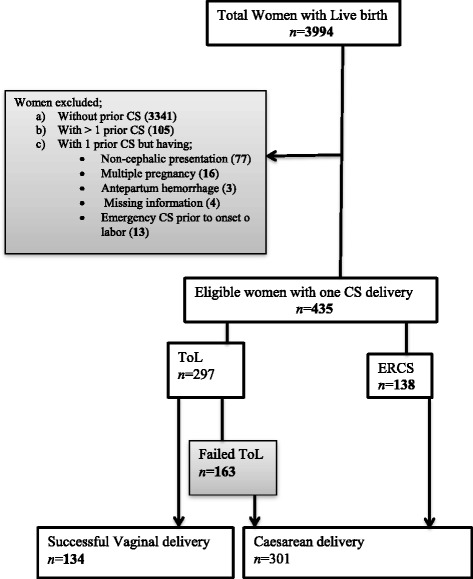
BACKGROUND: Offering a trial of labor (ToL) after previous caesarean section (CS) is an important strategy to reduce short- and long-term morbidity associated with repeated CS. We compared maternal and perinatal outcomes between ToL and elective repeat caesarean section (ERCS) at a district hospital in rural Rwanda. METHODS: Audit of women's records with one prior CS who delivered at Ruhengeri district hospital in Rwanda between June 2013 and December 2014. RESULTS: Out of 4131 women who came for delivery, 435 (11%) had scarred uteri. ToL, which often started at home or at health centers without appropriate counseling, occurred in 297/435 women (68.3%), while 138 women (31.7%) delivered by ERCS. ToL was successful in 134/297 (45.1%) women. There were no maternal deaths. Twenty-eight out of all 435 women with a scarred uterus (6.4%) sustained severe acute maternal morbidity (puerperal sepsis, postpartum hemorrhage, uterine rupture), which was higher in women with ToL (n = 23, 7.7%) compared with women who had an ERCS (n = 5, 3.6%): adjusted odds ration (aOR) 1.4 (95% CI 1.2-5.4). There was no difference in neonatal admissions between women who underwent ToL (n = 64/297; 21.5%) and those who delivered by ERCS (n = 35/138; 25.4%: aOR 0.8; CI 0.5-1.6). The majority of admissions were due to perinatal asphyxia that occurred more often in infants whose mothers underwent ToL (n = 40, 13.4%) compared to those who delivered by ERCS (n = 15, 10.9%: aOR 1.9; CI 1.6-3.6). Perinatal mortality was similar among infants whose mothers had ToL (n = 8; 27/1000 ToLs) and infants whose mothers underwent ERCS (n = 4; 29/1000 ERCSs). CONCLUSIONS: A considerable proportion of women delivering at a rural Rwandan hospital had scarred uteri. Severe acute maternal morbidity was higher in the ToL group, perinatal mortality did not differ. ToL took place under suboptimal conditions: access for women with scarred uteri into a facility with 24-h surgery should be guaranteed to increase the safety of ToL.
Overview
The claims and statistics of this paper haven’t been checked yet.
Free: it reads the open-access text and checks the first 5 claims that cite a source we can check. Create a free account to check every claim.
Integrity signals
Registry
Cites
Statistics
Figures
Verification
Claims the paper makes
The claims and statistics of this paper haven’t been checked yet.
Free: it reads the open-access text and checks the first 5 claims that cite a source we can check. Create a free account to check every claim.
Claims other papers make about this one
Each is checked against this paper’s own text: does it say what the citing paper says it does?
The source backs part of the claim, not all of it — or backs it for a different population, condition or comparison.
In the citing paper
“literature has shown a that a trial of labor would be preferred by mothers because it prevents unnecessary post-cesarean complications and consequently reduces maternal morbidity and mortality [6].”
From Preference and determinants of delivery mode in pregnant women with one cesarean scar: a cross-sectional study in two urban Ugandan public hospitals (2025) · cites this paper as [6]
Experimental — accuracy not yet measured
Self-check
Percentages, sums and reported differences re-computed from the paper’s own numbers.
The self-check needs the paper’s full text.
Citations
Cites
Maternal and Perinatal Outcomes Associated with a Trial of Labor after Prior Cesarean Delivery
Landon, M. B., Hauth, J. C., Leveno, K. J., Spong, C. Y., Leindecker, S., Varner, M. W., Moawad, A. H., Caritis, S. N., Harper, M., Wapner, R. J., et al. (2004) · New England Journal of Medicine · doi:10.1056/nejmoa040405 · Cited by 1,286
Vogel, J. P., Betrán, A. P., Vindevoghel, N., Souza, J. P., Torloni, M. R., Zhang, J., Tunçalp, Ö., Mori, R., Morisaki, N., Ortiz-Panozo, E., et al. (2015) · The Lancet Global Health · doi:10.1016/s2214-109x(15)70094-x · Cited by 1,037
Betran, A. P., Torloni, M. R., Zhang, J., Ye, J., Mikolajczyk, R., Deneux-Tharaux, C., Oladapo, O. T., Souza, J. P., Tunçalp, Ö., Vogel, J. P., et al. (2015) · Reproductive Health · doi:10.1186/s12978-015-0043-6 · Cited by 585
Practice Bulletin No. 115: Vaginal Birth After Previous Cesarean Delivery
(2010) · Obstetrics & Gynecology · doi:10.1097/aog.0b013e3181eeb251 · Cited by 446
Vaginal birth after cesarean: new insights.
Guise, J., Eden, K., Emeis, C. L., Denman, M. A., Marshall, N., Fu, R., Janik, R., Nygren, P., Walker, M., & McDonagh, M. S. (2010) · PubMed · Cited by 425
ACOG Practice bulletin no. 115: Vaginal birth after previous cesarean delivery
Chestnut, D. H. (2011) · Yearbook of Anesthesiology and Pain Management · doi:10.1016/j.yane.2010.09.021 · Cited by 310
Inequities in the use of cesarean section deliveries in the world
Gibbons, L., Belizan, J. M., Lauer, J. A., Betran, A. P., Merialdi, M., & Althabe, F. (2012) · American Journal of Obstetrics and Gynecology · doi:10.1016/j.ajog.2012.02.026 · Cited by 309
Can we reduce the caesarean section rate?
Robson, M. S. (2001) · Best Practice & Research Clinical Obstetrics & Gynaecology · doi:10.1053/beog.2000.0156 · Cited by 292
Vaginal Birth After Cesarean Delivery: Results of a 5-Year Multicenter Collaborative Study
FLAMM, B. L., NEWMAN, L. A., THOMAS, S. J., FALLON, D., & YOSHIDA, M. M. (1990) · Obstetrics & Gynecology · doi:10.1097/00006250-199011000-00004 · Cited by 224
Chu, K., Cortier, H., Maldonado, F., Mashant, T., Ford, N., & Trelles, M. (2012) · PLoS ONE · doi:10.1371/journal.pone.0044484 · Cited by 154
Availability and use of emergency obstetric services: Kenya, Rwanda, Southern Sudan, and Uganda
Pearson, L., & Shoo, R. (2005) · International Journal of Gynecology & Obstetrics · doi:10.1016/j.ijgo.2004.09.027 · Cited by 140
Maternal Near Miss and quality of care in a rural Rwandan hospital
Kalisa, R., Rulisa, S., van den Akker, T., & van Roosmalen, J. (2016) · BMC Pregnancy and Childbirth · doi:10.1186/s12884-016-1119-1 · Cited by 93
Self-citationRecommendations for Routine Reporting on Indications for Cesarean Delivery in Developing Countries
Stanton, C., Ronsmans, C., & the Baltimore Group on Cesarean (2008) · Birth · doi:10.1111/j.1523-536x.2008.00241.x · Cited by 77
Trial of labour after caesarean section in sub‐Saharan Africa: ameta‐analysis
Boulvain, M., Fraser, W. D., Brisson‐Carroll, G., Faron, G., & Wallast, E. (1997) · BJOG An International Journal of Obstetrics & Gynaecology · doi:10.1111/j.1471-0528.1997.tb11008.x · Cited by 71
Delivery After Previous Cesarean: Short-Term Perinatal Outcomes
Patel, R. M., & Jain, L. (2010) · Seminars in Perinatology · doi:10.1053/j.semperi.2010.03.007 · Cited by 64
Briand, V., Dumont, A., Abrahamowicz, M., Traoré, M., Watier, L., & Fournier, P. F. (2012) · BMC Pregnancy and Childbirth · doi:10.1186/1471-2393-12-114 · Cited by 51
Kaboré, C., Chaillet, N., Kouanda, S., Bujold, E., Traoré, M., & Dumont, A. (2015) · BJOG An International Journal of Obstetrics & Gynaecology · doi:10.1111/1471-0528.13615 · Cited by 46
Caesarean Morbidity and Mortality in a Private Hospital in Lagos, Nigeria
Ezechi, O., Nwokoro, C. A., Kalu, B. K. E., Njokanma, F. O., & Okeke, G. C. E. (2002) · Tropical Journal of Obstetrics and Gynaecology · doi:10.4314/tjog.v19i2.14382 · Cited by 46
Dumont, A., Fournier, P., Fraser, W., Haddad, S., Traore, M., Diop, I., Gueye, M., Gaye, A., Couturier, F., Pasquier, J.-C., et al. (2009) · Trials · doi:10.1186/1745-6215-10-85 · Cited by 43
Nonclinical Factors Affecting Women’s Access to Trial of Labor After Cesarean Delivery
Korst, L. M., Gregory, K. D., Fridman, M., & Phelan, J. P. (2011) · Clinics in Perinatology · doi:10.1016/j.clp.2011.03.004 · Cited by 39
Formal education does not improve the acceptance of cesarean section among pregnant Nigerian women
Onah, H. E. (2002) · International Journal of Gynecology & Obstetrics · doi:10.1016/s0020-7292(01)00578-1 · Cited by 29
Vaginal birth after cesarean section in rural Tanzania
van Roosmalen, J. (1991) · International Journal of Gynecology & Obstetrics · doi:10.1016/0020-7292(91)90351-5 · Cited by 29
Safety concerns for planned vaginal birth after caesarean section in sub‐ S aharan A frica
Wanyonyi, S., & Ngichabe, S. (2013) · BJOG An International Journal of Obstetrics & Gynaecology · doi:10.1111/1471-0528.12477 · Cited by 28
VBAC: A Medicolegal Perspective
Bonanno, C., Clausing, M., & Berkowitz, R. L. (2011) · Clinics in Perinatology · doi:10.1016/j.clp.2011.03.005 · Cited by 25
Frass, K., & Harazi, A. H. A. (2011) · Eastern Mediterranean Health Journal · doi:10.26719/2011.17.8.646 · Cited by 20
Pang, M. W., Law, L. W., Leung, T. Y., Lai, P. Y., & Lau, T. K. (2009) · European Journal of Obstetrics & Gynecology and Reproductive Biology · doi:10.1016/j.ejogrb.2008.10.016 · Cited by 20
Pembe, A. B., & Othman, M. K. (2010) · Tanzania journal of health research/Tanzania Journal of Health Research · doi:10.4314/thrb.v12i3.53779 · Cited by 17
Safety concerns for caesarean section
van Roosmalen, J., & van den Akker, T. (2014) · BJOG An International Journal of Obstetrics & Gynaecology · doi:10.1111/1471-0528.12747 · Cited by 12
Women's experiences following failed vaginal birth after cesarean delivery
Chigbu, C. O., Enwereji, J., & Ikeme, A. C. C. (2007) · International Journal of Gynecology & Obstetrics · doi:10.1016/j.ijgo.2007.04.043 · Cited by 9
Research works printed but not linked: 2
- Boulvain M Benski A-C Jastrow N Commentary on ‘safety concerns for planned vaginal birth after caesarean section in sub-Saharan Africa’ BJOG 2014 121 144 24206159
- Ikechebelu JI Mbamara S Afuba AN Vaginal birth after one caesarean section: a review of the practice at Nnewi, Southeast Nigeria Med Med Sci 2010 1 309 313
Cited by
Wu, Y., Kataria, Y., Wang, Z.-L., Ming, W., & Ellervik, C. (2019) · BMC Pregnancy and Childbirth · doi:10.1186/s12884-019-2517-y · Cited by 212
Kibe, P., Mbuthia, G. W., Shikuku, D. N., Akoth, C., Oguta, J. O., Ng’ang’a, L., & Gatimu, S. M. (2022) · BMC Pregnancy and Childbirth · doi:10.1186/s12884-022-04679-y · Cited by 50
Mengesha, M. B., Adhanu, H. H., Weldegeorges, D. A., Assefa, N. E., Werid, W. M., Weldemariam, M. G., Welay, F. T., Hidru, H. D., & Gebru, T. T. (2019) · BMC Research Notes · doi:10.1186/s13104-019-4690-5 · Cited by 37
Jamshed, S. Q., Chien, S.-C., Tanweer, A., Asdary, R. N., Hardhantyo, M., Greenfield, D., Chien, C., Weng, S., Jian, W., & Iqbal, U. (2022) · Frontiers in Medicine · doi:10.3389/fmed.2021.740000 · Cited by 33
Risk Factors Associated with Uterine Rupture and Dehiscence: A Cross-Sectional Canadian Study
Figueiró-Filho, E. A., Mejía-Gómez, J. C., & Farine, D. (2021) · Revista Brasileira Ginecologia e Obstetrícia · doi:10.1055/s-0041-1739461 · Cited by 29
Metadata
- Authors
- Kalisa, R., Rulisa, S., van Roosmalen, J., & van den Akker, T.
- Affiliations
- Vrije Universiteit Amsterdam (NL)
- University of Rwanda (RW)
- Corresponding author
- Kalisa, Richard
- Venue
- BMC Pregnancy and Childbirth
- Published
- 2017-08-25
- Volume
- 17
- Issue
- 1
- Pages
- 272-272
- ISSN
- 1471-2393 (ISSN-L)
- PMC
- PMC5574082
- OpenAlex
- W2749942327
- Cited by
- 34
- References
- 32
- Citations by year
- 2026: 2 · 2025: 4 · 2024: 4 · 2023: 4 · 2022: 10 · 2021: 4 · 2020: 2 · 2019: 2 · 2018: 2
- FWCI
- 1.93
- Type
- journal article
- Language
- en
- Open access
- gold
- doi.org
- Licence
- cc-by
- Locations
- BMC Pregnancy and Childbirth (publishedVersion, cc-by)
- Europe PMC (PubMed Central) (publishedVersion, cc-by)
- PubMed Central (publishedVersion, cc-by)
- PubMed (publishedVersion)
- Data Archiving and Networked Services (DANS) (submittedVersion)
- Leiden Repository (Leiden University) (submittedVersion)
- DOAJ (DOAJ: Directory of Open Access Journals) (submittedVersion, cc-by-sa)
- VU Research Portal (submittedVersion, other-oa)
- Data Archiving and Networked Services (DANS) (submittedVersion, other-oa)
- Topics
- Health Sciences › Medicine › Obstetrics and Gynecology › Maternal and Perinatal Health Interventions
- Health Sciences › Medicine › Pediatrics, Perinatology and Child Health › Maternal and fetal healthcare
- Health Sciences › Medicine › Pediatrics, Perinatology and Child Health › Global Maternal and Child Health
- Keywords
- elective repeat cesarean delivery, scarred uterus, maternal morbidity, perinatal asphyxia, perinatal mortality, neonatal admission, rural Rwanda, obstetric care, puerperal fever, postpartum hemorrhage, uterine rupture
- MeSH terms
- Adult, Cesarean Section, Cicatrix, Female, Humans, Pregnancy, Retrospective Studies, Rwanda, Trial of Labor, Uterus, Vaginal Birth after Cesarean, Treatment Outcome, Elective Surgical Procedures, Cesarean Section, Repeat, Rural Health Services, Perinatal Mortality
About these checks
Registry, retraction, Cites and statistics results are computed, not judged, with one exception: a printed reference that no index lists is read once by a model before it counts as a citation error. Claims are extracted by a model and kept only when their quote appears verbatim in the text; each cited source is then checked, with a model’s help, for whether it says what the claim relies on. Those verdicts can be wrong — read the claim’s quote and the cited source before relying on one.
Statistics and arithmetic are recomputed, not judged.
Confidence bands are shown only for fields calibrated on our annotated test set. None is calibrated yet, so no band is shown.
What counts as a claim ›How we measure confidence ›How we check this ›
Are you an author, or do you see a problem with this page? Request a review
Data sources
Bibliographic data: Semantic Scholar, OpenAlex, Crossref.
Contains information from the Semantic Scholar Academic Graph Datasets, made available under the ODC Attribution License (ODC-BY 1.0).
Semantic Scholar’s data is described in: Kinney, R., et al. (2023). The Semantic Scholar Open Data Platform. arXiv:2301.10140.
