

Delivery of the second twin: Influence of presentation on neonatal outcome, a case controlled study.
Open accessThe DOI matches its Crossref record; 35 of the 35 references it cites were found in a registry or an index.
Abstract
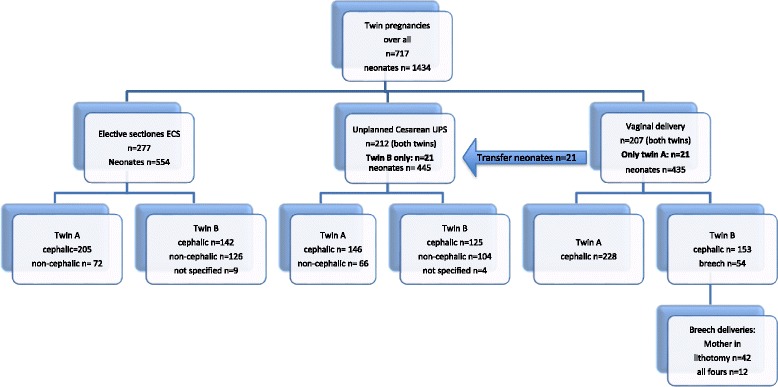
BACKGROUND: Spontaneous vaginal twin delivery after 32nd week of gestation is safe when first twin presenting cephalic. Aim of this study is to identify obstetric factors influencing the condition of second twin and to verify whether non-cephalic presentation and vaginal breech delivery of the second twin is safe. METHODS: This is a retrospective case controlled cohort study of 717 uncomplicated twin deliveries ≥32 + 0 weeks of gestation from 2005 to 2014 in two tertiary perinatal centers. Obstetric parameters were evaluated in three groups with descriptive, univariate logistic regression analysis for perinatal outcome of second twins. RESULTS: The three groups included twins delivered by elective cesarean section ECS (n = 277, 38.6%), by unplanned cesarean section UPC (n = 233, 32.5%) and vaginally (n = 207, 28.9%). Serious adverse fetal outcome is rare and we found no differences between the groups. Second twins after ECS had significant better umbilical artery UA pH (p < 0.001) and better Apgar compared to UPC (p = 0.002). Variables for a fetal population "at risk" for adverse neonatal outcome after vaginal delivery (UA pH < 7.20, Apgar 5´ < 9) were associated with higher gestational age (p = 0.001), longer twin-twin interval (p = 0.05) and vacuum extraction of twin A (p = 0.04). Non-cephalic presentation of second twins was not associated (UA pH < 7.20 OR 1.97, CI 95% 0.93-4.22, p = 0.07, Apgar 5´ < 9 OR 1.63, CI 95% 0.70-3.77, p = 0.25, Transfer to neonatal intermediate care unit p = 0.48). Twenty-one second twins (2,9%) were delivered by cesarean section following vaginal delivery of the first twin. Even though non-cephalic presentation was overrepresented in this subgroup, outcome variables were not significantly different compared to cephalic presentation. CONCLUSIONS: Even though elective cesarean means reduced stress for second twins this seems not to be clinically relevant. Non-cephalic presentation of the second twin does not significantly influence the perinatal outcome of the second twin but might be a risk factor for vaginal-cesarean birth.
Overview
The claims and statistics of this paper haven’t been checked yet.
Free: it reads the open-access text and checks the first 5 claims that cite a source we can check. Create a free account to check every claim.
Integrity signals
Registry
Cites
Statistics
Figures
Verification
Claims the paper makes
The claims and statistics of this paper haven’t been checked yet.
Free: it reads the open-access text and checks the first 5 claims that cite a source we can check. Create a free account to check every claim.
Claims other papers make about this one
Each is checked against this paper’s own text: does it say what the citing paper says it does?
The check wasn’t confident either way, so it gives no verdict — never disputed.
In the citing paper
“Compared to singleton pregnancies, twin pregnancies have a higher risk of poor outcomes, such as postpartum hemorrhage (PPH) and preterm birth, as well as obstetrical and post-partum complications [3–5].”
From Comparison of perinatal outcome and mode of birth of twin and singleton pregnancies in migrant and refugee populations on the Thai Myanmar border: A population cohort (2024) · cites this paper as [3]
Experimental — accuracy not yet measured
Self-check
Percentages, sums and reported differences re-computed from the paper’s own numbers.
The self-check needs the paper’s full text.
Citations
Cites
Hannah, M. E., Hannah, W. J., Hewson, S. A., Hodnett, E. D., Saigal, S., & Willan, A. R. (2000) · The Lancet · doi:10.1016/s0140-6736(00)02840-3 · Cited by 1,556
Safe prevention of the primary cesarean delivery
Caughey, A. B., Cahill, A. G., Guise, J.-M., & Rouse, D. J. (2014) · American Journal of Obstetrics and Gynecology · doi:10.1016/j.ajog.2014.01.026 · Cited by 1,319
Annual Summary of Vital Statistics: 2006
Martin, J. A., Kung, H.-C., Mathews, T. J., Hoyert, D. L., Strobino, D. M., Guyer, B., & Sutton, S. R. (2008) · Pediatrics · doi:10.1542/peds.2007-3753 · Cited by 759
A Randomized Trial of Planned Cesarean or Vaginal Delivery for Twin Pregnancy.
Barrett, J. F. R., Hannah, M. E., Hutton, E. K., Willan, A. R., Allen, A. C., Armson, B. A., Gafni, A., Joseph, K. S., Mason, D., Ohlsson, A., et al. (2013) · New England Journal of Medicine · doi:10.1056/nejmoa1214939 · Cited by 474
Hack, K., Derks, J., Elias, S., Franx, A., Roos, E., Voerman, S., Bode, C., Koopman‐Esseboom, C., & Visser, G. (2008) · BJOG: An International Journal of Obstetrics & Gynaecology · doi:10.1111/j.1471-0528.2007.01556.x · Cited by 415 · cited 2×
“Even in monochorionic twin deliveries, a trial of labor succeeds in 77% without increased perinatal morbidity [31, 33].”
BackgroundFive years to the term breech trial: The rise and fall of a randomized controlled trial
Glezerman, M. (2006) · American Journal of Obstetrics and Gynecology · doi:10.1016/j.ajog.2005.08.039 · Cited by 249
Hack, K. E. A., Derks, J. B., Elias, S. G., Franx, A., Roos, E. J., Voerman, S. K., Bode, C. L., Koopman-Esseboom, C., & Visser, G. H. A. (2008) · Obstetric Anesthesia Digest · doi:10.1097/01.aoa.0000326398.59896.a6 · Cited by 198
Determinants of Perinatal Mortality and Serious Neonatal Morbidity in the Second Twin
Armson, B. A., O’Connell, C., Persad, V., Joseph, K. S., Young, D. C., & Baskett, T. F. (2006) · Obstetrics & Gynecology · doi:10.1097/01.aog.0000227747.37184.0a · Cited by 186 · cited 2×
“Regarding the influence of birth interval between twin A and B, breech presentation of twin B has the potential to decrease the perinatal outcome (higher rate of vaginal-cesarean delivery but without decrease of post partum UA pH [9, 18, 35]).”
BackgroundRandomized management of the second nonvertex twin: Vaginal delivery or cesarean section
Rabinovici, J., Barkai, G., Reichman, B., Serr, D. M., & Mashiach, S. (1987) · American Journal of Obstetrics and Gynecology · doi:10.1016/0002-9378(87)90201-8 · Cited by 175 · cited 2×
“Only one small randomized trial suggests that in twins with noncephalic presentation after the thirty-fifth gestational week the neonatal outcome of the second twin is not significantly influenced by the route of delivery [10].”
BackgroundNeonatal Outcomes of Twin Pregnancy According to the Planned Mode of Delivery
Schmitz, T., Carné, C. D., Azria, É., López, E., CABROL, D., & Goffinet, F. (2008) · Obstetrics and Gynecology · doi:10.1097/aog.0b013e318163c435 · Cited by 152 · cited 1×
“avoidance of cesarean delivery for the second twin after vaginal delivery of the first twin [18, 29].”
BackgroundTrends in Cesarean Delivery for Twin Births in the United States: 1995–2008
Lee, H. C., Gould, J. B., Boscardin, W. J., El-Sayed, Y. Y., & Blumenfeld, Y. J. (2011) · Obstetrics & Gynecology · doi:10.1097/aog.0b013e3182318651 · Cited by 133
Smith, G. C. S., Pell, J. P., & Dobbie, R. (2002) · BMJ · doi:10.1136/bmj.325.7371.1004 · Cited by 133 · cited 1×
“Generally, retrospective studies show increased risk of perinatal mortality for the second twin [8, 9].”
BackgroundVlemmix, F., Bergenhenegouwen, L., Schaaf, J. M., Ensing, S., Rosman, A. N., Ravelli, A. C. J., van der Post, J., Verhoeven, A. T. M., Visser, G. H. A., Mol, B. W., et al. (2014) · Acta Obstetricia Et Gynecologica Scandinavica · doi:10.1111/aogs.12449 · Cited by 128
Effect of twin-to-twin delivery interval on umbilical cord blood gas in the second twins
Leung, T. (2002) · BJOG: An International Journal of Obstetrics and Gynaecology · doi:10.1016/s1470-0328(02)01159-x · Cited by 99
Combined vaginal-cesarean delivery of twin pregnancies
Persad, V (2001) · Obstetrics & Gynecology · doi:10.1016/s0029-7844(01)01597-6 · Cited by 89 · cited 1×
“Vaginal-cesarean delivery is associated with non-cephalic second twin and a prolonged inter-delivery interval [28].”
BackgroundFox, N. S., Silverstein, M., Bender, S. D., Klauser, C. K., Saltzman, D. H., & Rebarber, A. (2010) · Obstetrics and Gynecology · doi:10.1097/aog.0b013e3181c8b462 · Cited by 86 · cited 3×
“Regarding the influence of birth interval between twin A and B, breech presentation of twin B has the potential to decrease the perinatal outcome (higher rate of vaginal-cesarean delivery but without decrease of post partum UA pH [9, 18, 35]).”
BackgroundOptimum Timing for Planned Delivery of Uncomplicated Monochorionic and Dichorionic Twin Pregnancies
Breathnach, F., McAuliffe, F. M., Geary, M. P., Daly, S., Higgins, J. R., Dornan, J., Morrison, J. J., Burke, G., Higgins, S., Dicker, P., et al. (2011) · Obstetrics and Gynecology · doi:10.1097/aog.0b013e31823d7b06 · Cited by 85 · cited 1×
“Therefore, the optimal time of delivery in monochorionic twins is the completed 37th week of gestation, in dichorionic twins the completed 38th week of gestation [34].”
BackgroundIntrapartum Management of Twin Gestations
Cruikshank, D. P. (2007) · Obstetrics and Gynecology · doi:10.1097/01.aog.0000260387.69720.5d · Cited by 79 · cited 2×
“Data from this study indicates that combined vaginalcesarean birth is the least optimal method for 2nd twins and should be avoided if possible [25].”
BackgroundFetal presentation and successful twin vaginal delivery
Easter, S. R., Lieberman, E., & Carusi, D. A. (2015) · American Journal of Obstetrics and Gynecology · doi:10.1016/j.ajog.2015.08.017 · Cited by 55 · cited 1×
“Intrapartum change from cephalic to non-cephalic during delivery was stated in 11% [24].”
BackgroundAzria, É., Meaux, J.-P. L., Khoshnood, B., Alexander, S., Subtil, D., & Goffinet, F. (2012) · American Journal of Obstetrics and Gynecology · doi:10.1016/j.ajog.2012.08.027 · Cited by 55
Prediction of safe and successful vaginal twin birth
Breathnach, F., McAuliffe, F. M., Geary, M. P., Daly, S., Higgins, J. R., Dornan, J., Morrison, J. J., Burke, G., Higgins, S., Dicker, P., et al. (2011) · American Journal of Obstetrics and Gynecology · doi:10.1016/j.ajog.2011.05.033 · Cited by 54 · cited 2×
“Trial of labor was successful in 77–82% [12].”
BackgroundBogner, G., Strobl, M., Schausberger, C. E., Fischer, T., Reisenberger, K., & Jacobs, V. R. (2014) · Journal of Perinatal Medicine · doi:10.1515/jpm-2014-0048 · Cited by 50 · cited 3×
“Technique and process of delivery in all fours has recently been described [19].”
BackgroundResultSelf-citationHack, K. E. A., Derks, J. B., Elias, S. G., van Mameren, F., Koopman-Esseboom, C., Mol, B. W., Lopriore, E., Schaap, A. H. P., Arabin, B., Duvekot, J. J., et al. (2011) · BJOG An International Journal of Obstetrics & Gynaecology · doi:10.1111/j.1471-0528.2011.02955.x · Cited by 45 · cited 1×
“Even in monochorionic twin deliveries, a trial of labor succeeds in 77% without increased perinatal morbidity [31, 33].”
BackgroundMode of delivery in non-cephalic presenting twins: a systematic review
Bisschop, C. N. S., Vogelvang, T. E., May, A. M., & Schuitemaker, N. (2012) · Archives of Gynecology and Obstetrics · doi:10.1007/s00404-012-2294-6 · Cited by 42 · cited 1×
“They conclude - together with others [27] - that a non-cephalic presentation is not relevant when considering planning the mode of delivery.”
BackgroundVogel, J. P., Holloway, E., Cuesta, C., Carroli, G., Souza, J. P., & Barrett, J. F. R. (2014) · BMC Pregnancy and Childbirth · doi:10.1186/1471-2393-14-55 · Cited by 42 · cited 2×
“Non-cephalic presentation of the second twin at term is infrequent, with about approximately 25% of all twin pregnancies, and planned cesarean section is more common in the non-cephalic presentation [23].”
BackgroundYang, Q., Wen, S. W., Chen, Y., Krewski, D., Fung, K. F. K., & Walker, M. (2005) · American Journal of Obstetrics and Gynecology · doi:10.1016/j.ajog.2004.06.084 · Cited by 40 · cited 1×
“combined vaginal-cesarean delivery can be as high as 6– 10% [30].”
BackgroundA Randomized Trial of Planned Cesarean or Vaginal Delivery for Twin Pregnancy
Barrett, J. F. R., Hannah, M. E., Hutton, E. K., Willan, A. R., Allen, A. C., Armson, B. A., Gafni, A., Joseph, K. S., Mason, D., Ohlsson, A., et al. (2014) · Obstetric Anesthesia Digest · doi:10.1097/01.aoa.0000455608.69521.dd · Cited by 39
Risk factors for cesarean delivery in twin pregnancies attempting vaginal delivery
Fox, N. S., Gupta, S., Melka, S., Silverstein, M., Bender, S. D., Saltzman, D. H., Klauser, C. K., & Rebarber, A. (2014) · American Journal of Obstetrics and Gynecology · doi:10.1016/j.ajog.2014.07.056 · Cited by 31
Garabédian, C., Poulain, C., Duhamel, A., Subtil, D., Houfflin‐Debarge, V., & Deruelle, P. (2014) · Acta Obstetricia Et Gynecologica Scandinavica · doi:10.1111/aogs.12558 · Cited by 26 · cited 1×
“ive study did not indicate monochorionicity as an additional risk for vaginal birth [32].”
BackgroundBogner, G., Xu, F. Z., Simbrunner, C., Bacherer, A., & Reisenberger, K. (2011) · International Journal of Gynecology & Obstetrics · doi:10.1016/j.ijgo.2011.09.027 · Cited by 25 · cited 1×
“The technique is according to external cephalic version and was previously described [20].”
MethodSelf-citationRising multiple maternity rates and medical management of subfertility: Better information is needed
Blondel, B., & Macfarlane, A. (2003) · European Journal of Public Health · doi:10.1093/eurpub/13.1.83 · Cited by 21
Twin-to-Twin Delivery Time: Neonatal Outcome of the Second Twin
Schneuber, S., Magnet, E., Haas, J. G., Giuliani, A., Freidl, T., Lang, U., & Bjelic‐Radisic, V. (2011) · Twin Research and Human Genetics · doi:10.1375/twin.14.6.573 · Cited by 19 · cited 1×
“Regarding the influence of birth interval between twin A and B, breech presentation of twin B has the potential to decrease the perinatal outcome (higher rate of vaginal-cesarean delivery but without decrease of post partum UA pH [9, 18, 35]).”
BackgroundRising Cesarean Rates of Twin Deliveries in Germany from 1990 to 2012
Kyvernitakis, A., Kyvernitakis, I., Karageorgiadis, A. S., Misselwitz, B., Papaspyrou, G., Kalder, M., & Schmidt, S. (2013) · Zeitschrift für Geburtshilfe und Neonatologie · doi:10.1055/s-0033-1357137 · Cited by 19
Is Cesarean Delivery Preferable in Twin Pregnancies at >=36 Weeks Gestation?
Dong, Y., Luo, Z., Yang, Z.-J., Chen, L., Guo, Y., Branch, W. D., Zhang, J., & Huang, H. (2016) · PLoS ONE · doi:10.1371/journal.pone.0155692 · Cited by 17 · cited 1×
“Notably it favors planned cesarean at gestational week ≥36 [22].”
BackgroundTwin Birth Considering the Current Results of the “Twin Birth Study”
Seelbach‐Goebel, B. (2014) · Geburtshilfe und Frauenheilkunde · doi:10.1055/s-0034-1383064 · Cited by 13 · cited 2×
“Due to lacking prospective studies to choose the best mode of delivery on the basis of individual case characteristics, in one hand expertise in the management of vaginal twin delivery is mandatory and on the other hand patient preference has to be respected [11].”
Background
Research works printed but not linked: 1
- Cunningham FG Levino KJ Bloom SL Huath JC Dj R Spong CY Chapter 28: breech delivery and chapter 45: multifetal pregnancy Williams obstetrics 2014 24 New York McGraw-Hill 558 574
Cited by
Dunsmore, G., Koleva, P. T., Sutton, R. T., Ambrosio, L., Huang, V., & Elahi, S. (2018) · World Journal of Gastroenterology · doi:10.3748/wjg.v24.i42.4787 · Cited by 18
Dathan‐Stumpf, A., Winkel, K., & Stepan, H. (2020) · Geburtshilfe und Frauenheilkunde · doi:10.1055/a-1181-8737 · Cited by 13
Abraham, M., Ali, N., Garapati, S. S. L. S., Pandey, P., Nair, S., Swarna, S., Chowdary, D. V., Aladeniyi, F., Daing, A., & Abbas, K. (2023) · Cureus · doi:10.7759/cureus.46514 · Cited by 10
“To further drive this point home, multiple sources have found no discernible correlation between delivering non-cephalic second twins vaginally and an increased probability of neonatal morbidity [28,54].”
BackgroundPrins, T. J., Min, A. M., Gilder, M. E., Tun, N. W., Schepens, J., McGregor, K., Carrara, V. I., Wiladphaingern, J., Paw, M. K., Moo, E., et al. (2024) · PLoS ONE · doi:10.1371/journal.pone.0301222 · Cited by 8
Mei, J. Y., Munoz, H. E., Kim, J. S., Szlachta-McGinn, A. W., Blat, C., Rao, R., Han, C. S., Irani, R. A., & Afshar, Y. (2020) · American Journal of Perinatology · doi:10.1055/s-0040-1718368 · Cited by 7
Metadata
- Authors
- Bogner, G., Wallner, V., Fazelnia, C., Strobl, M., Volgger, B., Fischer, T., & Jacobs, V. R.
- Affiliations
- Paracelsus Medical University (AT)
- Klinikum Wels-Grieskirchen (AT)
- Corresponding author
- Bogner, Gerhard
- Venue
- BMC Pregnancy and Childbirth
- Published
- 2018-05-18
- Volume
- 18
- Issue
- 1
- Pages
- 176-176
- ISSN
- 1471-2393 (ISSN-L)
- PMC
- PMC5960113
- OpenAlex
- W2804384777
- Cited by
- 23
- References
- 35
- Citations by year
- 2026: 2 · 2025: 1 · 2024: 5 · 2023: 3 · 2022: 2 · 2021: 3 · 2020: 5 · 2019: 1 · 2018: 1
- FWCI
- 2.76
- Type
- journal article
- Language
- en
- Open access
- gold
- doi.org
- Licence
- cc-by
- creativecommons.org/licenses/by/4.0/ (tdm)
- Locations
- BMC Pregnancy and Childbirth (publishedVersion, cc-by)
- Europe PMC (PubMed Central) (publishedVersion, other-oa)
- PubMed Central (publishedVersion, cc-by)
- PubMed (publishedVersion)
- DOAJ (DOAJ: Directory of Open Access Journals) (submittedVersion, cc-by-sa)
- Topics
- Health Sciences › Medicine › Pediatrics, Perinatology and Child Health › Assisted Reproductive Technology and Twin Pregnancy
- Health Sciences › Medicine › Obstetrics and Gynecology › Maternal and Perinatal Health Interventions
- Health Sciences › Medicine › Obstetrics and Gynecology › Preterm Birth and Chorioamnionitis
- Keywords
- twin delivery, second twin, non-cephalic presentation, breech presentation, vaginal breech delivery, elective cesarean section, unplanned cesarean section, neonatal outcomes, umbilical artery pH, Apgar score, vacuum extraction, fetal distress, twin-twin transfusion syndrome, twin pregnancy complications, gestational age
- MeSH terms
- Adult, Cesarean Section, Female, Gestational Age, Humans, Infant, Newborn, Labor Presentation, Pregnancy, Retrospective Studies, Twins, Case-Control Studies, Delivery, Obstetric, Pregnancy, Twin
About these checks
Registry, retraction, Cites and statistics results are computed, not judged, with one exception: a printed reference that no index lists is read once by a model before it counts as a citation error. Claims are extracted by a model and kept only when their quote appears verbatim in the text; each cited source is then checked, with a model’s help, for whether it says what the claim relies on. Those verdicts can be wrong — read the claim’s quote and the cited source before relying on one.
Statistics and arithmetic are recomputed, not judged.
Confidence bands are shown only for fields calibrated on our annotated test set. None is calibrated yet, so no band is shown.
What counts as a claim ›How we measure confidence ›How we check this ›
Are you an author, or do you see a problem with this page? Request a review
Data sources
Bibliographic data: Semantic Scholar, OpenAlex, Crossref.
Contains information from the Semantic Scholar Academic Graph Datasets, made available under the ODC Attribution License (ODC-BY 1.0).
Semantic Scholar’s data is described in: Kinney, R., et al. (2023). The Semantic Scholar Open Data Platform. arXiv:2301.10140.
