

The DOI matches its Crossref record; 77 of the 77 references it cites were found in a registry or an index.
A systematic review and time-response meta-analysis of the optimal timing of elective caesarean sections for best maternal and neonatal health outcomes
Abstract
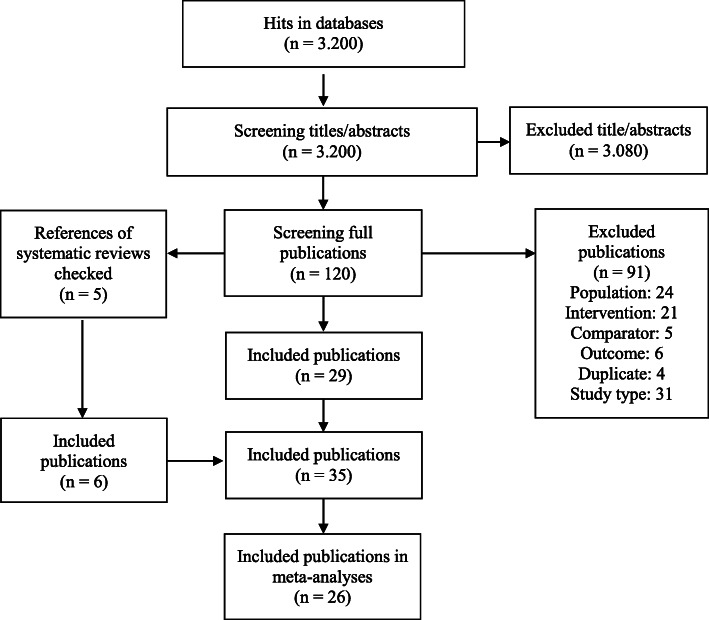
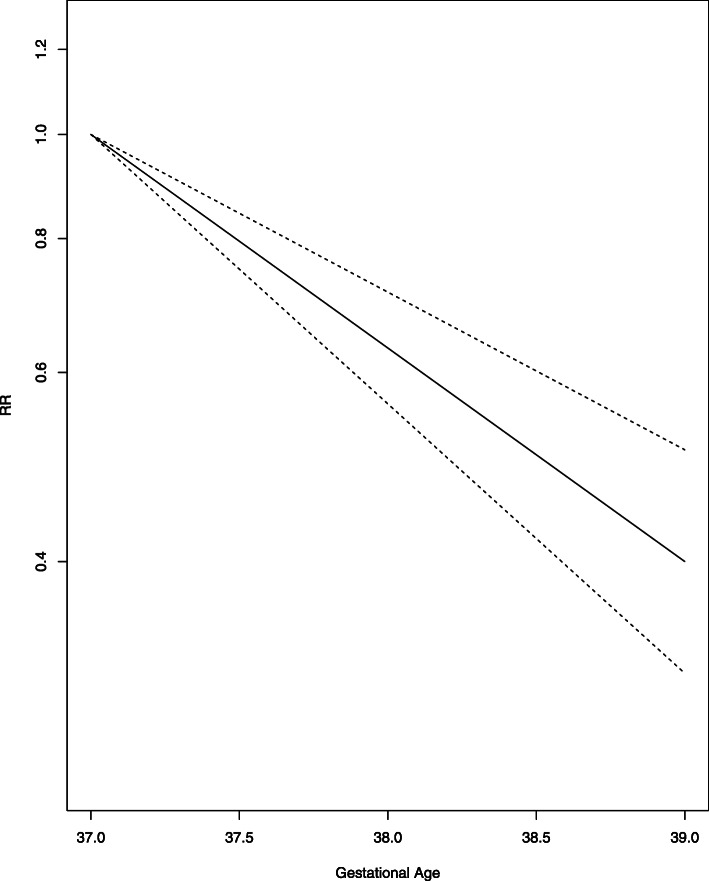
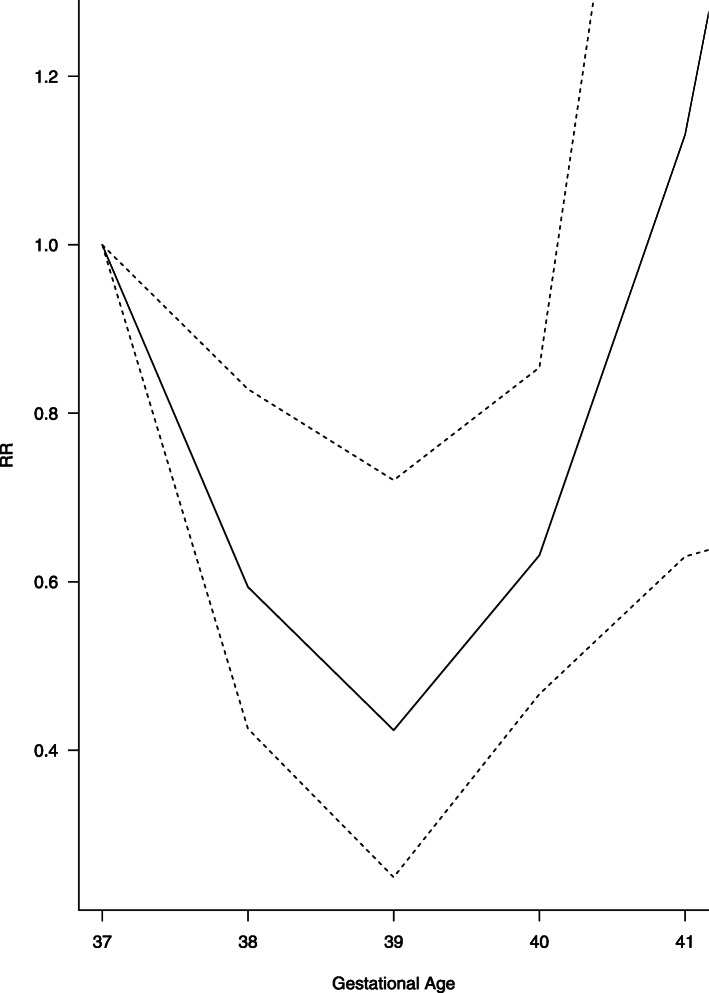
Background: The rate of caesarean sections (CS) has increased in the last decades to about 30% of births in high income countries. Many CSs are electively planned without an urgent medical reason for mother or child. An early CS though may harm the newborn. Our aim was to evaluate the gestational time point after the 37 + 0 week of gestation (WG) (after prematurity = term) of performing an elective CS with the lowest morbidity for mother and child by assessing the time course from 37 + 0 to 42+ 6 WG. Methods: We performed a systematic literature search in MEDLINE, EMBASE, CENTRAL and CINAHL in November 2018. We included studies that compared different time points of elective CS at term no matter the reason for elective CS. Our primary outcomes were the rate of admissions to the neonatal intensive care unit (NICU), neonatal death and maternal death in early versus late term elective CS. Various binary and dose response random effects meta-analyses were performed. Results: We identified 35 studies including 982,749 women. Except one randomised controlled trial, all studies were cohort studies. We performed a linear time-response meta-analysis on the primary outcome NICU admission on 14 studies resulting in a decrease of the relative risk (RR) to 0.63 (95% CI 0.56, 0.71) from 37 + 0 to 39 + 6 WG. RR for neonatal death showed a decrease to 39 + (0–6) WG (RR 0.59 95% CI 0.43 to 0.83) and increase from then on (RR 2.09 95% CI 1.18 to 3.70) assuming a U-shape course and using a cubic spline model for meta-analysis of four studies. We only identified one study analyzing maternal death resulting in RR of 0.38 (95% CI 0.04 to 3.40) for 37 + 0 + 38 + 6 WG versus ≥39 + 0 WG. Conclusion: Our systematic review showed that elective CS (primary and repeated) before the 39 + 0 WG lead to more NICU admissions and neonatal deaths, although death is rare and increases again after 39 + 6 WG. We did not find enough evidence on maternal outcomes. There is a need for more research, considering maternal outcomes to provide a balanced decision between neonatal and maternal health. Systematic review registration: Registered in PROSPERO (CRD42017078231).
Overview
The claims and statistics of this paper haven’t been checked yet.
Run the check — free, no account needed. It reads the open-access text and checks the sources it cites.
Integrity signals
Registry
Cites
Statistics
Figures
Verification
Claims the paper makes
The claims and statistics of this paper haven’t been checked yet.
Run the check — free, no account needed. It reads the open-access text and checks the sources it cites.
Claims other papers make about this one
Each is checked against this paper’s own text: does it say what the citing paper says it does?
The cited source says what the claim attributes to it.
In the citing paper
“A systematic review and time-response meta-analysis by Prediger et al. (2020) reinforced the importance of gestational age, showing that neonatal outcomes are less favorable when elective cesarean section is performed at 37 or 38 weeks compared with 39 weeks.”
From Elective cesarean section versus vaginal delivery: A comparative analysis of maternal and neonatal outcomes (2026) · cites this paper as Prediger et al., 2020
Self-check
Percentages, sums and reported differences re-computed from the paper’s own numbers.
The self-check needs the paper’s full text.
Citations
Cites
Bias in meta-analysis detected by a simple, graphical test
Egger, M., Smith, G. D., Schneider, M., & Minder, C. (1997) · BMJ · doi:10.1136/bmj.315.7109.629 · Cited by 56,722
Quantifying heterogeneity in a meta‐analysis
Higgins, J. P. T., & Thompson, S. G. (2002) · Statistics in Medicine · doi:10.1002/sim.1186 · Cited by 36,763
The Cochrane Collaboration's tool for assessing risk of bias in randomised trials
Higgins, J. P. T., Altman, D. G., Gotzsche, P. C., Juni, P., Moher, D., Oxman, A. D., Savovic, J., Schulz, K. F., Weeks, L., Sterne, J. A. C., et al. (2011) · BMJ · doi:10.1136/bmj.d5928 · Cited by 33,817
Dermyshi, E., Wang, Y., Yan, C., Hong, W., Qiu, G., Gong, X., & Zhang, T. (2017) · Neonatology · doi:10.1159/000454668 · Cited by 24,451
ROBINS-I: a tool for assessing risk of bias in non-randomised studies of interventions
Sterne, J. A., Hernán, M. A., Reeves, B. C., Savović, J., Berkman, N. D., Viswanathan, M., Henry, D., Altman, D. G., Ansari, M. T., Boutron, I., et al. (2016) · BMJ · doi:10.1136/bmj.i4919 · Cited by 20,329
Operating characteristics of a rank correlation test for publication bias
Begg, C. B., & Mazumdar, M. (1994) · Biometrics · doi:10.2307/2533446 · Cited by 16,955
How to perform a meta-analysis with R: a practical tutorial
Balduzzi, S., Rücker, G., & Schwarzer, G. (2019) · Evidence Based Mental Health · doi:10.1136/ebmental-2019-300117 · Cited by 5,827
GRADE guidelines: a new series of articles in the Journal of Clinical Epidemiology
Guyatt, G. H., Oxman, A. D., Schünemann, H. J., Tugwell, P., & Knottnerus, A. (2011) · Journal of Clinical Epidemiology · doi:10.1016/j.jclinepi.2010.09.011 · Cited by 3,094
Saving Mothers’ Lives: Reviewing maternal deaths to make motherhood safer: 2006–2008
Cantwell, R., Clutton-Brock, T. H., COOPER, G. M., Dawson, A. H., Drife, J., Garrod, D., Harper, A., Hulbert, D., Lucas, S. B., McClure, J. H., et al. (2011) · BJOG An International Journal of Obstetrics & Gynaecology · doi:10.1111/j.1471-0528.2010.02847.x · Cited by 3,067
IntHout, J., Ioannidis, J. P., & Borm, G. F. (2014) · BMC Medical Research Methodology · doi:10.1186/1471-2288-14-25 · Cited by 2,419
Research works printed but not linked: 2
- Graziosi GCM, Bakker CM, Brouwers HA, Bruinse HW. Elective caesarean section preferably after at least 38 complete weeks of pregnancy. Ned Tijdschr Geneeskd. 1998;142(42):2300–3.
- Hansen AK, Wisborg K, Uldbjerg N, Henriksen TB. Risk of respiratory morbidity in term infants delivered by elective cesarean section: cohort study. BMJ. 2008;336. · DOI · Paper page
Cited by
Fernandes, J. Z., Pizzinatto, N. L., Santos, G. L. C., Name, B. D. H., & Ruszczyk, G. B. (2026) · International Health Sciences Review · doi:10.70164/ihsr.v2i2.167
Metadata
- Authors
- Prediger, B., Mathes, T., Polus, S., Glatt, A., Bühn, S., Schiermeier, S., Neugebauer, E. A. M., & Pieper, D.
- Venue
- BMC Pregnancy and Childbirth
- Published
- 2020-07-08
- Volume
- 20
- Issue
- 1
- ISSN
- 1471-2393
- PMC
- PMC7341650
- Cited by
- 16
- References
- 77
- Language
- en
- Licence
- creativecommons.org/licenses/by/4.0 (tdm)
- creativecommons.org/licenses/by/4.0 (vor)
- Funders
- Bundesministerium für Gesundheit (GE 20160425)
About these checks
Registry, retraction, Cites and statistics results are computed, not judged, with one exception: a printed reference that no index lists is read once by a model before it counts as a citation error. Claims are extracted by a model and kept only when their quote appears verbatim in the text; each cited source is then checked, with a model’s help, for whether it says what the claim relies on. Those verdicts can be wrong — read the claim’s quote and the cited source before relying on one.
Statistics and arithmetic are recomputed, not judged.
Confidence bands are shown only for fields calibrated on our annotated test set. None is calibrated yet, so no band is shown.
What counts as a claim ›How we measure confidence ›How we check this ›
Are you an author, or do you see a problem with this page? Request a review
Data sources
Bibliographic data: Semantic Scholar, OpenAlex, Crossref.
Contains information from the Semantic Scholar Academic Graph Datasets, made available under the ODC Attribution License (ODC-BY 1.0).
Semantic Scholar’s data is described in: Kinney, R., et al. (2023). The Semantic Scholar Open Data Platform. arXiv:2301.10140.
