

Distance is “a big problem”: a geographic analysis of reported and modelled proximity to maternal health services in Ghana.
Open accessThe DOI matches its Crossref record; 40 of the 41 references it cites were found in a registry or an index.
Abstract
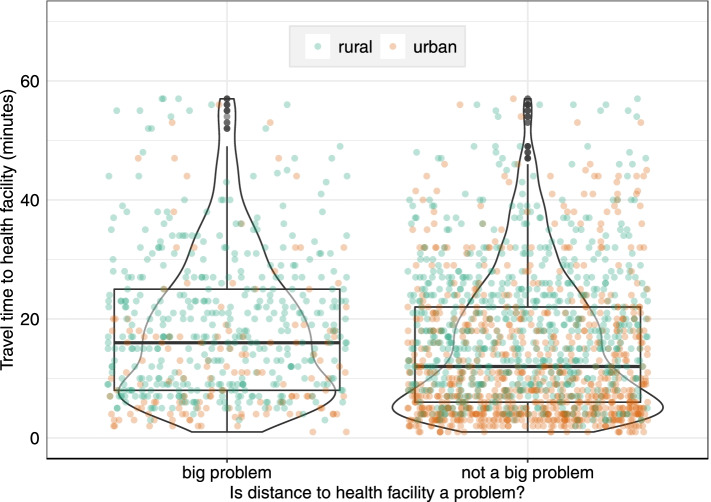
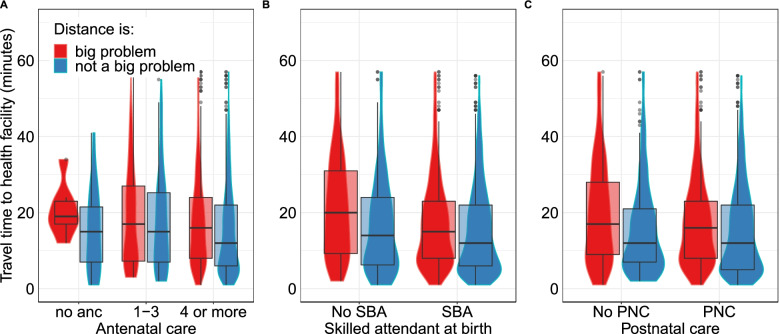
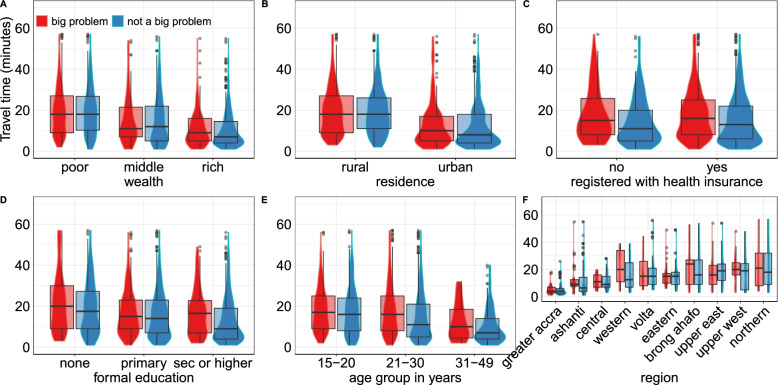
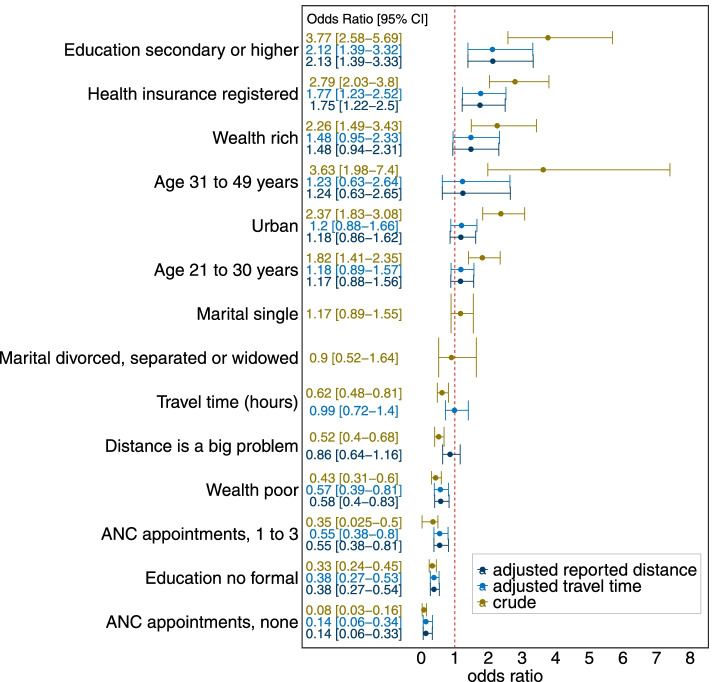
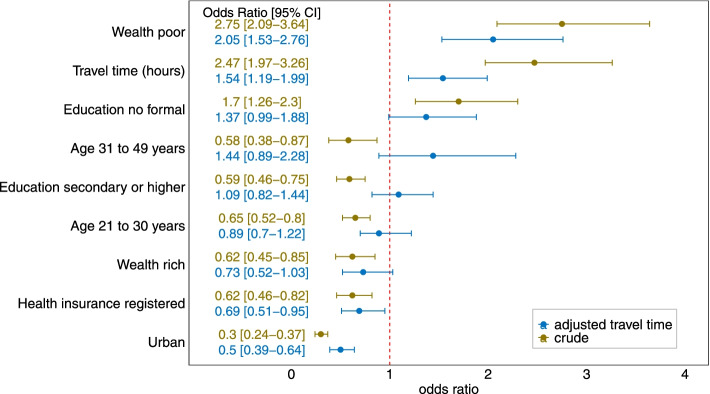
Background: Geographic barriers to healthcare are associated with adverse maternal health outcomes. Modelling travel times using georeferenced data is becoming common in quantifying physical access. Multiple Demographic and Health Surveys ask women about distance-related problems accessing healthcare, but responses have not been evaluated against modelled travel times. This cross-sectional study aims to compare reported and modelled distance by socio-demographic characteristics and evaluate their relationship with skilled birth attendance. Also, we assess the socio-demographic factors associated with self-reported distance problems in accessing healthcare. Methods: Distance problems and socio-demographic characteristics reported by 2210 women via the 2017 Ghana Maternal Health Survey were included in analysis. Geospatial methods were used to model travel time to the nearest health facility using roads, rivers, land cover, travel speeds, cluster locations and health facility locations. Logistic regressions were used to predict skilled birth attendance and self-reported distance problems. Results: Women reporting distance challenges accessing healthcare had significantly longer travel times to the nearest health facility. Poverty significantly increased the odds of reporting challenges with distance. In contrast, living in urban areas and being registered with health insurance reduced the odds of reporting distance challenges. Women with a skilled attendant at birth, four or more skilled antenatal appointments and timely skilled postnatal care had shorter travel times to the nearest health facility. Generally, less educated, poor, rural women registered with health insurance had longer travel times to their nearest health facility. After adjusting for socio-demographic characteristics, the following factors increased the odds of skilled birth attendance: wealth, health insurance, higher education, living in urban areas, and completing four or more antenatal care appointments. Conclusion: Studies relying on modelled travel times to nearest facility should recognise the differential impact of geographic access to healthcare on poor rural women. Physical access to maternal health care should be scaled up in rural areas and utilisation increased by improving livelihoods.
Overview
The claims and statistics of this paper haven’t been checked yet.
Free: it reads the open-access text and checks the first 5 claims that cite a source we can check. Create a free account to check every claim.
Integrity signals
Registry
Cites
Statistics
Figures
Verification
Claims the paper makes
The claims and statistics of this paper haven’t been checked yet.
Free: it reads the open-access text and checks the first 5 claims that cite a source we can check. Create a free account to check every claim.
Self-check
Percentages, sums and reported differences re-computed from the paper’s own numbers.
The self-check needs the paper’s full text.
Citations
Cites
Global causes of maternal death: a WHO systematic analysis
Say, L., Chou, D., Gemmill, A., Tunçalp, Ö., Moller, A.-B., Daniels, J., Gülmezoglu, A. M., Temmerman, M., & Alkema, L. (2014) · The Lancet Global Health · doi:10.1016/s2214-109x(14)70227-x · Cited by 6,582 · cited 1×
“The leading causes of maternal mortality are severe bleeding after childbirth, pregnancy-induced high blood pressure and infections after childbirth [3, 5].”
BackgroundPurposeful selection of variables in logistic regression
Bursac, Z., Gauss, C. H., Williams, D. K., & Hosmer, D. W. (2008) · Source Code for Biology and Medicine · doi:10.1186/1751-0473-3-17 · Cited by 4,035 · cited 1×
“All independent variables in the crude model associated with SBA at 10 % significance level were added to the adjusted models to allow for associations that can be insignificant in the crude model but change in the presence of other variables [36].”
MethodLevesque, J.-F., Harris, M. F., & Russell, G. (2013) · International Journal for Equity in Health · doi:10.1186/1475-9276-12-18 · Cited by 3,484
Alkema, L., Chou, D., Hogan, D., Zhang, S., Moller, A.-B., Gemmill, A., Fat, D. M., Boerma, T., Temmerman, M., Mathers, C., et al. (2016) · The Lancet · doi:10.1016/s0140-6736(15)00838-7 · Cited by 2,261 · cited 1×
“Introduction Maternal mortality has declined globally, but progress in reducing pregnancy and childbirth-related deaths in Sub Saharan Africa is slow [1].”
BackgroundGLC2000: a new approach to global land cover mapping from Earth observation data
Bartholomé, E., & Belward, A. S. (2005) · International Journal of Remote Sensing · doi:10.1080/01431160412331291297 · Cited by 1,798
Strategies for reducing maternal mortality: getting on with what works
Campbell, O. M., & Graham, W. J. (2006) · The Lancet · doi:10.1016/s0140-6736(06)69381-1 · Cited by 1,785 · cited 2×
“because it is the key determinant of maternal health outcomes [7].”
BackgroundStill too far to walk: Literature review of the determinants of delivery service use
Gabrysch, S., & Campbell, O. M. (2009) · BMC Pregnancy and Childbirth · doi:10.1186/1471-2393-9-34 · Cited by 1,255
Global Maps of Travel Time to Healthcare Facilities
Weiss, D. J., Nelson, A., Vargas-Ruiz, C. A., Gligorić, K., Bavadekar, S., Gabrilovich, E., Bertozzi-Villa, A., Rozier, J., Gibson, H. S., Shekel, T., et al. (2020) · Nature Medicine · doi:10.1038/s41591-020-1059-1 · Cited by 635
Barriers to Accessing Maternal Care in Low Income Countries in Africa: A Systematic Review.
Dahab, R., & Sakellariou, D. (2020) · International Journal of Environmental Research and Public Health · doi:10.3390/ijerph17124292 · Cited by 335 · cited 9×
“Wigley AS, Tejedor‑Garavito N, Alegana V, Carioli A, Ruktanonchai CW, Pezzulo C, et al. Measuring the availability and geographical accessibil‑ ity of maternal health services across sub‑Saharan Africa.”
BackgroundInfluentialAccess to Care: Remembering Old Lessons
McLaughlin, C. G., & Wyszewianski, L. (2002) · Health Services Research · doi:10.1111/1475-6773.12171 · Cited by 254
Atuoye, K. N., Dixon, J., Rishworth, A., Galaa, S. Z., Boamah, S. A., & Luginaah, I. (2015) · BMC Health Services Research · doi:10.1186/s12913-015-1005-y · Cited by 236
Examining the “Urban Advantage” in Maternal Health Care in Developing Countries
Matthews, Z., Channon, A., Neal, S., Osrin, D., Madise, N., & Stones, W. (2010) · PLoS Medicine · doi:10.1371/journal.pmed.1000327 · Cited by 197
Self-citationRay, N., & Ebener, S. (2008) · International Journal of Health Geographics · doi:10.1186/1476-072x-7-63 · Cited by 182
Burgert‐Brucker, C. R., Colston, J. M., Roy, T., & Zachary, B. (2013) · doi:10.13140/rg.2.1.4887.6563 · Cited by 178
Karra, M., Fink, G., & Canning, D. (2016) · International Journal of Epidemiology · doi:10.1093/ije/dyw062 · Cited by 163
Geographical access to care at birth in Ghana: a barrier to safe motherhood
Gething, P. W., Johnson, F. A., Frempong-Ainguah, F., Nyarko, P., Baschieri, A., Aboagye, P., Falkingham, J., Matthews, Z., & Atkinson, P. M. (2012) · BMC Public Health · doi:10.1186/1471-2458-12-991 · Cited by 152
Self-citationHanson, C., Cox, J., Mbaruku, G., Manzi, F., Gabrysch, S., Schellenberg, D., Tanner, M., Ronsmans, C., & Schellenberg, J. (2015) · The Lancet Global Health · doi:10.1016/s2214-109x(15)00048-0 · Cited by 135
The social determinants of health facility delivery in Ghana
Dankwah, E., Zeng, W., Feng, C. X., Kirychuk, S., & Farag, M. (2019) · Reproductive Health · doi:10.1186/s12978-019-0753-2 · Cited by 107
Wigley, A. S., Tejedor‐Garavito, N., Alegana, V. A., Carioli, A., Ruktanonchai, C. W., Pezzulo, C., Matthews, Z., Tatem, A. J., & Nilsen, K. (2020) · BMC Medicine · doi:10.1186/s12916-020-01707-6 · Cited by 96
Self-citationWomen’s Health Decision-Making Autonomy and Skilled Birth Attendance in Ghana
Ameyaw, E. K., Tanle, A., Kissah-Korsah, K., & Amo-Adjei, J. (2016) · International Journal of Reproductive Medicine · doi:10.1155/2016/6569514 · Cited by 92
Wong, K. L. M., Benova, L., & Campbell, O. M. R. (2017) · PLOS ONE · doi:10.1371/journal.pone.0184432 · Cited by 86
The influence of distance and quality of care on place of delivery in rural Ghana.
Nesbitt, R. C., Lohela, T. J., Soremekun, S., Vesel, L., Manu, A., Okyere, E., Grundy, C., Amenga-Etego, S., Owusu-Agyei, S., Kirkwood, B. R., et al. (2016) · Scientific Reports · doi:10.1038/srep30291 · Cited by 78 · cited 1×
“Women living farther from health facilities might either not use them [13] or reach the health facility late with a lifethreatening complication.”
BackgroundDotse-Gborgbortsi, W., Dwomoh, D., Alegana, V., Hill, A., Tatem, A. J., & Wright, J. (2020) · BMJ Global Health · doi:10.1136/bmjgh-2019-002020 · Cited by 78 · cited 1×
“Hence, modelling proximity to the nearest health facility can be problematic as some women might bypass the nearest facility and travel longer [52].”
BackgroundSelf-citationBanke-Thomas, A. O., Wong, K. L., Ayomoh, F. I., Giwa-Ayedun, R. O., & Beňová, L. (2021) · BMJ Global Health · doi:10.1136/bmjgh-2020-004318 · Cited by 75
Solanke, B. L., & Rahman, S. A. (2018) · BMC Pregnancy and Childbirth · doi:10.1186/s12884-018-2074-9 · Cited by 63
Hirose, A., Borchert, M., Cox, J., Alkozai, A. S., & Filippi, V. (2015) · BMC Pregnancy and Childbirth · doi:10.1186/s12884-015-0435-1 · Cited by 60
Do, M., Micah, A. E., Brondi, L., Campbell, H. J., Marchant, T., Eisele, T. P., & Munos, M. K. (2016) · Journal of Global Health · doi:10.7189/jogh.06.020501 · Cited by 57
Makacha, L., Makanga, P. T., Dube, Y. P., Bone, J. N., Munguambe, K., Katageri, G., Sharma, S., Vidler, M., Sevene, E., Ramadurg, U. Y., et al. (2020) · International Journal of Health Geographics · doi:10.1186/s12942-020-0197-5 · Cited by 52
Mapping slums using spatial features in Accra, Ghana
Engstrom, R. N., Sandborn, A., Yu, Q., Burgdorfer, J., Stow, D. A., Weeks, J. R., & Graesser, J. (2015) · Joint Urban Remote Sensing Event (JURSE) · doi:10.1109/jurse.2015.7120494 · Cited by 48
van Duinen, A. J., Adde, H. A., Fredin, O., Holmer, H., Hagander, L. E., Koroma, A. P., Koroma, M. M., Leather, A. J. M., Wibe, A., & Bolkan, H. A. (2020) · BMJ Global Health · doi:10.1136/bmjgh-2020-003943 · Cited by 45
Strategies to reduce global maternal mortality
Nyfløt, L. T., & Sitras, V. (2018) · Acta Obstetricia Et Gynecologica Scandinavica · doi:10.1111/aogs.13356 · Cited by 43
Amporfu, E., & Grépin, K. A. (2019) · International Journal for Equity in Health · doi:10.1186/s12939-019-1025-z · Cited by 38
Wariri, O., Egwu, O., Alhassan, J. A. K., Dase, E., Jalo, I., Laima, C. H., Farouk, H. U., El-Nafaty, A. U., Okomo, U. A., & Dotse‐Gborgbortsi, W. (2021) · PLoS ONE · doi:10.1371/journal.pone.0245297 · Cited by 38
Self-citationAmeyaw, E. K., Dickson, K. S., & Adde, K. S. (2021) · BMC Pregnancy and Childbirth · doi:10.1186/s12884-021-03643-6 · Cited by 38
Wright, K. J., Biney, A. A. E., Kushitor, M. K., Awoonor‐Williams, J. K., Bawah, A. A., & Phillips, J. F. (2020) · Global Health Action · doi:10.1080/16549716.2019.1705460 · Cited by 35
Moyer, C. A., McLaren, Z. M., Adanu, R. M., & Lantz, P. M. (2013) · International Journal of Gynecology & Obstetrics · doi:10.1016/j.ijgo.2013.04.005 · Cited by 30
Ganle, J. K., Mahama, M. S., Maya, E., Manu, A., Torpey, K., & Adanu, R. (2019) · The International Journal of Health Planning and Management · doi:10.1002/hpm.2731 · Cited by 29
Appiah, F., Salihu, T., Fenteng, J. O. D., Darteh, A. O., Kannor, P., Ayerakwah, P. A., & Ameyaw, E. K. (2021) · BMC Pregnancy and Childbirth · doi:10.1186/s12884-020-03497-4 · Cited by 28
Dotse‐Gborgbortsi, W., Tatem, A. J., Alegana, V. A., Utazi, C. E., Ruktanonchai, C. W., & Wright, J. (2020) · Tropical Medicine & International Health · doi:10.1111/tmi.13460 · Cited by 26
Self-citationWhitaker, J., Brunelli, G., Boeckel, T. P. V., Dube, A. L. N., Amoah, A. S., Rickard, R. F., Leather, A. J. M., & Davies, J. I. (2022) · Injury · doi:10.1016/j.injury.2022.02.010 · Cited by 22
Research works printed but not linked: 2
- WHO Trends in maternal mortality 2000 to 2017: estimates by WHO, UNICEF, UNFPA 2019 World Bank Group and the United Nations Population Division
- Black R Laxminarayan R Temmerman M Neff W Disease control priorities: reproductive, maternal, newborn, and child health 2016 Washington, DC World Bank 27227205
Cited by
Gube, A. A., Murányi, E., Vitrai, J., & Lohner, S. (2024) · Frontiers in Public Health · doi:10.3389/fpubh.2024.1415092 · Cited by 33
Wongnaah, F. G., Osborne, A., Duodu, P. A., Seidu, A., & Ahinkorah, B. O. (2025) · BMC Health Services Research · doi:10.1186/s12913-025-12226-6 · Cited by 28
Inequalities in the geographic access to delivery services in Brazil
Neto, V. P., Machado, C., Lima, F. E. D. F., Román, S., & Dutra, G. J. (2024) · BMC Health Services Research · doi:10.1186/s12913-024-12042-4 · Cited by 28
Albuquerque, P. C., Felipe, L. L., Lopes, J. F., Tassinari, W. D. S., Zicker, F., & Fonseca, B. D. P. F. E. (2024) · The Lancet Regional Health - Americas · doi:10.1016/j.lana.2024.100976 · Cited by 17
Sani, J., Halane, S. A., Ahmed, A. M., & Ahmed, M. M. (2025) · Scientific Reports · doi:10.1038/s41598-025-04704-y · Cited by 16
Metadata
- Authors
- Dotse-Gborgbortsi, W., Nilsen, K., Ofosu, A., Matthews, Z., Tejedor-Garavito, N., Wright, J., & Tatem, A. J.
- Affiliations
- University of Southampton (GB)
- Ghana Health Service (GH)
- Venue
- BMC Pregnancy and Childbirth
- Published
- 2022-08-31
- Volume
- 22
- Issue
- 1
- Pages
- 672-672
- ISSN
- 1471-2393 (ISSN-L)
- PMC
- PMC9429654
- OpenAlex
- W4293747416
- Cited by
- 73
- References
- 41
- Citations by year
- 2026: 25 · 2025: 25 · 2024: 16 · 2023: 6 · 2022: 1
- FWCI
- 13.18
- Type
- journal article
- Language
- en
- Open access
- gold
- doi.org
- Licence
- cc-by
- creativecommons.org/licenses/by/4.0 (tdm)
- creativecommons.org/licenses/by/4.0 (vor)
- Locations
- BMC Pregnancy and Childbirth (publishedVersion, cc-by)
- PubMed Central (publishedVersion, cc-by)
- PubMed (publishedVersion)
- ePrints Soton (University of Southampton) (acceptedVersion, other-oa)
- DOAJ (DOAJ: Directory of Open Access Journals) (submittedVersion, cc-by-sa)
- Funders
- Bill and Melinda Gates Foundation (INV-007594)
- Economic and Social Research Council (2123367, ES/P000673, ES/P000673/1, P000673)
- Topics
- Health Sciences › Medicine › Pediatrics, Perinatology and Child Health › Global Maternal and Child Health
- Social Sciences › Health › Public Health and Social Inequalities
- Health Sciences › Medicine › Public Health, Environmental and Occupational Health › Global Health Workforce Issues
- Keywords
- access to maternal health services, travel time to health facilities, skilled birth attendance, antenatal care utilization, rural women, poverty, health insurance, urban-rural disparities
- MeSH terms
- Cross-Sectional Studies, Female, Ghana, Health Services Accessibility, Humans, Infant, Newborn, Maternal Health Services, Pregnancy, Prenatal Care, Delivery, Obstetric
About these checks
Registry, retraction, Cites and statistics results are computed, not judged, with one exception: a printed reference that no index lists is read once by a model before it counts as a citation error. Claims are extracted by a model and kept only when their quote appears verbatim in the text; each cited source is then checked, with a model’s help, for whether it says what the claim relies on. Those verdicts can be wrong — read the claim’s quote and the cited source before relying on one.
Statistics and arithmetic are recomputed, not judged.
Confidence bands are shown only for fields calibrated on our annotated test set. None is calibrated yet, so no band is shown.
What counts as a claim ›How we measure confidence ›How we check this ›
Are you an author, or do you see a problem with this page? Request a review
Data sources
Bibliographic data: Semantic Scholar, OpenAlex, Crossref.
Contains information from the Semantic Scholar Academic Graph Datasets, made available under the ODC Attribution License (ODC-BY 1.0).
Semantic Scholar’s data is described in: Kinney, R., et al. (2023). The Semantic Scholar Open Data Platform. arXiv:2301.10140.
