

Enhancing adherence in trials promoting change in diet and physical activity in individuals with a diagnosis of colorectal adenoma; a systematic review of behavioural intervention approaches
Open accessThe DOI matches its Crossref record; 40 of the 40 references it cites were found in a registry or an index.
Abstract
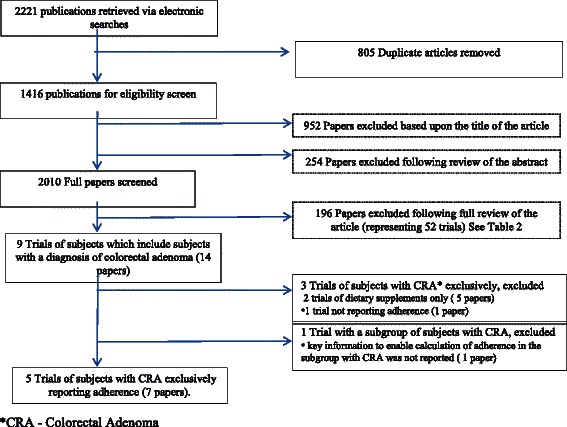
BACKGROUND: Little is known about colorectal adenoma patients' ability to adhere to behavioural interventions promoting a change in diet and physical activity. This review aimed to examine health behaviour intervention programmes promoting change in diet and/or physical activity in adenoma patients and characterise interventions to which this patient group are most likely to adhere. METHODS: Searches of eight databases were restricted to English language publications 2000-2014. Reference lists of relevant articles were also reviewed. All randomised controlled trials (RCTs) of diet and physical activity interventions in colorectal adenoma patients were included. Eligibility and quality were assessed and data were extracted by two reviewers. Data extraction comprised type, intensity, provider, mode and location of delivery of the intervention and data to enable calculation of four adherence outcomes. Data were subject to narrative analysis. RESULTS: Five RCTs with a total of 1932 participants met the inclusion criteria. Adherence to the goals of the intervention ranged from 18 to 86 % for diet and 13 to 47 % for physical activity. Diet interventions achieving ≥ 50 % adherence to the goals of the intervention were clinic based, grounded in cognitive theory, delivered one to one and encouraged social support. CONCLUSIONS: The findings of this review indicate that behavioural interventions can encourage colorectal adenoma patients to improve their diet. This review was not however able to clearly characterise effective interventions promoting increased physical activity in this patient group. Further research is required to establish effective interventions to promote adherence to physical activity in this population.
Overview
The claims and statistics of this paper haven’t been checked yet.
Free: it reads the open-access text and checks the first 5 claims that cite a source we can check. Create a free account to check every claim.
Integrity signals
Registry
Cites
Statistics
Figures
Verification
Claims the paper makes
The claims and statistics of this paper haven’t been checked yet.
Free: it reads the open-access text and checks the first 5 claims that cite a source we can check. Create a free account to check every claim.
Claims other papers make about this one
Each is checked against this paper’s own text: does it say what the citing paper says it does?
The source backs part of the claim, not all of it — or backs it for a different population, condition or comparison.
In the citing paper
“Outlining briefly each of the chronic diseases, cancer exercise programs may also need to analyze patients’ barriers and facilitators to exercise before the intervention [14,30,31,33,34] and choose good accessibility and an adequate place to deliver the intervention [11,14,30,34].”
From Key Factors Associated with Adherence to Physical Exercise in Patients with Chronic Diseases and Older Adults: An Umbrella Review (2021) · cites this paper as [33]
Experimental — accuracy not yet measured
Self-check
Percentages, sums and reported differences re-computed from the paper’s own numbers.
The self-check needs the paper’s full text.
Citations
Cites
Speck, R. M., Courneya, K. S., Mâsse, L. C., Duval, S., & Schmitz, K. H. (2010) · Journal of Cancer Survivorship · doi:10.1007/s11764-009-0110-5 · Cited by 1,352 · cited 1×
“Previous systematic reviews of exercise and diet interventions for adults have focussed on different types of cancer, types of intervention and various outcomes [10–25].”
BackgroundEffects of exercise on breast cancer patients and survivors: a systematic review and meta-analysis
McNeely, M. L. (2006) · Canadian Medical Association Journal · doi:10.1503/cmaj.051073 · Cited by 1,078 · cited 1×
“Previous systematic reviews of exercise and diet interventions for adults have focussed on different types of cancer, types of intervention and various outcomes [10–25].”
BackgroundPhysical Activity, Obesity, and Risk for Colon Cancer and Adenoma in Men
Giovannucci, E., Ascherio, A., Rimm, E. B., Colditz, G. A., Stampfer, M. J., & Willett, W. C. (1995) · Annals of Internal Medicine · doi:10.7326/0003-4819-122-5-199503010-00002 · Cited by 1,013 · cited 1×
“creased risk of colorectal cancer [39–42].”
Primary Prevention of Colorectal Cancer
Chan, A. T., & Giovannucci, E. L. (2010) · Gastroenterology · doi:10.1053/j.gastro.2010.01.057 · Cited by 723
Controlled Physical Activity Trials in Cancer Survivors: A Systematic Review and Meta-analysis
Schmitz, K. H., Holtzman, J., Courneya, K. S., Mâsse, L. C., Duval, S., & Kane, R. (2005) · Cancer Epidemiology, Biomarkers & Prevention · doi:10.1158/1055-9965.epi-04-0703 · Cited by 638 · cited 1×
“Previous systematic reviews of exercise and diet interventions for adults have focussed on different types of cancer, types of intervention and various outcomes [10–25].”
BackgroundReview of Exercise Intervention Studies in Cancer Patients
Galvão, D. A., & Newton, R. U. (2005) · Journal of Clinical Oncology · doi:10.1200/jco.2005.06.085 · Cited by 578 · cited 1×
“Previous systematic reviews of exercise and diet interventions for adults have focussed on different types of cancer, types of intervention and various outcomes [10–25].”
BackgroundKnols, R., Aaronson, N. K., Uebelhart, D., Fransen, J., & Aufdemkampe, G. (2005) · Journal of Clinical Oncology · doi:10.1200/jco.2005.02.148 · Cited by 575 · cited 1×
“Previous systematic reviews of exercise and diet interventions for adults have focussed on different types of cancer, types of intervention and various outcomes [10–25].”
BackgroundA Randomized Trial of Rofecoxib for the Chemoprevention of Colorectal Adenomas
Baron, J. A., Sandler, R. S., Bresalier, R. S., Quan, H., Riddell, R., Lanas, A., Bolognese, J. A., Oxenius, B., Horgan, K., Loftus, S., et al. (2006) · Gastroenterology · doi:10.1053/j.gastro.2006.08.079 · Cited by 433 · cited 1×
“Whilst adenoma removal reduces the risk of colorectal cancer, the underlying risk factors that influence recurrence of ademona remain and the recurrence rate for adenoma has been shown to be relatively high at around 40 % after three years [4].”
BackgroundSandhu, M. S., White, I. R., & McPherson, K. (2001) · PubMed · Cited by 432
Exercise and cancer rehabilitation: A systematic review
Spence, R. R., Heesch, K. C., & Brown, W. J. (2010) · Cancer Treatment Reviews · doi:10.1016/j.ctrv.2009.11.003 · Cited by 305 · cited 1×
“Previous systematic reviews of exercise and diet interventions for adults have focussed on different types of cancer, types of intervention and various outcomes [10–25].”
BackgroundPhysical activity, obesity, and risk of colorectal adenoma in women (United States)
Giovannucci, E., Colditz, G. A., Stampfer, M. J., & Willett, W. C. (1996) · Cancer Causes and Control · doi:10.1007/bf00051301 · Cited by 285 · cited 1×
“creased risk of colorectal cancer [39–42].”
Physical Activity and Colorectal Cancer
Slattery, M. L. (2003) · American Journal of Epidemiology · doi:10.1093/aje/kwg134 · Cited by 234
Exercise interventions for cancer patients: systematic review of controlled trials
Stevinson, C., Lawlor, D. A., & Fox, K. R. (2004) · Cancer Causes and Control · doi:10.1007/s10552-004-1325-4 · Cited by 200
Breast-cancer screening with mammography in women aged 40–49 years
Organizing Committee and Collaborators, F. M. (1996) · International Journal of Cancer · doi:10.1002/(sici)1097-0215(19961211)68:6<727::aid-ijc6>3.0.co;2-5 · Cited by 196
Physical Activity and Colorectal Cancer
Slattery, M. L. (2004) · Sports Medicine · doi:10.2165/00007256-200434040-00004 · Cited by 187
Progressive resistance training in breast cancer: a systematic review of clinical trials
Cheema, B., Gaul, C. A., Lane, K., & Fiatarone Singh, M. A. (2008) · Breast Cancer Research and Treatment · doi:10.1007/s10549-007-9638-0 · Cited by 177 · cited 1×
“Previous systematic reviews of exercise and diet interventions for adults have focussed on different types of cancer, types of intervention and various outcomes [10–25].”
BackgroundOldervoll, L. M., Kaasa, S., Hjermstad, M. J., Lund, J. Å., & Loge, J. H. (2004) · European Journal of Cancer · doi:10.1016/j.ejca.2003.12.005 · Cited by 169 · cited 1×
“Previous systematic reviews of exercise and diet interventions for adults have focussed on different types of cancer, types of intervention and various outcomes [10–25].”
BackgroundLanza, E., Schatzkin, A., Daston, C., Corle, D., Freedman, L., Ballard-Barbash, R., Caan, B., Lance, P., Marshall, J., Iber, F., et al. (2001) · The American Journal of Clinical Nutrition · doi:10.1093/ajcn/74.3.387 · Cited by 167 · cited 2×
“Two of the RCTs also failed to provide details of the required sample size and/or to comment upon whether the study was adequately powered to detect a significant difference between the two study arms [31, 32].”
BackgroundMethodSmith‐Warner, S. A., Elmer, P. J., Tharp, T. M., Fosdick, L., Randall, B. L., Gross, M. D., Wood, J., & Potter, J. D. (2000) · PubMed · Cited by 167
Enhancing adherence in clinical research
Robiner, W. N. (2005) · Contemporary Clinical Trials · doi:10.1016/j.cct.2004.11.015 · Cited by 155 · cited 1×
“Clinical trials of behavioural interventions frequently suffer from low levels of adherence with estimates suggesting that between 25 and 50 % of research participants are not adherent [26].”
BackgroundMcBride, C. M., Puleo, E., Pollak, K. I., Clipp, E. C., Woolford, S., & Emmons, K. M. (2007) · Social Science & Medicine · doi:10.1016/j.socscimed.2007.10.014 · Cited by 121
A review of the benefits of whole body exercise during and after treatment for breast cancer
Kirshbaum, M. N. (2006) · Journal of Clinical Nursing · doi:10.1111/j.1365-2702.2006.01638.x · Cited by 121 · cited 1×
“Previous systematic reviews of exercise and diet interventions for adults have focussed on different types of cancer, types of intervention and various outcomes [10–25].”
BackgroundAnderson, A. S., Craigie, A. M., Caswell, S., Treweek, S., Stead, M., Macleod, M., Daly, F., Belch, J., Rodger, J., Kirk, A., et al. (2014) · BMJ · doi:10.1136/bmj.g1823 · Cited by 119 · cited 12×
“In the BeWEL trial, 9 % with-drew (Table 5).”
MethodInfluentialEffects of Exercise on Quality of Life in Women Living with Breast Cancer: A Systematic Review
Bicego, D., Brown, K., Ruddick, M., Storey, D., Wong, C., & Harris, S. R. (2009) · The Breast Journal · doi:10.1111/j.1524-4741.2008.00670.x · Cited by 119 · cited 1×
“Previous systematic reviews of exercise and diet interventions for adults have focussed on different types of cancer, types of intervention and various outcomes [10–25].”
BackgroundMaddocks, M. M., Mockett, S. P., & Wilcock, A. (2009) · Cancer Treatment Reviews · doi:10.1016/j.ctrv.2008.11.008 · Cited by 95 · cited 1×
“Previous systematic reviews of exercise and diet interventions for adults have focussed on different types of cancer, types of intervention and various outcomes [10–25].”
BackgroundProject PREVENT: A Randomized Trial to Reduce Multiple Behavioral Risk Factors for Colon Cancer
Emmons, K. M., McBride, C. M., Puleo, E., Pollak, K. I., Clipp, E., Kuntz, K., Marcus, B. H., Napolitano, M., Onken, J., Farraye, F., et al. (2005) · Cancer Epidemiology, Biomarkers & Prevention · doi:10.1158/1055-9965.epi-04-0620 · Cited by 91 · cited 7×
“A more structured, maximum contact, patient focused, physical activity programme than that provided by the PREVENT and BHBH interventions may therefore be necessary to promote adherence in this patient group.”
MethodInfluentialColorectal Cancer Survivorship: Movement Matters
Denlinger, C. S., & Engstrom, P. F. (2011) · Cancer Prevention Research · doi:10.1158/1940-6207.capr-11-0098 · Cited by 90 · cited 1×
“ment of colorectal cancer [6–9].”
Exercise issues in older cancer survivors
Courneya, K. S., Vallance, J. K. H., McNeely, M. L., Karvinen, K. H., Peddle, C. J., & Mackey, J. R. (2004) · Critical Reviews in Oncology/Hematology · doi:10.1016/j.critrevonc.2004.05.001 · Cited by 84 · cited 1×
“Previous systematic reviews of exercise and diet interventions for adults have focussed on different types of cancer, types of intervention and various outcomes [10–25].”
BackgroundSansbury, L. B., Wanke, K. L., Albert, P. S., Kahle, L., Schatzkin, A. G., Lanza, E., & the Polyp Prevention Trial Study Group (2009) · American Journal of Epidemiology · doi:10.1093/aje/kwp169 · Cited by 79 · cited 1×
“The Minnesota Cancer Prevention Research Unit (Minnesota CPRU) [31] trial and the Polyp Prevention Trial (PP trial) [32, 36] evaluated the impact of a behavioural intervention upon diet alone and the Bowel Health for Better Health (BHBH) [34], PREVENT [33] and the BeWEL [35] trials examined the impact of a behavioural…”
MethodEffects of Exercise Intervention on Persons with Metastatic Cancer: A Systematic Review
Beaton, R., Pagdin-Friesen, W., Robertson, C., Vigar, C., Watson, H., & Harris, S. R. (2009) · Physiotherapy Canada · doi:10.3138/physio.61.3.141 · Cited by 76 · cited 1×
“Previous systematic reviews of exercise and diet interventions for adults have focussed on different types of cancer, types of intervention and various outcomes [10–25].”
BackgroundPhysical activity among cancer survivors: a literature review.
Szymlek‐Gay, E. A., Richards, R., & Egan, R. (2011) · PubMed · Cited by 69
Rajarajeswaran, P., & Vishnupriya, R. (2009) · Indian Journal of Medical and Paediatric Oncology · doi:10.4103/0971-5851.60050 · Cited by 65 · cited 1×
“Furthermore, these strategies have been shown to be effective in increasing adherence to physical activity in cancer patients and survivors [37, 38].”
BackgroundWho Will Adhere? Key Issues in the Study and Prediction of Adherence in Randomized Controlled Trials
Ginis, K. A. M., Bowen, D. J., Dunbar‐Jacob, J. M., & Perri, M. G. (2000) · Controlled Clinical Trials · doi:10.1016/s0197-2456(00)00078-7 · Cited by 64
Adherence to Pharmacological Interventions
Ellis, S. D., Shumaker, S. A., Sieber, W. J., & Rand, C. S. (2000) · Controlled Clinical Trials · doi:10.1016/s0197-2456(00)00082-9 · Cited by 52 · cited 1×
“Inadequate adherence in clinical trials contributes to significantly increased study costs, complicates statistical analysis and threatens study validity [26–28].”
BackgroundLeisure and occupational physical activity and risk of colorectal adenomatous polyps
Neugut, A. I., Terry, M. B., Hocking, G., Mosca, L. J., Garbowski, G. C., Forde, K. A., Treat, M. R., & Waye, J. D. (1996) · International Journal of Cancer · doi:10.1002/(sici)1097-0215(19961211)68:6<744::aid-ijc9>3.0.co;2-3 · Cited by 40
Halfdanarson, T. R., Thordardottir, E., West, C. P., & Jatoi, A. (2008) · PubMed · Cited by 39
Caswell, S., Anderson, A. S., & Steele, R. J. C. (2009) · British Journal of Nutrition · doi:10.1017/s0007114509990808 · Cited by 32 · cited 6×
“A more structured, maximum contact, patient focused, physical activity programme than that provided by the PREVENT and BHBH interventions may therefore be necessary to promote adherence in this patient group.”
MethodInfluentialDeficiencies in Knowledge and Familial Risk Communication Among Colorectal Adenoma Patients
Schroy, P. C., Lal, S. K., Wilson, S., Heeren, T., & Farraye, F. A. (2005) · Journal of Clinical Gastroenterology · doi:10.1097/01.mcg.0000155129.31208.0d · Cited by 27 · cited 1×
“are more amenable to behaviour change following a health event or scare [43], it is possible that improved”
BackgroundSelf-citationDaley, A., Stokes-Lampard, H. J., Thomas, A., Rees, M., Coleman, S., Roalfe, A. K., Hunter, M. S., & MacArthur, C. (2013) · Maturitas · doi:10.1016/j.maturitas.2013.08.004 · Cited by 15 · cited 1×
“This was considered in light of the fact most people in the modern Western world are sedentary and do very little physical activity–so a shift in physical activity from very little to a minimum adherence of 50 % of a physical activity intervention is not insignificant and even small changes in behaviour can be clinica…”
BackgroundSelf-citationHirose, K., & Tajima, K. (2004) · Environmental Health and Preventive Medicine · doi:10.1007/bf02898091 · Cited by 2 · cited 1×
“ment of colorectal cancer [6–9].”
Cited by
Collado-Mateo, D., Lavín-Pérez, A. M., Peñacoba, C., Del Coso, J., Leyton-Román, M., Luque-Casado, A., Gasque, P., Fernández-del-Olmo, M. Á., & Amado-Alonso, D. (2021) · International Journal of Environmental Research and Public Health · doi:10.3390/ijerph18042023 · Cited by 791
“interventions [33,61,62,70], exercise referral schemes [65,73–75], technology and multimedia effects [21,27,38,64], behavior change techniques [47,49,50,56,62], and barriers and facilitators to exercise [46,52,59,69,75].”
BackgroundUrban Nature Experiences Reduce Stress in the Context of Daily Life Based on Salivary Biomarkers
Hunter, M. R., Gillespie, B. W., & Chen, S. Y.-P. (2019) · Frontiers in Psychology · doi:10.3389/fpsyg.2019.00722 · Cited by 358
Downer, M. K., Gea, A., Stampfer, M., Sánchez-Tainta, A., Corella, D., Salas-Salvadó, J., Ros, E., Estruch, R., Fitó, M., Gómez-Gracia, E., et al. (2016) · International Journal of Behavioral Nutrition and Physical Activity · doi:10.1186/s12966-016-0394-6 · Cited by 78
Cheville, A. L., Rhudy, L. M., Basford, J. R., Griffin, J. M., & Flores, A. M. (2016) · Archives of Physical Medicine and Rehabilitation · doi:10.1016/j.apmr.2016.08.459 · Cited by 65
Hubbard, G., O’Carroll, R. E., Munro, J., Mutrie, N., Haw, S. J., Mason, H., & Treweek, S. P. (2016) · Pilot and Feasibility Studies · doi:10.1186/s40814-016-0090-y · Cited by 38
Metadata
- Authors
- McCahon, D., Daley, A. J., Jones, J., Haslop, R., Shajpal, A., Taylor, A., Wilson, S., & Dowswell, G.
- Affiliations
- University of Birmingham (GB)
- Queen Mary University of London (GB)
- Corresponding author
- McCahon, Deborah
- Venue
- BMC Cancer
- Published
- 2015-07-07
- Volume
- 15
- Issue
- 1
- Pages
- 505-505
- ISSN
- 1471-2407 (ISSN-L)
- PMC
- PMC4494153
- OpenAlex
- W1546757817
- Semantic Scholar
- 017f79c44876a8b6ff1b227707c333f8727035e1
- Cited by
- 20
- References
- 39
- Citations by year
- 2025: 1 · 2024: 4 · 2023: 1 · 2022: 2 · 2021: 2 · 2019: 2 · 2018: 1 · 2017: 1 · 2016: 6
- FWCI
- 0.37
- Type
- journal article
- Language
- en
- Open access
- gold
- doi.org
- Locations
- BMC Cancer (publishedVersion, cc-by)
- PubMed Central (publishedVersion, cc-by)
- PubMed (publishedVersion)
- University of Birmingham Research Portal (University of Birmingham) (submittedVersion, cc-by)
- Bristol Research (University of Bristol) (submittedVersion)
- Explore Bristol Research (submittedVersion)
- Funders
- National Institute for Health and Care Research
- University of Birmingham
- Research for Patient Benefit Programme
- Topics
- Social Sciences › Psychology › Applied Psychology › Behavioral Health and Interventions
- Health Sciences › Medicine › Oncology › Colorectal Cancer Screening and Detection
- Health Sciences › Medicine › Public Health, Environmental and Occupational Health › Nutritional Studies and Diet
- Keywords
- colorectal adenoma, dietary intervention, physical activity interventions, intervention adherence, behavioral interventions, cognitive theory, social support, colorectal cancer prevention
- MeSH terms
- Behavior Therapy, Clinical Trials as Topic, Diet, Female, Humans, Male, Patient Compliance, Colorectal Neoplasms, Exercise
About these checks
Registry, retraction, Cites and statistics results are computed, not judged, with one exception: a printed reference that no index lists is read once by a model before it counts as a citation error. Claims are extracted by a model and kept only when their quote appears verbatim in the text; each cited source is then checked, with a model’s help, for whether it says what the claim relies on. Those verdicts can be wrong — read the claim’s quote and the cited source before relying on one.
Statistics and arithmetic are recomputed, not judged.
Confidence bands are shown only for fields calibrated on our annotated test set. None is calibrated yet, so no band is shown.
What counts as a claim ›How we measure confidence ›How we check this ›
Are you an author, or do you see a problem with this page? Request a review
Data sources
Bibliographic data: Semantic Scholar, OpenAlex, Crossref.
Contains information from the Semantic Scholar Academic Graph Datasets, made available under the ODC Attribution License (ODC-BY 1.0).
Semantic Scholar’s data is described in: Kinney, R., et al. (2023). The Semantic Scholar Open Data Platform. arXiv:2301.10140.
