

CK1α overexpression correlates with poor survival in colorectal cancer
Open accessThe DOI matches its Crossref record; 39 of the 40 references it cites were found in a registry or an index.
Abstract
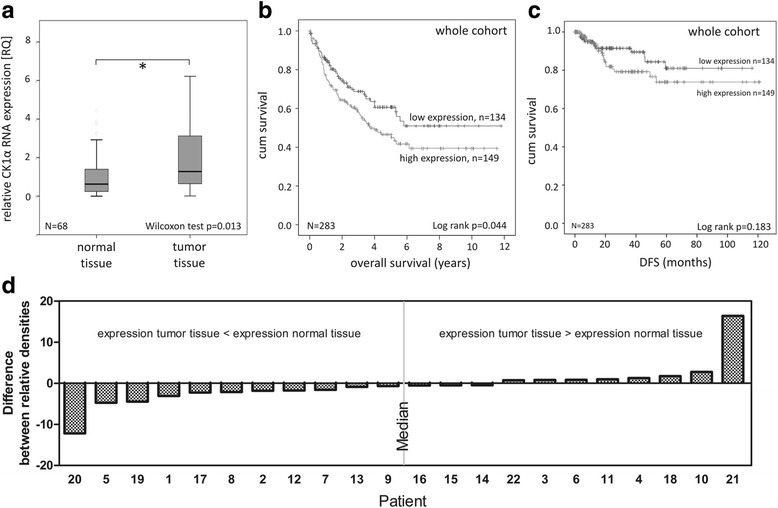
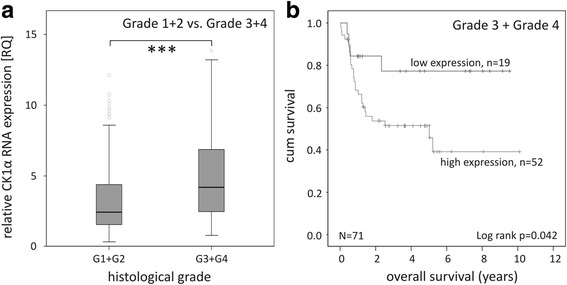
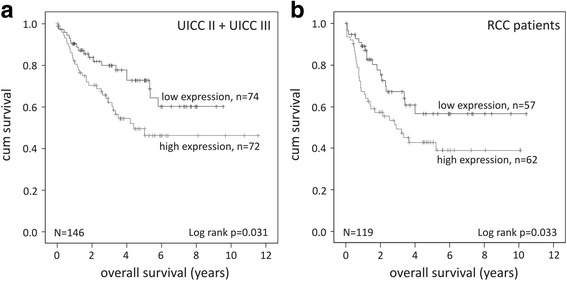
BACKGROUND: Colorectal cancer (CRC) is the fourth leading cause of cancer related deaths worldwide and prognosis in advanced tumor stage still remains poor. Since CK1 isoforms have been reported to be deregulated in several tumor entities CK1 has emerged as a novel drug target in cancer therapy. In this study we set out to investigate whether CK1α might have the potential to serve as prognostic marker. METHODS: CK1α RNA and protein expression levels in healthy and tumor tissue of CRC patients were analyzed using quantitative real-time PCR and Western Blot analysis, respectively. Prognostic relevance was investigated by correlating obtained CK1α expression levels with patients' survival rate generating Kaplan-Meier survival plots. RESULTS: It could be shown that CK1α is overexpressed in colorectal tumor tissue compared to normal tissue and CK1α overexpression in tumor tissue correlates with poor survival in CRC patients. Results become more significant when only considering patients with high-grade tumors, as well as patients assigned to UICC II and UICC III stage. Furthermore, Cox regression analysis revealed that CK1α is an independent prognostic factor. In addition, tumors expressing decreased levels of the kinase reveal positive effects on overall survival when localized in the right colon compared to those in the left side. CONCLUSION: In summary, this study provides evidence for the first time that CK1α RNA levels might serve as prognostic marker for CRC.
Overview
The claims and statistics of this paper haven’t been checked yet.
Free: it reads the open-access text and checks the first 5 claims that cite a source we can check. Create a free account to check every claim.
Integrity signals
Registry
Cites
Statistics
Figures
Verification
Claims the paper makes
The claims and statistics of this paper haven’t been checked yet.
Free: it reads the open-access text and checks the first 5 claims that cite a source we can check. Create a free account to check every claim.
Claims other papers make about this one
Each is checked against this paper’s own text: does it say what the citing paper says it does?
The source backs part of the claim, not all of it — or backs it for a different population, condition or comparison.
In the citing paper
“in addition, its involvement in supporting the survival of various solid tumors, including colorectal, kidney and lung cancers, suggests its wider therapeutic potential (Bowman et al. 2015;Mai et al. 2016;Richter et al. 2018;Nishiguchi et al. 2024).”
From From serendipity to strategy: molecular glue degraders in cancer therapeutics (2025) · cites this paper as Richter et al. 2018
Experimental — accuracy not yet measured
Self-check
Percentages, sums and reported differences re-computed from the paper’s own numbers.
The self-check needs the paper’s full text.
Citations
Cites
Cancer incidence and mortality worldwide: Sources, methods and major patterns in GLOBOCAN 2012
Ferlay, J., Soerjomataram, I., Dikshit, R., Eser, S., Mathers, C., Rebelo, M., Parkin, D. M., Forman, D., & Bray, F. (2015) · International Journal of Cancer · doi:10.1002/ijc.29210 · Cited by 28,766
A genetic model for colorectal tumorigenesis
Fearon, E. R., & Vogelstein, B. (1990) · Cell · doi:10.1016/0092-8674(90)90186-i · Cited by 12,132 · cited 2×
“According to Vogelstein’s adenoma-carcinoma sequence a stepwise pattern of mutational inactivation of tumor suppressors and activation of oncogenes initiates and proceeds to colorectal carcinogenesis [5].”
BackgroundSiegel, R., Ma, J., Zou, Z., & Jemal, A. (2014) · CA: A Cancer Journal for Clinicians · doi:10.3322/caac.21208 · Cited by 11,499
Signet-Ring Cell Carcinoma of the Colon: A Case Report and Review of the Literature
Park, P. Y., Goldin, T., Chang, J., Markman, M., & Kundranda, M. N. (2015) · Case Reports in Oncology · doi:10.1159/000441772 · Cited by 5,273
Watterson, K. R., Bestow, D., Gallagher, J., Hamilton, D. L., Ashford, F. B., Meakin, P. J., & Ashford, M. L. J. (2013) · Neurosignals · doi:10.1159/000334144 · Cited by 3,389
The selectivity of protein kinase inhibitors: a further update
Bain, J., Plater, L., Elliott, M., Shpiro, N., Hastie, C. J., Mclauchlan, H., Klevernic, I., Arthur, J. S. C., Alessi, D. R., & Cohen, P. (2007) · Biochemical Journal · doi:10.1042/bj20070797 · Cited by 2,520 · cited 1×
“Recently, D4476 has been described as a potent inhibitor of CK1α [24–26], although previously having been described as CK1δ/ε specific inhibitor [27, 28].”
BackgroundMicrosatellite Instability in Colorectal Cancer
Boland, C. R., & Goel, A. (2010) · Gastroenterology · doi:10.1053/j.gastro.2009.12.064 · Cited by 2,456
Colorectal Cancer Epidemiology: Incidence, Mortality, Survival, and Risk Factors
Haggar, F., & Boushey, R. (2009) · Clinics in Colon and Rectal Surgery · doi:10.1055/s-0029-1242458 · Cited by 2,011 · cited 1×
“In fact, CRC is the fourth leading cause of cancer related deaths resulting largely from the inefficiency of early detection and resistance to chemotherapy [2].”
BackgroundMolecular mechanisms of drug resistance
Longley, D., & Johnston, P. (2005) · The Journal of Pathology · doi:10.1002/path.1706 · Cited by 1,672 · cited 1×
“5% and the main reason for therapy failure seems to be due to acquired treatment resistance occurring in 90% of the patients [11, 12].”
BackgroundLinking Colorectal Cancer to Wnt Signaling
Bienz, M., & Clevers, H. (2000) · Cell · doi:10.1016/s0092-8674(00)00122-7 · Cited by 1,515
Research works printed but not linked: 1
- Sobin LH Gospodarowicz MK Wittekind C TNM classification of malignant tumours: John Wiley & Sons 2011
Cited by
Targeting the CK1α/CBX4 axis for metastasis in osteosarcoma
Wang, X., Qin, G., Liang, X., Wang, W., Wang, Z., Liao, D., Zhong, L., Zhang, R., Zeng, Y., Wu, Y., et al. (2020) · Nature Communications · doi:10.1038/s41467-020-14870-4 · Cited by 161
Hedgehog Signal and Genetic Disorders
Sasai, N., Toriyama, M., & Kondo, T. (2019) · Frontiers in Genetics · doi:10.3389/fgene.2019.01103 · Cited by 160
“5 unknown Elyada et al., 2011 overexpressed in colorectal cancer Richter et al., 2018 (Continued) Frontiers in G enetics | w w w .frontiersin.org N ovem ber 2019 | Volum e 10 | Article 1103 R ecent Progress on H edgehog R esearch Sasai et al. 7 TABLE 1 | Continued Phenotypes in the mouse Syndromes…”
BackgroundWnt/β-Catenin Signaling Pathway in the Development and Progression of Colorectal Cancer
He, K., & Gan, W.-J. (2023) · Cancer Management and Research · doi:10.2147/cmar.s411168 · Cited by 167
Casein kinase 1α: biological mechanisms and theranostic potential
Jiang, S., Zhang, M., Sun, J., & Yang, X. (2018) · Cell Communication and Signaling · doi:10.1186/s12964-018-0236-z · Cited by 130
The long and the short of it: the MDM4 tail so far
Haupt, S., Mejía-Hernández, J. O., Vijayakumaran, R., Keam, S. P., & Haupt, Y. (2019) · Journal of Molecular Cell Biology · doi:10.1093/jmcb/mjz007 · Cited by 68
Metadata
- Authors
- Richter, J., Kretz, A.-L., Lemke, J., Fauler, M., Werner, J.-U., Paschke, S., Leithäuser, F., Henne-Bruns, D., Hillenbrand, A., & Knippschild, U.
- Affiliations
- University Hospital Ulm (DE)
- Universität Ulm (DE)
- Corresponding author
- Knippschild, Uwe
- Venue
- BMC Cancer
- Published
- 2018-02-06
- Volume
- 18
- Issue
- 1
- Pages
- 140-140
- ISSN
- 1471-2407 (ISSN-L)
- PMC
- PMC5801892
- OpenAlex
- W2802691835
- Cited by
- 28
- References
- 40
- Citations by year
- 2025: 4 · 2024: 2 · 2023: 6 · 2022: 4 · 2021: 3 · 2020: 4 · 2019: 3 · 2018: 2
- FWCI
- 1.13
- Type
- journal article
- Language
- en
- Open access
- gold
- doi.org
- Licence
- cc-by
- Locations
- BMC Cancer (publishedVersion, cc-by)
- PubMed Central (publishedVersion, cc-by)
- PubMed (publishedVersion)
- DOAJ (DOAJ: Directory of Open Access Journals) (submittedVersion, cc-by-sa)
- Funders
- Deutsche Forschungsgemeinschaft (KN356/6-1)
- Topics
- Health Sciences › Medicine › Oncology › Colorectal Cancer Treatments and Studies
- Life Sciences › Biochemistry, Genetics and Molecular Biology › Cancer Research › Cancer Mechanisms and Therapy
- Health Sciences › Medicine › Pathology and Forensic Medicine › Genetic factors in colorectal cancer
- Keywords
- CK1α, colorectal cancer, prognostic factors, gene overexpression, overall survival, tumor stage, tumor grade, right-sided colon tumors, cancer therapy targets
- MeSH terms
- Adult, Aged, Aged, 80 and over, Female, Humans, Male, Middle Aged, Neoplasm Staging, Prognosis, Biomarkers, Tumor, Colorectal Neoplasms, Gene Expression Regulation, Enzymologic, Gene Expression Regulation, Neoplastic, Casein Kinase Ialpha, Kaplan-Meier Estimate
About these checks
Registry, retraction, Cites and statistics results are computed, not judged, with one exception: a printed reference that no index lists is read once by a model before it counts as a citation error. Claims are extracted by a model and kept only when their quote appears verbatim in the text; each cited source is then checked, with a model’s help, for whether it says what the claim relies on. Those verdicts can be wrong — read the claim’s quote and the cited source before relying on one.
Statistics and arithmetic are recomputed, not judged.
Confidence bands are shown only for fields calibrated on our annotated test set. None is calibrated yet, so no band is shown.
What counts as a claim ›How we measure confidence ›How we check this ›
Are you an author, or do you see a problem with this page? Request a review
How to cite
Cite CoChat for the checks on this page, and the paper for its own findings.
- This page
- CoChat. (2026). Citation check: CK1α overexpression correlates with poor survival in colorectal cancer. https://app.cochat.ai/papers/10.1186/s12885-018-4019-0
- The paper
- Richter, J., Kretz, A.-L., Lemke, J., Fauler, M., Werner, J.-U., Paschke, S., Leithäuser, F., Henne-Bruns, D., Hillenbrand, A., & Knippschild, U. (2018). CK1α overexpression correlates with poor survival in colorectal cancer. BMC Cancer. https://doi.org/10.1186/s12885-018-4019-0
Data sources
Bibliographic data: Semantic Scholar, OpenAlex, Crossref.
Contains information from the Semantic Scholar Academic Graph Datasets, made available under the ODC Attribution License (ODC-BY 1.0).
Semantic Scholar’s data is described in: Kinney, R., et al. (2023). The Semantic Scholar Open Data Platform. arXiv:2301.10140.
