

Association of Helicobacter pylori infection with survival outcomes in advanced gastric cancer patients treated with immune checkpoint inhibitors
Open accessThe DOI matches its Crossref record; 36 of the 37 references it cites were found in a registry or an index.
Abstract
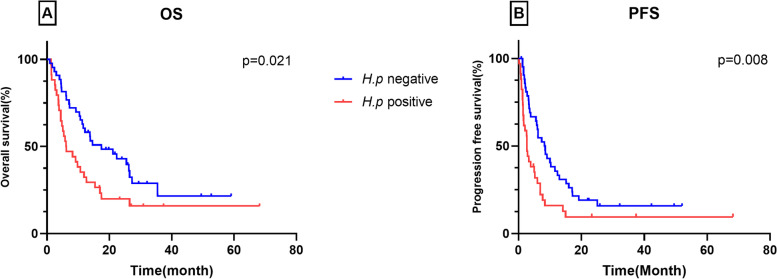
Background: Accumulating evidence has revealed that the gut microbiota influences the effectiveness of immune checkpoint inhibitors (ICIs) in cancer patients. As a part of the human microbiome, Helicobacter pylori (H. pylori) was reported to be associated with reduced effectiveness of anti-PD1 immunotherapy in patients with non-small-cell lung cancer (NSCLC). Gastric cancer is more closely related to H. pylori, so we conducted a retrospective analysis to verify whether the association of H. pylori and effectiveness is applicable to advanced gastric cancer (AGC) patients. Material and methods: AGC patients who had evidence of H. pylori and received anti-PD-1 antibodies were enrolled in the study. The differences in the disease control rate (DCR), overall survival (OS) and progression-free survival (PFS) between the H. pylori -positive group and the negative group were compared. Results: A total of 77 patients were included in this study; 34 patients were H. pylori positive, and the prevalence of H. pylori infection was 44.2%. Compared with the H. pylori -negative group, patients in the H. pylori -positive group had a higher risk of nonclinical response to anti-PD-1 antibody, with an OR of 2.91 (95% CI: 1.13–7.50). Patients in the H. pylori -negative group had a longer OS and PFS than those in the positive group, with an estimated median OS of 17.5 months vs. 6.2 months (HR = 2.85, 95% CI: 1.70–4.78; P = 0.021) and a median PFS of 8.4 months vs. 2.7 months (HR = 3.11, 95% CI: 1.96–5.07, P = 0.008). Multivariate analysis indicated that H. pylori infection was independently associated with PFS (HR = 1.90, 95% CI: 1.10–3.30; P = 0.022). Conclusion: Our study unveils for the first time that H. pylori infection is associated with the outcome of immunotherapy for AGC patients. Multicenter, large sample and prospective clinical studies are needed to verify the association.
Overview
The claims and statistics of this paper haven’t been checked yet.
Free: it reads the open-access text and checks the first 5 claims that cite a source we can check. Create a free account to check every claim.
Integrity signals
Registry
Cites
Statistics
Figures
Verification
Claims the paper makes
The claims and statistics of this paper haven’t been checked yet.
Free: it reads the open-access text and checks the first 5 claims that cite a source we can check. Create a free account to check every claim.
Claims other papers make about this one
Each is checked against this paper’s own text: does it say what the citing paper says it does?
The source backs part of the claim, not all of it — or backs it for a different population, condition or comparison.
In the citing paper
“In the context of ICIs, three retrospective studies demonstrated that the presence of circulating anti-H. pylori antibodies is associated with resistance to immunotherapy in patients with non-small cell lung cancer (NSCLC), melanoma, and gastric cancer.”
From Melanoma and microbiota: Current understanding and future directions (2024) · cites this paper as [67]
Experimental — accuracy not yet measured
Self-check
Percentages, sums and reported differences re-computed from the paper’s own numbers.
The self-check needs the paper’s full text.
Citations
Cites
Bray, F., Ferlay, J., Soerjomataram, I., Siegel, R. L., Torre, L. A., & Jemal, A. (2018) · CA: A Cancer Journal for Clinicians · doi:10.3322/caac.21492 · Cited by 84,109
Gut microbiome influences efficacy of PD-1-based immunotherapy against epithelial tumors
Routy, B., Le Chatelier, E., Derosa, L., Duong, C. P. M., Alou, M. T., Daillère, R., Fluckiger, A., Messaoudene, M., Rauber, C., Roberti, M. P., et al. (2018) · Science · doi:10.1126/science.aan3706 · Cited by 5,671
Gut microbiome modulates response to anti-PD-1 immunotherapy in melanoma patients
Gopalakrishnan, V., Spencer, C. N., Nezi, L., Reuben, A., Andrews, M. C., Karpinets, T. V., Prieto, P. A., Vicente, D., Hoffman, K., Wei, S. C., et al. (2018) · Science · doi:10.1126/science.aan4236 · Cited by 4,812
Commensal Bifidobacterium promotes antitumor immunity and facilitates anti–PD-L1 efficacy
Sivan, A., Corrales, L., Hubert, N., Williams, J. B., Aquino-Michaels, K., Earley, Z. M., Benyamin, F. W., Man Lei, Y., Jabri, B., Alegre, M.-L., et al. (2015) · Science · doi:10.1126/science.aac4255 · Cited by 3,888
Anticancer immunotherapy by CTLA-4 blockade relies on the gut microbiota
Vétizou, M., Pitt, J. M., Daillère, R., Lepage, P., Waldschmitt, N., Flament, C., Rusakiewicz, S., Routy, B., Roberti, M. P., Duong, C. P. M., et al. (2015) · Science · doi:10.1126/science.aad1329 · Cited by 3,488
The commensal microbiome is associated with anti-PD-1 efficacy in metastatic melanoma patients
Matson, V., Fessler, J., Bao, R., Chongsuwat, T., Zha, Y., Alegre, M.-L., Luke, J. J., & Gajewski, T. F. (2018) · Science · doi:10.1126/science.aao3290 · Cited by 3,107
Bagchi, S., Yuan, R., & Engleman, E. G. (2021) · Annual Review of Pathology: Mechanisms of Disease · doi:10.1146/annurev-pathol-042020-042741 · Cited by 2,189
Kim, S. T., Cristescu, R., Bass, A. J., Kim, K.-M., Odegaard, J. I., Kim, K., Liu, X. Q., Sher, X., Jung, H., Lee, M., et al. (2018) · Nature Medicine · doi:10.1038/s41591-018-0101-z · Cited by 1,654
Thrift, A. P., & El-Serag, H. B. (2020) · Clinical Gastroenterology and Hepatology · doi:10.1016/j.cgh.2019.07.045 · Cited by 1,456
Chaput, N., Lepage, P., Coutzac, C., Soularue, E., Le Roux, K., Monot, C., Boselli, L., Routier, E., Cassard, L., Collins, M., et al. (2017) · Annals of Oncology · doi:10.1093/annonc/mdx108 · Cited by 1,310
Shitara, K., Özgüroğlu, M., Bang, Y.-J., Di Bartolomeo, M., Mandalà, M., Ryu, M.-H., Fornaro, L., Olesiński, T., Caglevic, C., Chung, H. C., et al. (2018) · The Lancet · doi:10.1016/s0140-6736(18)31257-1 · Cited by 1,296
Plummer, M., Franceschi, S., Vignat, J., Forman, D., & de Martel, C. (2015) · International Journal of Cancer · doi:10.1002/ijc.28999 · Cited by 957
Derosa, L., Hellmann, M. D., Spaziano, M., Halpenny, D., Fidelle, M., Rizvi, H., Long, N., Plodkowski, A. J., Arbour, K. C., Chaft, J. E., et al. (2018) · Annals of Oncology · doi:10.1093/annonc/mdy103 · Cited by 908
Arnold, I. C., Dehzad, N., Reuter, S., Martin, H., Becher, B., Taube, C., & Müller, A. (2011) · Journal of Clinical Investigation · doi:10.1172/jci45041 · Cited by 462
The role of gut microbiota in cancer treatment: friend or foe?
Cheng, W. Y., Wu, C.-Y., & Yu, J. (2020) · Gut · doi:10.1136/gutjnl-2020-321153 · Cited by 384
Pathogenesis of Helicobacter pylori infection
Camilo, V., Sugiyama, T., & Touati, E. (2017) · Helicobacter · doi:10.1111/hel.12405 · Cited by 376
Inverse Associations of Helicobacter pylori With Asthma and Allergy
Chen, Y. (2007) · Archives of Internal Medicine · doi:10.1001/archinte.167.8.821 · Cited by 374
Helicobacter pylori and extragastric diseases: A review
Gravina, A. G., Zagari, R. M., Musis, C. D., Romano, L., Loguercio, C., & Romano, M. (2018) · World Journal of Gastroenterology · doi:10.3748/wjg.v24.i29.3204 · Cited by 328
Structure of the human gastric bacterial community in relation to Helicobacter pylori status
Maldonado-Contreras, A., Goldfarb, K. C., Godoy-Vitorino, F., Karaoz, U., Contreras, M., Blaser, M. J., Brodie, E. L., & Dominguez-Bello, M. G. (2011) · The ISME Journal · doi:10.1038/ismej.2010.149 · Cited by 301
Gut microbiome and cancer immunotherapy
Li, W., Deng, Y., Chu, Q., & Zhang, P. (2019) · Cancer Letters · doi:10.1016/j.canlet.2019.01.015 · Cited by 253
Elkrief, A., Derosa, L., Kroemer, G., Zitvogel, L., & Routy, B. (2019) · Annals of Oncology · doi:10.1093/annonc/mdz206 · Cited by 246
Roberti, M. P., Yonekura, S., Duong, C. P. M., Picard, M., Ferrere, G., Tidjani Alou, M., Rauber, C., Iebba, V., Lehmann, C. H. K., Amon, L., et al. (2020) · Nature Medicine · doi:10.1038/s41591-020-0882-8 · Cited by 208
Helicobacter pylori infection has a detrimental impact on the efficacy of cancer immunotherapies
Oster, P., Vaillant, L., Riva, E., McMillan, B., Begka, C., Truntzer, C., Richard, C., Leblond, M. M., Messaoudene, M., Machremi, E., et al. (2022) · Gut · doi:10.1136/gutjnl-2020-323392 · Cited by 176
Dellon, E. S., Peery, A. F., Shaheen, N. J., Morgan, D. R., Hurrell, J. M., Lash, R. H., & Genta, R. M. (2011) · Gastroenterology · doi:10.1053/j.gastro.2011.06.081 · Cited by 176
An Overview of Helicobacter pylori Infection
Fitzgerald, R., & Smith, S. M. (2021) · Methods in molecular biology · doi:10.1007/978-1-0716-1302-3_1 · Cited by 163
The microbiome and breast cancer: a review
Chen, J. H., Douglass, J., Prasath, V., Neace, M., Atrchian, S., Manjili, M. H., Shokouhi, S., & Habibi, M. (2019) · Breast Cancer Research and Treatment · doi:10.1007/s10549-019-05407-5 · Cited by 156
Immunotherapy of gastric cancer: Past, future perspective and challenges
Xie, J., Fu, L., & Li, J. (2020) · Pathology - Research and Practice · doi:10.1016/j.prp.2020.153322 · Cited by 92
Heimesaat, M. M., Fischer, A., Plickert, R., Wiedemann, T., Loddenkemper, C., Göbel, U. B., Bereswill, S., & Rieder, G. (2014) · PLoS ONE · doi:10.1371/journal.pone.0100362 · Cited by 91
Zhang, C., Wang, J., Sun, Z., Cao, Y., Mu, Z., & Ji, X. (2021) · Cancer Science · doi:10.1111/cas.14979 · Cited by 79
The Microbiome and Prostate Cancer Risk
Wheeler, K. M., & Liss, M. A. (2019) · Current Urology Reports · doi:10.1007/s11934-019-0922-4 · Cited by 68
The role of the bacterial microbiome in the treatment of cancer
Yu, Z., Xie, R., You, R., Liu, Y., Chen, X.-Y., Chen, M., & Huang, P.-Y. (2021) · BMC Cancer · doi:10.1186/s12885-021-08664-0 · Cited by 62
Elsalem, L., Jum’ah, A. A., Alfaqih, M. A., & Aloudat, O. (2020) · Clinical and Experimental Gastroenterology · doi:10.2147/ceg.s243337 · Cited by 39
Gastric mucosa: long-term outcome after cure ofHelicobacter pylori infection
Franceschi, F., Genta, R. M., & Sepulveda, A. R. (2002) · Journal of Gastroenterology · doi:10.1007/bf02990094 · Cited by 36
Association Between Helicobacter pylori Colonization and Inflammatory Bowel Disease
Shirzad‐Aski, H., Besharat, S., Kienesberger, S., Sohrabi, A., Roshandel, G., Amiriani, T., Norouzi, A., & Keshtkar, A. (2020) · Journal of Clinical Gastroenterology · doi:10.1097/mcg.0000000000001415 · Cited by 35
Park, R., Umar, S., & Kasi, A. (2020) · Current Colorectal Cancer Reports · doi:10.1007/s11888-020-00456-1 · Cited by 28
Existe-t-il des manifestations extradigestives de l’infection à Helicobacter pylori ?
de Korwin, J.-D. (2008) · La Presse Médicale · doi:10.1016/j.lpm.2007.07.029 · Cited by 24
Cited by
Helicobacter pylori and gastric cancer: mechanisms and new perspectives
Duan, Y., Xu, Y., Dou, Y., & Xu, D. (2025) · Journal of Hematology & Oncology · doi:10.1186/s13045-024-01654-2 · Cited by 300
Intratumoural microbiota: a new frontier in cancer development and therapy
Cao, Y., Xia, H., Tan, X., Shi, C., Ma, Y., Meng, D., Zhou, M., Lv, Z., Wang, S., & Jin, Y. (2024) · Signal Transduction and Targeted Therapy · doi:10.1038/s41392-023-01693-0 · Cited by 253
“Certain medications have been used clinically to eradicate microorganisms to prevent cancer as much as possible and to assist in the treatment of cancer; these include the use of quadruple antibiotics to prevent and treat H. pylori -derived GC, 280 – 282 direct antiviral drugs (DAAs) against HCV, 283,284 as well as va…”
BackgroundInfluentialGut microbiota shapes cancer immunotherapy responses
Lei, W., Zhou, K., Lei, Y., Li, Q., & Zhu, H. (2025) · npj Biofilms and Microbiomes · doi:10.1038/s41522-025-00786-8 · Cited by 195
Li, Y., Xing, S., Chen, F., Li, Q., Dou, S., Huang, Y., An, J., Liu, W., & Zhang, G. (2023) · Nature Communications · doi:10.1038/s41467-023-40987-3 · Cited by 122
“Similarly, a recent study demonstrated that Hp could decrease the effectiveness of anti-PD-1 immunotherapies in NSCLC and gastric cancer 35,37 .”
Melanoma and microbiota: Current understanding and future directions
Routy, B., Jackson, T., Mählmann, L., Baumgartner, C. K., Blaser, M., Byrd, A., Corvaia, N., Couts, K., Davar, D., Derosa, L., et al. (2024) · Cancer Cell · doi:10.1016/j.ccell.2023.12.003 · Cited by 89
Metadata
- Authors
- Che, H., Xiong, Q., Ma, J., Chen, S., Wu, H., Xu, H., & Hou, B.
- Affiliations
- Chinese PLA General Hospital (CN)
- The Affiliated Yongchuan Hospital of Chongqing Medical University (CN)
- Corresponding author
- Xu, Hongli
- Hou, Baicun
- Venue
- BMC Cancer
- Published
- 2022-08-19
- Volume
- 22
- Issue
- 1
- Pages
- 904-904
- ISSN
- 1471-2407 (ISSN-L)
- PMC
- PMC9389789
- OpenAlex
- W4292332522
- Cited by
- 74
- References
- 37
- Citations by year
- 2026: 14 · 2025: 20 · 2024: 19 · 2023: 15 · 2022: 5
- FWCI
- 14.10
- Type
- journal article
- Language
- en
- Open access
- gold
- doi.org
- Licence
- cc-by
- creativecommons.org/licenses/by/4.0 (tdm)
- creativecommons.org/licenses/by/4.0 (vor)
- Locations
- BMC Cancer (publishedVersion, cc-by)
- Research Square (acceptedVersion, cc-by)
- PubMed Central (publishedVersion, cc-by)
- PubMed (publishedVersion)
- DOAJ (DOAJ: Directory of Open Access Journals) (submittedVersion, cc-by-sa)
- Funders
- General Hospital of People’s Liberation Army
- Topics
- Health Sciences › Medicine › Gastroenterology › Helicobacter pylori-related gastroenterology studies
- Health Sciences › Medicine › Oncology › Cancer Immunotherapy and Biomarkers
- Health Sciences › Medicine › Oncology › Gastric Cancer Management and Outcomes
- Keywords
- Helicobacter pylori infection, advanced gastric cancer, immune checkpoint inhibitors, anti-PD-1 therapy, gut microbiota, immunotherapy response, overall survival, progression-free survival, disease control rate
- MeSH terms
- Immune Checkpoint Inhibitors, Carcinoma, Non-Small-Cell Lung, Humans, Lung Neoplasms, Prospective Studies, Retrospective Studies, Stomach Neoplasms, Helicobacter pylori, Helicobacter Infections
About these checks
Registry, retraction, Cites and statistics results are computed, not judged, with one exception: a printed reference that no index lists is read once by a model before it counts as a citation error. Claims are extracted by a model and kept only when their quote appears verbatim in the text; each cited source is then checked, with a model’s help, for whether it says what the claim relies on. Those verdicts can be wrong — read the claim’s quote and the cited source before relying on one.
Statistics and arithmetic are recomputed, not judged.
Confidence bands are shown only for fields calibrated on our annotated test set. None is calibrated yet, so no band is shown.
What counts as a claim ›How we measure confidence ›How we check this ›
Are you an author, or do you see a problem with this page? Request a review
Data sources
Bibliographic data: Semantic Scholar, OpenAlex, Crossref.
Contains information from the Semantic Scholar Academic Graph Datasets, made available under the ODC Attribution License (ODC-BY 1.0).
Semantic Scholar’s data is described in: Kinney, R., et al. (2023). The Semantic Scholar Open Data Platform. arXiv:2301.10140.
