

Efficacy and safety of interventions to control myopia progression in children: an overview of systematic reviews and meta-analyses
Open accessThe DOI matches its Crossref record; 60 of the 60 references it cites were found in a registry or an index.
Abstract
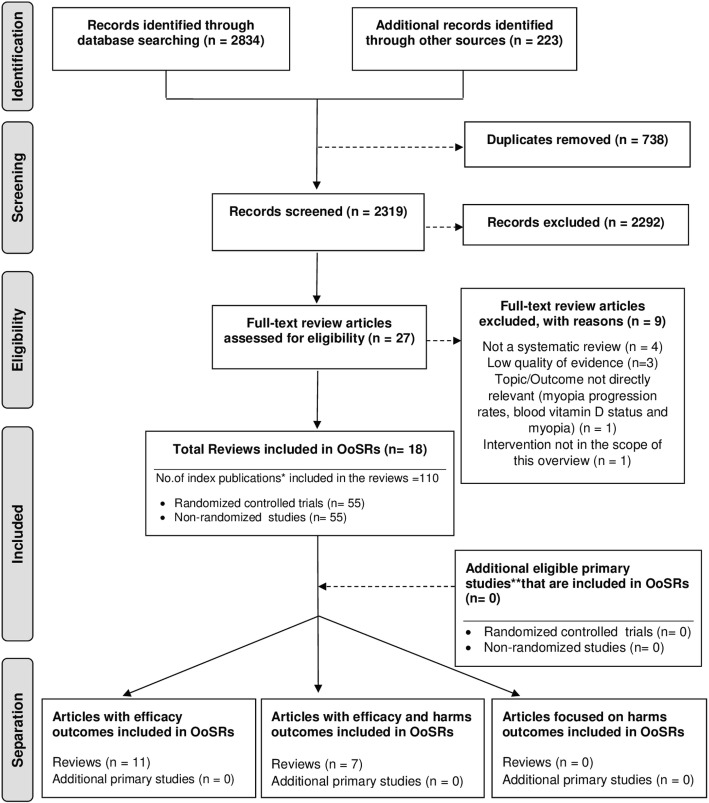
BACKGROUND: Myopia is a common visual disorder with increasing prevalence. Halting progression of myopia is critical, as high myopia can be complicated by a number of vision-compromising conditions. METHODS: Literature search was conducted in the following databases: Medical Literature Analysis and Retrieval System Online (MEDLINE), Excerpta Medica dataBASE (EMBASE), Cochrane Database of Systematic Reviews (CDSR), Database of Abstracts of Reviews of Effects (DARE) and Centre for Reviews and Dissemination (CRD) Health Technology Assessment (HTA) database. Systematic reviews and meta-analyses investigating the efficacy and safety of multiple myopia interventions vs control conditions, were considered. Methodological quality and quality of evidence of eligible studies were assessed using the ROBIS tool and GRADE rating. The degree of overlapping of index publications in the eligible reviews was calculated with the corrected covered area (CCA). RESULTS: Forty-four unique primary studies contained in 18 eligible reviews and involving 6400 children were included in the analysis. CCA was estimated as 6.2% and thus considered moderate. Results demonstrated the superior efficacy of atropine eyedrops; 1% atropine vs placebo (change in refraction: -0.78D, [- 1.30 to - 0.25] in 1 year), 0.025 to 0.05% atropine vs control (change in refraction: -0.51D, [- 0.60 to - 0.41] in 1 year), 0.01% atropine vs control (change in refraction: -0.50D, [- 0.76 to - 0.24] in 1 year). Atropine was followed by orthokeratology (axial elongation: - 0.19 mm, [- 0.21 to - 0.16] in 1 year) and novel multifocal soft contact lenses (change in refraction: -0.15D, [- 0.27 to - 0.03] in 1 year). As regards adverse events, 1% atropine induced blurred near vision (odds ratio [OR] 9.47, [1.17 to 76.78]) and hypersensitivity reactions (OR 8.91, [1.04 to 76.03]). CONCLUSIONS: Existing evidence has failed to convince doctors to uniformly embrace treatments for myopic progression control, possibly due to existence of some heterogeneity, reporting of side effects and lack of long-term follow-up. Research geared towards efficient interventions is still necessary.
Overview
The claims and statistics of this paper haven’t been checked yet.
Free: it reads the open-access text and checks the first 5 claims that cite a source we can check. Create a free account to check every claim.
Integrity signals
Registry
Cites
Statistics
Figures
Verification
Claims the paper makes
The claims and statistics of this paper haven’t been checked yet.
Free: it reads the open-access text and checks the first 5 claims that cite a source we can check. Create a free account to check every claim.
Claims other papers make about this one
Each is checked against this paper’s own text: does it say what the citing paper says it does?
In the citing paper
“Since overlap was estimated at below 10%, all included reviews were retained in the analysis.”
From Managing overlap of primary study results across systematic reviews: practical considerations for authors of overviews of reviews (2021) · cites this paper as [24]
In the citing paper
“This overview identified 18 systematic reviews that synthesized the efficacy of a variety of interventions for myopia from 44 unique primary studies (1989–2016).”
From Managing overlap of primary study results across systematic reviews: practical considerations for authors of overviews of reviews (2021) · cites this paper as [24]
In the citing paper
“Overlap was considered moderate in this overview and was estimated at 6.2% using the CCA method.”
From Managing overlap of primary study results across systematic reviews: practical considerations for authors of overviews of reviews (2021) · cites this paper as [24]
Self-check
Percentages, sums and reported differences re-computed from the paper’s own numbers.
The self-check needs the paper’s full text.
Citations
Cites
Cochrane Handbook for Systematic Reviews of Interventions: Cochrane Book Series
(2008) · doi:10.1002/9780470712184 · Cited by 25,048
GRADE guidelines: 3. Rating the quality of evidence
Balshem, H., Helfand, M., Schünemann, H. J., Oxman, A. D., Kunz, R., Brozek, J., Vist, G. E., Falck-Ytter, Y., Meerpohl, J., & Norris, S. (2011) · Journal of Clinical Epidemiology · doi:10.1016/j.jclinepi.2010.07.015 · Cited by 8,285
What is ‘quality of evidence’ and why is it important to clinicians?
Guyatt, G. H., Oxman, A. D., Kunz, R., Vist, G. E., Falck-Ytter, Y., & Schünemann, H. J. (2008) · BMJ · doi:10.1136/bmj.39490.551019.be · Cited by 3,250 · cited 1×
“The quality of evidence was evaluated by two independent authors (EP, AF) using four domains of the Grading of Recommendations Assessment, Development, and Evaluation (GRADE) tool: study limitations, imprecision, inconsistency of results, and indirectness and a summary of findings for each outcome of interest was desi…”
MethodROBIS: A new tool to assess risk of bias in systematic reviews was developed
Whiting, P., Savović, J., Higgins, J. P. T., Caldwell, D. M., Reeves, B. C., Shea, B., Davies, P., Kleijnen, J., & Churchill, R. (2016) · Journal of Clinical Epidemiology · doi:10.1016/j.jclinepi.2015.06.005 · Cited by 2,272
Systematic review finds overlapping reviews were not mentioned in every other overview
Pieper, D., Antoine, S.-L., Mathes, T., Neugebauer, E. A. M., & Eikermann, M. (2014) · Journal of Clinical Epidemiology · doi:10.1016/j.jclinepi.2013.11.007 · Cited by 1,318
Publication bias in meta-analysis its causes and consequences
Thornton, A. (2000) · Journal of Clinical Epidemiology · doi:10.1016/s0895-4356(99)00161-4 · Cited by 1,291
Efficacy Comparison of 16 Interventions for Myopia Control in Children
Huang, J., Wen, D., Wang, Q., McAlinden, C., Flitcroft, I., Chen, H., Saw, S. M., Chen, H., Bao, F., Zhao, Y., et al. (2016) · Ophthalmology · doi:10.1016/j.ophtha.2015.11.010 · Cited by 752
Low-Concentration Atropine for Myopia Progression (LAMP) Study
Yam, J. C., Jiang, Y., Tang, S. M., Law, A. K. P., Chan, J. J., Wong, E., Ko, S. T., Young, A. L., Tham, C. C., Chen, L. J., et al. (2019) · Ophthalmology · doi:10.1016/j.ophtha.2018.05.029 · Cited by 724
Five-Year Clinical Trial on Atropine for the Treatment of Myopia 2
Chia, A., Lu, Q.-S., & Tan, D. (2016) · Ophthalmology · doi:10.1016/j.ophtha.2015.07.004 · Cited by 649
Xiong, S., Sankaridurg, P., Naduvilath, T., Zang, J., Zou, H., Zhu, J., Lv, M., He, X., & Xu, X. (2017) · Acta Ophthalmologica · doi:10.1111/aos.13403 · Cited by 617
Myopia Prevention and Outdoor Light Intensity in a School-Based Cluster Randomized Trial
Wu, P.-C., Chen, C.-T., Lin, K.-K., Sun, C.-C., Kuo, C.-N., Huang, H.-M., Poon, Y.-C., Yang, M.-L., Chen, C.-Y., Huang, J.-C., et al. (2018) · Ophthalmology · doi:10.1016/j.ophtha.2017.12.011 · Cited by 574
The Association between Time Spent Outdoors and Myopia in Children and Adolescents
Sherwin, J. C., Reacher, M. H., Keogh, R. H., Khawaja, A. P., Mackey, D. A., & Foster, P. J. (2012) · Ophthalmology · doi:10.1016/j.ophtha.2012.04.020 · Cited by 469
The role of optical defocus in regulating refractive development in infant monkeys
Smith III, E. L., & Hung, L.-F. (1999) · Vision Research · doi:10.1016/s0042-6989(98)00229-6 · Cited by 403
Lam, C. S. Y., Tang, W. C., Tse, D. Y.-Y., Tang, Y. Y., & To, C. H. (2014) · British Journal of Ophthalmology · doi:10.1136/bjophthalmol-2013-303914 · Cited by 368
Interventions to slow progression of myopia in children
Walline, J. J., Lindsley, K., Vedula, S. S., Cotter, S. A., Mutti, D. O., & Twelker, J. D. (2011) · Cochrane Database of Systematic Reviews · doi:10.1002/14651858.cd004916.pub3 · Cited by 362
Wu, P.-C., Huang, H.-M., Yu, H.-J., Fang, P.-C., & Chen, C.-T. (2016) · Asia-Pacific Journal of Ophthalmology · doi:10.1097/apo.0000000000000236 · Cited by 357
Undercorrection of myopia enhances rather than inhibits myopia progression
Chung, K., Mohidin, N., & O’Leary, D. J. (2002) · Vision Research · doi:10.1016/s0042-6989(02)00258-4 · Cited by 292
Efficacy and Adverse Effects of Atropine in Childhood Myopia: A Meta-analysis
Gong, Q., Janowski, M., Luo, M., Wei, H., Chen, B., Yang, G., & Liu, L. (2017) · JAMA Ophthalmology · doi:10.1001/jamaophthalmol.2017.1091 · Cited by 288
Myopia Control during Orthokeratology Lens Wear in Children Using a Novel Study Design
Swarbrick, H. A., Alharbi, A., Watt, K., Lum, E., & Kang, P. (2015) · Ophthalmology · doi:10.1016/j.ophtha.2014.09.028 · Cited by 260
Bougioukas, K. I., Liakos, A., Tsapas, A., Ntzani, E., & Haidich, A.-B. (2018) · Journal of Clinical Epidemiology · doi:10.1016/j.jclinepi.2017.10.002 · Cited by 251
Self-citationUpdate in myopia and treatment strategy of atropine use in myopia control
Wu, P.-C., Chuang, M.-N., Choi, J., Chen, H., Wu, G., Ohno-Matsui, K., Jonas, J. B., & Cheung, C. M. G. (2019) · Eye · doi:10.1038/s41433-018-0139-7 · Cited by 239
TAN, D., LAM, D., CHUA, W., SHUPING, D., & CROCKETT, R. (2005) · Ophthalmology · doi:10.1016/j.ophtha.2004.06.038 · Cited by 224
Shih, Y., Hsiao, C. K., Chen, C., Chang, C., Hung, P. T., & Lin, L. L. ‐. (2001) · Acta Ophthalmologica Scandinavica · doi:10.1034/j.1600-0420.2001.790304.x · Cited by 221
Developing eyes that lack accommodation grow to compensate for imposed defocus
Schaeffel, F., Troilo, D., Wallman, J., & Howland, H. C. (1990) · Visual Neuroscience · doi:10.1017/s0952523800002327 · Cited by 212
The Safety of Orthokeratology—A Systematic Review
Liu, Y. M., & Xie, P. (2016) · Eye & Contact Lens: Science & Clinical Practice · doi:10.1097/icl.0000000000000219 · Cited by 211
The possible effect of undercorrection on myopic progression in children
Adler, D., & Millodot, M. (2006) · Clinical and Experimental Optometry · doi:10.1111/j.1444-0938.2006.00055.x · Cited by 193
Siatkowski, R. M., Cotter, S. A., Crockett, R. S., Miller, J. M., Novack, G. D., & Zadnik, K. (2008) · Journal of American Association for Pediatric Ophthalmology and Strabismus · doi:10.1016/j.jaapos.2007.10.014 · Cited by 183
Orthokeratology for Myopia Control: A Meta-analysis
Si, J.-K., Tang, K., Bi, H.-S., Guo, D.-D., Guo, J.-G., & Wang, X.-R. (2015) · Optometry and Vision Science · doi:10.1097/opx.0000000000000505 · Cited by 179
Orthokeratology to Control Myopia Progression: A Meta-Analysis
Sun, Y., Xu, F., Zhang, T., Liu, M., Wang, D., Chen, Y., & Liu, Q. (2015) · PLOS ONE · doi:10.1371/journal.pone.0124535 · Cited by 176
Li, S., Kang, M., Wu, S., Liu, L.-R., Li, H., Chen, Z., & Wang, N. (2015) · Current Eye Research · doi:10.3109/02713683.2015.1050743 · Cited by 173
The Economic Cost of Myopia in Adults Aged Over 40 Years in Singapore
Zheng, Y., Pan, C., Chay, J., Wong, T. Y., Finkelstein, E. A., & Saw, S. (2013) · Investigative Ophthalmology & Visual Science · doi:10.1167/iovs.13-12795 · Cited by 171
Li, S., Kang, M., Wu, S., Meng, B., Sun, Y., Wei, S., Liu, L.-R., Peng, X., Chen, Z., Zhang, F., et al. (2016) · Ophthalmic and Physiological Optics · doi:10.1111/opo.12332 · Cited by 164
Ballard, M., & Montgomery, P. (2017) · Research Synthesis Methods · doi:10.1002/jrsm.1229 · Cited by 136
Randomized Trial of the Effect of Contact Lens Wear on Self‐Perception in Children
Walline, J. J., Jones, L. A., Sinnott, L. T., Chitkara, M., Coffey, B., Jackson, J. M., Manny, R. E., Rah, M., Prinstein, M. J., & the ACHIEVE Study Group (2009) · Optometry and Vision Science · doi:10.1097/opx.0b013e3181971985 · Cited by 116
Jensen, H. (1991) · PubMed · Cited by 113
Atropine Slows Myopia Progression More in Asian than White Children by Meta‐analysis
Li, S., Wu, S., Kang, M., Liu, Y., Shu-mei, J., Li, S., Zhan, S., Liu, L.-R., Li, H., Chen, W., et al. (2014) · Optometry and Vision Science · doi:10.1097/opx.0000000000000178 · Cited by 109
Boluyt, N., Tjosvold, L., Lefebvre, C., Klassen, T. P., & Offringa, M. (2008) · Archives of Pediatrics & Adolescent Medicine · doi:10.1001/archpediatrics.2007.40 · Cited by 108
Interventions to retard myopia progression in children
Saw, S., Shih‐Yen, E. C., Koh, A., & Tan, D. T.-H. (2002) · Ophthalmology · doi:10.1016/s0161-6420(01)00972-1 · Cited by 107
Discontinuation of orthokeratology on eyeball elongation (DOEE)
Cho, P., & Cheung, S. W. (2016) · Contact Lens and Anterior Eye · doi:10.1016/j.clae.2016.12.002 · Cited by 104
Infectious keratitis and orthokeratology lens use: a systematic review
Kam, K. W., Yung, W., Li, G. K. H., Chen, L. J., & Young, A. L. (2017) · Infection · doi:10.1007/s15010-017-1023-2 · Cited by 101
Methodology for jbi umbrella reviews
Aromataris, E., Fernandez, R. S., Godfrey, C. M., Holly, C. M., Khalil, H., & Tungpunkom, P. (2014) · Research Online (University of Wollongong) · Cited by 95
Wen, D., Huang, J., Chen, H., Bao, F., Savini, G., Calossi, A., Chen, H., Li, X.-X., & Wang, Q. (2015) · Journal of Ophthalmology · doi:10.1155/2015/360806 · Cited by 85
Effect of uncorrection versus full correction on myopia progression in 12-year-old children
Sun, Y., Li, S., Li, S., Kang, M., Liu, L.-R., Meng, B., Fj, Z., Millodot, M., & Wang, N. (2016) · Graefe s Archive for Clinical and Experimental Ophthalmology · doi:10.1007/s00417-016-3529-1 · Cited by 83
Song, Y., Wang, H., Wang, B.-S., Qi, H. Y., Rong, Z., & Chen, H. (2011) · Journal of Ocular Pharmacology and Therapeutics · doi:10.1089/jop.2011.0017 · Cited by 79
Li, X., Friedman, I. B., Medow, N. B., & Zhang, C. (2017) · Journal of Pediatric Ophthalmology & Strabismus · doi:10.3928/01913913-20170106-01 · Cited by 66
Li, S., Ji, Y., Wu, S., Zhan, S.-Y., Wang, B., Liu, L.-R., Li, S., Wang, N., & Wang, J. J. (2011) · Survey of Ophthalmology · doi:10.1016/j.survophthal.2011.06.002 · Cited by 63
Vasudevan, B., Esposito, C., Peterson, C., Coronado, C., & Ciuffreda, K. (2014) · Journal of Optometry · doi:10.1016/j.optom.2013.12.007 · Cited by 60
Ophthalmic statistics note 1: unit of analysis
Bunce, C., Patel, K., Xing, W., Freemantle, N., Doré, C. J., & On behalf of the Ophthalmic Statistics Group (2013) · British Journal of Ophthalmology · doi:10.1136/bjophthalmol-2013-304587 · Cited by 51
Adaptation to Progressive Additive Lenses: Potential Factors to Consider
Alvarez, T. L., Kim, E. H., & Granger-Donetti, B. (2017) · Scientific Reports · doi:10.1038/s41598-017-02851-5 · Cited by 51
Optical and pharmacological strategies of myopia control
Kang, P. (2018) · Clinical and experimental optometry · doi:10.1111/cxo.12666 · Cited by 49
Acupuncture for slowing the progression of myopia in children and adolescents
Wei, M. L., Liu, J., Li, N., & Liu, M. (2011) · Cochrane Database of Systematic Reviews · doi:10.1002/14651858.cd007842.pub2 · Cited by 48
Use of Atropine for Prevention of Childhood Myopia Progression in Clinical Practice
Shih, K. C., Chan, T. C. Y., Ng, A. L. K., Lai, J. S. M., Li, W. W.-T., Cheng, A., & Fan, D. S.-P. (2015) · Eye & Contact Lens Science & Clinical Practice · doi:10.1097/icl.0000000000000189 · Cited by 47
How Can We Prevent Myopia Progression?
Chassine, T., Villain, M., Hamel, C., & Daïen, V. (2015) · European Journal of Ophthalmology · doi:10.5301/ejo.5000571 · Cited by 39
Results of a monozygotic cotwin control study on a treatment for myopia.
Schwartz, J. T. (1981) · PubMed · Cited by 31
The Lowdown on Low-Concentration Atropine for Myopia Progression
Sankaridurg, P. R., & Tran, H. D. M. (2018) · Ophthalmology · doi:10.1016/j.ophtha.2018.08.024 · Cited by 19
Most overviews of Cochrane reviews neglected potential biases from dual authorship
Büchter, R. B., & Pieper, D. (2016) · Journal of Clinical Epidemiology · doi:10.1016/j.jclinepi.2016.04.008 · Cited by 15
Myopia correction in children: a meta-analysis
Cui, Y., Li, L., Wu, Q. V., Zhao, J., Chu, H.-H., Yu, G., & Wei, W. (2017) · Clinical and investigative medicine · doi:10.25011/cim.v40i3.28391 · Cited by 11
Prousali, E., Mataftsi, A., Ziakas, N. G., Fontalis, A., BRAZITIKOS, P. D., & Haidich, A. (2017) · Systematic Reviews · doi:10.1186/s13643-017-0580-x · Cited by 10
Self-citationVasudevan, B. V., Esposito, C. A., Peterson, C., Coronado, C., & Ciuffreda, K. J. (2014) · Journal of Optometry · doi:10.1016/j.optom.2014.09.004 · Cited by 4
Childhood blindness: A priority eye disease
Bhatnagar, K. (2016) · Medical Journal of Dr D Y Patil University · doi:10.4103/0975-2870.186048 · Cited by 4
Research works printed but not linked: 2
- Becker LA Oxman AD Higgins JPT Green S Chapter 22: overviews of reviews Cochrane handbook for systematic reviews of interventions (version 5.1.0). The Cochrane Collaboration; 2011. In: Cochrane Handbook for Systematic Reviews of Interventions 2011 Chichester Wiley, Ltd 607 631
- Howick J Chalmers I Glasziou P Greenhalgh T Heneghan C Liberati A The Oxford 2011 levels of evidence. Oxford Centre evidence-based medicine 2011
Cited by
Brennan, N. A., Toubouti, Y. M., Cheng, X., & Bullimore, M. A. (2021) · Progress in Retinal and Eye Research · doi:10.1016/j.preteyeres.2020.100923 · Cited by 355
Lunny, C., Pieper, D., Thabet, P., & Kanji, S. (2021) · BMC Medical Research Methodology · doi:10.1186/s12874-021-01269-y · Cited by 252
Biological Mechanisms of Atropine Control of Myopia
Upadhyay, A., & Beuerman, R. W. (2020) · Eye & Contact Lens: Science & Clinical Practice · doi:10.1097/icl.0000000000000677 · Cited by 186
Nucci, P., Lembo, A., Schiavetti, I., Shah, R., Edgar, D. F., & Evans, B. J. W. (2023) · PLoS ONE · doi:10.1371/journal.pone.0281816 · Cited by 144
Choroidal thickness and ocular growth in childhood
Prousali, E., Δαστιρίδου, Ά., Ziakas, N. G., Androudi, S. N., & Mataftsi, A. (2020) · Survey of Ophthalmology · doi:10.1016/j.survophthal.2020.06.008 · Cited by 98
Self-citation
Metadata
- Authors
- Prousali, E., Haidich, A.-B., Fontalis, A., Ziakas, N., Brazitikos, P., & Mataftsi, A.
- Affiliations
- Aristotle University of Thessaloniki (GR)
- Corresponding author
- Mataftsi, Asimina
- Venue
- BMC Ophthalmology
- Published
- 2019-05-09
- Volume
- 19
- Issue
- 1
- Pages
- 106-106
- ISSN
- 1471-2415 (ISSN-L)
- PMC
- PMC6506938
- OpenAlex
- W2943981724
- Cited by
- 75
- References
- 60
- Citations by year
- 2026: 8 · 2025: 13 · 2024: 3 · 2023: 14 · 2022: 9 · 2021: 17 · 2020: 11
- FWCI
- 1.35
- Type
- journal article
- Language
- en
- Open access
- gold
- doi.org
- Licence
- cc-by
- creativecommons.org/licenses/by/4.0/ (tdm)
- Locations
- BMC Ophthalmology (publishedVersion, cc-by)
- PubMed Central (publishedVersion, cc-by)
- PubMed (publishedVersion)
- DOAJ (DOAJ: Directory of Open Access Journals) (submittedVersion, cc-by-sa)
- Funders
- State Scholarships Foundation (2018-050-0502-12431)
- Topics
- Health Sciences › Medicine › Ophthalmology › Ophthalmology and Visual Impairment Studies
- Social Sciences › Human Factors and Ergonomics › Ergonomics and Musculoskeletal Disorders
- Health Sciences › Medicine › Ophthalmology › Retinal Diseases and Treatments
- Keywords
- myopia progression, myopia control, children, atropine eye drops, orthokeratology, multifocal soft contact lenses, adverse events, hypersensitivity, axial elongation, systematic reviews and meta-analyses, publication bias
- MeSH terms
- Child, Contact Lenses, Hydrophilic, Eyeglasses, Humans, Mydriatics, Disease Progression, Risk Reduction Behavior, Myopia, Degenerative
About these checks
Registry, retraction, Cites and statistics results are computed, not judged, with one exception: a printed reference that no index lists is read once by a model before it counts as a citation error. Claims are extracted by a model and kept only when their quote appears verbatim in the text; each cited source is then checked, with a model’s help, for whether it says what the claim relies on. Those verdicts can be wrong — read the claim’s quote and the cited source before relying on one.
Statistics and arithmetic are recomputed, not judged.
Confidence bands are shown only for fields calibrated on our annotated test set. None is calibrated yet, so no band is shown.
What counts as a claim ›How we measure confidence ›How we check this ›
Are you an author, or do you see a problem with this page? Request a review
Data sources
Bibliographic data: Semantic Scholar, OpenAlex, Crossref.
Contains information from the Semantic Scholar Academic Graph Datasets, made available under the ODC Attribution License (ODC-BY 1.0).
Semantic Scholar’s data is described in: Kinney, R., et al. (2023). The Semantic Scholar Open Data Platform. arXiv:2301.10140.
