

The DOI matches its Crossref record; 30 of the 30 references it cites were found in a registry or an index.
Surgical antibiotic prophylaxis in children: a mixed method study on healthcare professionals attitudes
Open accessAbstract
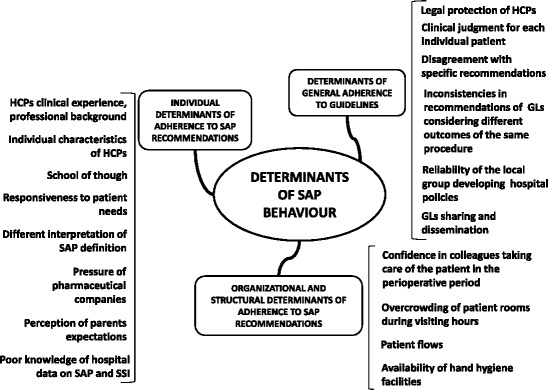
BACKGROUND: Qualitative and quantitative research investigating determinants of adherence to clinical guidelines (GLs) on surgical antibiotic prophylaxis (SAP) are scarce. We conducted a mixed-method study aimed at investigating barriers and at describing attitudes of healthcare professionals (HCPs) regarding SAP in three Italian children's hospitals. METHODS: The study comprised two sequential phases: 1) collection of qualitative data through focus groups; 2) conduction of a survey on HCPs attitudes towards SAP. Focus groups were carried out in each hospital with a theoretical convenience sample of 10-15 HCPs. Categorical analysis was conducted. Emerging categories and additional topics derived by literature search were used to develop the survey questionnaire, which included 13 questions expressed through a 4-point Likert scale. Members of surgical teams were invited by e-mail to fill in the questionnaire. We summed up the points assigned to each 4-point Likert scale response and calculated a cumulative score expressing overall concordance to expected HCPs attitudes on SAP. We conducted univariate and multivariate analysis to evaluate the relationship among characteristics of respondents and concordance with expected attitudes. RESULTS: The main categories identified in the qualitative phase included determinants of general adherence to GLs (e.g., relevance of clinical judgment), individual determinants (e.g., poor knowledge on hospital data) and organizational/structural determinants (e.g., patient flows). A total of 357 HCPs participated in the survey (response rate: 82.1%). Among respondents, 75% reported that SAP should be performed with first or second-generation cephalosporins, 44% that 2-3 days of antibiotic administration are useful as a precaution after surgery, 32% that SAP is needed for all surgical procedures. At multivariate analysis, professional category (physicians vs nurses; OR: 3.31; 95%CI: 1.88-5.82), and hospital (hospital 1 and 2 vs hospital 3; ORs: 2.79, 95%CI: 1.22-6.36; 2.40, 95%CI: 1.30-4.43, respectively) were significantly and independently associated with higher concordance with expected attitudes on SAP. CONCLUSIONS: Results from this study were useful to identify obstacles to appropriate SAP use in children. In our setting, findings support that a quality-improvement intervention should take into account local contexts, with development of hospital policies, education on SAP recommendations, and dissemination of data on adherence to recommendations.
Overview
The claims and statistics of this paper haven’t been checked yet.
Run the check — free, no account needed. It reads the open-access text and checks the sources it cites.
Integrity signals
Registry
Cites
Statistics
Figures
Verification
Claims the paper makes
The claims and statistics of this paper haven’t been checked yet.
Run the check — free, no account needed. It reads the open-access text and checks the sources it cites.
Claims other papers make about this one
Each is checked against this paper’s own text: does it say what the citing paper says it does?
The source backs part of the claim, not all of it — or backs it for a different population, condition or comparison.
In the citing paper
“The studies in LMICs focus on surgical prophylaxis,17–20 overlooking the extent of post-operative empirical antibiotic use.”
From Rationalizing irrational prescribing—infection-related attitudes and practices across paediatric surgery specialties in a hospital in South India (2024) · cites this paper as [17]
Experimental — accuracy not yet measured
Self-check
Percentages, sums and reported differences re-computed from the paper’s own numbers.
The self-check needs the paper’s full text.
Citations
Cites
Tong, A., Sainsbury, P., & Craig, J. (2007) · International Journal for Quality in Health Care · doi:10.1093/intqhc/mzm042 · Cited by 42,509
Designing and Conducting Mixed Methods Research
Robinson, P. M. (2007) · Australian and New Zealand Journal of Public Health · doi:10.1111/j.1753-6405.2007.00096.x · Cited by 23,362
(2006) · Cited by 7,081
Why Don't Physicians Follow Clinical Practice Guidelines?: A Framework for Improvement
Cabana, M. D., Rand, C. S., Powe, N. R., Wu, A. W., Wilson, M. H., Abboud, P.-A. C., & Rubin, H. R. (1999) · JAMA · doi:10.1001/jama.282.15.1458 · Cited by 6,677
Audit and feedback: effects on professional practice and healthcare outcomes
Ivers, N., Jamtvedt, G., Flottorp, S., Young, J. M., Odgaard-Jensen, J., French, S. D., O'Brien, M. A., Johansen, M., Grimshaw, J., & Oxman, A. D. (2012) · Cochrane Database of Systematic Reviews · doi:10.1002/14651858.cd000259.pub3 · Cited by 5,485
Qualitative research in health care: Assessing quality in qualitative research
Mays, N. (2000) · BMJ · doi:10.1136/bmj.320.7226.50 · Cited by 3,742
Clinical practice guidelines for antimicrobial prophylaxis in surgery
Bratzler, D. W., Dellinger, E. P., Olsen, K. M., Perl, T. M., Auwaerter, P. G., Bolon, M. K., Fish, D. N., Napolitano, L. M., Sawyer, R. G., Slain, D., et al. (2013) · American Journal of Health-System Pharmacy · doi:10.2146/ajhp120568 · Cited by 2,600
The Scottish Intercollegiate Guidelines Network (SIGN)
Miller, J. (2002) · The British Journal of Diabetes · doi:10.1177/14746514020020010401 · Cited by 1,546
The effective period of preventive antibiotic action in experimental incisions and dermal lesions.
Burke, J. F. (1961) · PubMed · Cited by 1,284
Bratzler, D. W., & Houck, P. M. (2005) · The American Journal of Surgery · doi:10.1016/j.amjsurg.2005.01.015 · Cited by 1,163
Cited by
Sorted by citations
Surendran, S., Nampoothiri, V., Dhar, P., Holmes, A., Singh, S., & Charani, E. (2024) · JAC-Antimicrobial Resistance · doi:10.1093/jacamr/dlae105 · Cited by 3
Metadata
- Authors
- The Apache Study Group, Giusti, A., Spila Alegiani, S., Ciofi degli Atti, M. L., Colaceci, S., Raschetti, R., Arace, P., Spiazzi, R., & Raponi, M.
- Affiliations
- Istituto Superiore di Sanità (IT)
- Azienda Socio Sanitaria Territoriale degli Spedali Civili di Brescia (IT)
- Bambino Gesù Children's Hospital (IT)
- Venue
- BMC Pediatrics
- Published
- 2016-12
- Volume
- 16
- Issue
- 1
- Pages
- 203-203
- ISSN
- 1471-2431 (ISSN-L)
- PMC
- PMC5139116
- OpenAlex
- W2560272401
- Cited by
- 27
- References
- 30
- Citations by year
- 2026: 1 · 2025: 3 · 2024: 2 · 2023: 3 · 2022: 3 · 2021: 7 · 2020: 2 · 2019: 1 · 2018: 3 · 2017: 2
- FWCI
- 2.21
- Type
- journal article
- Language
- en
- Open access
- gold
- doi.org
- Licence
- cc-by
- Locations
- BMC Pediatrics (publishedVersion, cc-by)
- Europe PMC (PubMed Central) (publishedVersion, cc-by)
- PubMed Central (publishedVersion, cc-by)
- PubMed (publishedVersion)
- Funders
- Italian Agency of Drugs (AIFA) (FARM9PJNAJ)
- Topics
- Health Sciences › Medicine › Surgery › Surgical site infection prevention
- Health Sciences › Medicine › Infectious Diseases › Antibiotic Use and Resistance
- Health Sciences › Medicine › Infectious Diseases › Infection Control in Healthcare
- Keywords
- surgical antibiotic prophylaxis, children, clinician attitudes, clinical guideline adherence, barriers to guideline adherence, pediatric surgery, cephalosporins, duration of antibiotic prophylaxis, professional role differences, hospital policy, quality improvement, children's hospitals, Italy, patient flow, surgical team, physicians, appropriateness of antibiotic use
- MeSH terms
- Anesthesiologists, Adult, Aged, Attitude of Health Personnel, Child, Female, Hospitals, Pediatric, Humans, Italy, Male, Middle Aged, Nurses, Preoperative Care, Focus Groups, Practice Guidelines as Topic, Antibiotic Prophylaxis, Guideline Adherence, Qualitative Research, Inappropriate Prescribing, Surgeons
About these checks
Registry, retraction, Cites and statistics results are computed, not judged, with one exception: a printed reference that no index lists is read once by a model before it counts as a citation error. Claims are extracted by a model and kept only when their quote appears verbatim in the text; each cited source is then checked, with a model’s help, for whether it says what the claim relies on. Those verdicts can be wrong — read the claim’s quote and the cited source before relying on one.
Statistics and arithmetic are recomputed, not judged.
Confidence bands are shown only for fields calibrated on our annotated test set. None is calibrated yet, so no band is shown.
What counts as a claim ›How we measure confidence ›How we check this ›
Are you an author, or do you see a problem with this page? Request a review
