

The DOI matches its Crossref record; 107 of the 109 references it cites were found in a registry or an index; 8 of the 77 sources its claims cite were checked for support.
Stockholm preterm interaction-based intervention (SPIBI) - study protocol for an RCT of a 12-month parallel-group post-discharge program for extremely preterm infants and their parents
Open accessAbstract
Background: Improved neonatal care has resulted in increased survival rates among infants born after only 22 gestational weeks, but extremely preterm children still have an increased risk of neurodevelopmental delays, learning disabilities and reduced cognitive capacity, particularly executive function deficits. Parent-child interaction and parental mental health are associated with infant development, regardless of preterm birth. There is a need for further early interventions directed towards extremely preterm (EPT) children as well as their parents. The purpose of this paper is to describe the Stockholm Preterm Interaction-Based Intervention (SPIBI), the arrangements of the SPIBI trial and the chosen outcome measurements. Methods: The SPIBI is a randomized clinical trial that includes EPT infants and their parents upon discharge from four neonatal units in Stockholm, Sweden. Inclusion criteria are EPT infants soon to be discharged from a neonatal intensive care unit (NICU), with parents speaking Swedish or English. Both groups receive three initial visits at the neonatal unit before discharge during the recruitment process, with a strengths-based and development-supportive approach. The intervention group receives ten home visits and two telephone calls during the first year from a trained interventionist from a multi-professional team. The SPIBI intervention is a strengths-based early intervention programme focusing on parental sensitivity to infant cues, enhancing positive parent-child interaction, improving self-regulating skills and supporting the infant’s next small developmental step through a scaffolding process and parent-infant co-regulation. The control group receives standard follow-up and care plus extended assessment. The outcomes of interest are parent-child interaction, child development, parental mental health and preschool teacher evaluation of child participation, with assessments at 3, 12, 24 and 36 months corrected age (CA). The primary outcome is emotional availability at 12 months CA. Discussion: If the SPIBI shows positive results, it could be considered for clinical implementation for child-support, ethical and health-economic purposes. Regardless of the outcome, the trial will provide valuable information about extremely preterm children and their parents during infancy and toddlerhood after regional hospital care in Sweden. Trial registration: The study was registered in ClinicalTrials.gov in October 2018 (NCT03714633).
Overview
CoChat Summary
TL;DR
The SPIBI protocol describes a two-arm randomized trial of a 12-month, strengths-based, interaction-focused home-visiting intervention for extremely preterm infants and their parents after NICU discharge in Stockholm. It reports no outcome results; it specifies the intervention, control condition, outcome measures, and planned analyses, with the primary outcome being emotional availability at 12 months corrected age.
Key findings
- The trial aims to recruit 130 extremely preterm infants (born before 28 gestational weeks) and their parents, with 50% randomized to the SPIBI intervention; the sample size is based on feasibility and assumes a moderate effect size on the primary outcome (Cohen’s d = 0.5), giving power of 0.8 with alpha 0.05.
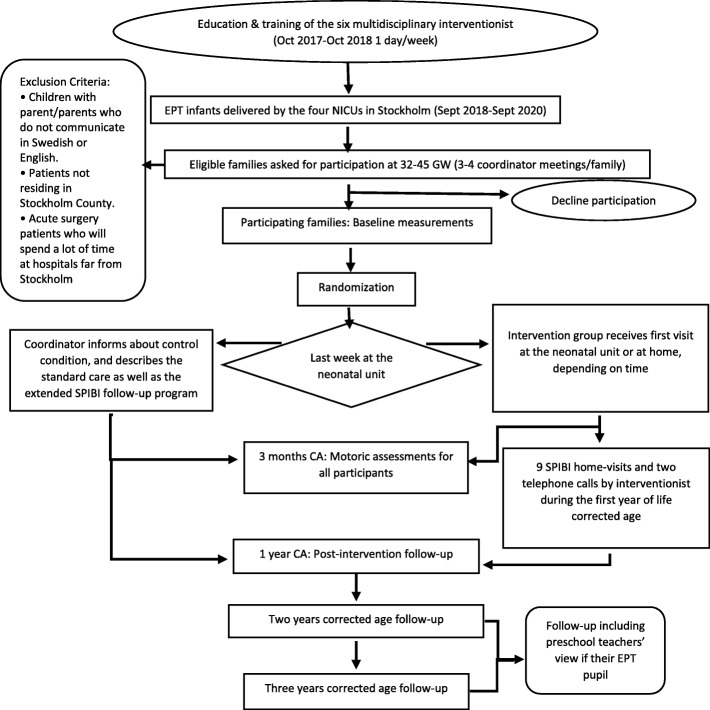
- The intervention group receives 10 home visits and 2 telephone calls during the first year, beginning before discharge and ending at 12 months corrected age; the control group receives treatment as usual plus extended assessment.
- The primary outcome is the Emotional Availability Scales (EAS) at 12 months corrected age, with four parental dimensions (sensitivity, structure, non-intrusiveness, non-hostility) and two child dimensions (responsiveness, involvement).
- Secondary outcomes cover child development (e.g., BSID-III, BRIEF-P, AIMS, HINE, M-CHAT), parental mental health (HADS, STAI, PSE, RES), and preschool teacher evaluations (CEQ, EBVS, play time/social time, ICF-CY), assessed at 3, 12, 24, and 36 months corrected age.
Methods
- Design: two-arm parallel-group randomized clinical trial at four neonatal units in Stockholm, Sweden, with recruitment from 1 September 2018 and anticipated end 31 August 2020 or when 130 participants are reached.
- Participants: extremely preterm infants born before 28 gestational weeks, in stable medical condition and close to discharge, with parents speaking Swedish or English and residing in Stockholm County; exclusion criteria include inability to communicate in Swedish or English, non-residence in Stockholm County, and acute surgery patients spending substantial time far from Stockholm.
- Analysis: intention-to-treat for the primary outcome, separate testing with multiplicity adjustments for secondary outcomes, linear mixed models for repeated continuous measures, generalized estimating equations for binary/ordinal outcomes, and multiple imputation only as a sensitivity analysis if any variable has more than 5% missing observations.
Limitations
- The paper states that the sample size is based on feasibility rather than a formal power calculation from prior outcome data, and that no outcome results are yet available because this is a study protocol.
- The paper states that the main analysis will not impute missing data, with multiple imputation used only as an additional sensitivity analysis if missingness exceeds 5%.
- Evident from the text: the primary coder is blind to group allocation, but the second coder used for interrater reliability checks in 20% of cases is not blind; the control group receives treatment as usual plus extended assessment and an additional coordinator visit, so it is not a pure no-contact control condition.
Model-written summary. Check it against the paper before relying on it.
Integrity signals
Registry
Cites
Statistics
Figures


Verification
Claims the paper makes
5 Valid · 0 Not valid · 29 Not checked · 24 Own results and interpretations
The cited sources support only part of this claim — read each source’s verdict below.
In the paper
“Being born extremely preterm, i.e., born before 28 gestation weeks, is a potentially life-threatening circumstance affecting the child [1–6], the parents [7–10] and the interactions among family members [11–13].”
§ Stockholm preterm interaction-based intervention (SPIBI) - study protocol for an RCT of a 12-month parallel-group post-discharge program for extremely preterm infants and their parents > Background
What the sources say
- Not checked yetcites [1] Jarjour IT. Topical review: neurodevelopmental outcome after extreme prematurity: a review of the literature. Pediatr Neurol. 2015;52(2):143–52. source
- Partly supportedcites [2] Montagna A, Nosarti C. Socio-emotional development following very preterm birth: pathways to psychopathology. Front Psychol. 2016. https://doi.org/10.3389/fpsyg.2016.00080. sourceExperimental — accuracy not yet measured
Our copy supports the substantive three-part assertion: the Introduction frames preterm birth as a threat to the child ('greater risk of brain damage and consequent neurological disorders, neuropsychological, and behavioral impairments', with 'life-saving stay in the NICU' and 'Life threating events in the perinatal period'), the parenting section states that 'Preterm birth and hospitalization are highly stressful experiences for parents' with more distress, depression and PTSD symptoms than parents of term-born children, and the developmental-mechanisms section says preterm birth 'affects the individual, together with the entire family and extended social systems' and alters the child–carer interaction. However, the claim's population qualifier is not this paper's: our copy works throughout with very preterm birth defined as <32 weeks of gestation, and where it names extremely preterm it defines it as <26 weeks (Psychiatric disorders in childhood), never <28 weeks. Additionally, the source hedges the parental/family effects ('may increase overall parental psychological distress and alter the interaction'), whereas the citing sentence presents them as a settled consequence. (LLM, conf=0.72)
- Not checked yetcites [3] Mulder H, Pitchford NJ, Hagger MS, Marlow N. Development of executive function and attention in preterm children: a systematic review. Dev Neuropsychol. 2009;34(4):393–421. source
- Not checked yetcites [4] Serenius F, Ewald U, Farooqi A, Fellman V, Hafström M, Hellgren K, et al. Neurodevelopmental outcomes among extremely preterm infants 6.5 years after active perinatal Care in Sweden. JAMA Pediatr. 2016;170(10):954–63. source
- Not checked yetcites [5] Serenius F, Källén K, Blennow M, Ewald U, Fellman V, Holmström G, et al. Neurodevelopmental outcome in extremely preterm infants at 2.5 years after active perinatal care in Sweden. JAMA. 2013;309(17):1810–20. source
- Not checked yetcites [6] Vohr BR, Wright LL, Poole WK, McDonald SA. Neurodevelopmental outcomes of extremely low birth weight infants <32 weeks’ gestation between 1993 and 1998. Pediatrics. 2005;116(3):635–43. source
- Not checked yetcites [7] Holditch-Davis D, Bartlett TR, Blickman AL, Miles MS. Posttraumatic stress symptoms in mothers of premature infants. J Obstet Gynecol Neonatal Nurs JOGNN. 2003;32(2):161–71. source
- Not checked yetcites [8] Holditch-Davis D, Santos H, Levy J, White-Traut R, O’Shea TM, Geraldo V, et al. Patterns of psychological distress in mothers of preterm infants. Infant Behav Dev. 2015;41:154–63. source
- Not checked yetcites [9] Kong L-P, Cui Y, Qiu Y-F, Han S-P, Yu Z-B, Guo X-R. Anxiety and depression in parents of sick neonates: a hospital-based study. J Clin Nurs. 2013;22(7–8):1163–72. source
- Partly supportedcites [10] Singer LT, Salvator A, Guo S, Collin M, Lilien L, Baley J. Maternal psychological distress and parenting stress after the birth of a very low-birth-weight infant. JAMA. 1999;281(9):799–805. sourceExperimental — accuracy not yet measured
Our copy supports the 'affecting the parents' and family parts: the Introduction (Conclusions section) states that 'the birth of an infant with VLBW poses a considerable challenge to parents,' and the Results (Family Impact) report greater financial, family and personal strain and higher total stress in mothers of VLBW infants versus term mothers, with the Impact on Family Scale covering disruption of family, social and sibling relations. However, the paper never characterises preterm birth as a 'potentially life-threatening circumstance' — it speaks only of improved survival rates and higher rates of neurodevelopmental impairment among survivors — and its cohorts are defined by birthweight (VLBW <1500 g, high- vs low-risk) rather than by the claim's gestational-age criterion of <28 weeks. The citing sentence also omits the source's counterweight that by 3 years many of these differences had resolved for low-risk VLBW mothers. (LLM, conf=0.78)
plainstates a cause- Asserted: passes — The authors put it forward as true.
- Checkable: passes — It can be checked against evidence.
- Load-bearing: passes — The paper’s conclusions depend on it.
- Based: passes — The paper gives a reason why it holds.
The sources with a verdict support this claim; the rest weren’t checked yet, have no full text we could read, or their verdicts aren’t rated yet.
In the paper
“Hence, adequate discharge planning and transition programmes for the child and family leaving the Neonatal Intensive Care Unit (NICU) is an area in need of further development [39, 40] to benefit not only the child but also the parents.”
§ Stockholm preterm interaction-based intervention (SPIBI) - study protocol for an RCT of a 12-month parallel-group post-discharge program for extremely preterm infants and their parents > Background
What the sources say
- Supportedcites [39] Aydon L, Hauck Y, Murdoch J, Siu D, Sharp M. Transition from hospital to home: parents’ perception of their preparation and readiness for discharge with their preterm infant. J Clin Nurs. 2018;27(1–2):269–77. source
The Conclusions (p. ~9) state that the WA study's findings 'reflect a necessity to develop strategies to improve the NICU transition and discharge experience for parents,' which is what the citing sentence attributes. The Transition to discharge section (pp. ~7-8) reinforces this by noting that international literature does not report parents' impressions/perceptions of readiness before and after discharge and that the authors 'have been unable to identify evidence involving NICU parental educational programs and their outcomes in Australia,' i.e. an area needing further development. The source frames the gap in terms of parents/families and discharge-planning strategies rather than explicitly 'the child,' but the substance of the paraphrase matches. (LLM, conf=0.85)
- Not checked yetcites [40] Bruder MB. Discharge planning: hospital to home transitions for infants. Top Early Child Spec Educ. 1990;9(4):26–42. source
plain- Asserted: passes — The authors put it forward as true.
- Checkable: unclear — It is unclear whether it could be checked against evidence.
- Load-bearing: passes — The paper’s conclusions depend on it.
- Based: passes — The paper gives a reason why it holds.
- Supported
The sources with a verdict support this claim; the rest weren’t checked yet, have no full text we could read, or their verdicts aren’t rated yet.
In the paper
“Working memory [18] and executive functions [3, 19, 20] seem to be particularly vulnerable in extremely preterm children”
§ Stockholm preterm interaction-based intervention (SPIBI) - study protocol for an RCT of a 12-month parallel-group post-discharge program for extremely preterm infants and their parents > Background
What the sources say
- Not checked yetcites [18] Stålnacke J, Lundequist A, Böhm B, Forssberg H, Smedler A-C. A longitudinal model of executive function development from birth through adolescence in children born very or extremely preterm. Child Neuropsychol. 2018;25:1–18.
- Not checked yetcites [3] Mulder H, Pitchford NJ, Hagger MS, Marlow N. Development of executive function and attention in preterm children: a systematic review. Dev Neuropsychol. 2009;34(4):393–421. source
- Not checked yetcites [19] Böhm B, Smedler A-C, Forssberg H. Impulse control, working memory and other executive functions in preterm children when starting school. Acta Paediatr. 2004;93(10):1363–71. source
- Supportedcites [20] Lundequist A, Böhm B, Lagercrantz H, Forssberg H, Smedler A-C. Cognitive outcome varies in adolescents born preterm, depending on gestational age, intrauterine growth and neonatal complications. Acta Paediatr. 2015;104(3):292–9. source
The Results (Executive functions) state that the extremely preterm group (22–27 weeks) performed significantly lower than the term group on all executive function measures, with medium to large effect sizes, and their Table 3b shows this including the working memory subtests (Digit span I&IV 0.55, Block repetition I&IV 0.74), working memory being listed in Table 2 as an executive function domain of the battery. The Discussion singles these out as the most affected ('the lowest results on all the cognitive tests, in particular on measures of executive functions', and 'extremely preterm birth per se poses a risk for long-term cognitive outcome, particularly in executive functions'), and notes the same pattern was seen at 5.5 years and had strengthened over time, covering the 'children' framing. The hedged 'seem to be' is consistent with the source's own conclusions, so the paraphrase is supported. (LLM, conf=0.85)
hedgedstates an association- Asserted: passes — The authors put it forward as true.
- Checkable: passes — It can be checked against evidence.
- Load-bearing: passes — The paper’s conclusions depend on it.
- Based: passes — The paper gives a reason why it holds.
Every source the paper cites for this claim was checked and supports it.
In the paper
“Moreover, several skills that are important for school success, such as mathematical [27] and linguistic abilities [28, 29], are negatively affected by extreme prematurity”
§ Stockholm preterm interaction-based intervention (SPIBI) - study protocol for an RCT of a 12-month parallel-group post-discharge program for extremely preterm infants and their parents > Background
What the sources say
- Supportedcites [27] Wolke D, Strauss VY-C, Johnson S, Gilmore C, Marlow N, Jaekel J. Universal Gestational Age Effects on Cognitive and Basic Mathematic Processing: 2 Cohorts in 2 Countries. J Pediatr. 2015;166(6):1410–1416.e2. source
Citation [27] is attached to mathematical abilities, not linguistic abilities. The Discussion reports mathematics achievement problems among preterm children, including children born before 34 weeks’ gestation, supporting the attributed effect of extreme prematurity on mathematical skills. No page number is available in our copy. (LLM, conf=0.89)
- Supportedcites [28] Adams-Chapman I, Bann C, Carter SL, Stoll BJ. Language outcomes among ELBW infants in early childhood. Early Hum Dev. 2015;91(6):373–9. source
The citation to this paper concerns linguistic abilities, not the separately cited mathematical abilities. The Introduction describes an increased risk of abnormal language development among extremely low birth weight infants, and the Discussion reports language delay in 64% of the cohort at 30 months adjusted age. (LLM, conf=0.90)
- Supportedcites [29] Putnick DL, Bornstein MH, Eryigit-Madzwamuse S, Wolke D. Long-Term Stability of Language Performance in Very Preterm, Moderate-Late Preterm, and Term Children. J Pediatr. 2017;181:74–79.e3. source
The Discussion states that very preterm children had lower language performance than term-born children at every measured age. This source is cited for linguistic abilities; the citing sentence assigns mathematical abilities to a different reference. (LLM, conf=0.90)
plainstates a cause- Asserted: passes — The authors put it forward as true.
- Checkable: passes — It can be checked against evidence.
- Load-bearing: passes — The paper’s conclusions depend on it.
- Based: passes — The paper gives a reason why it holds.
- Supported
None of the sources cited for this claim have been checked yet.
In the paper
“Parent-child interaction and parental mental health are associated with infant development, regardless of preterm birth.”
- Also stated in: § Background · hedged
“Parental mental health may be negatively affected by a child’s preterm birth [8, 36], and poor parental mental health is associated with less favourable social, behavioural and functional development of preschool-aged EPT children [37, 38].”
§ Stockholm preterm interaction-based intervention (SPIBI) - study protocol for an RCT of a 12-month parallel-group post-discharge program for extremely preterm infants and their parents > Abstract > Background
What the sources say
- Not checked yetcites [8] Holditch-Davis D, Santos H, Levy J, White-Traut R, O’Shea TM, Geraldo V, et al. Patterns of psychological distress in mothers of preterm infants. Infant Behav Dev. 2015;41:154–63. source
- Not checked yetcites [36] Treyvaud K. Parent and family outcomes following very preterm or very low birth weight birth: a review. Semin Fetal Neonatal Med. 2014;19(2):131–5. source
- Not checked yetcites [37] Huhtala M, Korja R, Lehtonen L, Haataja L, Lapinleimu H, Munck P, et al. Parental psychological well-being and cognitive development of very low birth weight infants at 2 years. Acta Paediatr. 2011;100(12):1555–60. source
- Not checked yetcites [38] Huhtala M, Korja R, Lehtonen L, Haataja L, Lapinleimu H, Rautava P. Associations between parental psychological well-being and socio-emotional development in 5-year-old preterm children. Early Hum Dev. 2014;90(3):119–24. source
plainstates an association- Asserted: passes — The authors put it forward as true.
- Checkable: passes — It can be checked against evidence.
- Load-bearing: passes — The paper’s conclusions depend on it.
- Based: passes — The paper gives a reason why it holds.
- Also stated in: § Background · hedged
18 more claims
Create a free account to see all 58 claims and to verify the 69 references still open.
- It may state two separate claims as one. 18
- Probably not a substantial claim. 27
Claims other papers make about this one
Each is checked against this paper’s own text: does it say what the citing paper says it does?
The source backs part of the claim, not all of it — or backs it for a different population, condition or comparison.
In the citing paper
“These infants are at risk of medical, cognitive and developmental sequelae.2–5”
From Coached, Coordinated, Enhanced Neonatal Transition (CCENT): Protocol for a multicentre pragmatic randomised controlled trial of transition-to-home support for parents of high-risk infants (2021) · cites this paper as [4]
Experimental — accuracy not yet measured
Self-check
Percentages, sums and reported differences re-computed from the paper’s own numbers.
Each contradiction between two passages listed here was confirmed by an independent check.
Rated major: it would touch a result — a value a result rests on, reported and recomputed p-values on opposite sides of the significance level, two passages that conflict with no sign which is right, or a cited work retracted before this paper was published.
In the paper
§ Stockholm preterm interaction-based intervention (SPIBI) - study protocol for an RCT of a 12-month parallel-group post-discharge program for extremely preterm infants and their parents > Abstract > Methods
“The intervention group receives ten home visits and two telephone calls during the first year from a trained interventionist from a multi-professional team.”
§ Stockholm preterm interaction-based intervention (SPIBI) - study protocol for an RCT of a 12-month parallel-group post-discharge program for extremely preterm infants and their parents > Methods > Content of the programme given to the intervention group (IG)
“When the child is 12 months corrected age, the interventionist makes the 9th and final home visit”
Citations
Cites
(1978) · Medical Entomology and Zoology · Cited by 53,488
The Hospital Anxiety and Depression Scale
Zigmond, A. S., & Snaith, R. P. (1983) · Acta Psychiatrica Scandinavica · doi:10.1111/j.1600-0447.1983.tb09716.x · Cited by 47,139
(1970) · Cited by 24,983
Depression and quality of life in older persons: A review
Sivertsen, H., Bjørkløf, G. H., Engedal, K., Selbæk, G., & Helvik, A.-S. (2015) · Dementia and Geriatric Cognitive Disorders · doi:10.1159/000437299 · Cited by 14,152
Psychometric properties of the strengths and difficulties questionnaire
GOODMAN, R. (2001) · Journal of the American Academy of Child & Adolescent Psychiatry · doi:10.1097/00004583-200111000-00015 · Cited by 6,813
A gradient of childhood self-control predicts health, wealth, and public safety
Moffitt, T. E., Arseneault, L., Belsky, D., Dickson, N., Hancox, R. J., Harrington, H., Houts, R., Poulton, R., Roberts, B. W., Ross, S., et al. (2011) · Proceedings of the National Academy of Sciences · doi:10.1073/pnas.1010076108 · Cited by 4,885
Development and psychometric evaluation of the Resilience Scale.
Wagnild, G. M., & Young, H. M. (1993) · PubMed · Cited by 3,697
Blair, C., & Razza, R. P. (2007) · Child Development · doi:10.1111/j.1467-8624.2007.01019.x · Cited by 3,140
Assessment of client/patient satisfaction: development of a general scale
Larsen, D. L., Attkisson, C. C., Hargreaves, W. A., & Nguyen, T. D. (1979) · Evaluation and Program Planning · doi:10.1016/0149-7189(79)90094-6 · Cited by 2,887
The Interpersonal World of the Infant: A View from Psychoanalysis and Developmental Psychology
Zeanah, C. H. (1986) · Journal of the American Academy of Child Psychiatry · doi:10.1016/s0002-7138(10)60025-8 · Cited by 2,801
Research works printed but not linked: 9
- Våra Frågor prematurförbundets hjärtefrågor. Prematurförbundet: Stockholm. 2019. http://prematurforbundet.se/vara-fragor/ Accessed 22 Jan 2019.
- Domellöf M, Blomberg M, Engström E, Farooqi A, Hafström O, Herbst A, et al. Handläggning av hotande förtidsbörd och nyfödda barn vid gränsen för viabilitet. Nationella riktlinjer, utarbetade av en arbetsgrupp “konsensusgruppen” utsedd av Svenska Neonatalföreningen och Perinatal-ARG inom Svensk Förening för Obstetrik och Gynekologi. 2016. http://neo.barnlakarforeningen.se/wp-content/uploads/sites/14/2016/04/Konsensusdokument-final-2016-04-07.pdf Accessed Jan 22 2019.
- Bayley N. Technical manual. PsychCorp: San Antonio; 2006.
- Folio MR, Fewell RR. PDMS-2 Peabody developmental motor scales second edition. Austin: PRO-ED Inc.; 2000.
- Squires J, Potter LW, Bricker DD. The ASQ’s user guide: a parent-completed, child-monitoring system. Baltimore: Paul H Brookes Publishing Co.; 1999.
- Granlund M, Almqvist L, Gustafsson P, Gustafsson B, Golsäter M, Proczkowska M, et al. Slutrapport tidig upptäckt tidig insats. Jönköping: CHILD Jönköping University; 2016.
- Mc WR. Children’s engagement questionnaire. Chapel Hill: Frank Porter Graham Child Development Center, University of North Carolina; 1991.
- Statens offentliga utredningar. Behov och resurser i vården - en analys SOU 1996:163. 1996. https://www.regeringen.se/rattsliga-dokument/statens-offentliga-utredningar/1996/11/sou-1996163/ Accessed 22 Jan 2019.
- Håkansson S, Sjörs G. National Quality Registry for Neonatal Care (SNQ). Stockholm: National Quality Registry for Neonatal Care (SNQ); 2019. http://kvalitetsregister.se/englishpages/findaregistry/registerarkivenglish/nationalqualityregistryforneonatalcaresnq.2191.html. Accessed 22 Jan 2019
Cited by
Orton, J., Doyle, L. W., Tripathi, T., Boyd, R. N., Anderson, P. J., & Spittle, A. J. (2024) · Cochrane Database of Systematic Reviews · doi:10.1002/14651858.cd005495.pub5 · Cited by 215
Baraldi, E., Allodi, M. W., Smedler, A.-C., Westrup, B., Löwing, K., & Ådén, U. (2020) · International Journal of Environmental Research and Public Health · doi:10.3390/ijerph17249326 · Cited by 52
Self-citationJeukens‐Visser, M., Koldewijn, K., Leemhuis, A. G., Flierman, M., Nollet, F., & Wolf, M. (2020) · Infant Mental Health Journal · doi:10.1002/imhj.21902 · Cited by 32
Örtqvist, M., Marschik, P. B., Toldo, M., Zhang, D., Fajardo, V. M., Nielsen‐Saines, K., Ådén, U., & Einspieler, C. (2023) · Acta Paediatrica · doi:10.1111/apa.16747 · Cited by 32
Self-citationEmotional Availability: Clinical Populations and Clinical Applications
Biringen, Z. C., Sandoval, K., Flykt, M. S., Joslin, S., & Lincoln, M. (2022) · Human Development · doi:10.1159/000525256 · Cited by 25
Metadata
- Authors
- Baraldi, E., Allodi, M. W., Löwing, K., Smedler, A.-C., Westrup, B., & Ådén, U.
- Affiliations
- Stockholm University (SE)
- Karolinska University Hospital (SE)
- Corresponding author
- Baraldi, Erika
- Venue
- BMC Pediatrics
- Published
- 2020-02-01
- Volume
- 20
- Issue
- 1
- Pages
- 49-49
- ISSN
- 1471-2431 (ISSN-L)
- PMC
- PMC6995087
- OpenAlex
- W3010403321
- Cited by
- 25
- References
- 109
- Citations by year
- 2026: 3 · 2025: 1 · 2024: 5 · 2023: 7 · 2022: 4 · 2021: 3 · 2020: 2
- FWCI
- 3.84
- Type
- journal article
- Language
- en
- Open access
- gold
- doi.org
- Licence
- cc-by
- creativecommons.org/licenses/by/4.0/ (tdm)
- creativecommons.org/licenses/by/4.0/ (vor)
- Locations
- BMC Pediatrics (publishedVersion, cc-by)
- PubMed Central (publishedVersion, cc-by)
- PubMed (publishedVersion)
- DOAJ (DOAJ: Directory of Open Access Journals) (submittedVersion, cc-by-sa)
- Funders
- SU-SLL fonden (SU-SLL no. 20160881)
- Centrum för kompetensutveckling inom vård och omsorg at Stockholm University (no. SU FV 2.1.1 - 402417)
- Clas Groschinskys Minnesfond (no. SF 18 109)
- Queen Silvia Jubilee Fund for research on children and disability (13th of December 2017)
- Filénska fonden (2017/2018)
- Stockholm University Faculty Funds (Funded the PhD position 50% 2016-2024)
- Lilla Barnets Fond (20191001)
- Topics
- Health Sciences › Medicine › Pediatrics, Perinatology and Child Health › Infant Development and Preterm Care
- Health Sciences › Medicine › Public Health, Environmental and Occupational Health › Maternal Mental Health During Pregnancy and Postpartum
- Social Sciences › Psychology › Clinical Psychology › Family and Disability Support Research
- Keywords
- extremely preterm infants, parent-child interaction, early intervention, post-discharge interventions, parental mental health, emotional availability, strengths-based approach, scaffolding, self-regulation, child development, neurodevelopmental delay, executive dysfunction, home visits, telephone support
- MeSH terms
- School Teachers, Adult, Aftercare, Child Development, Humans, Infant, Infant, Newborn, Intensive Care Units, Neonatal, Parents, Patient Discharge, Sweden, Randomized Controlled Trials as Topic, Premature Birth, Infant, Extremely Premature
About these checks
Registry, retraction, Cites and statistics results are computed, not judged, with one exception: a printed reference that no index lists is read once by a model before it counts as a citation error. Claims are extracted by a model and kept only when their quote appears verbatim in the text; each cited source is then checked, with a model’s help, for whether it says what the claim relies on. Those verdicts can be wrong — read the claim’s quote and the cited source before relying on one.
The claim verdicts this report counts are experimental: their accuracy is not yet measured.
A language model drew the claims from the paper on 2026-10-04, under version 3 of the claim definition (model deepseek-v4.1-flash, prompt extract-v3).
A second model labelled each claim on 2026-10-04 (model jev-1.13-20260917, definition revision gold-guideline-v0.2).
Cited sources are checked with a language model’s help (qwen3.8-omni-flash and gpt-6-sol).
Statistics and arithmetic are recomputed, not judged.
Confidence bands are shown only for fields calibrated on our annotated test set. None is calibrated yet, so no band is shown.
What counts as a claim ›How we measure confidence ›How we check this ›
Are you an author, or do you see a problem with this page? Request a review
How to cite
Cite CoChat for the checks on this page, and the paper for its own findings.
- This page
- CoChat. (2026). Citation check: Stockholm preterm interaction-based intervention (SPIBI) - study protocol for an RCT of a 12-month parallel-group post-discharge program for extremely preterm infants and their parents. https://app.cochat.ai/papers/10.1186/s12887-020-1934-4
- The paper
- Baraldi, E., Allodi, M. W., Löwing, K., Smedler, A.-C., Westrup, B., & Ådén, U. (2020). Stockholm preterm interaction-based intervention (SPIBI) - study protocol for an RCT of a 12-month parallel-group post-discharge program for extremely preterm infants and their parents. BMC Pediatrics. https://doi.org/10.1186/s12887-020-1934-4
Data sources
Bibliographic data: Semantic Scholar, OpenAlex, Crossref.
Contains information from the Semantic Scholar Academic Graph Datasets, made available under the ODC Attribution License (ODC-BY 1.0).
Semantic Scholar’s data is described in: Kinney, R., et al. (2023). The Semantic Scholar Open Data Platform. arXiv:2301.10140.
