

PRO*BPD: effectiveness of outpatient treatment programs for borderline personality disorder: a comparison of Schema therapy and dialectical behavior therapy: study protocol for a randomized trial
Open accessThe DOI matches its Crossref record; 102 of the 105 references it cites were found in a registry or an index.
Abstract
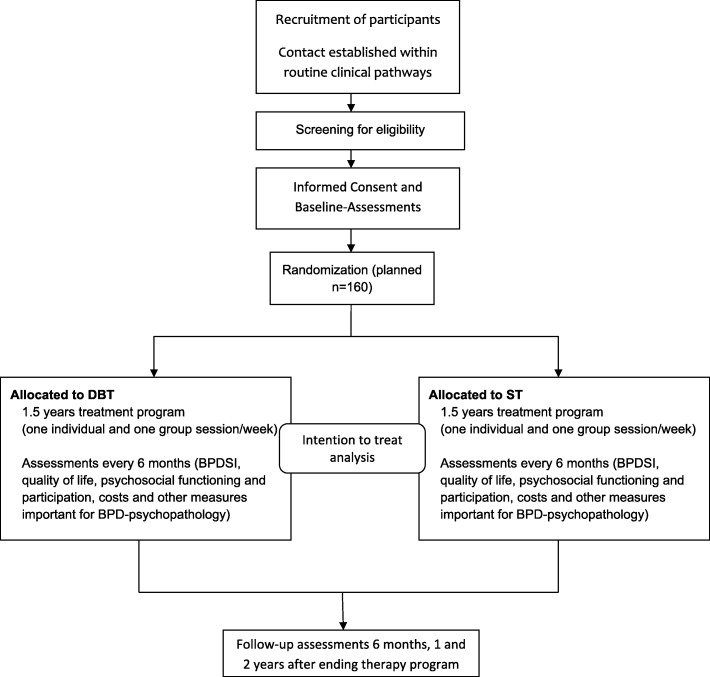
BACKGROUND: Borderline Personality Disorder (BPD) is a severe mental illness that is associated with low quality of life, low psychosocial functioning, and high societal costs. Treatments for BPD have improved in the last decades. Dialectical behavior therapy (DBT) and Schema therapy (ST) have demonstrated efficacy in reducing BPD symptoms and costs. However, research has not compared these two treatment approaches. In addition, there is a lack of 'real world studies' that replicate positive findings in regular mental healthcare settings. Thus, the PROgrams for Borderline Personality Disorder (PRO*BPD) study will compare the (cost-) effectiveness of DBT and ST in structured outpatient treatment programs in the routine clinical setting of an outpatient clinic. METHODS/DESIGN: We aim to recruit 160 BPD patients, who will be randomly assigned to either DBT or ST. In both conditions, patients receive one group therapy and one individual therapy session/week for a maximum of 18 months. Both treatment programs have similar frameworks, which guarantee clinical equipoise. The primary outcome is a reduction of BPD-symptoms. Also, the costs related to BPD are assessed and an economic evaluation is performed from a societal perspective. Secondary outcomes examine other measures of BPD-typical and general psychopathology, comorbidity, quality of life, psychosocial functioning and participation. Data are collected prior to the beginning therapy and every six months until the end of therapy, as well as at six months, one year and two years of follow-up after the end of therapy. Finally, we conduct a qualitative study to understand patients' experiences with the two methods. DISCUSSION: The PRO*BPD study is the first randomized trial to compare the (cost-) effectiveness of DBT and ST. By examining the clinical effectiveness of a broad spectrum of outcome parameters, conducting an economic evaluation and assessing patients' experiences, this study will significantly advance our knowledge on psychotherapy for BPD and will provide insight into the treatment approaches that should be offered to different BPD patients from clinical, economic and stakeholder's perspectives. TRIAL REGISTRATION: German Clinical Trial Register, DRKS00011534 , Date of registration: 11/01/2017, retrospectively registered.
Overview
The claims and statistics of this paper haven’t been checked yet.
Free: it reads the open-access text and checks the first 5 claims that cite a source we can check. Create a free account to check every claim.
Integrity signals
Registry
Cites
Statistics
Figures
Verification
Claims the paper makes
The claims and statistics of this paper haven’t been checked yet.
Free: it reads the open-access text and checks the first 5 claims that cite a source we can check. Create a free account to check every claim.
Claims other papers make about this one
Each is checked against this paper’s own text: does it say what the citing paper says it does?
The cited source says what the claim attributes to it.
In the citing paper
“Waiving a comparison group with no treatment guarantees inclusion into an effective treatment and minimizes unwillingness to be randomized [35].”
Self-check
Percentages, sums and reported differences re-computed from the paper’s own numbers.
The self-check needs the paper’s full text.
Citations
Cites
Diagnostic and Statistical Manual of Mental Disorders
American Psychiatric Association (2013) · doi:10.1176/appi.books.9780890425596 · Cited by 116,369
How Many Interviews Are Enough?: An Experiment with Data Saturation and Variability
Guest, G., Bunce, A., & Johnson, L. (2006) · Field Methods · doi:10.1177/1525822x05279903 · Cited by 20,808
Depression and quality of life in older persons: A review
Sivertsen, H., Bjørkløf, G. H., Engedal, K., Selbæk, G., & Helvik, A.-S. (2015) · Dementia and Geriatric Cognitive Disorders · doi:10.1159/000437299 · Cited by 14,152
Diagnostic and Statistical Manual of Mental Disorders (DSM-IV)
Hu, R. J. (2003) · Encyclopedia of the Neurological Sciences · doi:10.1016/b0-12-226870-9/01070-4 · Cited by 9,117
Gratz, K. L., & Roemer, L. (2004) · Journal of Psychopathology and Behavioral Assessment · doi:10.1023/b:joba.0000007455.08539.94 · Cited by 8,942 · cited 1×
“Difficulties in emotion regulation are assessed with the Difficulties in Emotion Regulation Scale (DERS), which has high internal consistency, good test-retest reliability, and adequate construct and predictive validity [85].”
MethodDevelopment of the World Health Organization WHOQOL-BREF Quality of Life Assessment
THE WHOQOL GROUP (1998) · Psychological Medicine · doi:10.1017/s0033291798006667 · Cited by 7,933
SPIRIT 2013 Statement: Defining Standard Protocol Items for Clinical Trials
Chan, A.-W., Tetzlaff, J. M., Altman, D. G., Laupacis, A., Gøtzsche, P. C., Krleža-Jerić, K., Hróbjartsson, A., Mann, H., Dickersin, K., Berlin, J. A., et al. (2013) · Annals of Internal Medicine · doi:10.7326/0003-4819-158-3-201302050-00583 · Cited by 7,363
The brief symptom inventory: an introductory report.
Derogatis, L. R., & Melisaratos, N. (1983) · Psychological Medicine · doi:10.1017/s0033291700048017 · Cited by 6,650
Development and validation of a brief screening version of the Childhood Trauma Questionnaire
Bernstein, D. P., Stein, J. A., Newcomb, M. D., Walker, E., Pogge, D., Ahluvalia, T., Stokes, J., Handelsman, L., Medrano, M., Desmond, D., et al. (2003) · Child Abuse & Neglect · doi:10.1016/s0145-2134(02)00541-0 · Cited by 6,419
EuroQol: the current state of play
Brooks, R. (1996) · Health Policy · doi:10.1016/0168-8510(96)00822-6 · Cited by 5,815
Research works printed but not linked: 5
- Linehan MM DBT skills handouts and worksheets 2015 2.ed New York The Guilford Press
- Ackermann H Biometrische Analyse von Stichproben (BiAS) für Windows 2016 Darmstadt Epsilon Verlag
- Linehan M Korslund KE Dialectical behaviour therapy adherence manual 2003 Seattle University of Wahington
- Fydrich T Renneberg B Schmitz B Strukturiertes Klinisches Interview für DSM-IV, Achse II (SKID II) 1997 Göttingen Hogrefe
- Wittchen HU Wunderlich U Gruschitz S Strukturiertes Klinisches Interview für DSM-IV, Achse I (SKID-I) 1997 Göttingen Hogrefe
Cited by
Psychological therapies for people with borderline personality disorder
Storebø, O. J., Stoffers-Winterling, J. M., Völlm, B. A., Kongerslev, M. T., Mattivi, J. T., Jørgensen, M. S., Faltinsen, E., Todorovac, A., Sales, C. P., Callesen, H. E., et al. (2020) · Cochrane Database of Systematic Reviews · doi:10.1002/14651858.cd012955.pub2 · Cited by 450
Psychotherapies for borderline personality disorder: a focused systematic review and meta-analysis
Stoffers-Winterling, J. M., Storebø, O. J., Kongerslev, M. T., Faltinsen, E., Todorovac, A., Sedoc Jørgensen, M., Sales, C. P., Edemann Callesen, H., Pereira Ribeiro, J., Völlm, B. A., et al. (2022) · The British Journal of Psychiatry · doi:10.1192/bjp.2021.204 · Cited by 156
Hubens, K., Krol, M., Coast, J., Drummond, M., Brouwer, W. B. F., Groot, C. A. U., & Roijen, L. H. (2021) · Value in Health · doi:10.1016/j.jval.2021.05.002 · Cited by 71
The societal cost of treatment-seeking patients with borderline personality disorder in Germany
Wagner, T., Assmann, N., Köhne, S., Schaich, A., Alvarez‐Fischer, D., Borgwardt, S., Arntz, A. R., Schweiger, U., & Faßbinder, E. (2021) · European Archives of Psychiatry and Clinical Neuroscience · doi:10.1007/s00406-021-01332-1 · Cited by 54
Self-citationBode, K., Vogel, R., Walker, J., & Kröger, C. B. (2016) · The European Journal of Health Economics · doi:10.1007/s10198-016-0858-2 · Cited by 46
Metadata
- Authors
- Fassbinder, E., Assmann, N., Schaich, A., Heinecke, K., Wagner, T., Sipos, V., Jauch-Chara, K., Hüppe, M., Arntz, A., & Schweiger, U.
- Affiliations
- University of Lübeck (DE)
- University of Amsterdam (NL)
- Corresponding author
- Fassbinder, Eva
- Venue
- BMC Psychiatry
- Published
- 2018-10-19
- Volume
- 18
- Issue
- 1
- Pages
- 341-341
- ISSN
- 1471-244X (ISSN-L)
- PMC
- PMC6194626
- OpenAlex
- W2897329311
- Cited by
- 33
- References
- 105
- Citations by year
- 2025: 3 · 2024: 4 · 2023: 7 · 2022: 7 · 2021: 6 · 2020: 5
- FWCI
- 3.22
- Type
- journal article
- Language
- en
- Open access
- gold
- doi.org
- Licence
- cc-by
- creativecommons.org/licenses/by/4.0/ (tdm)
- Locations
- BMC Psychiatry (publishedVersion, cc-by)
- Europe PMC (PubMed Central) (publishedVersion, other-oa)
- PubMed Central (publishedVersion, cc-by)
- PubMed (publishedVersion)
- UvA-DARE (University of Amsterdam) (submittedVersion, cc-by)
- Research Publications (Maastricht University) (submittedVersion, other-oa)
- DOAJ (DOAJ: Directory of Open Access Journals) (submittedVersion, cc-by-sa)
- Research Publications (Maastricht University) (submittedVersion, cc-by)
- Data Archiving and Networked Services (DANS) (submittedVersion, other-oa)
- Funders
- Department of Biotechnology, Ministry of Science and Technology, India
- Topics
- Social Sciences › Psychology › Clinical Psychology › Personality Disorders and Psychopathology
- Social Sciences › Psychology › Clinical Psychology › Psychotherapy Techniques and Applications
- Health Sciences › Medicine › Psychiatry and Mental health › Bipolar Disorder and Treatment
- Keywords
- borderline personality disorder, dialectical behavior therapy, schema therapy, outpatient care, psychotherapy comparison, cost-effectiveness, economic evaluation, group therapy, individual psychotherapy, psychosocial functioning, quality of life, patient experience, routine clinical practice
- MeSH terms
- Dialectical Behavior Therapy, Adolescent, Adult, Aged, Ambulatory Care, Borderline Personality Disorder, Child, Cost-Benefit Analysis, Female, Humans, Male, Middle Aged, Outpatients, Quality of Life, Surveys and Questionnaires, Retrospective Studies, Reproducibility of Results, Treatment Outcome, Young Adult, Self Report
About these checks
Registry, retraction, Cites and statistics results are computed, not judged, with one exception: a printed reference that no index lists is read once by a model before it counts as a citation error. Claims are extracted by a model and kept only when their quote appears verbatim in the text; each cited source is then checked, with a model’s help, for whether it says what the claim relies on. Those verdicts can be wrong — read the claim’s quote and the cited source before relying on one.
Statistics and arithmetic are recomputed, not judged.
Confidence bands are shown only for fields calibrated on our annotated test set. None is calibrated yet, so no band is shown.
What counts as a claim ›How we measure confidence ›How we check this ›
Are you an author, or do you see a problem with this page? Request a review
How to cite
Cite CoChat for the checks on this page, and the paper for its own findings.
- This page
- CoChat. (2026). Citation check: PRO*BPD: effectiveness of outpatient treatment programs for borderline personality disorder: a comparison of Schema therapy and dialectical behavior therapy: study protocol for a randomized trial. https://app.cochat.ai/papers/10.1186/s12888-018-1905-6
- The paper
- Fassbinder, E., Assmann, N., Schaich, A., Heinecke, K., Wagner, T., Sipos, V., Jauch-Chara, K., Hüppe, M., Arntz, A., & Schweiger, U. (2018). PRO*BPD: effectiveness of outpatient treatment programs for borderline personality disorder: a comparison of Schema therapy and dialectical behavior therapy: study protocol for a randomized trial. BMC Psychiatry. https://doi.org/10.1186/s12888-018-1905-6
Data sources
Bibliographic data: Semantic Scholar, OpenAlex, Crossref.
Contains information from the Semantic Scholar Academic Graph Datasets, made available under the ODC Attribution License (ODC-BY 1.0).
Semantic Scholar’s data is described in: Kinney, R., et al. (2023). The Semantic Scholar Open Data Platform. arXiv:2301.10140.
