

The DOI matches its Crossref record; 68 of the 68 references it cites were found in a registry or an index.
Systematic review and meta-analysis of the relationship between sleep disorders and suicidal behaviour in patients with depression
Open accessAbstract
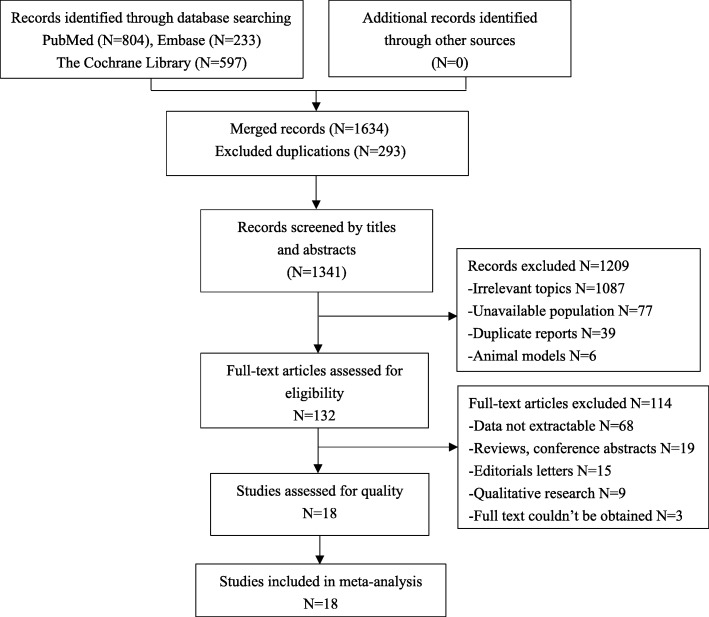
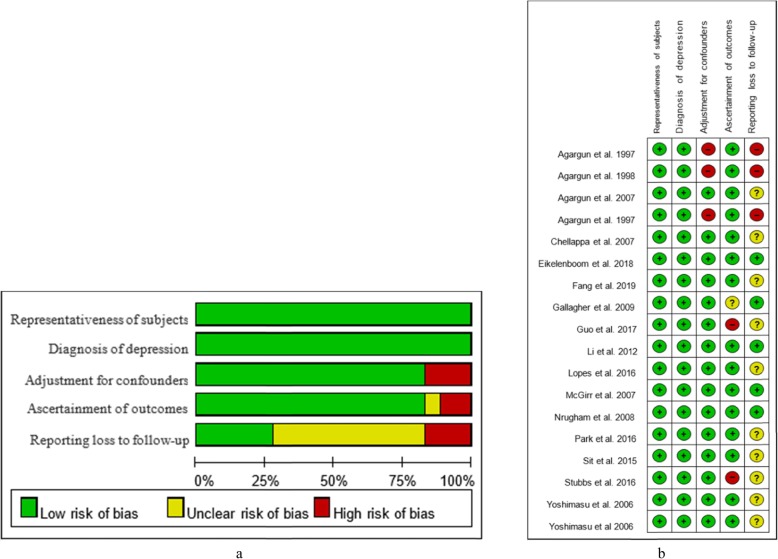
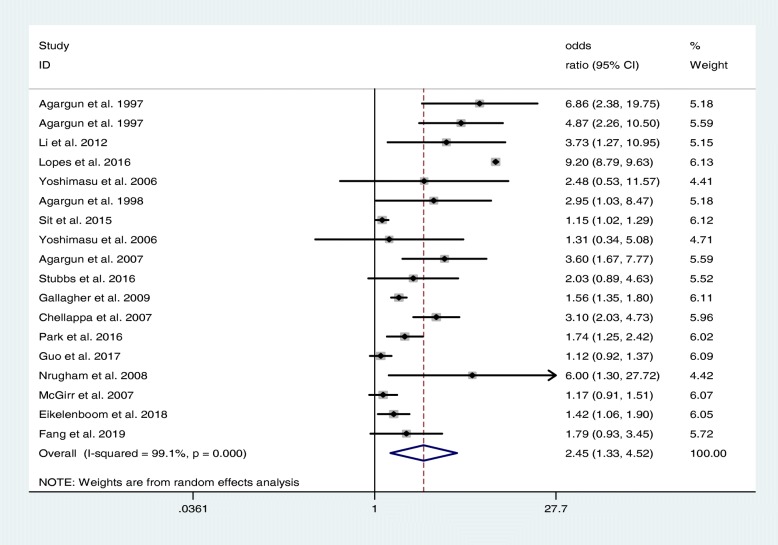
Background: The potential link between sleep disorders and suicidal behaviour has been the subject of several reviews. We performed this meta-analysis to estimate the overall association between sleep disorders and suicidal behaviour and to identify a more specific relationship in patients with depression. Methods: A systematic search strategy was developed across the electronic databases PubMed, EMBASE and the Cochrane Library from inception to January 1, 2019 for studies that reported a relationship between sleep disorders and suicidal behaviour in depressed patients. The odds ratio (OR) and corresponding 95% confidence interval (CI) were used to measure the outcomes. Heterogeneity was evaluated by Cochran’s Q test and the I 2 statistic. The Newcastle-Ottawa Scale (NOS) was adopted to evaluate the methodological quality of each of the included studies, and the Grading of Recommendations Assessment, Development and Evaluation (GRADE) approach was used to assess the quality of the evidence. We calculated the overall association between sleep disorders and suicidal behaviour and estimated more specific categories, including insomnia, nightmares, hypersomnia, suicidal ideation, suicide attempt, and completed suicide. Results: A total of 18 studies were included in this study. Overall, sleep disorders were closely related to suicidal behaviour in patients with depression (OR = 2.45 95% CI: 1.33 4.52). The relatively increased risks of sleep disorders with suicidal ideation, suicide attempt and completed suicide ranged from 1.24 (95% CI: 1.00 1.53) to 2.41 (95% CI: 1.45 4.02). Nightmares were found to be highly correlated with the risk of suicidal behaviour (OR = 4.47 95% CI: 2.00 9.97), followed by insomnia (OR = 2.29 95% CI: 1.69 3.10). The certainty of the evidence was rated as very low for the overall outcome and the major depression subgroup and was rated as low for the depression subgroup. Conclusions: This meta-analysis supports the finding that sleep disorders, particularly nightmares and insomnia, increase the risk of suicidal behaviour in depressed patients. Considering that all included studies were observational, the quality of the evidence is rated as very low. More well-designed studies are needed to confirm our findings and to better explain the mechanisms by which sleep disorders aggravate suicidal behaviour in depressed patients.
Overview
The claims and statistics of this paper haven’t been checked yet.
Run the check — free, no account needed. It reads the open-access text and checks the sources it cites.
Integrity signals
Registry
Cites
Statistics
Figures
Verification
Claims the paper makes
The claims and statistics of this paper haven’t been checked yet.
Run the check — free, no account needed. It reads the open-access text and checks the sources it cites.
Claims other papers make about this one
Each is checked against this paper’s own text: does it say what the citing paper says it does?
The source backs part of the claim, not all of it — or backs it for a different population, condition or comparison.
In the citing paper
“Alongside this, sleep disturbances have been found to significantly heighten the risk of suicidal behaviour in people living with mental illness 71 .”
From A meta-review of "lifestyle psychiatry": the role of exercise, smoking, diet and sleep in the prevention and treatment of mental disorders (2020) · cites this paper as [71]
Experimental — accuracy not yet measuredIn the citing paper
“As one example, observed gender differences in depression prevalence became statistically nonsignificant when controls were included for latent internalizing and externalizing dimensions. 179”
From Time for united action on depression: a Lancet–World Psychiatric Association Commission (2022) · cites this paper as [179]
In the citing paper
“In patients with depression, insomnia and nightmares increase the risk of suicidal ideation, suicide attempts and completed suicides [4].”
From Cognitive behavioral therapy for insomnia in patients with mental disorders and comorbid insomnia: A systematic review and meta-analysis (2022) · cites this paper as [4]
Self-check
Percentages, sums and reported differences re-computed from the paper’s own numbers.
The self-check needs the paper’s full text.
Citations
Cites
PRISMA-P Group, Moher, D., Shamseer, L., Clarke, M., Ghersi, D., Liberati, A., Petticrew, M., Shekelle, P., & Stewart, L. A. (2015) · Systematic Reviews · doi:10.1186/2046-4053-4-1 · Cited by 26,223
Dermyshi, E., Wang, Y., Yan, C., Hong, W., Qiu, G., Gong, X., & Zhang, T. (2017) · Neonatology · doi:10.1159/000454668 · Cited by 24,586
GRADE guidelines: 1. Introduction—GRADE evidence profiles and summary of findings tables
Guyatt, G., Oxman, A. D., Akl, E. A., Kunz, R., Vist, G., Brozek, J., Norris, S., Falck-Ytter, Y., Glasziou, P., & deBeer, H. (2011) · Journal of Clinical Epidemiology · doi:10.1016/j.jclinepi.2010.04.026 · Cited by 10,681
Risk factors for suicidal thoughts and behaviors: A meta-analysis of 50 years of research
Franklin, J. C., Ribeiro, J. D., Fox, K. R., Bentley, K. H., Kleiman, E. M., Huang, X., Musacchio, K. M., Jaroszewski, A. C., Chang, B. P., & Nock, M. K. (2017) · Psychological Bulletin · doi:10.1037/bul0000084 · Cited by 3,784
Norderyd, O. M., Koch, G., Papias, A., Köhler, A. A., Helkimo, A. N., Brahm, C., Lindmark, U., Lindfors, N., Mattsson, A., Rolander, B., et al. (2015) · PubMed · Cited by 3,584
GRADE guidelines: a new series of articles in the Journal of Clinical Epidemiology
Guyatt, G. H., Oxman, A. D., Schünemann, H. J., Tugwell, P., & Knottnerus, A. (2011) · Journal of Clinical Epidemiology · doi:10.1016/j.jclinepi.2010.09.011 · Cited by 3,094
An international study of the relation between somatic symptoms and depression
Simon, G. E., VonKorff, M., Piccinelli, M., Fullerton, C., & Ormel, J. (1999) · New England Journal of Medicine · doi:10.1056/nejm199910283411801 · Cited by 1,303
Mental health: a world of depression
Smith, K. (2014) · Nature · doi:10.1038/515180a · Cited by 1,148
Tsuno, N., Besset, A., & Ritchie, K. (2005) · The Journal of Clinical Psychiatry · doi:10.4088/jcp.v66n1008 · Cited by 1,084
The Effects of Psychological Stress on Depression
Yang, L., Zhao, Y., Wang, Y., Liu, L., Zhang, X., Li, B., & Cui, R. (2015) · Current Neuropharmacology · doi:10.2174/1570159x1304150831150507 · Cited by 589
Research works printed but not linked: 1
- Bernert R, Reeve J, Perlis MIL, Joiner TE. Insomnia and nightmares as predictors of elevated suicide risk among patients seeking admission to emergency mental health facility. Sleep. 2009;32:A365–6.
Cited by
Sorted by citations
Items 101–177 of 177
Нарушения сна и суицидальное поведение. Сообщение I: Распространённость, влияния и взаимосвязи
Любов, Е. Б., & Zotov, P. B. (2020) · Суицидология · doi:10.32878/suiciderus.20-11-01(38)-98-116 · Cited by 6
Mansuri, Z., Reddy, A., Vadukapuram, R., Thootkur, M., & Trivedi, C. G. (2022) · Behavioral Sciences · doi:10.3390/bs12050117 · Cited by 4
Kaur, N., Vetter, C., Konrad, M., & Kostev, K. (2024) · Children · doi:10.3390/children11070758 · Cited by 4
In search of clinical targets for suicide prevention in major depressive disorder
Olgiati, P., & Serretti, A. (2023) · International Clinical Psychopharmacology · doi:10.1097/yic.0000000000000468 · Cited by 4
Yılmaz, H. Ö., & Arslan, M. (2023) · Current Psychology · doi:10.1007/s12144-023-05152-5 · Cited by 4
Goodman, M. L., Lee, M., Springer, A. E., Schick, V., Vaughan, E. M., Markham, C. M., Gitari, S., & Mukiri, F. (2023) · Journal of Sleep Research · doi:10.1111/jsr.14119 · Cited by 5
Takeshima, M., Sakurai, H., Inada, K., Aoki, Y., Ie, K., Kise, M., Yoshida, E., Matsui, K., Utsumi, T., Shimura, A., et al. (2024) · BMC Family Practice · doi:10.1186/s12875-024-02449-7 · Cited by 4
Khachatryan, S. G., Isayan, M., & Hovakimyan, H. (2021) · Armenian Journal of Health & Medical Sciences · doi:10.54235/27382737-2021.1.1-28 · Cited by 4
Rollinson, R., Ewing, B., Reeve, S., Graham, A., Lyons, J., Gee, B., Wilson, J., Tofan, I., Semper, K., & Clarke, T. (2025) · British Journal of Clinical Psychology · doi:10.1111/bjc.12531 · Cited by 3
Haritos, R., Küppers, V., Samea, F., Riemann, D. W., Jessen, F., Eickhoff, S. B., Dafsari, F. S., & Tahmasian, M. (2025) · European Psychiatry · doi:10.1192/j.eurpsy.2025.10088 · Cited by 6
Nightmares matter: rethinking suicide risk assessment and intervention in depression
Maruani, J., & Geoffroy, P. A. (2026) · SLEEP · doi:10.1093/sleep/zsag101 · Cited by 3
Fiori, V., Lombardo, C., Baglioni, C., & Ballesio, A. (2026) · Sleep Medicine Reviews · doi:10.1016/j.smrv.2026.102339 · Cited by 3
ALTERAÇÕES DE SONO EM PACIENTES DEPRESSIVOS ADULTOS: UMA REVISÃO INTEGRATIVA
Neto, M. S., Soares, E. A., & Duarte, G. G. D. M. (2023) · Arquivos de Ciências da Saúde da UNIPAR · doi:10.25110/arqsaude.v27i4.2023-008 · Cited by 3
Association between screen time, physical activity and sleep quality among youths
Liu, G., & Liu, D. (2023) · International Journal of Public Health Science (IJPHS) · doi:10.11591/ijphs.v12i3.23098 · Cited by 3
Relationship Between Insomnia and Continued Outpatient Treatment in Psychiatric Patients
Kamata, Y., Takashio, O., Sato, R., Kawai, H., Ishii, H., Aoyagi, K., Tomita, A., Toda, S., & Iwanami, A. (2024) · Neuropsychiatric Disease and Treatment · doi:10.2147/ndt.s454757 · Cited by 3
Scariot, P. P. M., Garbuio, A. L. P., Pelosi, A. C., Pedroso, L. C., Silva, L. A. H., Berigo, S. A., dos Reis, I. G. M., & Messias, L. H. D. (2024) · Journal of Clinical Medicine · doi:10.3390/jcm13226743 · Cited by 3
Michelsen, M. E., Erlangsen, A., Høier, N. K., Jennum, P., Nordentoft, M., & Madsen, T. (2025) · International Journal of Clinical and Health Psychology · doi:10.1016/j.ijchp.2025.100580 · Cited by 3
Hsiao, S., Cheng, C., Lin, I.-J., Yu, C.-P., Huang, Y.-C., Huang, S.-H., Sun, C., Fann, L.-Y., Sheu, M.-Y., & Chien, W. (2022) · International Journal of Environmental Research and Public Health · doi:10.3390/ijerph192013169 · Cited by 6
Top 10 academic progress on traditional Chinese medicine in 2022
Li, J. (2023) · Science of Traditional Chinese Medicine · doi:10.1097/st9.0000000000000015 · Cited by 3
Slanitz, C., Fuchshuber, J., Fink, A., & Unterrainer, . (2024) · Frontiers in Public Health · doi:10.3389/fpubh.2024.1322069 · Cited by 3
Social zeitgeber and sleep loss as risk factors for suicide in American Indian adolescents
Ehlers, C. L., Gilder, D. A., Benedict, J., Wills, D. N., Phillips, E., Gonzales, C., Karriker‐Jaffe, K. J., & Bernert, R. A. (2024) · Transcultural Psychiatry · doi:10.1177/13634615241227679 · Cited by 4
Seasonal allergies and mental health: Do small health shocks affect suicidality?
Abramowitz, J., Danagoulian, S., & Fleming, O. (2025) · Journal of Health Economics · doi:10.1016/j.jhealeco.2025.103069 · Cited by 3
Tai, Y., Tsai, C.-W., & Yang, S. (2020) · Taiwanese Journal of Psychiatry · doi:10.4103/tpsy.tpsy_34_20 · Cited by 3
Attitudes Towards Suicide: A Systematic Review of Evaluation Instruments in Different Settings
Diaz, M., Pina, D., Díez-Gómez, A., Cascales-Martínez, A., López, R. L., & Puente-López, E. (2025) · The European Journal of Psychology Applied to Legal Context · doi:10.5093/ejpalc2025a8 · Cited by 3
Ding, R., Liu, X.-Y., Ding, Y., Leng, M., Yang, L., & Zhang, A. (2025) · World Journal of Psychiatry · doi:10.5498/wjp.v15.i12.112672 · Cited by 2
Tong, Y., Li, H., Duan, M., He, Q., & Gao, Z. (2025) · BMC Psychiatry · doi:10.1186/s12888-025-07592-8 · Cited by 2
Clinical practice guideline for assessment and management of depression in India
Tripathi, A., Shukla, R., Kar, S. K., Gupta, S., Saran, P., Pattojoshi, A., & Rao, T. (2026) · Indian Journal of Psychiatry · doi:10.4103/indianjpsychiatry_1321_25 · Cited by 4
Sleep and Depression: What We Know and What to Learn?
Antsyborov, A. V., Kalinchuk, A. V., & Dubatova, I. V. (2020) · Interactive science · doi:10.21661/r-551927 · Cited by 3
Anxiety and Depression During the COVID-19 Pandemic and Their Impact on Sleep
Maqbali, M. A. H. A. (2023) · Progress in Sleep Research · doi:10.1007/978-981-99-0240-8_3 · Cited by 2
Dama, M. H., Wu, M., Tassone, V. K., Demchenko, I., Frey, B. N., Milev, R. V., Ravindran, A. V., Parikh, S. V., Rotzinger, S., Lou, W. Y. W., et al. (2023) · Psychiatry Research · doi:10.1016/j.psychres.2023.115222 · Cited by 2
Torres, L. H. S. F., Medeiros, Y. K. M. E., de Sousa, G. M., Vargas, H. D. Q., Galvão, A. C. D. M., de Almeida, R. N., Leocádio-Miguel, M. A., Soares, B. L., Palhano-Fontes, F., de Araújo, D. B., et al. (2024) · Current Psychology · doi:10.1007/s12144-024-05786-z · Cited by 2
Sleep disruption and premolar absence, NHANES, 2017–2020: A cross‐sectional study
Wiener, R. C., Hnat, M., & Ngan, P. (2024) · Community Dentistry And Oral Epidemiology · doi:10.1111/cdoe.12983 · Cited by 2
Hein, M., Wacquier, B., Conenna, M., Lanquart, J., & Point, C. (2024) · Journal of Clinical Medicine · doi:10.3390/jcm13195907 · Cited by 2
Nightmare Disorder: An Overview
Robertson, B., Semenov, A., Skluzacek, T. J., Ly, H., & Miller, M. (2024) · Springer optimization and its applications · doi:10.1007/978-3-031-68263-6_11 · Cited by 2
Senn, R., Rigotti, V., Bahmani, D. S., Stanga, Z. G., Ülgür, I. I., Blais, R. K., Fichter, C., Schkade, I., Annen, H., & Brand, S. (2025) · Behavioral Sleep Medicine · doi:10.1080/15402002.2024.2441792 · Cited by 2
Insônia e depressão: confluências neurobiológicas e tratamento
Zanini, M. A., Pinna, C. M. D. S., Lourenço, R. B., dos Reis, F. Z., Borges, D. G. S., Santana, G., Margis, R., & Júnior, A. R. T. (2025) · Debates em Psiquiatria · doi:10.25118/2763-9037.2025.v15.1332 · Cited by 2
Socio-demographic Characteristics and Sleeping Habits of Children with Suicide Attempt Abstract
Fidancı, İ., Taşar, M. A., & Saç, R. Ü. (2022) · Turkish Journal of Pediatric Emergency and Intensive Care Medicine · doi:10.4274/cayd.galenos.2021.64426 · Cited by 1
The contribution of sleep deprivation to suicidal behavior
Azevedo, T. G. D. M., Ponceano, A. K. M., Viana, M. S., Aguiar, M. C. C., dos Santos, M. V. R., & dos Santos, J. C. C. (2023) · Research Society and Development · doi:10.33448/rsd-v12i11.43543 · Cited by 1
Berardelli, I., Sarubbi, S., Trocchia, M. A., Longhini, L., Moschillo, A., Rogante, E., Cifrodelli, M., Erbuto, D., Innamorati, M., & Pompili, M. (2024) · The Journal of Nervous and Mental Disease · doi:10.1097/nmd.0000000000001793 · Cited by 1
Ma, H., Zhao, M., Zhao, S., & Wei, P. (2025) · European Journal of Psychotraumatology · doi:10.1080/20008066.2025.2588889 · Cited by 1
Association between weekend catch-up sleep and specific depressive symptoms: a real world research
Ma, S., Wang, Q., Zhang, Y., Cai, M., Su, R., Wang, T., Wang, H., Wang, X.-Y., & Hu, G.-T. (2025) · Frontiers in Psychiatry · doi:10.3389/fpsyt.2025.1698743 · Cited by 1
Self-citationWang, M., & Zhang, J. (2026) · Current Psychology · doi:10.1007/s12144-025-08927-0 · Cited by 1
Lestiawan, H., Jatmoko, C., Agustina, F., Sinaga, D., & Erawan, L. (2023) · Journal of Applied Intelligent System · doi:10.33633/jais.v8i3.8987 · Cited by 3
Algethami, A. M., Alfahmi, F. K., Alhusayni, M. A., Bamusa, S. A., Alsalmi, Y. I., Alboqami, A. F., & Aldosari, A. F. (2024) · Cureus · doi:10.7759/cureus.64124 · Cited by 1
A REVIEW ON THE RELATIONSHIP BETWEEN NIDRA QUALITY AND MENTAL HEALTH: A PHYSIOLOGICAL ASPECT
Keshri, M. K., & Prakash, S. (2022) · International Journal of Research in Ayurveda and Pharmacy · doi:10.7897/2277-4343.1306167 · Cited by 1
Suicide: An Immunological Disorder?Preprint
O'Connor, K. (2021) · SSRN Electronic Journal · doi:10.2139/ssrn.3783063 · Cited by 1
Haritos, R., Küppers, V., Samea, F., Riemann, D. W., Jessen, F., Eickhoff, S. B., Dafsari, F. S., & Tahmasian, M. (2025) · medRxiv · doi:10.1101/2025.03.28.25324836 · Cited by 1
Fukushima, T., Takashio, O., Kokaze, A., Sudo, H., Yamada, M., Kawai, H., Uno, H., Yoshida, T., Tosaka, Y., Kawai, K., et al. (2021) · Research Square · doi:10.21203/rs.3.rs-243654/v1
Психологическая реабилитация нейрохирургических больных на стационарном этапе лечения
Гриднева, Н. А. (2011) · Вестник новых медицинских технологий
Chen, J., Tuersun, Y., Yang, J., Xiong, M., Wang, Y., Rao, X., & Jiang, S. (2022) · Research Square · doi:10.21203/rs.3.rs-1350270/v2
Musa, E., Bohra, M. H., & Shapiro, C. M. (2021) · Elsevier eBooks · doi:10.1016/b978-0-12-822963-7.00133-x
Beesdo‐Baum, K. (2020) · Faculty Opinions – Post-Publication Peer Review of the Biomedical Literature · doi:10.3410/f.738680951.793580928
Chen, J., Tuersun, Y., Yang, J., Xiong, M., Wang, Y., Rao, X., & Jiang, S. (2022) · Research Square · doi:10.21203/rs.3.rs-1350270/v1
Ma, Z., Yu, Y., Gao, M., Chen, P., Hong, H., Yu, D., Liang, Z., Ye, Q., Wang, Y., Huang, G., et al. (2022) · doi:10.22541/au.167061219.95188925/v1
Construction and Validation of a Risk Warning Model of Depression in Patients with Pulmonary Nodule
Sun, J., Zhou, Y., & Wang, Z. (2023) · Perspectives In Psychiatric Care · doi:10.1155/2023/3449836
Interroger les rêves pour ouvrir une fenêtre sur la santé mentale
Geoffroy, P. A. (2023) · Médecine du Sommeil · doi:10.1016/j.msom.2023.05.001
Fagundes, D. L., Sougey, É. B., Silva, T. S., & Andrade, L. T. (2023) · Research Square · doi:10.21203/rs.3.rs-2749328/v1
Research Progress on the Association between Depression and Sleep Disorders
景, 平. (2024) · Advances in Clinical Medicine · doi:10.12677/acm.2024.143922
Shi, H., Sun, J., & Wang, Y. (2024) · Sleep and Biological Rhythms · doi:10.1007/s41105-024-00550-z
de Souza, L. S. M., & Faro, A. (2024) · Salud Mental · doi:10.17711/sm.0185-3325.2024.033 · Cited by 1
Cirulli, F., Ciacchella, C., & Collacchi, B. (2024) · Sustainable development goals series · doi:10.1007/978-3-031-70165-8_20
Developing a suicide risk prediction model for hospitalized adolescents with depression in China
Zhao, J., Li, Y., Chen, Y., & Shuid, A. N. (2025) · Frontiers in Psychiatry · doi:10.3389/fpsyt.2025.1532828
Iverson, G. L. (2025) · Scandinavian Journal of Medicine and Science in Sports · doi:10.1111/sms.70086
EMS Professionals Sleep Disturbance
Amiry, A. A., Ponder, W. N., Carbajal, J., Tarrant, M., & Cassiello-Robbins, C. F. (2025) · Journal of Occupational and Environmental Medicine · doi:10.1097/jom.0000000000003595
Sardarzehi, R., Vand, H. D. A., Fatollahzade, S., Bastami, M., & Jansson‐Fröjmark, M. (2025) · Archives of Suicide Research · doi:10.1080/13811118.2025.2597356
Yan, R., Geng, J. T., Huang, Y. H., Zou, H. W., Wang, X. M., Xia, Y., Zhao, S., Chen, Z. L., Zhou, H., Chen, Y., et al. (2022) · Figshare · doi:10.6084/m9.figshare.19234324
Self-citationFactors affecting sleep in gender dysphoria
Morii, T., Takashio, O., Yamada, H., Toda, S., Takahashi, A., Okino, K., Hirakawa, T., & Iwanami, A. (2025) · The Showa Medical University Journal · doi:10.15369/smuj.37.3_111
Huber, R., Gaillard, M., Sievertsen, S., Ma, J., Shao, S., Rubin, D. Y. D., Jones, S. A., Hill, A. R., Bartholomeusz, R., McGlade, E. C., et al. (2025) · JAACAP Open · doi:10.1016/j.jaacop.2025.11.004
Sevda, P., Kathiresan, P., Nebhinani, N., & Banerjee, M. (2026) · Indian Journal of Psychiatry · doi:10.4103/indianjpsychiatry_933_24
Luo, S., Zhu, Y., Luo, C., Luo, S., Li, Y., Cao, Y., & Zhang, G. (2026) · International Journal of Sport and Exercise Psychology · doi:10.1080/1612197x.2026.2665669
Yasuntimur, A., Ilbak, İ., Ersoy, E., Bayhan, V., & Vveinhardt, J. (2026) · BMC Public Health · doi:10.1186/s12889-026-27693-7
Sleep Problems as Prospective Predictors of Suicidal Ideation
Shimura, A., Iida, M., Takada, Y., Furui, Y., & Inoue, Y. (2026) · Archives of Suicide Research · doi:10.1080/13811118.2026.2703972
Troubles de l’humeur et sommeil
Maruani, J., & Geoffroy, P. A. (2025) · Elsevier eBooks · doi:10.1016/b978-2-294-78711-9.00014-1
Troubles du sommeil associés aux conduites suicidaires
Romier, A., & Geoffroy, P. A. (2025) · Elsevier eBooks · doi:10.1016/b978-2-294-78794-2.00029-4
Nightmare disorder and depression: Exploring a neglected clinical association
Maruani, J., Clerici, E., Lejoyeux, M., & Geoffroy, P. A. (2026) · Journal of Psychiatric Research · doi:10.1016/j.jpsychires.2026.08.021
Wang, M., Niu, M., Luo, X., Chen, X., Liu, H., Chen, T., Almulla, A. F., Zhang, Y., Li, J., & Maes, M. (2026) · medRxiv · doi:10.64898/2026.10.18.26365736
Palagini, L., Bassetti, C. L., Strambi, L. F., Riemann, D. W., & Fiorillo, A. (2026) · Current Sleep Medicine Reports · doi:10.1007/s40675-026-00401-y
Metadata
- Authors
- Wang, X., Cheng, S., & Xu, H.
- Affiliations
- Central South University (CN)
- Corresponding author
- Xu, Huilan
- Venue
- BMC Psychiatry
- Published
- 2019-10-17
- Volume
- 19
- Issue
- 1
- Pages
- 303-303
- ISSN
- 1471-244X (ISSN-L)
- PMC
- PMC6798511
- OpenAlex
- W2980774592
- Cited by
- 178
- References
- 68
- Citations by year
- 2026: 12 · 2025: 29 · 2024: 38 · 2023: 32 · 2022: 30 · 2021: 23 · 2020: 13
- FWCI
- 2.60
- Type
- journal article
- Language
- en
- Open access
- gold
- doi.org
- Locations
- BMC Psychiatry (publishedVersion, cc-by)
- PubMed Central (publishedVersion, cc-by)
- PubMed (publishedVersion)
- DOAJ (DOAJ: Directory of Open Access Journals) (submittedVersion, cc-by-sa)
- Topics
- Social Sciences › Psychology › Clinical Psychology › Suicide and Self-Harm Studies
- Social Sciences › Psychology › Experimental and Cognitive Psychology › Sleep and related disorders
- Health Sciences › Medicine › Pharmacology (medical) › Treatment of Major Depression
- Keywords
- sleep disorders, suicidal behavior, depression, insomnia, nightmares, hypersomnia, suicidal ideation, suicide attempts, suicide mortality, suicide risk
- MeSH terms
- Adult, Depression, Major Depressive Disorder, Female, Humans, Male, Sleep Wake Disorders, Suicide, Attempted, Odds Ratio, Suicidal Ideation
About these checks
Registry, retraction, Cites and statistics results are computed, not judged, with one exception: a printed reference that no index lists is read once by a model before it counts as a citation error. Claims are extracted by a model and kept only when their quote appears verbatim in the text; each cited source is then checked, with a model’s help, for whether it says what the claim relies on. Those verdicts can be wrong — read the claim’s quote and the cited source before relying on one.
Statistics and arithmetic are recomputed, not judged.
Confidence bands are shown only for fields calibrated on our annotated test set. None is calibrated yet, so no band is shown.
What counts as a claim ›How we measure confidence ›How we check this ›
Are you an author, or do you see a problem with this page? Request a review
