

The DOI matches its Crossref record; 79 of the 80 references it cites were found in a registry or an index.
The effect of yoga on sleep quality and insomnia in women with sleep problems: a systematic review and meta-analysis
Open accessPublished version of a preprint
Abstract
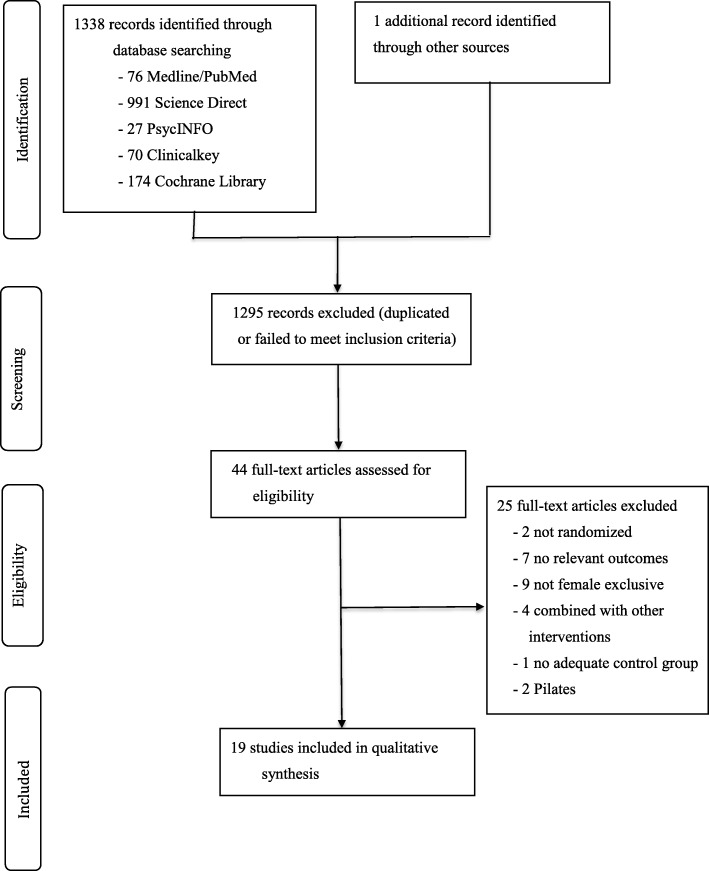
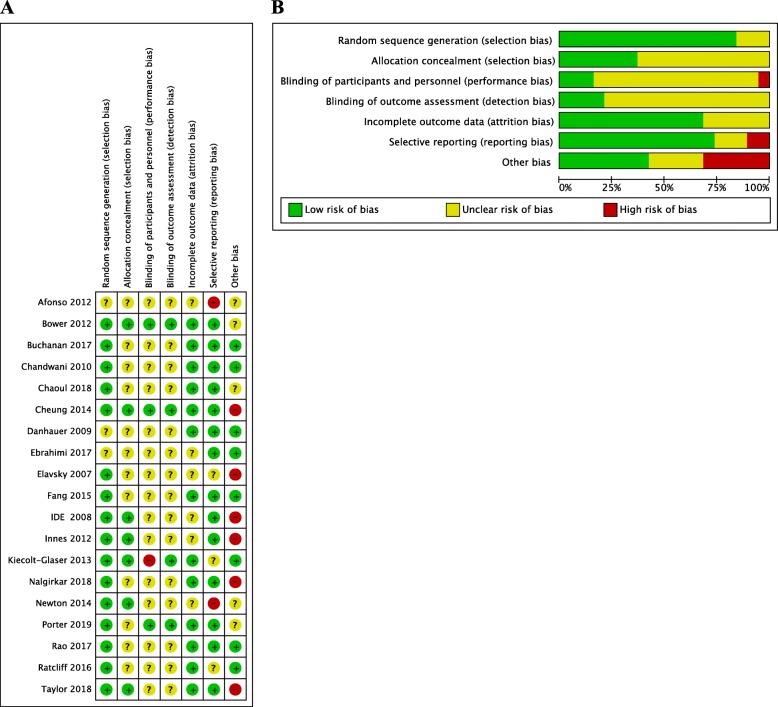
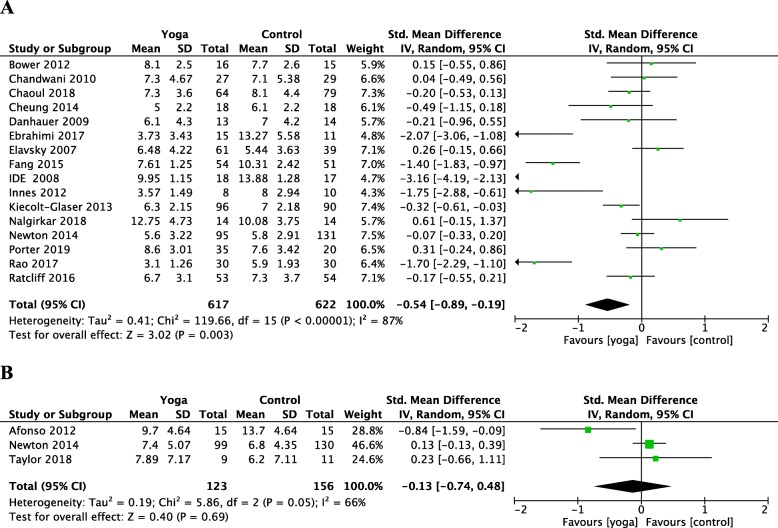
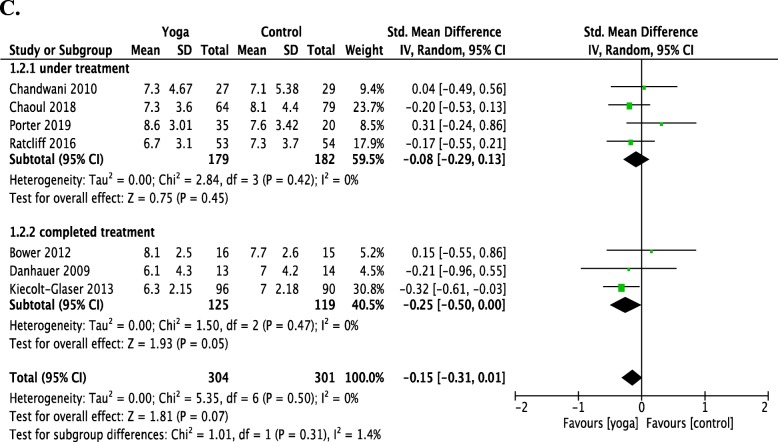
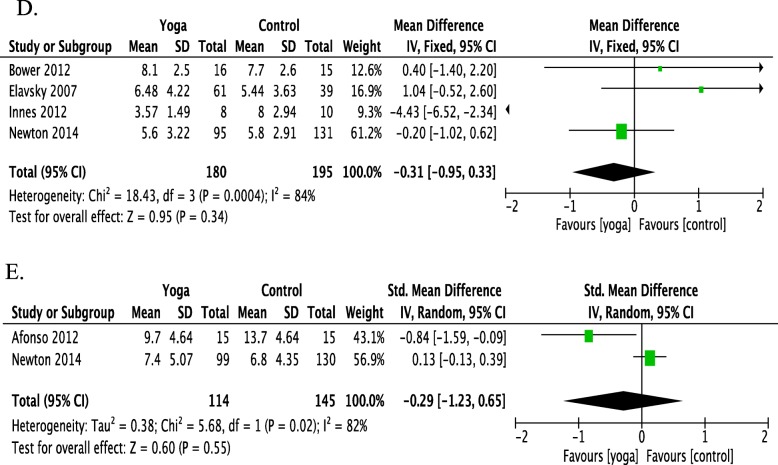
Background: To examine the effectiveness and safety of yoga of women with sleep problems by performing a systematic review and meta-analysis. Methods: Medline/PubMed, ClinicalKey, ScienceDirect, Embase, PsycINFO, and the Cochrane Library were searched throughout the month of June, 2019. Randomized controlled trials comparing yoga groups with control groups in women with sleep problems were included. Two reviewers independently evaluated risk of bias by using the risk of bias tool suggested by the Cochrane Collaboration for programming and conducting systematic reviews and meta-analyses. The main outcome measure was sleep quality or the severity of insomnia, which was measured using subjective instruments, such as the Pittsburgh Sleep Quality Index (PSQI), Insomnia Severity Index (ISI), or objective instruments such as polysomnography, actigraphy, and safety of the intervention. For each outcome, a standardized mean difference (SMD) and confidence intervals (CIs) of 95% were determined. Results: Nineteen studies in this systematic review included 1832 participants. The meta-analysis of the combined data conducted according to Comprehensive Meta-Analysis showed a significant improvement in sleep (SMD = − 0.327, 95% CI = − 0.506 to − 0.148, P < 0.001). Meta-analyses revealed positive effects of yoga using PSQI scores in 16 randomized control trials (RCTs), compared with the control group in improving sleep quality among women using PSQI (SMD = − 0.54; 95% CI = − 0.89 to − 0.19; P = 0.003). However, three RCTs revealed no effects of yoga compared to the control group in reducing insomnia among women using ISI (SMD = − 0.13; 95% CI = − 0.74 to 0.48; P = 0.69). Seven RCTs revealed no evidence for effects of yoga compared with the control group in improving sleep quality for women with breast cancer using PSQI (SMD = − 0.15; 95% CI = − 0.31 to 0.01; P = 0.5). Four RCTs revealed no evidence for the effects of yoga compared with the control group in improving the sleep quality for peri/postmenopausal women using PSQI (SMD = − 0.31; 95% CI = − 0.95 to 0.33; P = 0.34). Yoga was not associated with any serious adverse events. Discussion: This systematic review and meta-analysis demonstrated that yoga intervention in women can be beneficial when compared to non-active control conditions in term of managing sleep problems. The moderator analyses suggest that participants in the non-breast cancer subgroup and participants in the non-peri/postmenopausal subgroup were associated with greater benefits, with a direct correlation of total class time with quality of sleep among other related benefits.
Overview
The claims and statistics of this paper haven’t been checked yet.
Run the check — free, no account needed. It reads the open-access text and checks the sources it cites.
Integrity signals
Registry
Cites
Statistics
Figures
Verification
Claims the paper makes
The claims and statistics of this paper haven’t been checked yet.
Run the check — free, no account needed. It reads the open-access text and checks the sources it cites.
Claims other papers make about this one
Each is checked against this paper’s own text: does it say what the citing paper says it does?
The cited source says what the claim attributes to it.
In the citing paper
“A meta-analysis conducted by researchers in Taiwan on the effects of yoga on sleep quality indicated—surprisingly enough—an improvement in sleep quality in female patients who followed the practice [94].”
From The Effect of Vinyasa Yoga Practice on the Well-Being of Breast-Cancer Patients during COVID-19 Pandemic (2023) · cites this paper as [94]
Self-check
Percentages, sums and reported differences re-computed from the paper’s own numbers.
The self-check needs the paper’s full text.
Citations
Cites
Preferred Reporting Items for Systematic Reviews and Meta-Analyses: the PRISMA statement
Moher, D., Liberati, A., Tetzlaff, J., Altman, D. G., & for the PRISMA Group (2009) · BMJ · doi:10.1136/bmj.b2535 · Cited by 83,823
Bias in meta-analysis detected by a simple, graphical test
Egger, M., Smith, G. D., Schneider, M., & Minder, C. (1997) · BMJ · doi:10.1136/bmj.315.7109.629 · Cited by 56,722
The Pittsburgh Sleep Quality Index: a new instrument for psychiatric practice and research
Buysse, D. J., Reynolds, C. F., Monk, T. H., Berman, S. R., & Kupfer, D. J. (1989) · Psychiatry Research · doi:10.1016/0165-1781(89)90047-4 · Cited by 35,234
Cochrane Handbook for Systematic Reviews of Interventions: Cochrane Book Series
(2008) · doi:10.1002/9780470712184 · Cited by 25,048
CONSORT 2010 Statement: updated guidelines for reporting parallel group randomised trials
the CONSORT Group, Schulz, K. F., Altman, D. G., & Moher, D. (2010) · BMC Medicine · doi:10.1186/1741-7015-8-18 · Cited by 13,371
Validation of the Insomnia Severity Index as an outcome measure for insomnia research
Bastien, C. (2001) · Sleep Medicine · doi:10.1016/s1389-9457(00)00065-4 · Cited by 8,067
Schulz (1995) · doi:10.1001/jama.1995.03520290060030 · Cited by 5,634
Reprint—Preferred Reporting Items for Systematic Reviews and Meta-Analyses: The PRISMA Statement
Moher, D., Liberati, A., Tetzlaff, J., Altman, D. G., & and the PRISMA Group (2009) · Physical Therapy · doi:10.1093/ptj/89.9.873 · Cited by 2,486
CONSORT 2010 statement: Updated guidelines for reporting parallel group randomised trials
Schulz, K. F., Altman, D. G., & Moher, D. (2010) · Journal of Pharmacology and Pharmacotherapeutics · doi:10.4103/0976-500x.72352 · Cited by 2,165
European guideline for the diagnosis and treatment of insomnia
Riemann, D., Baglioni, C., Bassetti, C., Bjorvatn, B., Dolenc Groselj, L., Ellis, J. G., Espie, C. A., Garcia‐Borreguero, D., Gjerstad, M., Gonçalves, M., et al. (2017) · Journal of Sleep Research · doi:10.1111/jsr.12594 · Cited by 2,049
Research works printed but not linked: 2
- Cohen J. Statistical power analysis for the behavioral science. 2nd ed. Hillsdale: L. Erlbaum Associates; 1988.
- Yen CY. Effect of body balance sport training on depressive tendencies and sleep quality of female college students. J Natl Taiwan Sports Univ. 2008;19:37–50.
Cited by
Sorted by citations
Susanti, H. D., Sonko, I., Chang, P., Chuang, Y., & Chung, M. (2022) · Nursing and Health Sciences · doi:10.1111/nhs.12931 · Cited by 64
Liang, X., Haegele, J. A., Tse, A. C. Y., Li, M., Zhang, H., Zhao, S., & Li, S. X. (2024) · Sleep Medicine Reviews · doi:10.1016/j.smrv.2024.101913 · Cited by 58
Determinants of natural adult sleep: An umbrella review
Philippens, N., Janssen, E., Kremers, S., & Crutzen, R. (2022) · PLoS ONE · doi:10.1371/journal.pone.0277323 · Cited by 60
Gao, X., Qiao, Y., Chen, Q., Wang, C., & Zhang, P. (2024) · Journal of Clinical Sleep Medicine · doi:10.5664/jcsm.11106 · Cited by 41
Crosswell, A. D., Mayer, S. E., Whitehurst, L. N., Picard, M. A., Zebarjadian, S., & Epel, E. S. (2023) · Psychological Review · doi:10.1037/rev0000453 · Cited by 50
Metadata
- Authors
- Wang, W.-L., Chen, K.-H., Pan, Y.-C., Yang, S.-N., & Chan, Y.-Y.
- Affiliations
- Taoyuan Armed Forces General Hospital (TW)
- Tri-Service General Hospital (TW)
- Chung Yuan Christian University (TW)
- Corresponding author
- Chan, Yuan-Yu
- Venue
- BMC Psychiatry
- Published
- 2020-05-01
- Volume
- 20
- Issue
- 1
- Pages
- 195-195
- ISSN
- 1471-244X (ISSN-L)
- PMC
- PMC7193366
- OpenAlex
- W3022782640
- Cited by
- 176
- References
- 80
- Citations by year
- 2026: 20 · 2025: 26 · 2024: 38 · 2023: 42 · 2022: 24 · 2021: 23 · 2020: 2
- FWCI
- 3.33
- Type
- journal article
- Language
- en
- Open access
- gold
- doi.org
- Locations
- BMC Psychiatry (publishedVersion, cc-by)
- Research Square (acceptedVersion, cc-by)
- PubMed Central (publishedVersion, cc-by)
- PubMed (publishedVersion)
- DOAJ (DOAJ: Directory of Open Access Journals) (submittedVersion, cc-by-sa)
- Funders
- AFTYGH (10831)
- TYAFGH-D (109026)
- Topics
- Social Sciences › Psychology › Experimental and Cognitive Psychology › Sleep and related disorders
- Social Sciences › Psychology › Clinical Psychology › Mindfulness and Compassion Interventions
- Health Sciences › Medicine › Physiology (medical) › Obstructive Sleep Apnea Research
- Keywords
- yoga, sleep quality, insomnia, women, breast cancer, menopause, postmenopausal women
- MeSH terms
- Female, Humans, Sleep Initiation and Maintenance Disorders, Quality of Life, Recreation, Sleep, Yoga
About these checks
Registry, retraction, Cites and statistics results are computed, not judged, with one exception: a printed reference that no index lists is read once by a model before it counts as a citation error. Claims are extracted by a model and kept only when their quote appears verbatim in the text; each cited source is then checked, with a model’s help, for whether it says what the claim relies on. Those verdicts can be wrong — read the claim’s quote and the cited source before relying on one.
Statistics and arithmetic are recomputed, not judged.
Confidence bands are shown only for fields calibrated on our annotated test set. None is calibrated yet, so no band is shown.
What counts as a claim ›How we measure confidence ›How we check this ›
Are you an author, or do you see a problem with this page? Request a review
