

Mindfulness-based crisis interventions (MBCI) for psychosis within acute inpatient psychiatric settings; a feasibility randomised controlled trial
Open accessPublished version of a preprint
The DOI matches its Crossref record; 31 of the 31 references it cites were found in a registry or an index.
Abstract
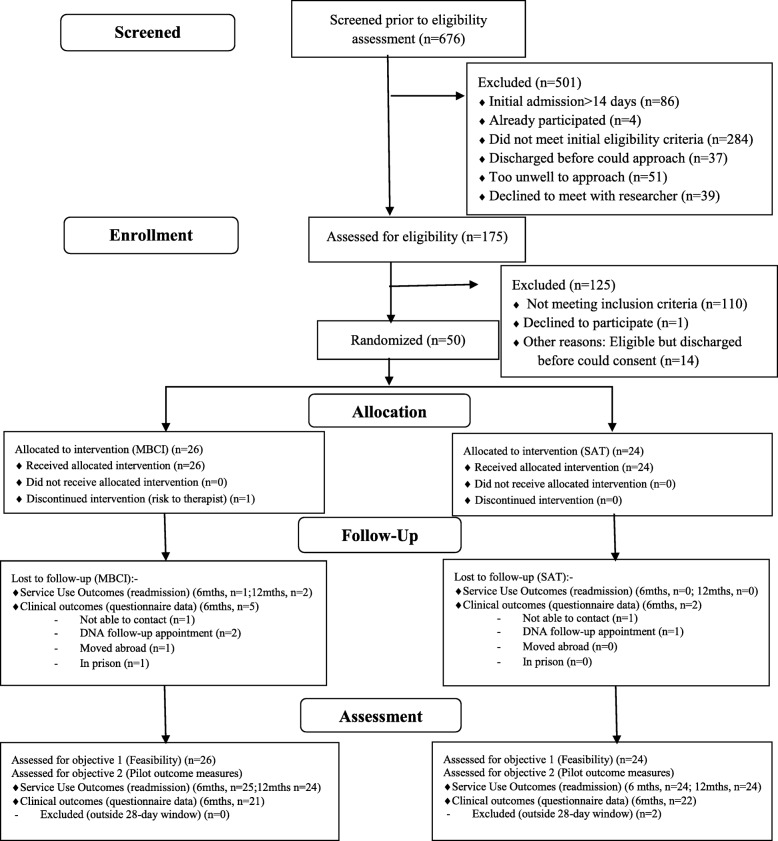
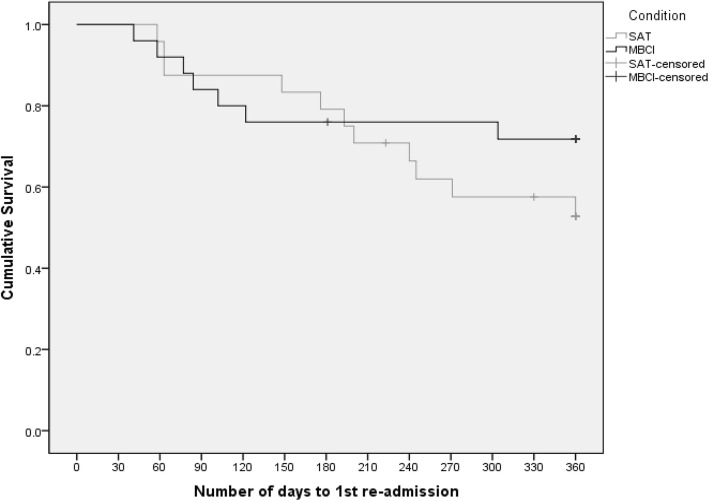
Background: Inpatient psychiatric care is a scarce and expensive resource in the National Health Service (NHS), with chronic bed shortages being partly driven by high re-admission rates. Brief inpatient talking therapies for psychosis could help reduce re-admission rates. The primary aim was to assess feasibility and acceptability of a novel, brief, mindfulness-based intervention for inpatients with psychosis. The secondary aim was to collect pilot outcome data on readmission rate, at 6 and 12 months (m) post discharge, and self-report symptom measures at 6 m. Methods: The amBITION study (BrIef Talking therapIes ON wards) was a parallel group, feasibility randomised controlled trial (RCT). In addition to treatment as usual (TAU), eligible inpatients with psychotic symptoms were randomly allocated to receive either (Mindfulness-Based Crisis Intervention; MBCI) or a control intervention (Social Activity Therapy; SAT), for 1–5 sessions. Results: Fifty participants were recruited (26 MBCI; 24 SAT); all received at least 1 therapy session (mean = 3). Follow-up rates were 98% at 6 m and 96% at 12 m for service use data extracted from clinical notes, and 86% for self-report measures. At 6 m follow-up, re-admission rates were similar across groups (MBCI = 6, SAT = 5; odds ratio = 1.20, 95% CI: 0.312–4.61). At 12 m follow-up, re-admissions were lower in the MBCI group (MBCI = 7, SAT = 11; odds ratio = 0.46, 95% CI: 0.14–1.51). Three participants experienced adverse events; none was related to trial participation. Conclusions: Delivering a brief mindfulness-based inpatient intervention for psychosis is feasible and acceptable, and may reduce risk of short-term readmission. These promising findings warrant progression to a larger clinical effectiveness trial. Trial registration: ISRCTN37625384 .
Overview
The claims and statistics of this paper haven’t been checked yet.
Free: it reads the open-access text and checks the first 5 claims that cite a source we can check. Create a free account to check every claim.
Integrity signals
Registry
Cites
Statistics
Figures
Verification
Claims the paper makes
The claims and statistics of this paper haven’t been checked yet.
Free: it reads the open-access text and checks the first 5 claims that cite a source we can check. Create a free account to check every claim.
Claims other papers make about this one
Each is checked against this paper’s own text: does it say what the citing paper says it does?
The source backs part of the claim, not all of it — or backs it for a different population, condition or comparison.
In the citing paper
“It has been demonstrated that using psychological interventions, such as acceptance and commitment therapy (ACT), as a coping strategy can improve resilience and the acceptance of crisis circumstances, as well as lowering anxiety and stress levels [14].”
From Physical Activity Plus Acceptance and Commitment Therapy Can Decrease Anxiety Symptoms and Insomnia Severity Among Individuals With Poor Sleep Quality (2023) · cites this paper as [14]
Experimental — accuracy not yet measuredThe source backs part of the claim, not all of it — or backs it for a different population, condition or comparison.
In the citing paper
“In terms of operationalising harm, 2/39 (5%) studies provided a clear definition of serious adverse events (Gumley et al., 2017;Jacobsen et al., 2020)”
From Systematic review of the safety of mindfulness-based interventions for psychosis (2024) · cites this paper as Jacobsen et al., 2020
Experimental — accuracy not yet measuredThe cited source says what the claim attributes to it.
In the citing paper
“The review demonstrated that only one intervention focused on crisis reduction as their primary target of therapy (Jacobsen et al., 2020), and only two focused on preventing rehospitalisation (Bach and Hayes, 2002, She et al., 2017), which are arguably the primary foci of psychiatric inpatient treatment.”
From A systematic review and meta-analysis of cognitive behavioural informed psychological interventions for psychiatric inpatients with psychosis (2020) · cites this paper as Jacobsen et al., 2020
The cited source says what the claim attributes to it.
In the citing paper
“Only one of the included studies (Jacobsen et al., 2020) explicitly identified changes made to their cognitive behavioural psychological intervention protocol for adaptation to the psychiatric inpatient setting.”
From A systematic review and meta-analysis of cognitive behavioural informed psychological interventions for psychiatric inpatients with psychosis (2020) · cites this paper as Jacobsen et al., 2020
The cited source says what the claim attributes to it.
In the citing paper
“All studies except one (Jacobsen et al., 2020) utilised a standard therapeutic protocol which was not explicitly described as being adapted to the needs and presentation of psychiatric inpatients”
From A systematic review and meta-analysis of cognitive behavioural informed psychological interventions for psychiatric inpatients with psychosis (2020) · cites this paper as Jacobsen et al., 2020
2 more claims about this paper
Create a free account to see every claim other papers make about this one.
Self-check
Percentages, sums and reported differences re-computed from the paper’s own numbers.
The self-check needs the paper’s full text.
Citations
Cites
Design and analysis of pilot studies: recommendations for good practice
Lancaster, G. A., Dodd, S., & Williamson, P. R. (2004) · Journal of Evaluation in Clinical Practice · doi:10.1111/j..2002.384.doc.x · Cited by 2,572
Hayes, S. C. (2004) · Behavior Therapy · doi:10.1016/s0005-7894(04)80013-3 · Cited by 2,493 · cited 1×
“The adapted therapy is brief (1–5 sessions), with stand-alone sessions to accommodate unpredictable lengths of stay, designed to target the putative underlying psychological processes implicated in crisis such as experiential avoidance [16].”
BackgroundComparative Studies of Psychotherapies: Is It True That "Everyone Has Won and All Must Have Prizes"?
Luborsky, L. (1975) · Archives of General Psychiatry · doi:10.1001/archpsyc.1975.01760260059004 · Cited by 1,485
Sim, J., & Lewis, M. (2012) · Journal of Clinical Epidemiology · doi:10.1016/j.jclinepi.2011.07.011 · Cited by 1,036
Bach, P., & Hayes, S. C. (2002) · Journal of Consulting and Clinical Psychology · doi:10.1037/0022-006x.70.5.1129 · Cited by 839 · cited 4×
“Bach P, Hayes SC.”
BackgroundMethodInfluentialHayes, S. C. (2016) · Behavior Therapy · doi:10.1016/j.beth.2016.11.006 · Cited by 785
Contamination in trials: is cluster randomisation the answer?
Torgerson, D. J. (2001) · BMJ · doi:10.1136/bmj.322.7282.355 · Cited by 508 · cited 1×
“Contact between people on the same ward who were assigned to different arms of the trial is not a contamination risk itself, as there is no plausible process by which a complex and individually tailored therapy could be ‘passed on’ [31].”
BackgroundGaudiano, B. A., & Herbert, J. D. (2006) · Behaviour Research and Therapy · doi:10.1016/j.brat.2005.02.007 · Cited by 435
Transitional interventions to reduce early psychiatric readmissions in adults: systematic review
Vigod, S. N., Kurdyak, P. A., Dennis, C.-L., Leszcz, T., Taylor, V. H., Blumberger, D. M., & Seitz, D. P. (2013) · British Journal of Psychiatry · doi:10.1192/bjp.bp.112.115030 · Cited by 260
Person‐Based Cognitive Therapy for Distressing Psychosis
Chadwick, P. (2006) · Wiley eBooks · doi:10.1002/9780470713075 · Cited by 253
Self-citation
Research works printed but not linked: 3
- World Health Organisation (WHO) Mental Health Atlas 2011 2011
- NHS Benchmarking Network Work Programme Report 2016/17 2017
- National Institute for Health and Care Excellence (NICE) Psychosis and schizophrenia in adults: prevention and management (CG178) 2014 32207892
Cited by
Wood, L., Williams, C., Billings, J., & Johnson, S. (2020) · Schizophrenia Research · doi:10.1016/j.schres.2020.03.041 · Cited by 63
Böge, K., Karadza, A., Fuchs, L. M., Ehlen, F., Ta, T. M. T., Thomas, N., Bajbouj, M., & Hahn, E. (2020) · Frontiers in Psychiatry · doi:10.3389/fpsyt.2020.00600 · Cited by 46
“Concerning the treatment length in Germany MBIs enduring for approximately four weeks might be especially suitable, even though an in-patient trial from the UK showed effects after 1– 3 sessions (80).”
BackgroundGaudiano, B. A., Ellenberg, S., Johnson, J. E., Mueser, K. T., & Miller, I. W. (2023) · Schizophrenia Research · doi:10.1016/j.schres.2023.09.017 · Cited by 20
Recommendations for monitoring and reporting harm in mindfulness for psychosis research
Ellett, L., & Chadwick, P. (2021) · The British Journal of Psychiatry · doi:10.1192/bjp.2021.98 · Cited by 16
“…constraints mean that it is not possible to monitor all potential adverse events, what is practicable is for researchers to follow Jacobsen et al 4 in stating clearly in their trial protocol those adverse events that were deemed particularly relevant to the trial, specifying how these were…”
Self-citationCurrent Tensions and Challenges in Mindfulness Research and Practice
Ainsworth, B., Atkinson, M. J., AlBedah, E., Duncan, S., Groot, J., Jacobsen, P. C., James, A. M., Jenkins, T. A., Kylišová, K., Marks, E. M., et al. (2023) · Journal of Contemporary Psychotherapy · doi:10.1007/s10879-023-09584-9 · Cited by 20
Self-citationWood, L., Williams, C., Pinfold, V., Nolan, F., Morrison, A. P., Morant, N., Lloyd-Evans, B., Lewis, G., Lay, B., Jones, R., et al. (2022) · Pilot and Feasibility Studies · doi:10.1186/s40814-022-01160-7 · Cited by 12
Evans, N., Edwards, D. J., Carrier, J., Elliott, M. B., Gillen, E., Hannigan, B., Lane, R., & Williams, L. (2023) · Health and Social Care Delivery Research · doi:10.3310/bppt3407 · Cited by 16
Jacobsen, P. C., Haddock, G., Raphael, J., Peak, C., Winter, R., & Berry, K. (2022) · BJPsych Open · doi:10.1192/bjo.2022.527 · Cited by 11
Self-citationReich, D., Evans, S., Nelson, B., Hickey, T., & O’Shea, M. (2021) · Mindfulness · doi:10.1007/s12671-021-01611-x · Cited by 10
“Only four studies detailed how adverse events were measured (Alvarez-Jimenez et al., 2018; Gumley et al., 2017; Jacobsen et al., 2020; van der Valk et al., 2013).”
BackgroundInfluentialWood, L., Jacobsen, P., Ovin, F., & Morrison, A. P. (2022) · Schizophrenia Bulletin Open · doi:10.1093/schizbullopen/sgac005 · Cited by 6
Self-citationSystematic review of the safety of mindfulness-based interventions for psychosis
O'Brien-Venus, B., Ellett, L., Burgess-Barr, S., & Chadwick, P. (2024) · Clinical Psychology Review · doi:10.1016/j.cpr.2024.102445 · Cited by 6
Self-citationChong, Y. Y., Chien, W. T., Mou, H., Ip, C. K., & Bressington, D. T. (2024) · Schizophrenia Research · doi:10.1016/j.schres.2024.11.007 · Cited by 10
Motivational Interviewing in Patients with Acute Psychosis: A Feasibility Study
Panchalingam, J., Horisberger, R., Corda, C., Kleisner, N., Krasnoff, J., Burrer, A., Spiller, T. R., Edkins, V., Seifritz, E., & Homan, P. (2025) · Schizophrenia Bulletin Open · doi:10.1093/schizbullopen/sgaf004 · Cited by 8
Plencler, I., Cechnicki, A., Stankiewicz, P., Krupa, A. J., Gorostowicz, A., Kalisz, A., Błądziński, P., Żwirska, M., & Siwek, M. (2025) · Mindfulness · doi:10.1007/s12671-025-02565-0 · Cited by 6
“(MacDougall et al., 2024) or 17 and 65 (Hardenberg et al., 2022) — mood disorder and one-time intervention (Jacobsen et al., 2020), online individual practice (McDon-ald et al., 2024) (Figure 1).”
Ensuring that psychological interventions are delivered as intended on mental health inpatient wards
Berry, K., Handerer, F., Bucci, S., Penn, G., Morley, H., Raphael, J., Lovell, K., Price, O., Edge, D., Drake, R., et al. (2024) · British Journal of Clinical Psychology · doi:10.1111/bjc.12510 · Cited by 6
“The proportion of cancelled therapy sessions is comparable to other studies that implemented therapy sessions in inpatient settings (Jacobsen et al., 2020) and similar to community settings (Mitchell & Selmes, 2007), providing further confirmation that delivering therapy to inpatients is acceptable.”
Impact of progressive muscle relaxation on psychological symptoms on an inpatient psychiatric unit
Farris, P. C., Lynch, S. T., Groenendaal, E., Klepacz, L., Meyers, L. B., & Ferrando, S. J. (2023) · Brain Behavior and Immunity Integrative · doi:10.1016/j.bbii.2023.100033 · Cited by 8
Metacognitive training in the acute psychiatric care setting: feasibility, acceptability, and safety
Fischer, R., Nagel, M., Schöttle, D., Lüdecke, D., Lassay, F., Moritz, S., & Scheunemann, J. (2023) · Frontiers in Psychology · doi:10.3389/fpsyg.2023.1247725 · Cited by 7
Jacobsen, P. C., Berry, K., Clarkson, L., Hiscocks, R., Hopkins, I., Morgan, C., Tandon, D., Teale, A., Tyler, N., & Wood, L. (2024) · BMC Psychiatry · doi:10.1186/s12888-024-06294-x · Cited by 6
Self-citationStefanova, M., Taylor, G. M. J., & Jacobsen, P. C. (2020) · Psychiatry Research · doi:10.1016/j.psychres.2020.113605 · Cited by 4
Self-citationMousavi, S. S., Molanorouzi, K., Shojaei, M., & Bahari, S. M. (2023) · Sleep Medicine Research · doi:10.17241/smr.2022.01543 · Cited by 5
“It has been demonstrated that using psychological interventions, such as acceptance and commitment therapy (ACT), as a coping strategy can improve resilience and the acceptance of crisis circumstances, as well as lowering anxiety and stress levels [14].”
BackgroundNew Adaptations in the Application of Mindfulness to Psychosis Spectrum Disorders
Díaz-Garrido, J. A., Laffite Cabrera, H., Roncancio Medina, T., & Martínez-Huidobro, M. F. (2024) · Papeles del Psicólogo - Psychologist Papers · doi:10.23923/pap.psicol.3028 · Cited by 2
ACT for the Treatment of Psychosis and Schizophrenia-Spectrum Disorders
Gaudiano, B. A., & Ellenberg, S. (2022) · Oxford University Press eBooks · doi:10.1093/oxfordhb/9780197550076.013.24 · Cited by 2
Gussmann, E., Lindner, C., Lucae, S., Falkai, P., Padberg, F., Egli, S., & Kopf‐Beck, J. (2023) · European Archives of Psychiatry and Clinical Neuroscience · doi:10.1007/s00406-023-01690-y · Cited by 3
“The results of the LMMs (see Table 5) revealed significant medium-to-large post-intervention reductions from baseline for all secondary clinical outcomes, except for the self-rated WHODAS measuring disabilities and functional impairments.”
ResultInfluentialTownsend, L. D., Gee, N. R., Friedmann, E., Mueller, M. K., Thakre, T. P., & Barker, S. (2026) · Healthcare · doi:10.3390/healthcare14020154 · Cited by 1
“An intervention intended specifically for patients with psychosis [17] demonstrated the lowest recruitment rates (16.56%), likely due to the severity of impairment faced by these patients, followed by an exercise intervention [12] at 38.16%.”
InfluentialAssessing dietary, exercise, and non-pharmacological modalities within psychiatric hospitals
Metri, N., Ee, C., Wardle, J., Ng, C. H., Siskind, D. J., Brakoulias, V., Ho, F. Y., Wong, V. W.-H., Naidoo, U., Eaton, M., et al. (2022) · General Hospital Psychiatry · doi:10.1016/j.genhosppsych.2022.03.006 · Cited by 1
Zlotnik, D. M., Yoon, A., Harlan, M., & Mackey, E. R. (2024) · Academic Psychiatry · doi:10.1007/s40596-024-02023-4 · Cited by 1
“The significance of implementing effective psychotherapeutic training and interventions has been growing as psychiatric inpatient hospitalization is costly and scarce [11, 12].”
(Etiopia), F. U. I., & Becerril, I. M. (2020) · MLS Psychology Research · doi:10.33000/mlspr.v3i2.571
Acceptance and Recovery Therapy by Levels for Psychosis (ART): A Context-Centred Model
Laffite, H., Díaz-Garrido, J. A., Zúñiga, R., Martínez-Huidobro, M. F., & Fleta, J. L. H. (2023) · Springer eBooks · doi:10.1007/978-3-031-27003-1_17 · Cited by 2
About Hobbits, Jedi, Goddesses and Magical Energies: Clinical Cases from ART
Zúñiga, R., Díaz-Garrido, J. A., Laffite, H., & Cejas-Méndez, M. R. (2023) · Springer eBooks · doi:10.1007/978-3-031-27003-1_18
Panchalingam, J., Horisberger, R., Corda, C., Kleisner, N., Krasnoff, J., Burrer, A., Spiller, T. R., Seifritz, E., & Homan, P. (2024) · doi:10.31234/osf.io/x3mub
Non-pharmacological Interventions for Mental Disorders
Pinho, L. G. D., Fonseca, C., Lopes, M., Schneider, B., & Gawęda, Ł. (2024) · Frontiers research topics · doi:10.3389/978-2-8325-4708-3
Predictors of the intention to use integrative medicine in psychiatric hospitals
Schaub, C., Faouzi, M., Vonlanthen, J., Cordey, M., Marchand, P., Stantzos, A., Berna, C., & Alexandre, K. (2025) · Integrative Medicine Research · doi:10.1016/j.imr.2025.101179
“To identify factors associated with healthcare professionals’ intentions to use CIM, an intention score was calculated by summing the item scores within each factor (range [3–15]).”
Gee, N. R., Townsend, L., Friedmann, E., Barker, S. B., Thakre, T. P., & Mueller, M. K. (2026) · Healthcare · doi:10.3390/healthcare14101420
“These include mindfulness and meditative interventions [3,4] as well as truncated versions of standard therapies [5–9].”
Metadata
- Authors
- Jacobsen, P., Peters, E., Robinson, E. J., & Chadwick, P.
- Affiliations
- King's College London (GB)
- Corresponding author
- Jacobsen, Pamela
- Venue
- BMC Psychiatry
- Published
- 2020-04-29
- Volume
- 20
- Issue
- 1
- Pages
- 193-193
- ISSN
- 1471-244X (ISSN-L)
- PMC
- PMC7191699
- OpenAlex
- W2811362281
- Cited by
- 32
- References
- 31
- Citations by year
- 2026: 2 · 2025: 3 · 2024: 7 · 2023: 9 · 2022: 5 · 2021: 2 · 2020: 4
- FWCI
- 2.00
- Type
- journal article
- Language
- en
- Open access
- gold
- doi.org
- Licence
- cc-by
- creativecommons.org/licenses/by/4.0/ (tdm)
- creativecommons.org/licenses/by/4.0/ (vor)
- Locations
- BMC Psychiatry (publishedVersion, cc-by)
- PubMed Central (publishedVersion, cc-by)
- PubMed (publishedVersion)
- DOAJ (DOAJ: Directory of Open Access Journals) (submittedVersion, cc-by-sa)
- Pure (University of Bath) (submittedVersion)
- PsyArXiv (OSF Preprints) (submittedVersion)
- PsyArXiv (OSF Preprints) (submittedVersion, cc-by)
- Funders
- Research Trainees Coordinating Centre (DRF-2014-07-003)
- Topics
- Social Sciences › Psychology › Clinical Psychology › Mindfulness and Compassion Interventions
- Health Sciences › Medicine › Psychiatry and Mental health › Schizophrenia research and treatment
- Social Sciences › Psychology › Clinical Psychology › Psychiatric care and mental health services
- Keywords
- psychosis, psychiatric inpatient care, hospital readmission, feasibility and acceptability, psychotic symptoms
- MeSH terms
- Adolescent, Adult, Aftercare, Aged, Crisis Intervention, Feasibility Studies, Female, Humans, Inpatients, Male, Middle Aged, Patient Discharge, Psychotic Disorders, State Medicine, Young Adult, Mindfulness
About these checks
Registry, retraction, Cites and statistics results are computed, not judged, with one exception: a printed reference that no index lists is read once by a model before it counts as a citation error. Claims are extracted by a model and kept only when their quote appears verbatim in the text; each cited source is then checked, with a model’s help, for whether it says what the claim relies on. Those verdicts can be wrong — read the claim’s quote and the cited source before relying on one.
Statistics and arithmetic are recomputed, not judged.
Confidence bands are shown only for fields calibrated on our annotated test set. None is calibrated yet, so no band is shown.
What counts as a claim ›How we measure confidence ›How we check this ›
Are you an author, or do you see a problem with this page? Request a review
Data sources
Bibliographic data: Semantic Scholar, OpenAlex, Crossref.
Contains information from the Semantic Scholar Academic Graph Datasets, made available under the ODC Attribution License (ODC-BY 1.0).
Semantic Scholar’s data is described in: Kinney, R., et al. (2023). The Semantic Scholar Open Data Platform. arXiv:2301.10140.
