

The DOI matches its Crossref record; 33 of the 33 references it cites were found in a registry or an index.
The reliability and validity of PHQ-9 in patients with major depressive disorder in psychiatric hospital
Open accessPublished version of a preprint
Abstract
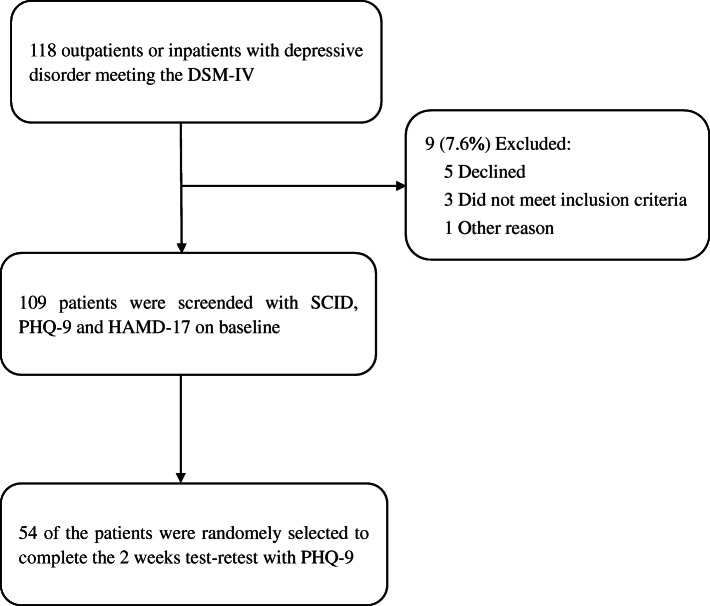
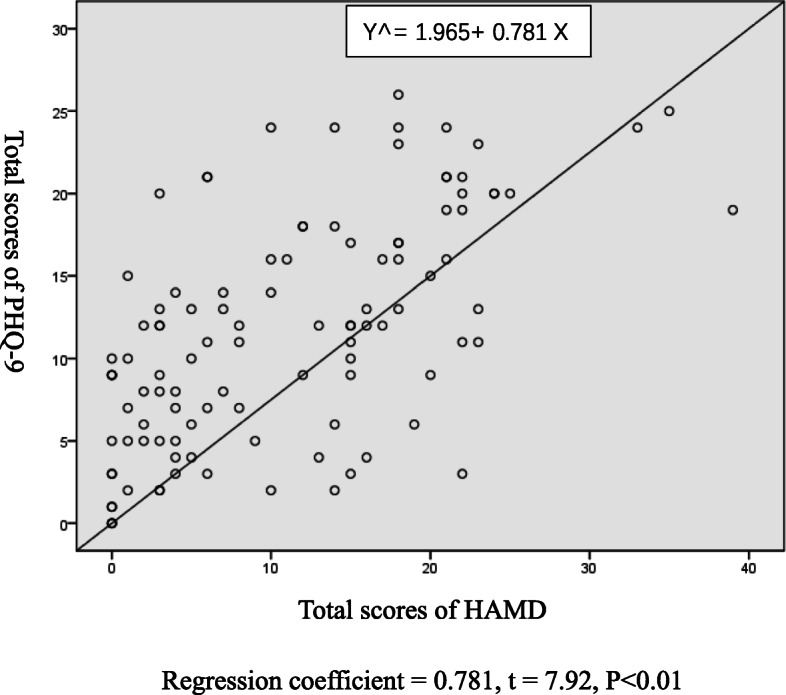
BACKGROUND: To assess the reliability and validity of Patient Health Questionnaire-9 (PHQ-9) for patients with major depressive disorder (MDD) and to assess the feasibility of its use in psychiatric hospitals in China. METHODS: One hundred nine outpatients or inpatients with MDD who qualified the Diagnostic and Statistical Manual of Mental Disorders, fourth edition (DSM-IV) criteria completed PHQ-9 and Hamilton Depression Scale (HAMD-17). Two weeks after the initial evaluation, 54 randomly selected patients underwent repeat assessment using PHQ-9. For validity analysis, the construct validity and criterion validity were assessed. The internal concordance coefficient and the test-retest correlation coefficients were used for reliability analysis. The correlation between total score and scores for each item and the correlation between scores for various items were evaluated using Pearson correlation coefficient. RESULTS: Principal components factor analysis showed good construct validity of the PHQ-9. PHQ-9 total score showed a positive correlation with HAMD-17 total score (r = 0.610, P < 0.001). With HAMD as the standard, PHQ-9 depression scores of 7, 15, and 21 points were used as cut-offs for mild, moderate, and severe depression, respectively. Consistency assessment was conducted between the depression severity as assessed by PHQ-9 and HAMD (Kappa = 0.229, P < 0.001). Intraclass correlation coefficient between PHQ-9 total score and HAMD total score was 0.594 (95% confidence interval, 0.456-0.704, P < 0.001). The Cronbach's α coefficient of PHQ-9 was 0.892. Correlation coefficients between each item score and the total score ranged from 0.567-0.789 (P < 0.01); the correlation coefficient between various item scores ranged from 0.233-0.747. The test-retest correlation coefficient for total score was 0.737. CONCLUSIONS: PHQ-9 showed good reliability and validity, and high adaptability for patients with MDD in psychiatric hospital. It is a simple, rapid, effective, and reliable tool for screening and evaluation of the severity of depression.
Overview
The claims and statistics of this paper haven’t been checked yet.
Run the check — free, no account needed. It reads the open-access text and checks the sources it cites.
Integrity signals
Registry
Cites
Statistics
Figures
Verification
Claims the paper makes
The claims and statistics of this paper haven’t been checked yet.
Run the check — free, no account needed. It reads the open-access text and checks the sources it cites.
Claims other papers make about this one
Each is checked against this paper’s own text: does it say what the citing paper says it does?
The cited source says what the claim attributes to it.
In the citing paper
“The Patient Health Questionnaire-9 (PHQ-9) (Spitzer et al., 1999) measures symptoms of depression with good internal consistency ( α = 0.89) and a test-retest reliability of 0.74 (Sun et al., 2020).”
From Acceptance and Commitment Therapy for inpatients with psychosis –an acceptability and feasibility single case AB designed study (2022) · cites this paper as Sun et al., 2020
Self-check
Percentages, sums and reported differences re-computed from the paper’s own numbers.
The self-check needs the paper’s full text.
Citations
Cites
The PHQ-9: Validity of a brief depression severity measure
Kroenke, K., Spitzer, R. L., & Williams, J. B. W. (2001) · Journal of General Internal Medicine · doi:10.1046/j.1525-1497.2001.016009606.x · Cited by 44,910
Kroenke, K., Spitzer, R. L., Williams, J. B. W., & Löwe, B. (2010) · General Hospital Psychiatry · doi:10.1016/j.genhosppsych.2010.03.006 · Cited by 4,057
Wang, W., Bian, Q., Zhao, Y., Li, X., Wang, W., Du, J., Zhang, G., Zhou, Q., & Zhao, M. (2014) · General Hospital Psychiatry · doi:10.1016/j.genhosppsych.2014.05.021 · Cited by 1,480
International Journal of Geriatric Psychiatry
Robinson, L., Hutchings, D., Dickinson, H. O., Corner, L., Beyer, F., Finch, T. L., Hughes, J., Vanoli, A., Ballard, C. G., & Bond, J. (2006) · International Journal of Geriatric Psychiatry · doi:10.1002/(issn)1099-1166 · Cited by 1,301
Gilbody, S., Richards, D., Brealey, S., & Hewitt, C. (2007) · Journal of General Internal Medicine · doi:10.1007/s11606-007-0333-y · Cited by 1,290
Sequenced treatment alternatives to relieve depression (STAR*D): Rationale and design
Rush, A. J., Fava, M., Wisniewski, S. R., Lavori, P. W., Trivedi, M. H., Sackeim, H. A., Thase, M. E., Nierenberg, A. A., Quitkin, F. M., Kashner, T. M., et al. (2004) · Controlled Clinical Trials · doi:10.1016/s0197-2456(03)00112-0 · Cited by 1,076
Whooley, M. A. (2008) · JAMA · doi:10.1001/jama.2008.711 · Cited by 887
Kocalevent, R.-D., Hinz, A., & Brähler, E. (2013) · General Hospital Psychiatry · doi:10.1016/j.genhosppsych.2013.04.006 · Cited by 748
Diez-Quevedo, C., Rangil, T., Sanchez-Planell, L., Kroenke, K., & Spitzer, R. L. (2001) · Psychosomatic Medicine · doi:10.1097/00006842-200107000-00021 · Cited by 649
Diagnostic accuracy of the mood module of the patient health questionnaire: a systematic review
Wittkampf, K. A., Naeije, L., Schene, A. H., Huyser, J., & van Weert, H. C. (2007) · General Hospital Psychiatry · doi:10.1016/j.genhosppsych.2007.06.004 · Cited by 493
Monahan, P. O., Shacham, E., Reece, M., Kroenke, K., Ong’or, W. O., Omollo, O., Yebei, V. N., & Ojwang, C. (2008) · Journal of General Internal Medicine · doi:10.1007/s11606-008-0846-z · Cited by 470
Validation of the PHQ-9 in a psychiatric sample
Beard, C., Hsu, K. J., Rifkin, L. S., Busch, A. B., & Björgvinsson, T. (2016) · Journal of Affective Disorders · doi:10.1016/j.jad.2015.12.075 · Cited by 467
Han, C., Jo, S. A., Kwak, J.-H., Pae, C.-U., Steffens, D., Jo, I., & Park, M. H. (2008) · Comprehensive Psychiatry · doi:10.1016/j.comppsych.2007.08.006 · Cited by 465
Reliability and validity of the Thai version of the PHQ-9
Lotrakul, M., Sumrithe, S., & Saipanish, R. (2008) · BMC Psychiatry · doi:10.1186/1471-244x-8-46 · Cited by 421
Yu, X.-N., Tam, W., Wong, P., Lam, T.-H., & Stewart, S. (2012) · Comprehensive Psychiatry · doi:10.1016/j.comppsych.2010.11.002 · Cited by 366
Reliability and validity of the PHQ‐9 for screening late‐life depression in Chinese primary care
Chen, S., Chiu, H. F. K., Xu, B., Ma, Y., Jin, T., Wu, M., & Conwell, Y. (2009) · International Journal of Geriatric Psychiatry · doi:10.1002/gps.2442 · Cited by 242
Liu, S.-I., Yeh, Z.-T., Huang, H.-C., Sun, F.-J., Tjung, J.-J., Hwang, L.-C., Shih, Y.-H., & Yeh, A. W.-C. (2011) · Comprehensive Psychiatry · doi:10.1016/j.comppsych.2010.04.013 · Cited by 192
Becker, S., Al Zaid, K., & Al Faris, E. (2002) · The International Journal of Psychiatry in Medicine · doi:10.2190/xtdd-8l18-p9e0-jyrv · Cited by 190
PHQ-9 and PHQ-2 for Screening Depression in Chinese Rural Elderly
Liu, Z.-W., Yu, Y., Hu, M., Liu, H., Zhou, L., & Xiao, S. (2016) · PLoS ONE · doi:10.1371/journal.pone.0151042 · Cited by 166
Hartung, T., Friedrich, M., Johansen, C., Wittchen, H., Faller, H., Koch, U., Brähler, E., Härter, M., Keller, M., Schulz, H., et al. (2017) · Cancer · doi:10.1002/cncr.30846 · Cited by 150
Test Review: Patient Health Questionnaire–9 (PHQ-9)
(2014) · Rehabilitation Counseling Bulletin · doi:10.1177/0034355213515305 · Cited by 124
Carballeira, Y., Dumont, P., Borgacci, S., Rentsch, D., Tonnac, N. D., Archinard, M., & Andreoli, A. (2007) · Psychology and Psychotherapy Theory Research and Practice · doi:10.1348/147608306x103641 · Cited by 123
Xiong, N., Fritzsche, K., Wei, J., Hong, X., Leonhart, R., Zhao, X., Zhang, L., Zhu, L., Tian, G., Nolte, S., et al. (2014) · Journal of Affective Disorders · doi:10.1016/j.jad.2014.12.042 · Cited by 108
Zhong, Q., Gelaye, B., Rondón, M. B., Sánchez, S. E., Simon, G. E., Henderson, D. C., Barrios, Y. V., Sánchez, P. M., & Williams, M. A. (2014) · Archives of Women s Mental Health · doi:10.1007/s00737-014-0481-0 · Cited by 101
Chen, S., Fang, Y., Chiu, H., Fan, H., Jin, T., & Conwell, Y. (2013) · Asia-Pacific Psychiatry · doi:10.1111/appy.12063 · Cited by 100
Feng, Y., Huang, W., Tian, T.-F., Wang, G., Hu, C., Chiu, H. F. K., Ungvari, G. S., Kilbourne, A. M., & Xiang, Y. (2016) · Psychiatry Research · doi:10.1016/j.psychres.2016.06.021 · Cited by 84
Du, N., Yu, K., Ye, Y., & Chen, S. (2016) · Asia-Pacific Psychiatry · doi:10.1111/appy.12266 · Cited by 83
Bonadiman, C. S. C., Passos, V. M. D. A., Mooney, M., Naghavi, M., & Melo, A. P. S. (2017) · Revista Brasileira de Epidemiologia · doi:10.1590/1980-5497201700050016 · Cited by 77
Yeung, A. S., Jing, Y., Brenneman, S. K., Chang, T. E., Baer, L., Hebden, T., Kalsekar, I., McQuade, R. D., Kurlander, J., Siebenaler, J., et al. (2012) · Depression and Anxiety · doi:10.1002/da.21983 · Cited by 74
van der Zwaan, G. L., van Dijk, S. E. M., Adriaanse, M. C., van Marwijk, H., van Tulder, M. W., Pols, A. D., & Bosmans, J. E. (2015) · Journal of Affective Disorders · doi:10.1016/j.jad.2015.09.045 · Cited by 34
Reliability and validity of Somali version of the PHQ-9 in primary care practice
Nallusamy, V., Afgarshe, M., & Shlosser, H. (2016) · The International Journal of Psychiatry in Medicine · doi:10.1177/0091217417696732 · Cited by 24
Yuan, H. W., Zhang, N., Wang, C., Luo, B. Y., Shi, Y., Li, J., Zhou, Y., Wang, Y., Zhang, T., Zhou, J., et al. (2013) · Neurological Sciences · doi:10.1007/s10072-013-1464-z · Cited by 15
Translating Science Into Service
Sussman, N. (2007) · The Primary Care Companion to The Journal of Clinical Psychiatry · doi:10.4088/pcc.v09n0501 · Cited by 14
Research works printed but not linked: 1
- Chen Q, Wang W, Liu Z. Calculation and evaluation of the ICC. Chin J Health Stat. 2008;25:314–5.
Cited by
Sorted by citations
Sun, Y., Kong, Z., Song, Y., Liu, J., & Wang, X. (2022) · BMC Psychiatry · doi:10.1186/s12888-021-03661-w · Cited by 131
Zhao, Y., Qu, D., Chen, S., & Chi, X. (2022) · Computers in Human Behavior · doi:10.1016/j.chb.2022.107424 · Cited by 135
Rahman, M. A., Dhira, T. A., Sarker, A. R., & Mehareen, J. (2022) · PLoS ONE · doi:10.1371/journal.pone.0269634 · Cited by 113
Ma, S., Yang, J., Yang, B., Kang, L., Wang, P., Zhang, N., Wang, W., Zong, X., Wang, Y., Bai, H., et al. (2021) · Frontiers in Psychiatry · doi:10.3389/fpsyt.2021.747139 · Cited by 91
Mullick, T., Radović, A., Shaaban, S., & Doryab, A. (2022) · JMIR Formative Research · doi:10.2196/35807 · Cited by 90
Metadata
- Authors
- Sun, Y., Fu, Z., Bo, Q., Mao, Z., Ma, X., & Wang, C.
- Affiliations
- Capital Medical University (CN)
- Corresponding author
- Bo, Qijing
- Venue
- BMC Psychiatry
- Published
- 2020-09-29
- Volume
- 20
- Issue
- 1
- Pages
- 474-474
- ISSN
- 1471-244X (ISSN-L)
- PMC
- PMC7525967
- OpenAlex
- W3089946977
- Cited by
- 343
- References
- 33
- Citations by year
- 2026: 54 · 2025: 90 · 2024: 79 · 2023: 62 · 2022: 47 · 2021: 11
- FWCI
- 29.00
- Type
- journal article
- Language
- en
- Open access
- gold
- doi.org
- Locations
- BMC Psychiatry (publishedVersion, cc-by)
- Research Square (acceptedVersion, cc-by)
- PubMed Central (publishedVersion, cc-by)
- PubMed (publishedVersion)
- DOAJ (DOAJ: Directory of Open Access Journals) (submittedVersion, cc-by-sa)
- Funders
- Beijing Municipal Administration of Hospitals Clinical Medicine Development of Special Funding Support (ZYLX201807)
- Beijing Hospitals Authority Youth Programme (QML20171901)
- Natural Science Foundation of Beijing Municipality (7192081)
- National Natural Science Foundation of China (81901355)
- Topics
- Social Sciences › Psychology › Experimental and Cognitive Psychology › Anxiety, Depression, Psychometrics, Treatment, Cognitive Processes
- Social Sciences › Decision Sciences › Management Science and Operations Research › Psychometric Methodologies and Testing
- Health Sciences › Medicine › Pharmacology (medical) › Treatment of Major Depression
- Keywords
- PHQ-9, major depressive disorder, depression severity assessment, depression screening, test-retest reliability, construct validity, criterion validity, Hamilton Depression Rating Scale, psychiatric inpatients, Chinese patients
- MeSH terms
- Patient Health Questionnaire, China, Depression, Major Depressive Disorder, Hospitals, Psychiatric, Humans, Psychiatric Status Rating Scales, Psychometrics, Surveys and Questionnaires, Reproducibility of Results
About these checks
Registry, retraction, Cites and statistics results are computed, not judged, with one exception: a printed reference that no index lists is read once by a model before it counts as a citation error. Claims are extracted by a model and kept only when their quote appears verbatim in the text; each cited source is then checked, with a model’s help, for whether it says what the claim relies on. Those verdicts can be wrong — read the claim’s quote and the cited source before relying on one.
Statistics and arithmetic are recomputed, not judged.
Confidence bands are shown only for fields calibrated on our annotated test set. None is calibrated yet, so no band is shown.
What counts as a claim ›How we measure confidence ›How we check this ›
Are you an author, or do you see a problem with this page? Request a review
