

Role of insulin-like growth factor 1, sex and corticosteroid hormones in male major depressive disorder
Open accessThe DOI matches its Crossref record; 40 of the 40 references it cites were found in a registry or an index.
Abstract
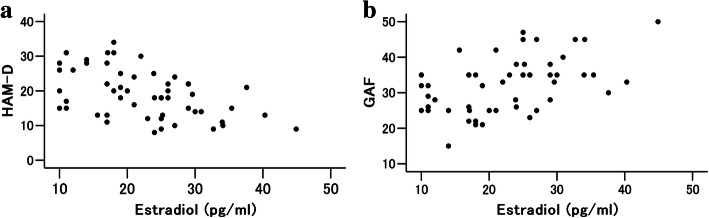
Background: Hormones of the hypothalamic–pituitary–gonadal (HPG), hypothalamic–pituitary–adrenal (HPA), and hypothalamic–pituitary–somatotropic (HPS) axes are potentially involved in major depressive disorder (MDD), but these hormones have not been simultaneously investigated in male patients with MDD. We investigated the association between male MDD symptoms and estradiol, testosterone, cortisol, dehydroepiandrosterone sulfate (DHEAS), and insulin-like growth factor 1 (IGF1). Methods: Serum estradiol, testosterone, cortisol, DHEAS, and IGF1 levels were measured in 54 male patients with MDD and 37 male controls and were compared with clinical factors. We investigated the associations between hormone levels and Hamilton Depression Rating Scale (HAM-D) scores. The correlations among hormones were also investigated. Results: Patients had significantly lower estradiol levels than controls (22.4 ± 8.4 pg/mL vs. 26.1 ± 8.5 pg/mL, P = 0.040). Serum estradiol levels were negatively correlated with HAM-D scores (P = 0.000094) and positively correlated with Global Assessment of Functioning scores (P = 0.000299). IGF1 levels and the cortisol:DHEAS ratio were higher in patients than in controls (IGF1: 171.5 ± 61.8 ng/mL vs. 144.1 ± 39.2 ng/mL, P = 0.011; cortisol:DHEAS ratio: 0.07 ± 0.05 vs. 0.04 ± 0.02, P = 0.001). DHEAS levels were lower in patients than in controls (227.9 ± 108.4 μg/dL vs. 307.4 ± 131.2 μg/dL, P = 0.002). IGF1, cortisol:DHEAS ratio, and DHEAS were not significantly correlated with HAM-D scores. Cortisol and testosterone levels were not significantly different between patients and controls. Serum estradiol levels were positively correlated with DHEAS levels (P = 0.00062) in patients, but were not significantly correlated with DHEAS levels in controls. Conclusion: Estradiol may affect the pathogenesis and severity of patients with MDD in men, and other hormones, such as those in the HPA and HPS axes, may also be involved in male MDD. Additionally, a correlation between estradiol and DHEAS may affect the pathology of MDD in men.
Overview
The claims and statistics of this paper haven’t been checked yet.
Free: it reads the open-access text and checks the first 5 claims that cite a source we can check. Create a free account to check every claim.
Integrity signals
Registry
Cites
Statistics
Figures
Verification
Claims the paper makes
The claims and statistics of this paper haven’t been checked yet.
Free: it reads the open-access text and checks the first 5 claims that cite a source we can check. Create a free account to check every claim.
Claims other papers make about this one
Each is checked against this paper’s own text: does it say what the citing paper says it does?
The cited source says what the claim attributes to it.
In the citing paper
“estradiol may influence the pathogenesis of male MDD patients. 120”
From Major depressive disorder: hypothesis, mechanism, prevention and treatment (2024) · cites this paper as [120]
Self-check
Percentages, sums and reported differences re-computed from the paper’s own numbers.
The self-check needs the paper’s full text.
Citations
Cites
The Corticosteroid Receptor Hypothesis of Depression
Holsboer, F. (2000) · Neuropsychopharmacology · doi:10.1016/s0893-133x(00)00159-7 · Cited by 2,181
Oyola, M. G., & Handa, R. J. (2017) · Stress · doi:10.1080/10253890.2017.1369523 · Cited by 710
Sex differences in anxiety and depression: Role of testosterone
McHenry, J., Carrier, N., Hull, E., & Kabbaj, M. (2014) · Frontiers in Neuroendocrinology · doi:10.1016/j.yfrne.2013.09.001 · Cited by 501 · cited 2×
“The association between testosterone and MDD in men has been studied [1, 2], and testosterone receptors have been found to be present in numerous brain regions associated with mood, such as the hippocampus and amygdala [1].”
BackgroundHPA axis and aging in depression: Systematic review and meta-analysis
Belvederi Murri, M., Pariante, C., Mondelli, V., Masotti, M., Atti, A. R., Mellacqua, Z., Antonioli, M., Ghio, L., Menchetti, M., Zanetidou, S., et al. (2014) · Psychoneuroendocrinology · doi:10.1016/j.psyneuen.2013.12.004 · Cited by 367
Juruena, M. F., Bocharova, M., Agustini, B., & Young, A. H. (2018) · Journal of Affective Disorders · doi:10.1016/j.jad.2017.09.052 · Cited by 360 · cited 1×
“However, some studies have shown that the HPA axis function may be reduced using antidepressants [8, 34, 35] and that this may be different for melancholic and atypical depression [36].”
BackgroundGuidelines for rating Global Assessment of Functioning (GAF)
Aas, I. M. (2011) · Annals of General Psychiatry · doi:10.1186/1744-859x-10-2 · Cited by 345 · cited 1×
“Social, occupational, and psychological functioning were assessed using the Global Assessment of Functioning (GAF) scale [21].”
MethodAcevedo‐Rodriguez, A., Kauffman, A. S., Cherrington, B. D., Borges, C. S., Roepke, T. A., & Laconi, M. (2018) · Journal of neuroendocrinology · doi:10.1111/jne.12590 · Cited by 298
Salivary cortisol and dehydroepiandrosterone in relation to puberty and gender
Netherton, C., Goodyer, I., Tamplin, A., & Herbert, J. (2004) · Psychoneuroendocrinology · doi:10.1016/s0306-4530(02)00150-6 · Cited by 232
Colizzi, M., Costa, R., & Todarello, O. (2014) · Psychoneuroendocrinology · doi:10.1016/j.psyneuen.2013.09.029 · Cited by 225
Elevation of the Cortisol-Dehydroepiandrosterone Ratio in Drug-Free Depressed Patients
Young, A. H., Gallagher, P., & Porter, R. J. (2002) · American Journal of Psychiatry · doi:10.1176/appi.ajp.159.7.1237 · Cited by 214 · cited 2×
“Through anti-glucocorticoid effects, DHEAS has protective effects against the neurotoxicity of cortisol [11]; therefore, changes in the cortisol:DHEAS ratio may represent a sensitive indicator of HPA function [12].”
Background
Cited by
Major depressive disorder: hypothesis, mechanism, prevention and treatment
Cui, L., Li, S., Wang, S., Wu, X., Liu, Y., Yu, W., Wang, Y., Tang, Y., Xia, M., & Li, B. (2024) · Signal Transduction and Targeted Therapy · doi:10.1038/s41392-024-01738-y · Cited by 1,244
“120 In animal models, E2 has been shown to alleviate depressive-like behavior.”
BackgroundArinami, H., Watanabe, Y., Suzuki, Y., Tajiri, M., Tsuneyama, N., & Someya, T. (2023) · Scientific Reports · doi:10.1038/s41598-023-28449-8 · Cited by 20
Self-citationChapter 4. Psychoneuroendocrinology
Sforzini, L., Weston, F. I., & Pariante, C. M. (2024) · American Psychiatric Association Publishing eBooks · doi:10.1176/appi.books.9781615375523.as04 · Cited by 16
Fernández-Pereira, C., & Agís‐Balboa, R. C. (2025) · International Journal of Molecular Sciences · doi:10.3390/ijms26062561 · Cited by 13
Association between IGF-1 levels and MDD: a case-control and meta-analysis
Qiao, X., Yan, J., Zang, Z., Xi, L., Zhu, W., Zhang, E., & Wu, L. (2024) · Frontiers in Psychiatry · doi:10.3389/fpsyt.2024.1396938 · Cited by 11
Li, Y., Lu, Y., Lin, X., & Zhao, L. (2026) · Annals of Medicine · doi:10.1080/07853890.2025.2611191 · Cited by 12
“…HPA axis, resulting in excessive glucocorticoid secretion, impaired negative feedback, and consequent neuronal damage in regions like the hippocampus and prefrontal cortex [74–79], with significant gender differences in stress sensitivity [80–82] and interactions with other endocrine axes [83–85].”
Aarestrup, M. R., Jensen, K. H. R., Larsen, S. V., Ozenne, B., Köhler‐Forsberg, K., Knudsen, G. M., Jørgensen, M. B., & Frøkjær, V. G. (2025) · Neuroscience Applied · doi:10.1016/j.nsa.2025.105517 · Cited by 7
“Further, middle-aged men with MDD treated with an SSRI appear to have lower plasma estradiol levels relative to healthy men and with plasma estradiol negatively correlated with their depression severity (Arinami et al., 2021).”
Arinami, H., Suzuki, Y., Watanabe, Y., Tajiri, M., Tsuneyama, N., & Someya, T. (2023) · Journal of Affective Disorders · doi:10.1016/j.jad.2023.10.009 · Cited by 6
Self-citationMachahary, N., Thakran, S., Thampi, G., Gangte, N., Sood, M., Kaushik, M., & Kukreti, R. (2025) · Biochemical and Biophysical Research Communications · doi:10.1016/j.bbrc.2025.153007 · Cited by 6
Exploring the potential of drug repurposing for treating depression
Verma, C., Jain, K., Saini, A., Mani, I., & Singh, V. (2024) · Progress in molecular biology and translational science · doi:10.1016/bs.pmbts.2024.03.037 · Cited by 3
Chibaatar, E., Fujii, R., Ikenouchi, A., Okamoto, N., Natsuyama, T., Hayasaki, G., Shinkai, T., & Yoshimura, R. (2024) · International Journal of Molecular Sciences · doi:10.3390/ijms252413663 · Cited by 5
“Pathologically, it is characterized by a range of structural and functional alterations in the brain, including neurotransmitter imbalances [3,4], neuroendocrine dysregulation [5,6], neuroinflammation [7,8], and oxidative stress [9,10].”
Jensen, K. H. R., Aarestrup, M. R., Larsen, S. V., Köhler‐Forsberg, K., Knudsen, G. M., Jørgensen, M. B., & Frøkjær, V. G. (2024) · Neuroscience Applied · doi:10.1016/j.nsa.2024.104050 · Cited by 3
“In a group of middle-aged males with MDD treated with an SSRI, plasma estradiol was lower than in healthy men, and estradiol was negatively correlated with depression severity (Arinami et al., 2021).”
Qiao, Z., Xie, Y., Wu, Y., Yang, X., Qiu, X., Zhou, J., Lu, Y., Chen, L., Tong, Y., Xu, J., et al. (2022) · Oxidative Medicine and Cellular Longevity · doi:10.1155/2022/3253687
Nouel‐Saied, L. M., Wang, R., & Werling, D. M. (2026) · Current Opinion in Genetics & Development · doi:10.1016/j.gde.2026.102546
Could chronic estradiol deficiency contribute to suicide risk in anorexia nervosa?
Mousa, A. M., McNeil, M., Mohamed, M. M. A., & Mahmoud, M. (2026) · Biological Psychiatry Global Open Science · doi:10.1016/j.bpsgos.2026.100843
Metadata
- Authors
- Arinami, H., Suzuki, Y., Tajiri, M., Tsuneyama, N., & Someya, T.
- Affiliations
- Niigata University (JP)
- Corresponding author
- Suzuki, Yutaro
- Venue
- BMC Psychiatry
- Published
- 2021-03-17
- Volume
- 21
- Issue
- 1
- Pages
- 157-157
- ISSN
- 1471-244X (ISSN-L)
- PMC
- PMC7967945
- OpenAlex
- W3138920802
- Semantic Scholar
- 3d49bd672ae1d6e7632dcefa557024c4c6256ae8
- Cited by
- 15
- References
- 40
- Citations by year
- 2026: 3 · 2025: 3 · 2024: 6 · 2023: 2 · 2022: 1
- FWCI
- 1.44
- Type
- journal article
- Language
- en
- Open access
- gold
- doi.org
- Licence
- cc-by
- creativecommons.org/licenses/by/4.0/ (tdm)
- creativecommons.org/licenses/by/4.0/ (vor)
- Locations
- BMC Psychiatry (publishedVersion, cc-by)
- PubMed Central (publishedVersion, cc-by)
- PubMed (publishedVersion)
- DOAJ (DOAJ: Directory of Open Access Journals) (submittedVersion, cc-by-sa)
- Funders
- Japan Society for the Promotion of Science (20H03597, 19K17085, 17K10268, 16K19755)
- Topics
- Life Sciences › Neuroscience › Behavioral Neuroscience › Stress Responses and Cortisol
- Health Sciences › Medicine › Pharmacology (medical) › Treatment of Major Depression
- Health Sciences › Medicine › Endocrinology, Diabetes and Metabolism › Hormonal and reproductive studies
- Keywords
- insulin-like growth factor I, major depressive disorder, male depression, estradiol, testosterone, cortisol, dehydroepiandrosterone sulfate, sex hormones, corticosteroids, hypothalamic-pituitary-gonadal axis, hypothalamic-pituitary-adrenal axis
- MeSH terms
- Major Depressive Disorder, Humans, Hydrocortisone, Insulin-Like Growth Factor I, Male, Testosterone, Dehydroepiandrosterone Sulfate
About these checks
Registry, retraction, Cites and statistics results are computed, not judged, with one exception: a printed reference that no index lists is read once by a model before it counts as a citation error. Claims are extracted by a model and kept only when their quote appears verbatim in the text; each cited source is then checked, with a model’s help, for whether it says what the claim relies on. Those verdicts can be wrong — read the claim’s quote and the cited source before relying on one.
Statistics and arithmetic are recomputed, not judged.
Confidence bands are shown only for fields calibrated on our annotated test set. None is calibrated yet, so no band is shown.
What counts as a claim ›How we measure confidence ›How we check this ›
Are you an author, or do you see a problem with this page? Request a review
Data sources
Bibliographic data: Semantic Scholar, OpenAlex, Crossref.
Contains information from the Semantic Scholar Academic Graph Datasets, made available under the ODC Attribution License (ODC-BY 1.0).
Semantic Scholar’s data is described in: Kinney, R., et al. (2023). The Semantic Scholar Open Data Platform. arXiv:2301.10140.
