

The DOI matches its Crossref record; 48 of the 49 references it cites were found in a registry or an index.
Are young female suicides increasing? A comparison of sex-specific rates and characteristics of youth suicides in Australia over 2004-2014
Open accessAbstract
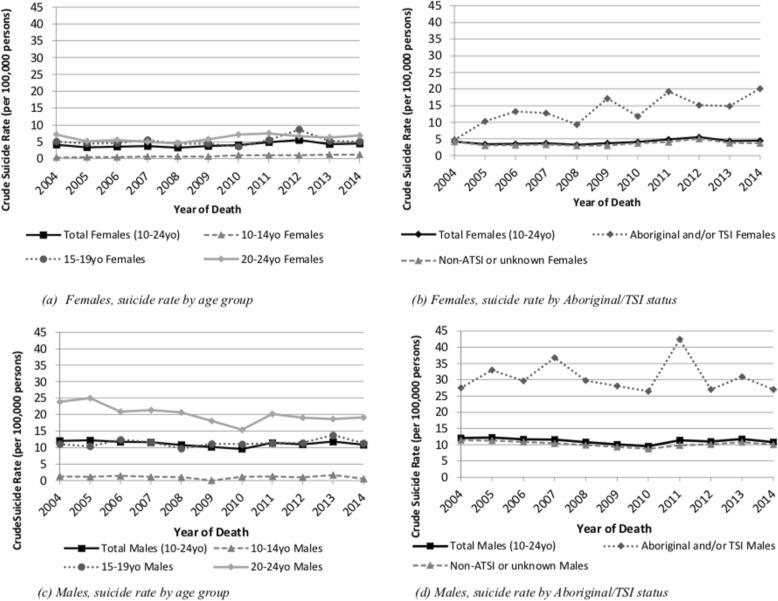
BACKGROUND: Australian mortality statistics suggest that young female suicides have increased since 2004 in comparison to young males, a pattern documented across other Western high-income countries. This may indicate a need for more targeted and multifaceted youth suicide prevention efforts. However, sex-based time trends are yet to be tested empirically within a comprehensive Australian sample. The aim of this study was to examine changes over time in sex-based rates and characteristics of all suicides among young people in Australia (2004-2014). METHODS: National Coronial Information System and Australian Bureau of Statistics data provided annual suicide counts and rates for 10-24-year-olds in Australia (2004-2014), stratified by sex, age group, Indigenous status and methods. Negative binomial regressions estimated time trends in population-stratified rates, and multinomial logistic regressions estimated time trends by major suicide methods (i.e., hanging, drug poisoning). RESULTS: Between 2004 and 2014, 3709 young Australians aged 10-24 years died by suicide. Whilst, overall, youth suicide rates did not increase significantly in Australia between 2004 and 2014, there was a significant increase in suicide rates for females (incident rate ratio [IRR] 1.03, 95% confidence interval [CI] 1.01 to 1.06), but not males. Rates were consistently higher among Aboriginal/Torres Strait Islander youth, males, and in older (20-24-years) as compared to younger (15-19 years) age groups. Overall, the odds of using hanging as a method of suicide increased over time among both males and females, whilst the odds of using drug-poisoning did not change over this period. CONCLUSIONS: We showed that suicide rates among young females, but not young males, increased over the study period. Patterns were observed in the use of major suicide methods with hanging the most frequently used method among both sexes and more likely among younger and Aboriginal/Torres Strait Islander groups. Findings highlight the need to broaden current conceptualizations of youth suicide to one increasingly involving young females, and strengthen the case for a multifaceted prevention approach that capitalize on young females' greater help-seeking propensity.
Overview
The claims and statistics of this paper haven’t been checked yet.
Run the check — free, no account needed. It reads the open-access text and checks the sources it cites.
Integrity signals
Registry
Cites
Statistics
Figures
Verification
Claims the paper makes
The claims and statistics of this paper haven’t been checked yet.
Run the check — free, no account needed. It reads the open-access text and checks the sources it cites.
Claims other papers make about this one
Each is checked against this paper’s own text: does it say what the citing paper says it does?
The source backs part of the claim, not all of it — or backs it for a different population, condition or comparison.
In the citing paper
“Rises in youth suicide rates have previously been reported in England and Wales (Bould et al., 2019), the USA (Ruch et al., 2019) and Australia (Stefanac et al., 2019).”
From Social media use, economic recession and income inequality in relation to trends in youth suicide in high-income countries: a time trends analysis (2020) · cites this paper as Stefanac et al., 2019
Experimental — accuracy not yet measuredThe source backs part of the claim, not all of it — or backs it for a different population, condition or comparison.
In the citing paper
“Although suicide rates are higher and are continuing to increase modestly for men and boys than for women and girls, in many countries rates are increasing more rapidly in young women than in young men.”
From The Lancet Psychiatry Commission on youth mental health (2024) · cites this paper as [39]
Experimental — accuracy not yet measuredIn the citing paper
“High-income countries were selected because recent studies have highlighted that some of the most striking rises in suicide rates have occurred in these settings (Bould et al., 2019; Ruch et al., 2019; Stefanac et al., 2019)”
From Social media use, economic recession and income inequality in relation to trends in youth suicide in high-income countries: a time trends analysis (2020) · cites this paper as Stefanac et al., 2019
In the citing paper
“Suicide rates in young people have markedly increased in several high-income countries over the last decade (Bould et al., 2019; Ruch et al., 2019; Stefanac et al., 2019).”
From Social media use, economic recession and income inequality in relation to trends in youth suicide in high-income countries: a time trends analysis (2020) · cites this paper as Stefanac et al., 2019
Self-check
Percentages, sums and reported differences re-computed from the paper’s own numbers.
The self-check needs the paper’s full text.
Citations
Cites
Suicide Prevention Strategies: A Systematic Review
Mann, J. J., Apter, A., Bertolote, J., Beautrais, A., Currier, D., Haas, A., Hegerl, U., Lonnqvist, J., Malone, K., Marusic, A., et al. (2005) · JAMA · doi:10.1001/jama.294.16.2064 · Cited by 2,852
Adolescence: A foundation for future health
Sawyer, S. M., Afifi, R. A., Bearinger, L. H., Blakemore, S.-J., Dick, B., Ezeh, A. C., & Patton, G. C. (2012) · The Lancet · doi:10.1016/s0140-6736(12)60072-5 · Cited by 2,635
Self-harm and suicide in adolescents
Hawton, K., Saunders, K. E., & O'Connor, R. C. (2012) · The Lancet · doi:10.1016/s0140-6736(12)60322-5 · Cited by 2,306
Suicide prevention strategies revisited: 10-year systematic review
Zalsman, G., Hawton, K., Wasserman, D., van Heeringen, K., Arensman, E., Sarchiapone, M., Carli, V., Höschl, C., Barzilay, R., Balazs, J., et al. (2016) · The Lancet Psychiatry · doi:10.1016/s2215-0366(16)30030-x · Cited by 1,765
Young People’s Help-Seeking for Mental Health Problems
Rickwood, D., Deane, F. P., Wilson, C. J., & Ciarrochi, J. (2005) · Australian e-Journal for the Advancement of Mental Health · doi:10.5172/jamh.4.3.218 · Cited by 1,619
Purdie, N., Dudgeon, P., & Walker, R. (2014) · Murdoch University Research Portal · Cited by 1,009
The prognosis of common mental disorders in adolescents: a 14-year prospective cohort study
Patton, G. C., Coffey, C., Romaniuk, H., Mackinnon, A., Carlin, J. B., Degenhardt, L., Olsson, C. A., & Moran, P. (2014) · The Lancet · doi:10.1016/s0140-6736(13)62116-9 · Cited by 527
Help-Seeking for Suicidal Thoughts and Self-Harm in Young People: A Systematic Review
Michelmore, L., & Hindley, P. (2012) · Suicide and Life-Threatening Behavior · doi:10.1111/j.1943-278x.2012.00108.x · Cited by 346
Suicide and Serious Suicide Attempts in Youth: A Multiple-Group Comparison Study
Beautrais, A. L. (2003) · American Journal of Psychiatry · doi:10.1176/appi.ajp.160.6.1093 · Cited by 336
National Confidential Inquiry into Suicide and Homicide by People with Mental Illness
Appleby, L., Shaw, J. J., & Amos, T. (1997) · The British Journal of Psychiatry · doi:10.1192/bjp.170.2.101 · Cited by 301
Cited by
Sorted by citations
Items 101–104 of 104
Cox, G., O’Neill, S. M., & Kavalidou, K. (2025) · Death Studies · doi:10.1080/07481187.2025.2569619
Pollock, N. J., Liu, L., Wilson, M., Reccord, C., Power, N., Mulay, S., Karaivanov, Y., & Tonmyr, L. (2021) · Figshare · doi:10.6084/m9.figshare.14903810
Gang, M., Ahn, Y., & Gwak, D. (2026) · Journal of Psychosocial Nursing and Mental Health Services · doi:10.3928/02793695-20260210-03
The recent trend in youth suicide and its associated factors in South Korea: a time series analysis
Choi, M., Lee, Y. H., Ki, M., & Chang, S. (2026) · The Lancet Regional Health - Western Pacific · doi:10.1016/j.lanwpc.2026.101924
Metadata
- Authors
- Stefanac, N., Hetrick, S., Hulbert, C., Spittal, M. J., Witt, K., & Robinson, J.
- Affiliations
- The University of Melbourne (AU)
- University of Auckland (NZ)
- Orygen (AU)
- Corresponding author
- Robinson, Jo
- Venue
- BMC Public Health
- Published
- 2019-10-28
- Volume
- 19
- Issue
- 1
- Pages
- 1389-1389
- ISSN
- 1471-2458 (ISSN-L)
- PMC
- PMC6819336
- OpenAlex
- W2982186017
- Cited by
- 105
- References
- 49
- Citations by year
- 2026: 3 · 2025: 13 · 2024: 11 · 2023: 47 · 2022: 8 · 2021: 11 · 2020: 11
- FWCI
- 8.75
- Type
- journal article
- Language
- en
- Open access
- gold
- doi.org
- Locations
- BMC Public Health (publishedVersion, cc-by)
- PubMed Central (publishedVersion, cc-by)
- PubMed (publishedVersion)
- DOAJ (DOAJ: Directory of Open Access Journals) (submittedVersion, cc-by-sa)
- Minerva Access (University of Melbourne) (submittedVersion, cc-by)
- ResearchSpace (University of Auckland) (submittedVersion, cc-by)
- Funders
- National Health and Medical Research Council
- Auckland Medical Research Foundation
- American Foundation for Suicide Prevention (PDF-0-145-16)
- Topics
- Social Sciences › Psychology › Clinical Psychology › Suicide and Self-Harm Studies
- Social Sciences › Sociology and Political Science › Homicide, Infanticide, and Child Abuse
- Health Sciences › Medicine › Public Health, Environmental and Occupational Health › Injury Epidemiology and Prevention
- Keywords
- youth suicide, young women, sex differences in suicide, suicide rates, temporal trends, hanging, drug poisoning, suicide methods, Aboriginal and Torres Strait Islander youth, Indigenous status, suicide prevention, Australia
- MeSH terms
- Adolescent, Australia, Child, Female, Humans, Male, Retrospective Studies, Suicide, Age Distribution, Sex Distribution, Young Adult
About these checks
Registry, retraction, Cites and statistics results are computed, not judged, with one exception: a printed reference that no index lists is read once by a model before it counts as a citation error. Claims are extracted by a model and kept only when their quote appears verbatim in the text; each cited source is then checked, with a model’s help, for whether it says what the claim relies on. Those verdicts can be wrong — read the claim’s quote and the cited source before relying on one.
Statistics and arithmetic are recomputed, not judged.
Confidence bands are shown only for fields calibrated on our annotated test set. None is calibrated yet, so no band is shown.
What counts as a claim ›How we measure confidence ›How we check this ›
Are you an author, or do you see a problem with this page? Request a review
