

Maternal health care services utilisation in the context of ‘Abiye’ (safe motherhood) programme in Ondo State, Nigeria
Open accessThe DOI matches its Crossref record; 20 of the 21 references it cites were found in a registry or an index.
Abstract
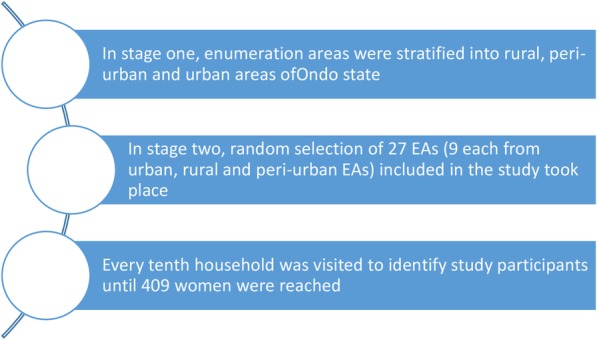
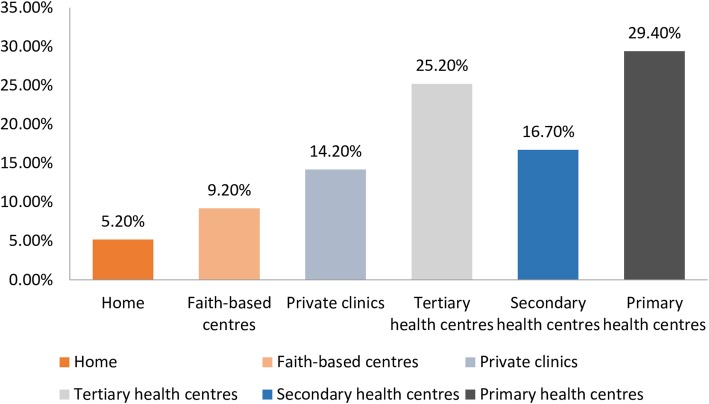
Background: The Nigeria Demographic and Health Survey (NDHS) of 2008 show that Ondo State had the worst maternal outcomes in the South Western region of Nigeria. To address this problem, the “Abiye” (safe motherhood) programme—which included community engagement, health system strengthening and user fee removal— was implemented by the state government. We assessed the use of maternal health care services and its determinants at 5 years after the implementation of this programme using a population-based survey. We also compared the results of our survey to the NDHS 2013 to assess improvement in maternal health care services utilisation. Methods: We conducted a population-based survey in 2016 among representative sample of 409 women who had given birth between 2011 and 2015, which were selected using cluster random sampling. We compared the findings of this 2016 survey to the 2013 NDHS, which contains maternal health care services utilisation information of a total of 434 women who gave birth between 2009 and 2013 to assess progress in the use of maternal health care services. We used descriptive and inferential statistics for our data analysis. Results: In the 2013 NDHS survey, about 80% of women received antenatal care compared to 98% in the 2016 survey. Our survey shows that the majority of births (85.6%) took place in health facilities compared to only 56.5% in NDHS 2013 survey, which represents a 29.1 percentage points increase. In both surveys, women with primary level of education or less had lower odds of delivering their babies in health facilities. However, while the 2013 NDHS survey shows that women who resided in urban areas were twice more likely to deliver their babies in health facilities compared to those living in rural areas, the 2016 survey shows that urban residence was no longer significantly associated with a higher odds of facility-based child delivery. Conclusion: Maternal health services utilisation has improved considerably following the implementation of the “Abiye” initiative. The findings of this study suggest that with community engagement, health system strengthening and user fee removal for the most vulnerable, universal access to and utilisation of maternal health services is possible.
Overview
The claims and statistics of this paper haven’t been checked yet.
Free: it reads the open-access text and checks the first 5 claims that cite a source we can check. Create a free account to check every claim.
Integrity signals
Registry
Cites
Statistics
Figures
Verification
Claims the paper makes
The claims and statistics of this paper haven’t been checked yet.
Free: it reads the open-access text and checks the first 5 claims that cite a source we can check. Create a free account to check every claim.
Claims other papers make about this one
Each is checked against this paper’s own text: does it say what the citing paper says it does?
The cited source doesn’t support the claim as written.
In the citing paper
“We further found that there is a definite lack of community engagement and formative research to ensure that cultural traditions are considered [60,147].”
From Digital Health Technologies for Maternal and Child Health in Africa and Other Low- and Middle-Income Countries: Cross-disciplinary Scoping Review With Stakeholder Consultation (2023) · doi:10.2196/42161 · cites this paper as [147]
Checked by a reasoning model — may be wrong.
Experimental — accuracy not yet measured
Self-check
Percentages, sums and reported differences re-computed from the paper’s own numbers.
The self-check needs the paper’s full text.
Citations
Cites
Global causes of maternal death: a WHO systematic analysis
Say, L., Chou, D., Gemmill, A., Tunçalp, Ö., Moller, A.-B., Daniels, J., Gülmezoglu, A. M., Temmerman, M., & Alkema, L. (2014) · The Lancet Global Health · doi:10.1016/s2214-109x(14)70227-x · Cited by 6,582
Alkema, L., Chou, D., Hogan, D., Zhang, S., Moller, A.-B., Gemmill, A., Fat, D. M., Boerma, T., Temmerman, M., Mathers, C., et al. (2016) · The Lancet · doi:10.1016/s0140-6736(15)00838-7 · Cited by 2,261
Nigeria Demographic and Health Survey 2008
Macro, I. (2009) · Cited by 2,063
You, D., Hug, L., Ejdemyr, S., Idele, P., Hogan, D., Mathers, C., Gerland, P., New, J. R., & Alkema, L. (2015) · The Lancet · doi:10.1016/s0140-6736(15)00120-8 · Cited by 830
Xu, K., Evans, D. B., Kadama, P., Nabyonga, J., Ogwal, P. O., Nabukhonzo, P., & Aguilar, A. M. (2006) · Social Science & Medicine · doi:10.1016/j.socscimed.2005.07.004 · Cited by 351
Kruk, M. E., Mbaruku, G., Rockers, P. C., & Galea, S. (2008) · Tropical Medicine & International Health · doi:10.1111/j.1365-3156.2008.02173.x · Cited by 204
McKinnon, B., Harper, S. B., Kaufman, J. S., & Bergevin, Y. (2014) · Health Policy and Planning · doi:10.1093/heapol/czu027 · Cited by 183
The Midwives Service Scheme in Nigeria
Abimbola, S., Okoli, U., Olubajo, O., Abdullahi, M. J., & Pate, M. A. (2012) · PLoS Medicine · doi:10.1371/journal.pmed.1001211 · Cited by 144
The national free delivery and caesarean policy in Senegal: evaluating process and outcomes
Witter, S., Dieng, T., Mbengue, D., Moreira, I., & De Brouwere, V. (2010) · Health Policy and Planning · doi:10.1093/heapol/czq013 · Cited by 136
User fees and maternity services in Ethiopia
Pearson, L., Gandhi, M., Admasu, K., & Keyes, E. (2011) · International Journal of Gynecology & Obstetrics · doi:10.1016/j.ijgo.2011.09.007 · Cited by 96
Research works printed but not linked: 5
- World Health Organization, UNICEF. Trends in maternal mortality: 1990- 2015: estimates from WHO, UNICEF, UNFPA, World Bank Group and the United Nations Population Division. 2015.
- Alkema L, Chou D, Hogan D, Zhang S, Moller A-B, Gemmill A, et al. Global, regional, and national levels and trends in maternal mortality between 1990 and 2015, with scenario-based projections to 2030: a systematic analysis by the UN maternal mortality estimation inter-agency group. Lancet. 2016; 387(10017):462-74. · DOI · Paper page
- Ondo State Ministry of Health. Abiye safe motherhood. Akure: Ondo State Ministry of Health; 2010.
- Isola OO, editor. The Use of Mobile Telephone in Reducing Pre-Natal Maternal Mortality: Case Study of Abiye (Safe Motherhood) Project in Ondo State, Southwest Nigeria. Paris: A Paper Presented at the International Conference on Habitele in University Sciences Po; 2013.
- Cooke J, Tahir F. Maternal health in Nigeria: with leadership, progress is possible. Washington DC: Center for Strategic and International Studies (CSIS); 2013.
Cited by
(2023) · doi:10.2196/42161 · Cited by 106
“We further found that there is a definite lack of community engagement and formative research to ensure that cultural traditions are considered [60,147].”
BackgroundChen, K. J., Duangthip, D., Gao, S. S., Huang, F. P., Anthonappa, R. P., de Oliveira, B. H., Turton, B. J., Durward, C. S., Tantawi, M. E., Attia, D., et al. (2021) · Frontiers in Oral Health · doi:10.3389/froh.2021.670154 · Cited by 102
“Also, the use of conditional cash transfer may improve the uptake of oral health care services [110] as this strategy improved the uptake of maternal care services by mothers in Nigeria [111].”
BackgroundNtoimo, L. F. C., Okonofua, F. E., Ekwo, C., Ojuolape, S., Igboin, B., Imongan, W., & Yaya, S. (2021) · Midwifery · doi:10.1016/j.midw.2021.103158 · Cited by 89
Lateef, A., Kuupiel, D., Mchunu, G. G., & Pillay, J. D. (2024) · International Journal of Environmental Research and Public Health · doi:10.3390/ijerph21040440 · Cited by 72
“Ajayi and Akpan, 2020 [73] • A low level of education was associated with the unlikeliness of pregnant women delivering a baby at a health facility.”
BackgroundOpara, U. C., Iheanacho, P., & Petrucka, P. M. (2024) · Reproductive Health · doi:10.1186/s12978-024-01933-8 · Cited by 62
Sule, F. A., Uthman, O. A., Olamijuwon, E. O., Ichegbo, N. K., Mgbachi, I. C., Okusanya, B., & Makinde, O. A. (2022) · BMJ Global Health · doi:10.1136/bmjgh-2021-007426 · Cited by 34
Coleman, T. L., Till, S. C., Farao, J., Shandu, L., Khuzwayo, N., Muthelo, L., Mbombi, M. O., Bopape, M. A., van Heerden, A. C., Mothiba, T. M., et al. (2023) · Proceedings of the ACM on Human-Computer Interaction · doi:10.1145/3610081 · Cited by 40
“Previous research [1] in MCH discovered that there is a definite shortage in community engagement and formative research to ensure that cultural practices are considered in this space [1, 17].”
BackgroundZuniga, J. A., García, A. A., Kyololo, O. M., Hamilton-Solum, P. L., Kabimba, A., Milimo, B., Abbyad, C. W., Reid, D., & Chelagat, D. (2021) · International Journal of Nursing Studies · doi:10.1016/j.ijnurstu.2021.103977 · Cited by 37
Muthelo, L., Mbombi, M. O., Bopape, M. A., Mothiba, T. M., Densmore, M., van Heerden, A. C., Norris, S. A., Verdezoto, N. X., Griffiths, P. L., & Mackintosh, N. J. (2023) · International Journal of Environmental Research and Public Health · doi:10.3390/ijerph20031842 · Cited by 39
“South Africa has made significant progress in reducing maternal and child mortality rates in the last two decades, but there is still a need to improve maternal and child healthcare services to reach Sustainable Development Goals (SDG) 4 and 5 by 2030 [18].”
BackgroundMethodInfluentialAjayi, A. I., Ahinkorah, B. O., & Seidu, A. (2022) · International Health · doi:10.1093/inthealth/ihac064 · Cited by 25
Self-citationBolarinwa, O. A., Babalola, T. O., Adebayo, O. A., & Ajayi, K. V. (2022) · Contraception and Reproductive Medicine · doi:10.1186/s40834-022-00187-8 · Cited by 20
“It is currently recognized as a significant element in reaching environmental, economic, and socially sustainable development [3] because it may help improve child and maternal health outcomes [4, 5].”
BackgroundAnumudu, S. I., Uhegwu, C. C., & Anumudu, C. K. (2025) · Global Health Journal · doi:10.1016/j.glohj.2025.10.004 · Cited by 31
Opara, U. C., Iheanacho, P., Li, H., & Petrucka, P. M. (2024) · BMC Pregnancy and Childbirth · doi:10.1186/s12884-024-06747-x · Cited by 20
Opara, U. C., Iheanacho, P., & Petrucka, P. M. (2025) · BMC Public Health · doi:10.1186/s12889-025-21275-9 · Cited by 21
“While many studies have suggested free MHS as an incentive to enhance the use of health services, several studies [20, 21, 56] found that free MHS does not always imply that women would access facility care as several factors, such as cultural factors and hidden cost of transportation are…”
Association between Socioeconomic Status and the Utilization of Maternal Health Services in Nigeria
Maitanmi, B. T., Adelaja, A. A., Okunola, D. R., Maitanmi, J. O., Tola, Y. O., & Akingbade, O. (2023) · Iranian Journal of Nursing and Midwifery Research · doi:10.4103/ijnmr.ijnmr_61_22 · Cited by 15
Mapping inequalities in health service coverage in Africa: a scoping review
Karamagi, H. C., Afriyie, D. O., Charif, A. B., Sy, S., Kipruto, H., Moyo, T., Oyelade, T. A., & Droti, B. (2024) · BMJ Open · doi:10.1136/bmjopen-2023-082918 · Cited by 16
Oyugi, B., Audi-Poquillon, Z., Kendall, S. A., & Peckham, S. (2024) · BMJ Open · doi:10.1136/bmjopen-2023-082011 · Cited by 18
“…reported else-where where, for instance, in Ghana, 77% of the mothers who participated in the EI noted that they were content with the HCWs service provision as they were patient and empathetic 93 or in Ethiopia, where 79.1% of the mothers interviewed were happy with the overall services provided.”
BackgroundInfluentialSunguya, B. F., Ngowi, J. E., Njiro, B. J., Munishi, C. G., Ndumwa, H. P., Kengia, J. T., Kapologwe, N., Deng, L., Timbrell, A., Kitinya, W. J., et al. (2024) · BMJ Open · doi:10.1136/bmjopen-2023-073859 · Cited by 8
Bolarinwa, O. A., Tadokera, R., & Tiwari, R. (2025) · Frontiers in Global Women s Health · doi:10.3389/fgwh.2025.1608774 · Cited by 4
“Also, ensuring that the free maternal healthcare policy is implemented in every state in Nigeria could enhance utilisation and improve maternal health outcomes (33).”
Ngusie, H. S., Tesfa, G. A., Taddese, A. A., Enyew, E. B., Alene, T. D., Abebe, G. K., Walle, A. D., & Zemariam, A. B. (2024) · Frontiers in Public Health · doi:10.3389/fpubh.2024.1439320 · Cited by 4
Addressing Malnutrition in Children: An Appraisal of the Ondo State Nutrition Program
Osunmakinwa, O. O., Oladoyin, V., Okunlola, O. A., Ibirongbe, D. O., Oyeyemi, O. T., Awosusi, A., Adebimpe, O., Ogundele, O. A., Akinkuotu, J., & Adejuwon, K. (2022) · Cureus · doi:10.7759/cureus.28595 · Cited by 3
“A study on the free health program in the State during this period showed that while women in the urban areas of the State were twice as more likely to deliver their babies in a health facility compared to their counterparts in rural areas (NDHS 2013), the 2016 study survey noted that the rural-urban divide in materna…”
Damerow, S. M., Lopes, H. D. G. M., Russo, G., Skovdal, M., Sørensen, J. B., & Fisker, A. B. (2024) · SSM - Health Systems · doi:10.1016/j.ssmhs.2024.100015 · Cited by 3
Akinrinade, O. T., Isere, E., & Ajayi, I. O. (2025) · Malaria Journal · doi:10.1186/s12936-025-05433-3 · Cited by 2
Adewuyi, E. O., Auta, A., Omonaiye, O., Adewuyi, M. I., Olutuase, V. O., Adefemi, K., Odeyemi, O. A., Zhao, Y., Tessema, G. A., & Pereira, G. F. (2025) · PLoS ONE · doi:10.1371/journal.pone.0337438 · Cited by 5
“The Abiye Programme’s success highlights that political will, sustainable financing, and community ownership are key [90,91].”
InfluentialThe Role of Leadership in Sub-Saharan Africa in Promoting Maternal and Child Health
Dimbuene, Z. T., Haregu, T., Nzuzi, R. M., & Kikhela, P.-D. N. (2023) · IntechOpen eBooks · doi:10.5772/intechopen.105773 · Cited by 3
Access and Uses of Free Maternal Health Care Services Among Women in Urban West Zanzibar
Abdul-Rahman, H. S., Dafay, M., & Hamad, A. U. (2021) · Journal of Health, Medicine and Nursing · doi:10.7176/jhmn/85-07
Banke-Thomas, A. O., & Eboreime, E. (2022) · Routledge eBooks · doi:10.4324/9781003128373-8 · Cited by 2
Proportion of Reproductive Age Women Utilizing Mobile Maternal Health Services in Makueni County
Mumo, J., Tai, S., & Kipkalom, R. (2023) · Journal of Health Medicine and Nursing · doi:10.47604/jhmn.2076
Determinants of Maternal Home Delivery in Nigeria: Evidence for Targeted Health Policy Interventions
Ayegboyin, M. (2025) · International Journal of Humanities Education and Social Sciences · doi:10.58578/ijhess.v3i3.6534
Health Policies and Prevention Strategies for Early Childhood Caries: A Narrative Review
Ramuvel, G., Bhardwaj, V., Fotedar, S., Thakur, A. S., Vashisth, S., & Sankhyan, A. (2025) · SBV Journal of Basic Clinical and Applied Health Science · doi:10.4103/sbvj.sbvj_58_25
The Tortuous Road to Ending Preventable Maternal Deaths in Nigeria
Dogbanya, G. (2026) · Annals of Global Health · doi:10.5334/aogh.5197
Adeleke, O. R., & Imisioluwa, J. O. (2026) · Journal of Clinical Practice and Medical Research · doi:10.59324/jcpmr.2026.2(4).09
Ojajuni, E. O., & Dirisu, J. O. (2026) · International Journal of Reproduction Contraception Obstetrics and Gynecology · doi:10.18203/2320-1770.ijrcog20263478
Famutimi, T. O., Iwaola, O. M., Sunday, F. R., Ojo, B. O., & Ajiboye, O. B. (2026) · Eurasian Journal of Family Medicine · doi:10.33880/ejfm.2026150302
Metadata
- Authors
- Ajayi, A. I., & Akpan, W.
- Affiliations
- African Population and Health Research Center (KE)
- Walter Sisulu University (ZA)
- Corresponding author
- Ajayi, Anthony Idowu
- Venue
- BMC Public Health
- Published
- 2020-03-19
- Volume
- 20
- Issue
- 1
- Pages
- 362-362
- ISSN
- 1471-2458 (ISSN-L)
- PMC
- PMC7082975
- OpenAlex
- W3012757328
- Cited by
- 34
- References
- 21
- Citations by year
- 2026: 4 · 2025: 7 · 2024: 8 · 2023: 5 · 2022: 6 · 2021: 4
- FWCI
- 3.60
- Type
- journal article
- Language
- en
- Open access
- gold
- doi.org
- Licence
- cc-by
- creativecommons.org/licenses/by/4.0/ (tdm)
- creativecommons.org/licenses/by/4.0/ (vor)
- Locations
- BMC Public Health (publishedVersion, cc-by)
- PubMed Central (publishedVersion, cc-by)
- PubMed (publishedVersion)
- DOAJ (DOAJ: Directory of Open Access Journals) (submittedVersion, cc-by-sa)
- Funders
- University of Fort Hare
- Topics
- Health Sciences › Medicine › Pediatrics, Perinatology and Child Health › Global Maternal and Child Health
- Health Sciences › Medicine › Public Health, Environmental and Occupational Health › Reproductive Health and Contraception
- Health Sciences › Medicine › Pediatrics, Perinatology and Child Health › Maternal and Neonatal Healthcare
- Keywords
- maternal health service utilization, facility-based childbirth, prenatal care, user fee removal, community participation, health system strengthening, educational attainment, urban-rural differences, Ondo State, Nigeria
- MeSH terms
- Maternal Health, Facilities and Services Utilization, Adolescent, Adult, Female, Health Promotion, Humans, Maternal Health Services, Middle Aged, Nigeria, Pregnancy, Program Evaluation, Health Care Surveys, Young Adult
About these checks
Registry, retraction, Cites and statistics results are computed, not judged, with one exception: a printed reference that no index lists is read once by a model before it counts as a citation error. Claims are extracted by a model and kept only when their quote appears verbatim in the text; each cited source is then checked, with a model’s help, for whether it says what the claim relies on. Those verdicts can be wrong — read the claim’s quote and the cited source before relying on one.
Statistics and arithmetic are recomputed, not judged.
Confidence bands are shown only for fields calibrated on our annotated test set. None is calibrated yet, so no band is shown.
What counts as a claim ›How we measure confidence ›How we check this ›
Are you an author, or do you see a problem with this page? Request a review
Data sources
Bibliographic data: Semantic Scholar, OpenAlex, Crossref.
Contains information from the Semantic Scholar Academic Graph Datasets, made available under the ODC Attribution License (ODC-BY 1.0).
Semantic Scholar’s data is described in: Kinney, R., et al. (2023). The Semantic Scholar Open Data Platform. arXiv:2301.10140.
