

The mediation effect of contraceptive use and women’s autonomy on the relationship between intimate partner violence and unintended pregnancy in Ethiopia
Open accessThe DOI matches its Crossref record; 49 of the 49 references it cites were found in a registry or an index; none of the 64 sources its claims cite is checked for support yet.
Abstract
Background: Intimate partner violence (IPV) affects one in every three women globally. Previous studies have revealed that women’s experiences of different forms of IPV are significantly associated with a higher rate of unintended pregnancy, reduced uptake of contraception, and reduced ability to make decisions regarding their fertility. The aim of this study was to investigate whether previously observed relationships between IPV and unintended pregnancy in Ethiopia are mediated by contraceptive use and women’s autonomy. Methods: This study was performed using nationally representative data from the 2016 Ethiopian Demographic and Health Survey (EDHS). A subsample of married women of reproductive age reporting a pregnancy within the 5 years preceding 2016 and who participated in the domestic violence sub-study of the survey were included in analyses. Logistic regression models, together with the product of coefficients method, were used to estimate direct and mediated effects. Results: Twenty six percent of participants reported an unintended pregnancy in the 5 years preceding the survey. Sixty-four percent reported having ever experienced IPV (a composite measure of physical, sexual, emotional abuse, and partner controlling behaviour). After adjusting for potential confounding factors, unintended pregnancy was significantly positively associated with reporting sexual IPV, emotional IPV, IPV (a composite measure of physical, sexual, or emotional abuse), and multiple partner controlling behaviour. However, IPV (as a composite of all four forms), physical IPV, and partner control (single act) were not significantly associated with unintended pregnancy. Women’s autonomy, but not contraception use, had a significant partial mediation effect in the relationships between some forms of IPV and unintended pregnancy. Women’s autonomy mediated about 35, 35, and 43% of the total effect of emotional IPV, IPV (physical, sexual, and/or emotional), and multiple partner control on unintended pregnancy respectively. Conclusion: Women’s autonomy appears to play a significant role in mediating the effect of IPV on unintended pregnancy in Ethiopia. Maternal health service interventions in Ethiopia could incorporate measures to improve women’s decision-making power to reduce the negative reproductive health effects of IPV.
Overview
CoChat Summary
TL;DR
In the 2016 Ethiopian Demographic and Health Survey subsample of 2,969 weighted married women pregnant within the past 5 years, 26% reported unintended pregnancy and 64% reported ever experiencing IPV (physical, sexual, emotional, and/or partner controlling behaviour). Women’s autonomy, but not contraceptive use, partially mediated the associations of emotional IPV, IPV (physical/sexual/emotional), and multiple partner controlling behaviour with unintended pregnancy.
Key findings
- Twenty-six percent of participants reported an unintended pregnancy; 64% reported ever experiencing IPV as a composite of physical, sexual, emotional abuse, and partner controlling behaviour. Sexual IPV was least prevalent (11.9%) and partner controlling behaviour most prevalent (56.4%).
- After adjustment, unintended pregnancy was significantly positively associated with sexual IPV (AOR 1.71, 95% CI 1.18–2.48), emotional IPV (AOR 1.40, 95% CI 1.02–1.93), IPV (physical, sexual, and/or emotional) (AOR 1.39, 95% CI 1.05–1.85), and multiple partner control (AOR 1.57, 95% CI 1.16–2.14). Physical IPV, single partner control, and IPV as a composite of all four forms were not significantly associated with unintended pregnancy.
- Women’s autonomy had a significant partial mediation effect for emotional IPV (34.5% of the total effect), IPV (physical, sexual, and/or emotional) (35.4%), and multiple partner control (43.4%); total proportion mediated was 52.8%, 35.6%, and 54.9%, respectively. Contraceptive use did not mediate these relationships.
Methods
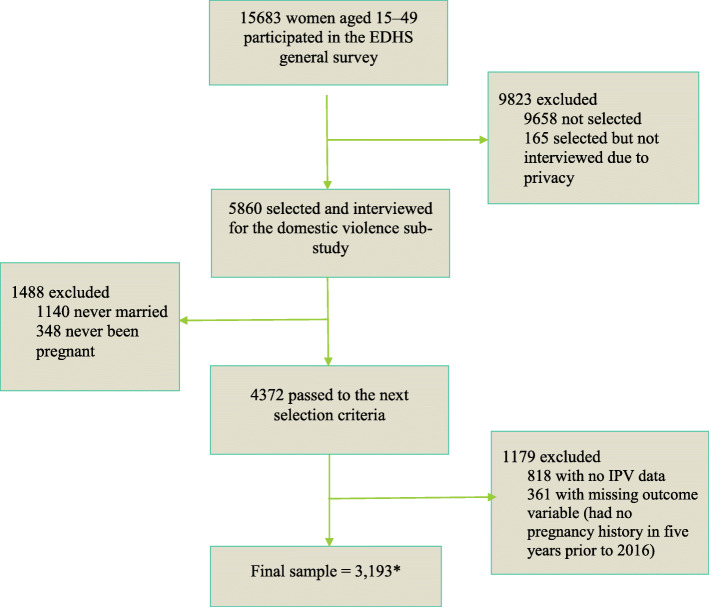
- Cross-sectional analysis of the 2016 Ethiopian Demographic and Health Survey domestic violence sub-study; included 2,969 weighted married women aged 15–49 who had been pregnant within 5 years preceding 2016 and had complete reproductive intention and IPV questionnaire data.
- Outcome: unintended pregnancy (mistimed or unwanted). Exposures: physical, sexual, emotional IPV, partner controlling behaviour, and composite IPV measures. Mediators: contraceptive use before the most recent pregnancy and women’s autonomy (involvement in all three decisions: own health care, major household purchases, visits to family/relatives).
- Logistic regression plus mediation analysis using the Baron and Kenny approach and product-of-coefficients method, with SEM/`gsem` in Stata; models adjusted for age, education, religion, rurality, region, number of children ever born, and wealth.
Limitations
- Stated by authors: cross-sectional data preclude causal inferences; women with unintended pregnancies or low autonomy may enter violent relationships; prospective studies are needed to examine temporal order; partial mediation means assumed pathways are not entirely established; residual confounding is possible; IPV may be underestimated due to social desirability bias, though WHO strategies were followed.
- Stated by authors: contraceptive use was not significant, and 76% of women were not using contraception; further research is needed on contraception types, effectiveness, and consistency. Women’s autonomy was measured as overall household decision-making and may not reflect autonomy in contraceptive choices.
- Evident from the text: the mediation models use lifetime IPV and a pregnancy within the past 5 years, so temporal ordering between IPV, mediators, and pregnancy intention cannot be established from these data.
Model-written summary. Check it against the paper before relying on it.
Integrity signals
Registry
Cites
Statistics
Figures
Verification
Claims the paper makes
0 Valid · 0 Not valid · 23 Not checked · 114 Own results and interpretations
A result the paper reports from its own data — it cites no other source for it, so there is none to check. The quote shows it is in the paper.
In the paper
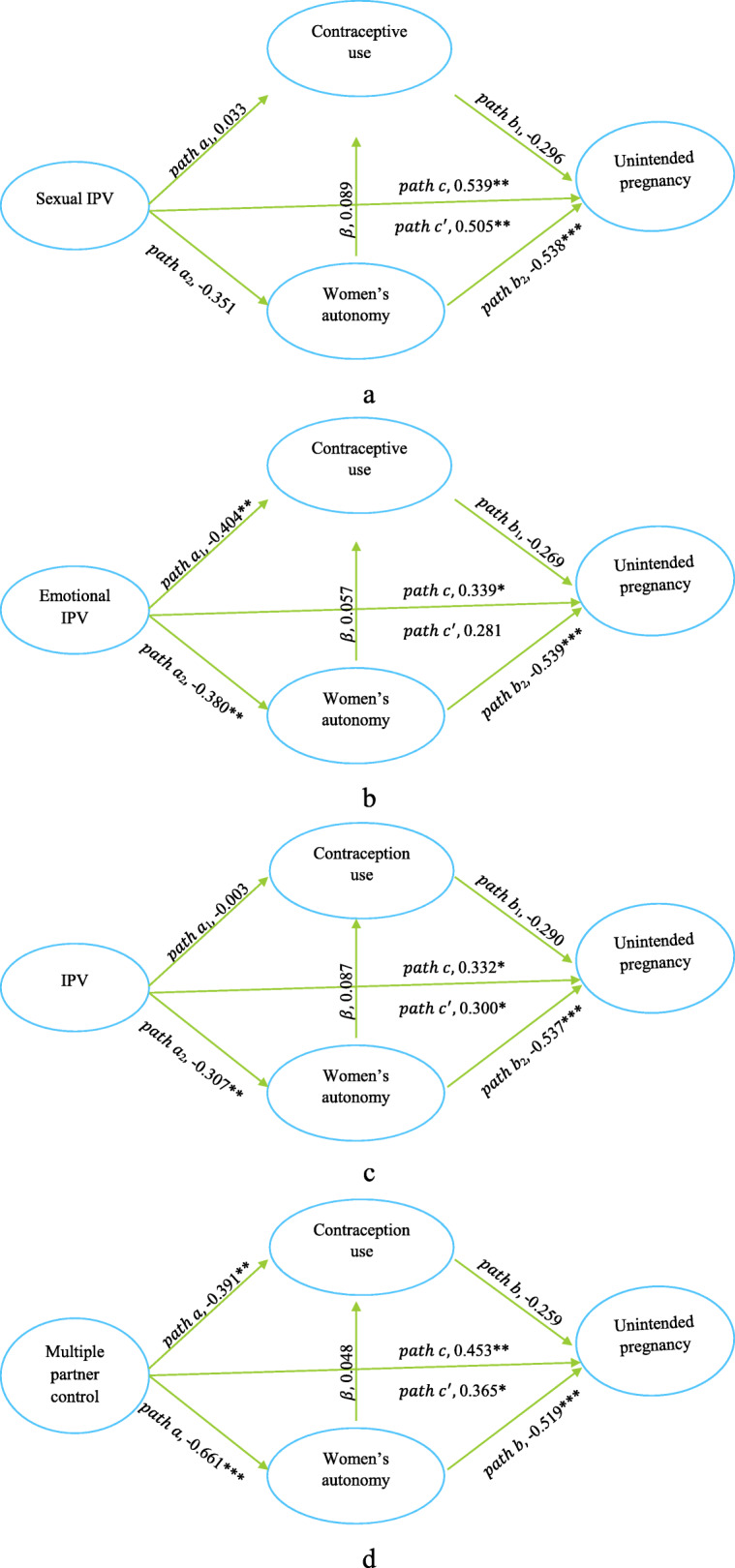
“Emotional IPV | Emotional IPV and contraception use | −0.404 | 0.007”
§ The mediation effect of contraceptive use and women’s autonomy on the relationship between intimate partner violence and unintended pregnancy in Ethiopia > Results > Mediation analysis results
plainstates an association- Asserted: passes — The authors put it forward as true.
- Checkable: passes — It can be checked against evidence.
- Load-bearing: passes — The paper’s conclusions depend on it.
- Based: passes — The paper gives a reason why it holds.
A result the paper reports from its own data — it cites no other source for it, so there is none to check. The quote shows it is in the paper.
In the paper
“the associations between IPV with contraception use (path a1), contraception use with unintended pregnancy (path b1), and women’s autonomy with contraception use were not significant”
§ The mediation effect of contraceptive use and women’s autonomy on the relationship between intimate partner violence and unintended pregnancy in Ethiopia > Results > Mediation analysis results
plain- Asserted: passes — The authors put it forward as true.
- Checkable: passes — It can be checked against evidence.
- Load-bearing: passes — The paper’s conclusions depend on it.
- Based: passes — The paper gives a reason why it holds.
A result the paper reports from its own data — it cites no other source for it, so there is none to check. The quote shows it is in the paper.
In the paper
“In the first mediation model (Fig. 2a, Table 4), sexual IPV was significantly associated with unintended pregnancy (path c, β = 0.539, p = 0.004) but sexual IPV was not significantly associated with contraceptive use (path a1, β = 0.033, p = 0.872) nor with women’s autonomy (path a2, β = − 0.351, p = 0.053).”
§ The mediation effect of contraceptive use and women’s autonomy on the relationship between intimate partner violence and unintended pregnancy in Ethiopia > Results > Mediation analysis results
plain- Asserted: passes — The authors put it forward as true.
- Checkable: passes — It can be checked against evidence.
- Load-bearing: passes — The paper’s conclusions depend on it.
- Based: passes — The paper gives a reason why it holds.
A result the paper reports from its own data — it cites no other source for it, so there is none to check. The quote shows it is in the paper.
In the paper
“the associations between IPV with contraception use (path a1), contraception use with unintended pregnancy (path b1), and women’s autonomy with contraception use were not significant”
§ The mediation effect of contraceptive use and women’s autonomy on the relationship between intimate partner violence and unintended pregnancy in Ethiopia > Results > Mediation analysis results
plain- Asserted: passes — The authors put it forward as true.
- Checkable: passes — It can be checked against evidence.
- Load-bearing: passes — The paper’s conclusions depend on it.
- Based: passes — The paper gives a reason why it holds.
A result the paper reports from its own data — it cites no other source for it, so there is none to check. The quote shows it is in the paper.
In the paper
“However, IPV (as a composite of all four forms), physical IPV, and partner control (single act) were not significantly associated with unintended pregnancy.”
- Also stated in: § The association of different forms of IPV with unintended pregnancy · plain
“Partner controlling behaviourd | Single | 1.34 (0.99, 1.83) | 0.062 | 1.30 (0.95, 1.79) | 0.102”
§ The mediation effect of contraceptive use and women’s autonomy on the relationship between intimate partner violence and unintended pregnancy in Ethiopia > Abstract > Results
plain- Asserted: passes — The authors put it forward as true.
- Checkable: passes — It can be checked against evidence.
- Load-bearing: unclear — It is unclear whether the paper’s conclusions depend on it.
- Based: passes — The paper gives a reason why it holds.
- Also stated in: § The association of different forms of IPV with unintended pregnancy · plain
109 more claims
Create a free account to see all 137 claims and to verify the 64 references still open.
- It may state two separate claims as one. 14
- Probably not a substantial claim. 12
Claims other papers make about this one
Each is checked against this paper’s own text: does it say what the citing paper says it does?
In the citing paper
“but IPV (as a composite of all four forms), physical IPV, and partner control (single act), were not significantly associated with unintended pregnancy [61].”
From Investigating the relationship between intimate partner violence, reproductive health and pregnancy outcome: a systematic review (2025) · cites this paper as [61]
In the citing paper
“unintended pregnancy was positively associated with reporting sexual IPV, emotional IPV, and partners controlling behavior”
From Investigating the relationship between intimate partner violence, reproductive health and pregnancy outcome: a systematic review (2025) · cites this paper as [61]
In the citing paper
“Unintended pregnancy was significantly associated with physical and/or emotional and/or sexual IPV [54, 61, 62].”
From Investigating the relationship between intimate partner violence, reproductive health and pregnancy outcome: a systematic review (2025) · cites this paper as [61]
In the citing paper
“Women’s autonomy, had a significant partial mediation effect in the relationships between some forms of IPV and unintended pregnancy [61].”
From Investigating the relationship between intimate partner violence, reproductive health and pregnancy outcome: a systematic review (2025) · cites this paper as [61]
Self-check
Percentages, sums and reported differences re-computed from the paper’s own numbers.
Each contradiction between two passages listed here was confirmed by an independent check.
Rated minor: it would not touch a result — a value no result rests on, a p-value that stays on the same side of the significance level, or a conflict that is clerical, resolved elsewhere in the paper, or outside its own findings.
In the paper
§ The mediation effect of contraceptive use and women’s autonomy on the relationship between intimate partner violence and unintended pregnancy in Ethiopia > Results > Mediation analysis results
“women’s autonomy alone mediated 42.4% of the total effect (Table 5).”
§ The mediation effect of contraceptive use and women’s autonomy on the relationship between intimate partner violence and unintended pregnancy in Ethiopia > Results > Mediation analysis results
“| Multiple partner control behaviours | Proportion mediated through women’s autonomy only = 43.4% | Proportion mediated through women’s autonomy only = 43.4% |”
Rated minor: it would not touch a result — a value no result rests on, a p-value that stays on the same side of the significance level, or a conflict that is clerical, resolved elsewhere in the paper, or outside its own findings.
In the paper
§ The mediation effect of contraceptive use and women’s autonomy on the relationship between intimate partner violence and unintended pregnancy in Ethiopia > Results > Mediation analysis results
“After controlling for contraception use and women’s autonomy, the coefficient for sexual IPV was decreased in magnitude and significance (path c′, β = 0.505, p = 0.008).”
§ The mediation effect of contraceptive use and women’s autonomy on the relationship between intimate partner violence and unintended pregnancy in Ethiopia > Results > Mediation analysis results
“b the remaining path coefficients of sexual IPV were not estimated because the first model to estimate path a were insignificant for both mediators”
Rated minor: it would not touch a result — a value no result rests on, a p-value that stays on the same side of the significance level, or a conflict that is clerical, resolved elsewhere in the paper, or outside its own findings.
In the paper
§ The mediation effect of contraceptive use and women’s autonomy on the relationship between intimate partner violence and unintended pregnancy in Ethiopia > Results > Participant characteristics
“the most prevalent form was partner controlling behaviour, (n = 1675 (56.4%)) (Table 2).”
§ The mediation effect of contraceptive use and women’s autonomy on the relationship between intimate partner violence and unintended pregnancy in Ethiopia > Results > Participant characteristics
“| Partner controlling | Yes | 1676 (56.4) | 1202 (55.1) | 474 (60.2) | 0.114 |”
Rated minor: it would not touch a result — a value no result rests on, a p-value that stays on the same side of the significance level, or a conflict that is clerical, resolved elsewhere in the paper, or outside its own findings.
In the paper
§ The mediation effect of contraceptive use and women’s autonomy on the relationship between intimate partner violence and unintended pregnancy in Ethiopia > Results > Participant characteristics
“36.4% of participants reported having no decision-making autonomy”
§ The mediation effect of contraceptive use and women’s autonomy on the relationship between intimate partner violence and unintended pregnancy in Ethiopia > Results > Participant characteristics
“| Decision making autonomy | No | 1083 (36.5) | 727 (33.3) | 356 (45.2) | <0.001 |”
Rated minor: it would not touch a result — a value no result rests on, a p-value that stays on the same side of the significance level, or a conflict that is clerical, resolved elsewhere in the paper, or outside its own findings.
In the paper
§ The mediation effect of contraceptive use and women’s autonomy on the relationship between intimate partner violence and unintended pregnancy in Ethiopia > Results > Participant characteristics
“The least prevalent form of IPV was sexual IPV, (n = 353 (11.9%))”
§ The mediation effect of contraceptive use and women’s autonomy on the relationship between intimate partner violence and unintended pregnancy in Ethiopia > Results > Participant characteristics
“| Sexual IPV | Yes | 354 (11.9) | 222 (10.2) | 132 (16.8) | 0.001 |”
Citations
Cites
Baron, R. M., & Kenny, D. A. (1986) · Journal of Personality and Social Psychology · doi:10.1037/0022-3514.51.6.1173 · Cited by 91,532
A comparison of methods to test mediation and other intervening variable effects
MacKinnon, D. P., Lockwood, C. M., Hoffman, J. M., West, S. G., & Sheets, V. (2002) · Psychological Methods · doi:10.1037/1082-989x.7.1.83 · Cited by 9,406
Equivalence of the Mediation, Confounding and Suppression Effect
MacKinnon, D. P., Krull, J. L., & Lockwood, C. M. (2000) · Prevention Science · doi:10.1023/a:1026595011371 · Cited by 4,188
Health consequences of intimate partner violence
Campbell, J. C. (2002) · The Lancet · doi:10.1016/s0140-6736(02)08336-8 · Cited by 4,055
Garcia-Moreno, C., Jansen, H. A., Ellsberg, M., Heise, L., & Watts, C. H. (2006) · The Lancet · doi:10.1016/s0140-6736(06)69523-8 · Cited by 3,176
(2004) · Cited by 677
Intimate partner violence during pregnancy: analysis of prevalence data from 19 countries
Devries, K. M., Kishor, S., Johnson, H., Stöckl, H., Bacchus, L. J., Garcia-Moreno, C., & Watts, C. (2010) · Reproductive Health Matters · doi:10.1016/s0968-8080(10)36533-5 · Cited by 505
Intimate Partner Violence and Adverse Health Consequences: Implications for Clinicians
Black, M. C. (2011) · American Journal of Lifestyle Medicine · doi:10.1177/1559827611410265 · Cited by 500 · cited 1×
“The reproductive health consequences of IPV include sexually transmitted infections [6– 8], obstetric complications such as haemorrhage, abortion, hypertensive disorders, and foetal complications [3, 9], and reduced utilization of maternal health services [4, 10].”
BackgroundFamily Planning and the Burden of Unintended Pregnancies
Tsui, A. O., McDonald-Mosley, R., & Burke, A. E. (2010) · Epidemiologic Reviews · doi:10.1093/epirev/mxq012 · Cited by 434
Pallitto, C. C., García‐Moreno, C., Jansen, H. A. F. M., Heise, L., Ellsberg, M., Watts, C., & Violence, W. M. S. O. W. H. A. D. (2013) · International Journal of Gynecology & Obstetrics · doi:10.1016/j.ijgo.2012.07.003 · Cited by 419
Research works printed but not linked: 2
- Krug EG Dahlberg LL Mercy JA Zwi AB Lozano R world report on violence and health 2002 Geneva World Health Organization
- Bruin J Command to compute new test UCLA 2006
Cited by
Social Determinants of Antenatal Care Service Use in Ethiopia: Changes Over a 15-Year Span
Ousman, S. K., Mdala, I., Thorsen, V. C., Sundby, J., & Magnus, J. H. (2019) · Frontiers in Public Health · doi:10.3389/fpubh.2019.00161 · Cited by 80
Kebede, S. A., Weldesenbet, A. B., & Tusa, B. S. (2022) · BMC Women s Health · doi:10.1186/s12905-022-01656-7 · Cited by 75
Gelaw, K. A., Atalay, Y. A., & Gebeyehu, N. A. (2023) · Contraception and Reproductive Medicine · doi:10.1186/s40834-023-00255-7 · Cited by 40
“A total of 23 studies [21, 22, 26, 29–48] with 40,338 study participants were ultimately included in this systematic review and meta-analysis (Fig.”
BackgroundMa, J., & zhang, S. (2025) · BMC Pregnancy and Childbirth · doi:10.1186/s12884-025-08209-4 · Cited by 16
“Partners may use violence to influence pregnancy outcomes [63].”
Association between sexual violence and unintended pregnancy among married women in Zambia
Kasonde, M. E., Bwalya, B. B., Nyirenda, E. T., Mapoma, C. C., Sikaluzwe, M., Chimpinde, K., & Songolo, G. I. (2022) · BMC Public Health · doi:10.1186/s12889-022-13881-8 · Cited by 13
“All variables, predictor, mediating and outcome variables were coded as binary variables and as such, all path models (a, b, c and d) were modelled as logistic models [25].”
MethodResult
Metadata
- Authors
- Tiruye, T. Y., Harris, M. L., Chojenta, C., Holliday, E., & Loxton, D.
- Affiliations
- University of Newcastle Australia (AU)
- Corresponding author
- Tiruye, Tenaw Yimer
- Venue
- BMC Public Health
- Published
- 2020-09-16
- Volume
- 20
- Issue
- 1
- Pages
- 1408-1408
- ISSN
- 1471-2458 (ISSN-L)
- PMC
- PMC7493352
- OpenAlex
- W3086704289
- Semantic Scholar
- 233f0388ee4505bc4ebe9ff7dc107791af85f9b5
- Cited by
- 23
- References
- 48
- Citations by year
- 2026: 2 · 2025: 9 · 2024: 2 · 2023: 2 · 2022: 6 · 2021: 1
- FWCI
- 0.95
- Type
- journal article
- Language
- en
- Open access
- gold
- doi.org
- Licence
- cc-by
- creativecommons.org/licenses/by/4.0 (tdm)
- creativecommons.org/licenses/by/4.0 (vor)
- Locations
- BMC Public Health (publishedVersion, cc-by)
- PubMed Central (publishedVersion, cc-by)
- PubMed (publishedVersion)
- UniSA Research Outputs Repository (University of South Australia) (acceptedVersion, cc-by)
- Adelaide Research & Scholarship (AR&S) (University of Adelaide) (submittedVersion, cc-by)
- DOAJ (DOAJ: Directory of Open Access Journals) (submittedVersion)
- Figshare (submittedVersion, cc-by)
- NOVA (University of Newcastle Australia) (submittedVersion, cc-by)
- Funders
- The University of Newcastle, Australia
- Australian Research Council
- Topics
- Social Sciences › Health › Intimate Partner and Family Violence
- Health Sciences › Medicine › Public Health, Environmental and Occupational Health › Reproductive Health and Contraception
- Health Sciences › Medicine › Infectious Diseases › HIV/AIDS Research and Interventions
- Keywords
- intimate partner violence, unintended pregnancy, contraceptive use, women's autonomy, mediating effect, sexual violence, emotional abuse, domestic violence, reproductive health, Ethiopia
- MeSH terms
- Intimate Partner Violence, Child, Preschool, Contraceptive Agents, Cross-Sectional Studies, Ethiopia, Female, Humans, Pregnancy, Risk Factors, Pregnancy, Unplanned
About these checks
Registry, retraction, Cites and statistics results are computed, not judged, with one exception: a printed reference that no index lists is read once by a model before it counts as a citation error. Claims are extracted by a model and kept only when their quote appears verbatim in the text; each cited source is then checked, with a model’s help, for whether it says what the claim relies on. Those verdicts can be wrong — read the claim’s quote and the cited source before relying on one.
A language model drew the claims from the paper on 2026-11-29, under version 3 of the claim definition (model deepseek-v4.1-flash, prompt extract-v3).
A second model labelled each claim on 2026-11-29 (model jev-1.13-20260917, definition revision gold-guideline-v0.2).
Statistics and arithmetic are recomputed, not judged.
Confidence bands are shown only for fields calibrated on our annotated test set. None is calibrated yet, so no band is shown.
What counts as a claim ›How we measure confidence ›How we check this ›
Are you an author, or do you see a problem with this page? Request a review
How to cite
Cite CoChat for the checks on this page, and the paper for its own findings.
- This page
- CoChat. (2026). Citation check: The mediation effect of contraceptive use and women’s autonomy on the relationship between intimate partner violence and unintended pregnancy in Ethiopia. https://app.cochat.ai/papers/10.1186/s12889-020-09514-7
- The paper
- Tiruye, T. Y., Harris, M. L., Chojenta, C., Holliday, E., & Loxton, D. (2020). The mediation effect of contraceptive use and women’s autonomy on the relationship between intimate partner violence and unintended pregnancy in Ethiopia. BMC Public Health. https://doi.org/10.1186/s12889-020-09514-7
Data sources
Bibliographic data: Semantic Scholar, OpenAlex, Crossref.
Contains information from the Semantic Scholar Academic Graph Datasets, made available under the ODC Attribution License (ODC-BY 1.0).
Semantic Scholar’s data is described in: Kinney, R., et al. (2023). The Semantic Scholar Open Data Platform. arXiv:2301.10140.
