

The English National Cohort Study of Flooding & Health: psychological morbidity at three years of follow up
Open accessThe DOI matches its Crossref record; 24 of the 24 references it cites were found in a registry or an index.
Abstract
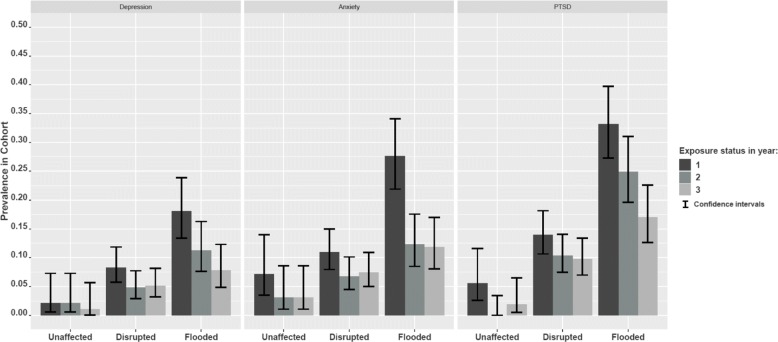
Background: Flooding is expected to increase due to climate change, population growth and urban development. The longer-term mental health impacts of flooding are not well understood. In 2015, the English National Study of Flooding and Health was established to improve understanding of the impact of flooding on health and inform future public health action. Methods: We used 3 years of data from the English National Study of Flooding and Health. Participants who had consented to follow up were sent a questionnaire. Participants were classified into either “unaffected”, “disrupted” or “flooded” according to their exposure. Logistic regression models were used to calculate adjusted odds ratios for probable depression, anxiety and post-traumatic stress disorder (PTSD) in each exposure group. The Wald test was used to assess the difference in probable mental health outcomes for those who did and did not experience “persistent damage” to their home. Conditional logistic regression was conducted to assess change in prevalence over the 3 years and to identify possible determinants of recovery. Results: Eight hundred nineteen individuals were included in the final analysis – 119 were classified as unaffected, 421 disrupted and 279 flooded. Overall, 5.7% had probable depression, 8.1% had probable anxiety and 11.8% had probable PTSD, with higher prevalence in the flooded group compared with the unaffected group. After adjustment for potential confounders, probable mental health outcomes were higher in the flooded group compared to the unaffected group, significantly for probable depression (aOR 8.48, 95% CI 1.04–68.97) and PTSD (aOR 7.74, 95% CI 2.24–26.79). Seventy-seven (9.4%) participants reported experiencing persistent damage to their home, most commonly damp (n = 40) and visible mould (n = 26) in liveable rooms. Of the 569 participants who responded at all 3 years, a significant reduction in prevalence for all probable mental health outcomes was observed in the flooded group. Conclusions: Flooding can have severe long-lasting consequences on mental health in affected populations. If these problems are not identified and treated early, they may persist for years. Further research is necessary to develop and evaluate interventions to increase resilience in at risk populations and to ensure timely access to support services following flooding.
Overview
The claims and statistics of this paper haven’t been checked yet.
Free: it reads the open-access text and checks the first 5 claims that cite a source we can check. Create a free account to check every claim.
Integrity signals
Registry
Cites
Statistics
Figures
Verification
Claims the paper makes
The claims and statistics of this paper haven’t been checked yet.
Free: it reads the open-access text and checks the first 5 claims that cite a source we can check. Create a free account to check every claim.
Claims other papers make about this one
Each is checked against this paper’s own text: does it say what the citing paper says it does?
The cited source says what the claim attributes to it.
In the citing paper
“The main predictors of developing a mental health condition after a flood disaster are socioeconomic vulnerability, long-term displacement (7), persistent material damage (9), and insurancerelated problems (8) (eTable 1).”
From The effects of climate change on mental health (2023) · cites this paper as [9]
Experimental — accuracy not yet measuredThe cited source says what the claim attributes to it.
In the citing paper
“A cohort study from the UK looking at the long-term impact of flooding found psychological morbidity persisted for at least three years after the flooding event [43].”
From Climate Change and Mental Health: A Scoping Review (2021) · cites this paper as [43]
Self-check
Percentages, sums and reported differences re-computed from the paper’s own numbers.
The self-check needs the paper’s full text.
Citations
Cites
An Ultra-Brief Screening Scale for Anxiety and Depression: The PHQ–4
Kroenke, K., Spitzer, R. L., Williams, J. B. W., & Löwe, B. (2009) · Psychosomatics · doi:10.1016/s0033-3182(09)70864-3 · Cited by 4,261
Detecting and monitoring depression with a two-item questionnaire (PHQ-2)
Löwe, B., Kroenke, K., & Gräfe, K. (2005) · Journal of Psychosomatic Research · doi:10.1016/j.jpsychores.2004.09.006 · Cited by 1,473
An abbreviated PTSD checklist for use as a screening instrument in primary care
Lang, A. J., & Stein, M. B. (2005) · Behaviour Research and Therapy · doi:10.1016/j.brat.2004.04.005 · Cited by 584
Flooding and Mental Health: A Systematic Mapping Review
Fernandez, A., Black, J., Jones, M., Wilson, L., Salvador-Carulla, L., Astell-Burt, T., & Black, D. (2015) · PLOS ONE · doi:10.1371/journal.pone.0119929 · Cited by 382
Morina, N., Wicherts, J. M., Lobbrecht, J., & Priebe, S. (2014) · Clinical Psychology Review · doi:10.1016/j.cpr.2014.03.002 · Cited by 314
Health Risks of Flood Disasters
Paterson, D. L., Wright, H., & Harris, P. N. A. (2018) · Clinical Infectious Diseases · doi:10.1093/cid/ciy227 · Cited by 274 · cited 1×
“Frequency and intensity of floods are anticipated to increase in the future due to population growth, urban development on flood plains, and climate change [3, 4].”
BackgroundDwyer, T., Pezic, A., Sun, C., Cochrane, J., Venn, A., Srikanth, V., Jones, G., Shook, R., Sui, X., Ortaglia, A., et al. (2015) · PLOS ONE · doi:10.1371/journal.pone.0141274 · Cited by 239
Health impacts of climate change and health and social inequalities in the UK
Paavola, J. (2017) · Environmental Health · doi:10.1186/s12940-017-0328-z · Cited by 228 · cited 1×
“A number of factors have been found to increase vulnerability to experiencing psychological impacts following extreme weather, including older age, pre-existing medical conditions, inadequate insurance cover and social deprivation [7].”
BackgroundOhl, C. A. (2000) · BMJ · doi:10.1136/bmj.321.7270.1167 · Cited by 193
The long-term physical and psychological health impacts of flooding: A systematic mapping
Zhong, S., Yang, L., Toloo, S., Wang, Z., Tong, S., Sun, X., Crompton, D., FitzGerald, G., & Huang, C. (2018) · Science of The Total Environment · doi:10.1016/j.scitotenv.2018.01.041 · Cited by 171
Cited by
Climate Change and Mental Health: A Scoping Review
Charlson, F., Ali, S., Benmarhnia, T., Pearl, M., Massazza, A., Augustinavicius, J., & Scott, J. G. (2021) · International Journal of Environmental Research and Public Health · doi:10.3390/ijerph18094486 · Cited by 507
“A cohort study from the UK looking at the long-term impact of flooding found psychological morbidity persisted for at least three years after the flooding event [43].”
BackgroundExtreme weather events in europe and their health consequences – A systematic review
Weilnhammer, V., Schmid, J., Mittermeier, I., Schreiber, F., Jiang, L., Pastuhovic, V., Herr, C., & Heinze, S. (2021) · International Journal of Hygiene and Environmental Health · doi:10.1016/j.ijheh.2021.113688 · Cited by 372
Chen, S., Bagrodia, R., Pfeffer, C. C., Meli, L., & Bonanno, G. A. (2020) · Journal of Anxiety Disorders · doi:10.1016/j.janxdis.2020.102297 · Cited by 161
The effects of climate change on mental health
Walinski, A., Sander, J., Gerlinger, G., Clemens, V., Meyer-Lindenberg, A., & Heinz, A. (2023) · Deutsches Ärzteblatt international · doi:10.3238/arztebl.m2022.0403 · Cited by 154
Climate change and mental health research methods, gaps, and priorities: a scoping review
Hwong, A. R., Wang, M., Khan, H., Chagwedera, D. N., Grzenda, A., Doty, B., Benton, T., Alpert, J., Clarke, D., & Compton, W. M. (2022) · The Lancet Planetary Health · doi:10.1016/s2542-5196(22)00012-2 · Cited by 154
Impact of Natural Disasters on Mental Health: Evidence and Implications
Heanoy, E. Z., & Brown, N. R. (2024) · Healthcare · doi:10.3390/healthcare12181812 · Cited by 124
“Stress–reaction models focus on the distress-specific psychological outcomes of experiencing a disaster, particularly depression, anxiety, and PTSD [23,24,47,48].”
BackgroundFungal impacts on Earth’s ecosystems
Case, N. T., Gurr, S. J., Fisher, M. C., Blehert, D. S., Boone, C. M., Casadevall, A., Chowdhary, A., Cuomo, C. A., Currie, C. R., Denning, D. W., et al. (2025) · Nature · doi:10.1038/s41586-024-08419-4 · Cited by 148
“These fungi can exacerbate asthma, with fatal consequences in severe cases 17,18 ; can lead to life-threatening infections in patients with cancer and in people who have undergone transplants 19 ; and can affect mental health 20 .”
Climate change and mental health research methods, gaps, and priorities: a scoping review
Hwong, A. R. (2022) · doi:10.17605/osf.io/xr9ut · Cited by 113
The clinical implications of climate change for mental health
Crandon, T. J., Dey, C., Scott, J. G., Thomas, H. J., Ali, S., & Charlson, F. J. (2022) · Nature Human Behaviour · doi:10.1038/s41562-022-01477-6 · Cited by 88
Massazza, A., Teyton, A., Charlson, F., Benmarhnia, T., & Augustinavicius, J. (2022) · The Lancet Planetary Health · doi:10.1016/s2542-5196(22)00120-6 · Cited by 92
The impact of extreme weather events on mental health in Africa: A scoping review of the evidence
Deglon, M., Dalvie, M. A., & Abrams, A. L. (2023) · The Science of The Total Environment · doi:10.1016/j.scitotenv.2023.163420 · Cited by 69
Climate Change and Mental Health: A Review of Empirical Evidence, Mechanisms and Implications
Crane, K., Li, L., Subramanian, P., Rovit, E., & Liu, J. (2022) · Atmosphere · doi:10.3390/atmos13122096 · Cited by 67
Klimawandel und psychische Gesundheit. Positionspapier einer Task-Force der DGPPN
Heinz, A., Meyer‐Lindenberg, A., Psyche“, D.-T.-F. „. U., Heinz, A., Meyer‐Lindenberg, A., Adli, M., Bornheimer, B., Brandt, L., Hurlemann, R., Karl, S., et al. (2023) · Der Nervenarzt · doi:10.1007/s00115-023-01457-9 · Cited by 54
Building resilience to Australian flood disasters in the face of climate change
Vardoulakis, S., Matthews, V., Bailie, R. S., Hu, W., Salvador‐Carulla, L., Barratt, A. L., & Chu, C. M.-Y. (2022) · The Medical Journal of Australia · doi:10.5694/mja2.51595 · Cited by 48
Hoppe, B. O., Prussia, L. L., Manning, C. M., Raab, K. K., & Jones-Casey, K. (2023) · Ecopsychology · doi:10.1089/eco.2022.0032 · Cited by 45
“…directly assess affected populations confirm a link be-tween climate change and these specific mental health outcomes (Cruz, White, Bell, & Coventry, 2020; Gibson et al., 2020; Hrabok, Delorme, & Agyapong, 2020; Mulchandani et al., 2020 Holzhauer, & Kushner, 2019; Woodhall-Melnik & Grogan, 2019).”
Recurrent Home Flooding in Detroit, MI 2012–2020: Results of a Household Survey
Larson, P. S., Gronlund, C. J., Thompson, L., Sampson, N., Washington, R., Thorsby, J. S., Lyon, N., & Miller, C. J. (2021) · International Journal of Environmental Research and Public Health · doi:10.3390/ijerph18147659 · Cited by 44
Li, A., Toll, M., & Bentley, R. (2023) · Lancet Planetary Health · doi:10.1016/s2542-5196(23)00089-x · Cited by 25
What mental health professionals and organisations should do to address climate change
Monsell, A., Krzanowski, J., Page, L., Cuthbert, S., & Harvey, G. (2021) · BJPsych Bulletin · doi:10.1192/bjb.2021.17 · Cited by 41
Mediterranean Cyclones in a Changing Climate: A Review on Their Socio‐Economic Impacts
Khodayar, S., Kushta, J., Catto, J. L., Dafis, S., Davolio, S., Ferrarin, C., Flaounas, E., Groenemeijer, P., Hatzaki, M., Hochman, A., et al. (2025) · Reviews of Geophysics · doi:10.1029/2024rg000853 · Cited by 46
Climate change and mental health: Position paper of the European Psychiatric Association
Brandt, L., Adorjan, K., Catthoor, K., Chkonia, E. D., Falkai, P., Fiorillo, A., Gondek, T. M., Vay, J. N. L., Kuzman, M. R., Meyer‐Lindenberg, A., et al. (2024) · European Psychiatry · doi:10.1192/j.eurpsy.2024.1754 · Cited by 43
“The mental symptom severity depends on the extent to which the person is affected by the environmental event [11, 12] and the symptoms can last for years [13].”
BackgroundFothergill, L., Disney, A., & Wilson, E. (2021) · Public Health · doi:10.1016/j.puhe.2021.07.016 · Cited by 29
Graham, H. M., Harrison, A. S., & Lampard, P. (2022) · International Journal of Environmental Research and Public Health · doi:10.3390/ijerph19042246 · Cited by 19
“Flooding [6,7] and air pollution [8–11] are placing human health at risk.”
BackgroundFlooding and the risk of PTSD, depression, and anxiety: A systematic review and meta-analysis
Yakubu, S., Mousavi, S. R., Palade, V., Eden, J., Kabajulizi, J., Salari, N., Far, A. H., Ali, H. A., & Daneshkhah, A. (2026) · Environmental Research · doi:10.1016/j.envres.2026.124063 · Cited by 22
Shabani, A., Rasoulian, M., Naserbakht, M., Shooshtari, M. H., Hajebi, A., Tiyuri, A., & Motevalian, S. A. (2024) · BMC Public Health · doi:10.1186/s12889-024-17861-y · Cited by 19
“The association of PTSD with low education is consistent with the findings of the assessment of Chinese flood victims in 2000 [37].”
ResultExtreme Weather Events in the UK and Resulting Public Health Outcomes
Dickinson, N., Spencer, L. H., Shu-hua, Y., Miller, C., Hursthouse, A. S., & Lynch, M. (2025) · International Journal of Public Health · doi:10.3389/ijph.2025.1607904 · Cited by 12
Climate change: shifting boundaries of fungal disease in Europe and beyond
Bottery, M. J., Sedik, S., Schwartz, I. S., Hoenigl, M., & van Rhijn, N. (2025) · Thorax · doi:10.1136/thorax-2024-222168 · Cited by 21
“50 51 Similarly, houses in Croatia that were subject to flooding showed increased levels of fungi and their secondary metabolites in the air.”
A mental health focus to amplify climate resilience actions
Mishra, J., Han, H. C., & Ramanathan, V. (2025) · npj Climate Action · doi:10.1038/s44168-025-00263-0 · Cited by 14
Climate Change and Human Well-Being in the 2020s: Lessons From 2020
Sheehan, M. C. (2021) · International Journal of Health Services · doi:10.1177/00207314211012155 · Cited by 14
“For example, one analysis of Taiwan’s Typhoon Morakot found significantly increased cardiovascular disease-related mortality in adults 2 years after the event,53 while an evaluation of insomnia, anxiety, depression, and PTSD found an increase of 2-fold following the disaster.54 A study of floods in the United Kingdom…”
BackgroundWiig, A., Mahmud, M., Kolstad, I., Lujala, P., & Bezu, S. (2023) · Regional Environmental Change · doi:10.1007/s10113-023-02086-3 · Cited by 12
“It should nevertheless be noted that more temporally distant shock may also have long-term effects on current preferences, e.g. through mental health impacts (Mulchandani et al. 2020).”
BackgroundRückle, K., Rohrer, M., Mihók, B., Johansson, M., Andersson, H., Pomee, M. S., Vergadi, E., Rouva, G., Agrawal, A., Balázs, B., et al. (2025) · Frontiers in Psychiatry · doi:10.3389/fpsyt.2025.1601871 · Cited by 11
Augustin, J., Andrees, V., Czerniejewski, A., Dallner, R., Schulz, C. M., & Mezger, N. C. S. (2024) · Bundesgesundheitsblatt - Gesundheitsforschung - Gesundheitsschutz · doi:10.1007/s00103-023-03809-x · Cited by 16
Valois, P., Tessier, M., Bouchard, D., Talbot, D. C., Morin, A. J. S., Anctil, F., & Cloutier, G. (2020) · BMC Public Health · doi:10.1186/s12889-020-09763-6 · Cited by 10
“was persistence of psychological morbidity [65].”
Climate change and child health: The growing burden of climate-related adverse health outcomes
Reichelt, P., Schumacher, A., Meyer, N., & Zenclussen, A. C. (2025) · Environmental Research · doi:10.1016/j.envres.2025.122502 · Cited by 16
Findlater, L., Robin, C., Hopgood, K., Waite, T., National Study of Flooding and Health Study Group, Waite, T., Beck, C., Oliver, I., Amlôt, R., Bone, A., et al. (2023) · European Journal of Public Health · doi:10.1093/eurpub/ckad082 · Cited by 5
Self-citationCaruana, T. (2024) · International Journal of Disaster Risk Reduction · doi:10.1016/j.ijdrr.2024.104244 · Cited by 4
Health effects of flooding in Limburg
de Jong, A. E. E., van Beek, J., Fischer, A. C., Geurts, M.-L., Mos, J., Geerling, G., Koopmans, M., & Boelee, E. (2023) · Journal of Coastal and Riverine Flood Risk · doi:10.59490/jcrfr.2023.0004 · Cited by 6
Nguyen, T. G., Tran, T. B., Le, D. D., Nguyen, T. M., Nguyen, H. V., Ho, P. U., Tran, S. V., Thuy, L. N. H., Trung, T. Đ., Long, P. T., et al. (2024) · Scientific Reports · doi:10.1038/s41598-024-57672-0 · Cited by 4
The Medium-Term Psychosocial Impact of the 2021 Floods in Belgium: A Survey-Based Study
Maeyer, N. D., Nagabhatla, N., Toles, O. M., Reubens, D. G., & Scheerens, C. (2025) · Climate · doi:10.3390/cli13030061 · Cited by 5
“…al. (2015), who found few studies investigating medium-to long-term psychosocial impacts, but with those few finding that adverse effects persist 3–5 years after exposure [11,20], illustrating the need for additional research on the impact of extreme weather events on psychosocial well-being [21].”
Bhakuni, M. S., & Das, A. (2024) · Computers & Industrial Engineering · doi:10.1016/j.cie.2024.110005 · Cited by 4
Montalti, M., Fabbri, M., Angelini, R., Bakken, E., Morri, M., Tamarri, F., Reali, C., Soldà, G., Silvestrini, G., & Lenzi, J. (2024) · Healthcare · doi:10.3390/healthcare12171760 · Cited by 3
“Exposure to natural disasters such as floods can indeed have adverse effects on mental health, with reports of psychological distress among affected populations [13,14].”
BackgroundCheah, W., Bono, S. A., Karpudewan, M., & Samsurijan, M. S. (2025) · Journal of Environmental Psychology · doi:10.1016/j.jenvp.2025.102844 · Cited by 4
Yin, H., Huang, C., Tan, W., & Xiao, R. (2025) · Applied Geography · doi:10.1016/j.apgeog.2025.103803 · Cited by 3
Tejera, M. E. T., Pérez, M. C. A., Domínguez, M. G., & Beltrá, M. N. (2026) · Atención Primaria · doi:10.1016/j.aprim.2025.103386 · Cited by 4
Osborn, D. (2022) · UCL Open Environment · doi:10.14324/111.444/ucloe.000043 · Cited by 5
Climate Change and Global Mental Health
Charlson, F., Patrick, R., & Dey, C. (2024) · CABI eBooks · doi:10.1079/9781800620025.0026 · Cited by 4
Empirical Evidence of the Effects of Climate Change on NCDs: A Literature Review
Bernhardt, L., & Roy, P. K. (2024) · Review of Economics · doi:10.1515/roe-2024-0058 · Cited by 2
Psychiatric drugs dispensing trends in the affected population following Brumadinho dam failure
Dell’Aringa, M. F., Corrêa‐Oliveira, G. E., Corte, F. D., Ragazzoni, L., Hubloue, I., Murray, V. S. G., Piazza, T., Osorio-de-Castro, C. G. S., Miranda, E. S., & Barone‐Adesi, F. (2025) · Frontiers in Public Health · doi:10.3389/fpubh.2025.1507556 · Cited by 3
Rrokaj, S., Bubeck, P., Thieken, A. H., & Molinari, D. (2026) · Natural Hazards · doi:10.1007/s11069-026-08045-5 · Cited by 4
Hurricane Michael and Adverse Social and Mental Health Risk Factors
Harville, E., Pan, K., Beitsch, L. M., Uejio, C. K., Lichtveld, M. Y., Sherchan, S. P., & Timuta, C. (2023) · Maternal and Child Health Journal · doi:10.1007/s10995-023-03596-6 · Cited by 1
“Secondary stressors are another major cause of mental health and other health issues post-disaster, including insurance problems, home repair, relationship issues, and neighborhood disagreements (Mulchandani et al., 2020).”
BackgroundO papel da psiquiatria em áreas afetadas por tragédias naturais
Weber, C. A. T., & da Silva, A. G. (2024) · Debates em Psiquiatria · doi:10.25118/2763-9037.2024.v14.1296 · Cited by 1
Climate Change and Mental Health from a Developmental and Life Course Perspective
Ha, S. (2024) · Springer eBooks · doi:10.1007/978-3-031-56736-0_2 · Cited by 1
Diefenthaeler, S. M., Cacilhas, A., & Hauck, S. (2025) · Disaster Medicine and Public Health Preparedness · doi:10.1017/dmp.2025.10125 · Cited by 2
Sociodemographic vulnerability to cold and stormy weather in relation to health and life
Lo, Y. T. E., Godwin, J. L., Maude, U., Day, H., Timpson, N. J., & Northstone, K. (2025) · Weather and Climate Extremes · doi:10.1016/j.wace.2025.100840 · Cited by 1
“Significantly higher odds of probable depression and post-traumatic stress disorder were found in respondents who experienced flooding, compared to those unaffected (Mulchandani et al., 2020).”
The Durability of Social Cohesion: The Effect of Climate-Related Disasters on Voluntary Work
Biferale, L., Brandano, M. G., & Modica, M. (2026) · Italian Economic Journal · doi:10.1007/s40797-026-00364-7 · Cited by 1
Ritbunyakorn, N. (2021) · Chula Digiverse · doi:10.58837/chula.the.2021.344 · Cited by 1
Daneshjoo, S., Truman, G., & Carey, V. (2024) · Australian Journal of Emergency Management · doi:10.47389/39.1.23
Niman, S., Mustikasari, M., Daulima, N. H. C., & Gayatri, D. (2024) · Frontiers of Nursing · doi:10.2478/fon-2024-0048 · Cited by 1
Oh, E., Cho, J., Kim, C., Lim, H., & Kim, K.-N. (2025) · Epidemiology and Health · doi:10.4178/epih.e2025014 · Cited by 2
“A United Kingdom study of 819 individuals affected by heavy rainfall found that the prevalence of depression was elevated by 8.48 times (95% CI, 1.04 to 68.97) and PTSD by 7.74 times (95% CI, 2.24 to 26.79) compared to an unaffected group [29].”
InfluentialBatool, A., Burke, D. T., Chique, C., O’Dwyer, J., Fong, K. F., Priyadarshini, A., & Hynds, P. D. (2025) · Journal of Environmental Psychology · doi:10.1016/j.jenvp.2025.102670
Valois, P., Tessier, M., Bouchard, D., Talbot, D., Morin, A. J. S., Anctil, F., & Cloutier, G. (2020) · Figshare · doi:10.6084/m9.figshare.13186020
Valois, P., Tessier, M., Bouchard, D., Talbot, D., Morin, A. J. S., Anctil, F., & Cloutier, G. (2020) · Figshare · doi:10.6084/m9.figshare.13186017
Design and Optimisation of Timber-Cardboard Sandwich Panels for Temporary Housing Applications
Abu-Saleem, M., & Gattas, J. M. (2025) · Lecture notes in civil engineering · doi:10.1007/978-981-96-9917-9_47
Climate-Related Extreme Weather and Urban Mental Health: A Traditional and Bayesian Meta-Analysis
Amnuaylojaroen, T., Parasin, N., & Saokaew, S. (2026) · Earth · doi:10.3390/earth7010014
Quantifying the spatiotemporal associations of flooding on mental health using telehealth call data
Robertson, C., Harcourt, S., Elliot, A. J., & LAKE, I. R. (2026) · International Journal of Environmental Health Research · doi:10.1080/09603123.2026.2627349
“2015; Mulchandani et al. 2020).”
InfluentialBeyond the Waters: Psychosocial Dimension of Flood Risk Reduction
Saeed, S., & Ali, I. (2026) · Springer eBooks · doi:10.1007/978-3-032-12225-4_20
Linking health risks, social vulnerability and response pathways in climate-driven floods
Tavella, R. A., & Furlan, J. P. R. (2026) · Frontiers in Water · doi:10.3389/frwa.2026.1806478
Opportunities and challenges in community-led action on weather extremes for health and wellbeing
Towers, L., de Chavez, A. C., Butler, C., Adger, W. N., Albers, P. N., Walker, G. P., Cotton, M., Bland, E., & de Vocht, F. (2026) · Health & Place · doi:10.1016/j.healthplace.2026.103697
Climate Change Impacts on Human Health in the Northern Hemisphere: A Narrative Review
Vaičiulis, V., Domkutė, G., Papadima, A., Radišauskas, R., Annus, I., Kaur, K., & Kalinienė, G. (2026) · Atmosphere · doi:10.3390/atmos17080736
Li, Y., Menéndez, H. D., & Fang, W. (2026) · International Conference on Geoinformatics · doi:10.1109/geoinformatics72247.2026.11665284
Flood exposure and suicide risk in Japan, 2008–2022: a nationwide study
Lin, G., Xu, Y., Liao, B., & Yu, H. (2026) · Environmental Research · doi:10.1016/j.envres.2026.125600
Stress reduction based on awareness for women affected by disasters: a randomized controlled trial
SEZGİN, L., Karakaya, A., ŞAHİN, A., Sahin, B., & Yıldız, E. A. B. (2026) · Psychology Health & Medicine · doi:10.1080/13548506.2026.2728576
Mercado, D. L., Rivera‐González, A. C., Santiago, K. M., Stimpson, J. P., Chavez, L. M., Langellier, B. A., Purtle, J., Stehr, M. F., Eberth, J. M., CANINO, G. J., et al. (2026) · Disaster Medicine and Public Health Preparedness · doi:10.1017/dmp.2026.10438
Ortiz‐Prado, E., Vásconez-González, J., Žalakevičiūtė, R., & Izquierdo‐Condoy, J. S. (2026) · Frontiers in Public Health · doi:10.3389/fpubh.2026.1959622
“Persistent physical and psychological morbidity, disability, disrupted chronic care, and continuing social vulnerability (111, 119, 142) Maintain clinical and psychosocial follow-up; provide rehabilitation according to assessed needs; restore routine services; reassess unmet needs and incorporate…”
Metadata
- Authors
- Mulchandani, R., Armstrong, B., Beck, C. R., Waite, T. D., Amlôt, R., Kovats, S., Leonardi, G., Rubin, G. J., & Oliver, I.
- Affiliations
- Public Health England (GB)
- London School of Hygiene & Tropical Medicine (GB)
- King's College London (GB)
- Corresponding author
- Mulchandani, Ranya
- ORCID
- Venue
- BMC Public Health
- Published
- 2020-03-30
- Volume
- 20
- Issue
- 1
- Pages
- 321-321
- ISSN
- 1471-2458 (ISSN-L)
- PMC
- PMC7104503
- OpenAlex
- W3013273136
- Cited by
- 73
- References
- 24
- Citations by year
- 2026: 15 · 2025: 16 · 2024: 14 · 2023: 8 · 2022: 9 · 2021: 7 · 2020: 4
- FWCI
- 2.80
- Type
- journal article
- Language
- en
- Open access
- gold
- doi.org
- Licence
- cc-by
- creativecommons.org/licenses/by/4.0/ (tdm)
- creativecommons.org/licenses/by/4.0/ (vor)
- Locations
- BMC Public Health (publishedVersion, cc-by)
- PubMed Central (publishedVersion, cc-by)
- PubMed (publishedVersion)
- LSHTM Research Online (London School of Hygiene and Tropical Medicine) (acceptedVersion)
- DOAJ (DOAJ: Directory of Open Access Journals) (submittedVersion, cc-by-sa)
- Explore Bristol Research (submittedVersion)
- Funders
- National Institute for Health Research (Health Protection Research Unit in Evaluation of Interventions, Health Protection Research Unit in Emergency Prepardness and Response, Health Protection Research Unit in Environmental Change)
- Topics
- Social Sciences › Psychology › Clinical Psychology › Posttraumatic Stress Disorder Research
- Physical Sciences › Environmental Science › Global and Planetary Change › Flood Risk Assessment and Management
- Health Sciences › Medicine › Psychiatry and Mental health › Mental Health Treatment and Access
- Keywords
- floods, mental health, psychological morbidity, depression, anxiety, post-traumatic stress disorder, flood exposure, housing damage, dampness, molds, climate change
- MeSH terms
- Adult, Anxiety, Depression, Disasters, England, Female, Follow-Up Studies, Humans, Male, Mental Health, Middle Aged, Morbidity, Surveys and Questionnaires, Risk Factors, Stress Disorders, Post-Traumatic, Cohort Studies, Prevalence, Logistic Models, Odds Ratio, Floods
About these checks
Registry, retraction, Cites and statistics results are computed, not judged, with one exception: a printed reference that no index lists is read once by a model before it counts as a citation error. Claims are extracted by a model and kept only when their quote appears verbatim in the text; each cited source is then checked, with a model’s help, for whether it says what the claim relies on. Those verdicts can be wrong — read the claim’s quote and the cited source before relying on one.
Statistics and arithmetic are recomputed, not judged.
Confidence bands are shown only for fields calibrated on our annotated test set. None is calibrated yet, so no band is shown.
What counts as a claim ›How we measure confidence ›How we check this ›
Are you an author, or do you see a problem with this page? Request a review
Data sources
Bibliographic data: Semantic Scholar, OpenAlex, Crossref.
Contains information from the Semantic Scholar Academic Graph Datasets, made available under the ODC Attribution License (ODC-BY 1.0).
Semantic Scholar’s data is described in: Kinney, R., et al. (2023). The Semantic Scholar Open Data Platform. arXiv:2301.10140.
