

Neonatal mortality burden and trends in UNHCR refugee camps, 2006–2017: a retrospective analysis
Open accessPublished version of a preprint
The DOI matches its Crossref record; 29 of the 29 references it cites were found in a registry or an index; 6 of the 18 sources its claims cite were checked for support.
Abstract
This study uses routine health information system data to examine neonatal mortality burden and trends in refugee camps between 2006 and 2017.
Overview
CoChat Summary
## TL;DR
This retrospective analysis used UNHCR Health Information System data from 150 refugee camps in 21 countries to examine neonatal mortality between 2006 and 2017. It found substantial burden and wide variation, with annual camp neonatal mortality rates ranging from 12 to 56 deaths per 1,000 live births and often lower than surrounding host populations, though the authors caution that underreporting likely means the true burden is higher.
## Key findings
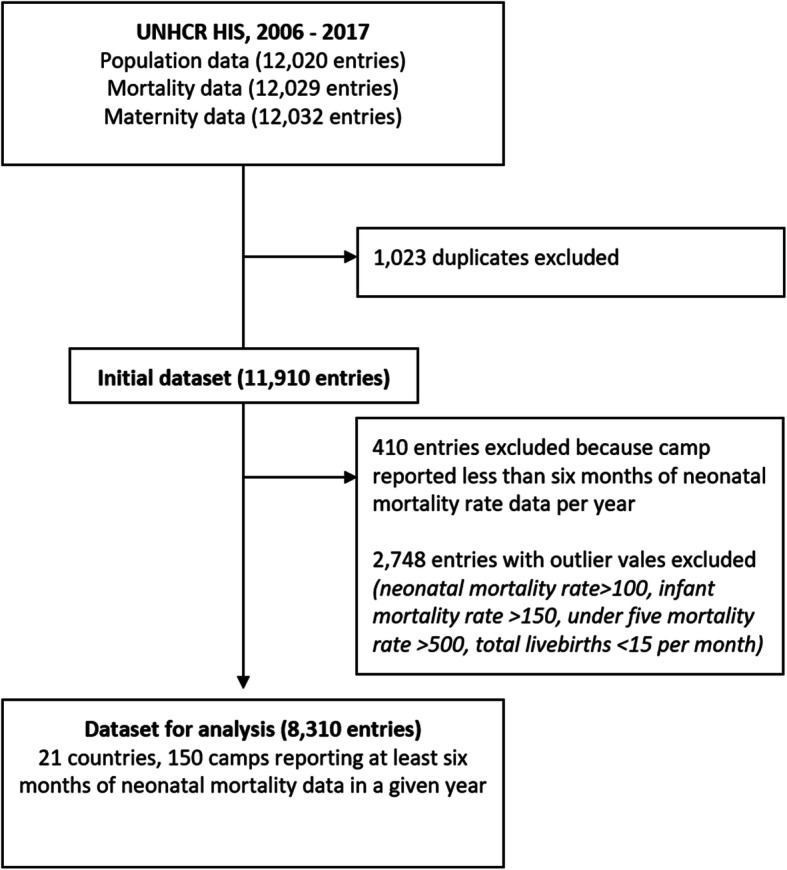
- The study included 150 refugee camps in 21 countries, with 663,892 live births and 3,382 neonatal deaths recorded from 2006–2017.
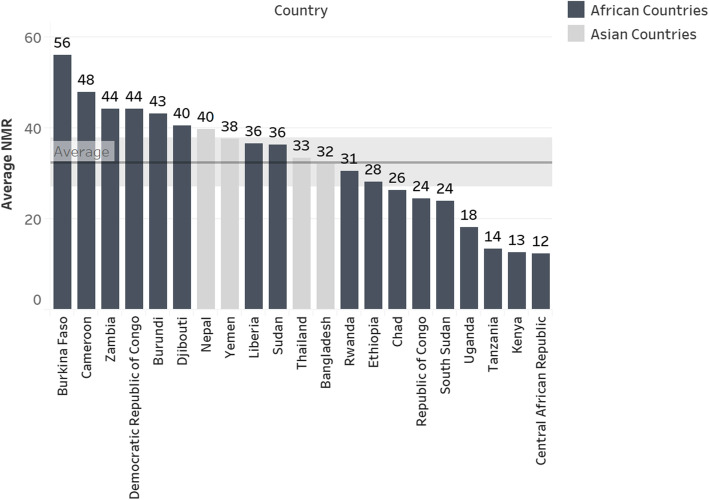
- Annual country-level refugee camp neonatal mortality rates ranged from 12 to 56 neonatal deaths per 1,000 live births.
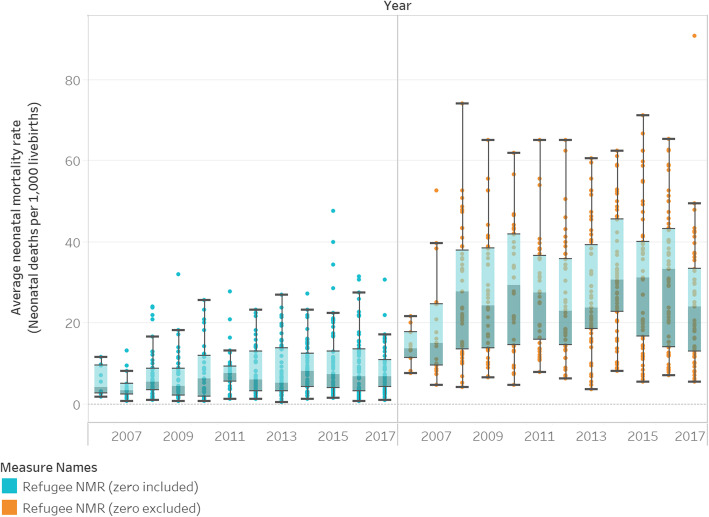
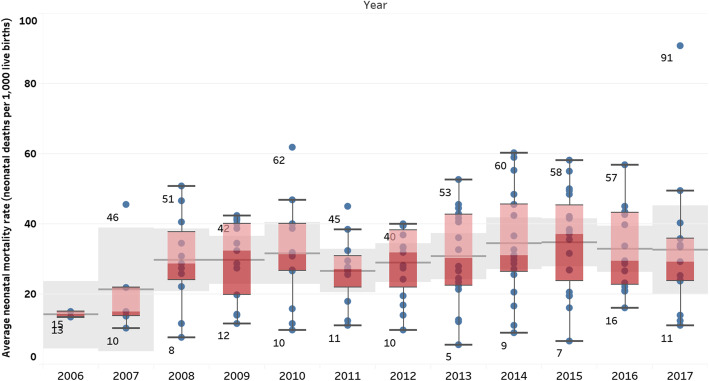
- Across all countries using the UNHCR HIS, there appeared to be little change in average neonatal mortality over time; the authors also state that 62% (n = 13) of countries had annual refugee NMRs above the Sphere Standard of 40 per 1,000 live births at some point.
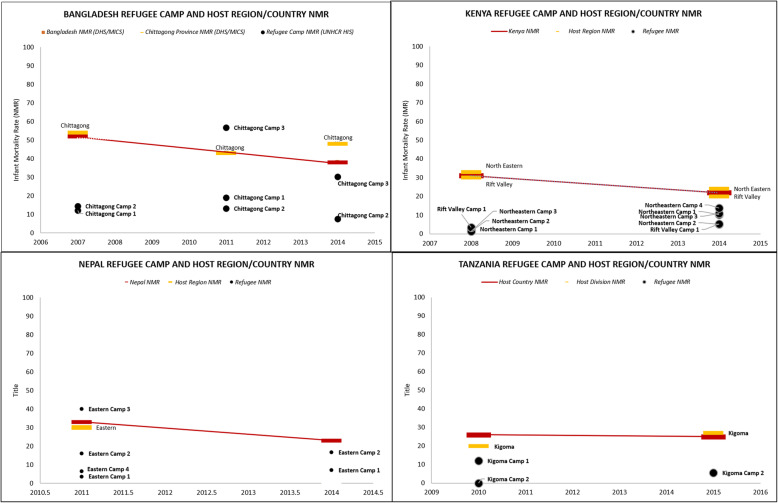
- In most countries and years where comparison data were available, refugee camp NMRs were lower than the immediate host community; the authors report this was true for 60% of locations/years in the sub-analysis.
## Methods
- Retrospective analysis of routine health information system data from the UNHCR Health Information System (HIS), with refugee population and mortality data exported via Tableau and cleaned/analyzed in Stata.
- Data were merged from three UNHCR HIS datasets using camp name and reporting year/month, then filtered to exclude camps with <6 months of neonatal mortality data in a year and implausible outliers; the final analytic database had 8,310 entries from 150 camps in 21 countries.
- Neonatal mortality burden and trends in camps were calculated and compared with national/subnational neonatal mortality rates from DHS and MICS surveys; analyses included a sensitivity analysis for months with zero reported neonatal deaths.
## Limitations
- The authors state that incomplete and/or inaccurate routine reporting and outdated population estimates can produce implausibly high or low mortality estimates.
- They note that stillbirths and neonatal deaths outside health facilities may be underreported, and that the UNHCR HIS does not distinguish early vs late neonatal deaths; these are limitations stated in the paper.
- The paper also states that population-based survey data are not directly comparable to routine health information system data because of different reference periods and timing.
- Evident from the text: the analysis excludes months with <6 months of neonatal mortality data and many entries with implausible values, so the results may be conservative and may not represent all camp months equally.
Model-written summary. Check it against the paper before relying on it.
Integrity signals
Registry
Cites
Statistics
Figures
Verification
Claims the paper makes
5 Valid · 0 Not valid · 4 Not checked · 25 Own results and interpretations
None of the sources cited for this claim have been checked yet.
In the paper
“limited information exists on the implementation or outcomes of these interventions in humanitarian contexts [9, 10].”
§ Neonatal mortality burden and trends in UNHCR refugee camps, 2006–2017: a retrospective analysis > Background
What the sources say
- Could not verifycites [9] Foster AM Evans DP Garcia M The 2018 inter-agency field manual on reproductive health in humanitarian settings: revising the global standards Reprod Health Matters 2017 25 51 18 24 10.1080/09688080.2017.1403277 29231788 sourceExperimental — accuracy not yet measured
The passage on evaluations (indexed section labelled Abstract; page unavailable) reports gaps in providing emergency obstetric and newborn care, not a lack of information about the implementation or outcomes of neonatal-mortality interventions. Searches for limited evidence, implementation data, and newborn-care outcomes found no passage making that claim. (LLM, conf=0.75)
- Not checked yetcites [10] Save the Children, UNICEF, WHO, Crises IWGfRHi Newborn Health in Humanitarian Settings Field Guide 2018 New York UNICEF
plain- Asserted: passes — The authors put it forward as true.
- Checkable: passes — It can be checked against evidence.
- Load-bearing: passes — The paper’s conclusions depend on it.
- Based: passes — The paper gives a reason why it holds.
- Could not verify
Every source the paper cites for this claim was checked and supports it.
In the paper
“A previous study, conducted as part of the 2014 Interagency Working Group for Reproductive Health in Crisis’s Global Evaluation, − examined reproductive health indicators, including neonatal mortality, in UNHCR post-emergency camps 2007–2013 in 10 countries [19].”
§ Neonatal mortality burden and trends in UNHCR refugee camps, 2006–2017: a retrospective analysis > Background
What the sources say
- Supportedcites [19] Whitmill J Blanton C Doraiswamy S Retrospective analysis of reproductive health indicators in the United Nations high commissioner for refugees post-emergency camps 2007-2013 Confl Heal 2016 10 3 10.1186/s13031-016-0069-6 PMC4784418 26962327 source
The Background says the study was part of the Interagency Working Group’s global evaluation. The Results identify ten included countries; the title gives the 2007–2013 period, and the Neonatal mortality section confirms that neonatal mortality was examined. Page numbers are unavailable in our copy. (LLM, conf=0.94)
plain- Asserted: passes — The authors put it forward as true.
- Checkable: passes — It can be checked against evidence.
- Load-bearing: passes — The paper’s conclusions depend on it.
- Based: passes — The paper gives a reason why it holds.
- Supported
The cited sources support only part of this claim — read each source’s verdict below.
In the paper
“This may be due in part to limited attention to newborn health in humanitarian settings prior to the development of the Newborn Health in Humanitarian Settings Field Guide and UNHCR’s Operational Guidelines on Improving Newborn Health in Refugee Operations in 2014–2015 [9, 26].”
§ Neonatal mortality burden and trends in UNHCR refugee camps, 2006–2017: a retrospective analysis > Discussion
What the sources say
- Partly supportedcites [9] Foster AM Evans DP Garcia M The 2018 inter-agency field manual on reproductive health in humanitarian settings: revising the global standards Reprod Health Matters 2017 25 51 18 24 10.1080/09688080.2017.1403277 29231788 sourceExperimental — accuracy not yet measured
The Abstract (page not specified) says the 2018 manual gives newborn health greater emphasis and more detailed coverage, lending support to the idea that earlier guidance gave it less attention. It does not link that attention to a limited change in neonatal mortality burden or identify the two named guides and their 2014–2015 development as a turning point. (LLM, conf=0.80)
- Not checked yetcites [26] United Nations Refugee Agency (UNHCR) Operational Guidelines for Improving Newborn Health in Refugee Operations 2015 Geneva UNHCR
hedgedstates a possible cause- Asserted: passes — The authors put it forward as true.
- Checkable: passes — It can be checked against evidence.
- Load-bearing: unclear — It is unclear whether the paper’s conclusions depend on it.
- Based: passes — The paper gives a reason why it holds.
- Partly supported
A result the paper reports from its own data — it cites no other source for it, so there is none to check. The quote shows it is in the paper.
In the paper
“Annual country-level refugee camp neonatal mortality rates (NMR) ranged from 12 to 56 neonatal deaths per 1000 live births.”
- Also stated in: § Results · plain
“Average NMRs for 2006–2017 ranged from a high of 56 neonatal deaths per 1000 live births in Burkina Faso refugee camps that reported data over a five-year period (2013–2017) to a low of 12 neonatal deaths per 1000 live births in Central African Republic camps that only reported data in 2013.”
§ Neonatal mortality burden and trends in UNHCR refugee camps, 2006–2017: a retrospective analysis > Abstract > Findings
plain- Asserted: passes — The authors put it forward as true.
- Checkable: passes — It can be checked against evidence.
- Load-bearing: unclear — It is unclear whether the paper’s conclusions depend on it.
- Based: passes — The paper gives a reason why it holds.
- Also stated in: § Results · plain
A result the paper reports from its own data — it cites no other source for it, so there is none to check. The quote shows it is in the paper.
In the paper
“A total of 663,892 live births and 3382 neonatal deaths were captured during this period.”
- Also stated in: § Results · plain
“Available reports documented a total of 663,892 live births and 3382 neonatal deaths in refugee camps between 2006 and 2017.”
§ Neonatal mortality burden and trends in UNHCR refugee camps, 2006–2017: a retrospective analysis > Abstract > Findings
plain- Asserted: passes — The authors put it forward as true.
- Checkable: passes — It can be checked against evidence.
- Load-bearing: unclear — It is unclear whether the paper’s conclusions depend on it.
- Based: passes — The paper gives a reason why it holds.
- Also stated in: § Results · plain
10 more claims
Create a free account to see all 34 claims and to verify the 6 references still open.
- Probably not a substantial claim. 9
- It may state two separate claims as one. 12
Claims other papers make about this one
Each is checked against this paper’s own text: does it say what the citing paper says it does?
The source backs part of the claim, not all of it — or backs it for a different population, condition or comparison.
In the citing paper
“Alternative methodologies that use health records, perinatal/neonatal rapid assessment process for institutional delivery22 and agency-based health information systems13 23 tend to underestimate the true magnitude of deaths, as most childbirths in humanitarian crises occur at home.”
From Estimating stillbirth and neonatal mortality rate among Rohingya refugees in Bangladesh, September 2017 to December 2018: a prospective surveillance (2022) · cites this paper as [13]
Experimental — accuracy not yet measuredThe source backs part of the claim, not all of it — or backs it for a different population, condition or comparison.
In the citing paper
“Few studies have reported neonatal mortality12–14 and even fewer studies report stillbirths in the acute phase of humanitarian crises.15 16”
From Estimating stillbirth and neonatal mortality rate among Rohingya refugees in Bangladesh, September 2017 to December 2018: a prospective surveillance (2022) · cites this paper as [13]
Experimental — accuracy not yet measuredThe source backs part of the claim, not all of it — or backs it for a different population, condition or comparison.
In the citing paper
“neonatal mortality in particular has been shown to be significantly underestimated by camp surveillance [31].”
From Implementation of maternal and perinatal death surveillance and response (MPDSR) in humanitarian settings: insights and experiences of humanitarian health practitioners and global technical expert meeting attendees (2022) · cites this paper as [31]
Experimental — accuracy not yet measured
Citations
Cites
Bulletin of the World Health Organization
van der Sande, M. A. B., Walraven, G. E. L., Milligan, P. J., BANYA, W. A. S., CEESAY, S. M., Nyan, O. A., & McAdam, K. P. W. J. (2001) · Bulletin of the World Health Organization · Cited by 7,097
Blencowe, H., Cousens, S., Jassir, F. B., Say, L., Chou, D., Mathers, C., Hogan, D., Shiekh, S., Qureshi, Z. U., You, D., et al. (2016) · The Lancet Global Health · doi:10.1016/s2214-109x(15)00275-2 · Cited by 1,062
Neonatal and perinatal mortality: country, regional and global estimates.
Lander, T. (2006) · Cited by 799
Two million intrapartum-related stillbirths and neonatal deaths: Where, why, and what can be done?
Lawn, J. E., Lee, A. C., Kinney, M., Sibley, L., Carlo, W. A., Paul, V. K., Pattinson, R., & Darmstadt, G. L. (2009) · International Journal of Gynecology & Obstetrics · doi:10.1016/j.ijgo.2009.07.016 · Cited by 561
International perspectives on sexual and reproductive health
Jstor (2009) · Cited by 204
Mabaso, Z., Erogbogbo, T., & Toure, K. (2016) · Bulletin of the World Health Organization · doi:10.2471/blt.16.174714 · Cited by 187
Maina, I., Wanjala, P., Soti, D., Kipruto, H., Droti, B., & Boerma, T. (2017) · Bulletin of the World Health Organization · doi:10.2471/blt.17.194399 · Cited by 119
Spiegel, P., Sheik, M., Gotway-Crawford, C., & Salama, P. (2002) · The Lancet · doi:10.1016/s0140-6736(02)11915-5 · Cited by 105
Leisher, S. H., Teoh, Z., Reinebrant, H., Allanson, E., Blencowe, H., Erwich, J. J., Frøen, J. F., Gardosi, J., Gordijn, S., Gülmezoglu, A. M., et al. (2016) · BMC Pregnancy and Childbirth · doi:10.1186/s12884-016-1071-0 · Cited by 82
Evidence to inform the future for maternal and newborn health
Lawn, J. E., Blencowe, H. K., Kinney, M. V., Bianchi-Jassir, F., & Graham, W. J. (2016) · Best Practice & Research Clinical Obstetrics & Gynaecology · doi:10.1016/j.bpobgyn.2016.07.004 · Cited by 79 · cited 1×
“Many countries with the highest neonatal mortality rates are currently or have recently been affected by complex humanitarian emergencies [7, 8].”
BackgroundSDG 3: Ensure Healthy Lives and Promote Well-Being for All at All Ages
Dagron, S. (2022) · Cambridge University Press eBooks · doi:10.1017/9781108769631.005 · Cited by 74
Global Humanitarian Overview 2019
United Nations Office for the Coordination of Humanitarian Affairs (2018) · United Nations eBooks · doi:10.18356/9789214030768 · Cited by 68
Foster, A. M., Evans, D. P., Garcia, M., Knaster, S., Krause, S., McGinn, T., Rich, S., Shah, M., Tappis, H., & Wheeler, E. (2017) · Reproductive Health Matters · doi:10.1080/09688080.2017.1403277 · Cited by 67 · cited 2×
“Although the widely referenced 2018 Interagency Field Manual for Reproductive Health in Humanitarian Crises explicitly highlights the importance of focusing on the maternal-newborn dyad, and the Newborn Health in Humanitarian Settings Field Guide summarizes existing evidence-based guidelines for interventions aimed at…”
BackgroundSelf-citationMusafili, A., Persson, L. Å., Baribwira, C., Påfs, J., Mulindwa, P. A., & Essén, B. (2017) · BMC Pregnancy and Childbirth · doi:10.1186/s12884-017-1269-9 · Cited by 60
A Study of Refugee Maternal Mortality in 10 Countries, 2008–2010
Hynes, M., Sakani, O., Spiegel, P., & Cornier, N. (2012) · International Perspectives on Sexual and Reproductive Health · doi:10.1363/3820512 · Cited by 57
Self-citationMeasuring maternal, foetal and neonatal mortality: Challenges and solutions
Blencowe, H., Calvert, P., Lawn, J. E., Cousens, S., & Campbell, O. M. R. (2016) · Best Practice & Research Clinical Obstetrics & Gynaecology · doi:10.1016/j.bpobgyn.2016.05.006 · Cited by 56 · cited 1×
“also have limitations and cannot be directly compared to routine health information system data [32].”
BackgroundMaternal Health Care Utilization Among Syrian Refugees in Lebanon and Jordan
Jordan Health Access Study Team, Tappis, H., Lebanon Health Access Study Team, Lyles, E., Burton, A., & Doocy, S. (2017) · Maternal and Child Health Journal · doi:10.1007/s10995-017-2315-y · Cited by 51
Self-citationHaskew, C., Spiegel, P., Tomczyk, B., Cornier, N., & Hering, H. (2010) · Bulletin of the World Health Organization · doi:10.2471/blt.09.074096 · Cited by 41 · cited 1×
“UNHCR Health Information System (HIS), a standardized system for routine reporting and analysis of public health indicators established in 2006, provides a valuable source of data for addressing these questions [18].”
BackgroundSelf-citationPlotkin, M., Bishanga, D. R., Kidanto, H. L., Jennings, M. C., Ricca, J., Mwanamsangu, A. H., Tibaijuka, G., Lemwayi, R., Ngereza, B., Drake, M., et al. (2018) · PLoS ONE · doi:10.1371/journal.pone.0201238 · Cited by 38 · cited 1×
“Outside of humanitarian settings, there are efforts to develop practical methods for improving measurements of perinatal mortality (stillbirth and early neonatal mortality) in health facilities [38], and strengthen maternal and perinatal death surveillance and response systems which may provide models for replication…”
BackgroundMorof, D. F., Serbanescu, F., Goodwin, M. M., Hamer, D. H., Asiimwe, A. R., Hamomba, L., Musumali, M., Binzen, S., Kekitiinwa, A., Picho, B., et al. (2019) · Global Health Science and Practice · doi:10.9745/ghsp-d-18-00272 · Cited by 38
National health information systems for achieving the Sustainable Development Goals
Suthar, A. B., Khalifa, A., Joos, O., Manders, E., Abdul-Quader, A. S., Amoyaw, F., Aoua, C., Aynalem, G., Barradas, D. T., Bello, G., et al. (2019) · BMJ Open · doi:10.1136/bmjopen-2018-027689 · Cited by 36
Positive effects of refugee presence on host community nutritional status in Turkana County, Kenya
Gengo, R. G., Oka, R. C., Vemuru, V., Golitko, M., & Gettler, L. T. (2018) · American Journal of Human Biology · doi:10.1002/ajhb.23060 · Cited by 34
Mekonnen, G. K., Alemu, B. M., Mulat, W., Sahilu, G., & Kloos, H. (2019) · Travel Medicine and Infectious Disease · doi:10.1016/j.tmaid.2019.02.003 · Cited by 28
Ahmed, S., Tholandi, M., Pedrana, A. E., Zazri, A., Parmawaty, N., Rahmanto, A., & Sethi, R. (2019) · International Journal of Gynecology & Obstetrics · doi:10.1002/ijgo.12731 · Cited by 27
Biswas, A., Ferdoush, J., Abdullah, A. S. M., & Halim, A. (2018) · Public health reviews · doi:10.1186/s40985-018-0098-3 · Cited by 26
Weiss, W. M., Vu, A., Tappis, H., Meyer, S., Haskew, C., & Spiegel, P. (2011) · Conflict and Health · doi:10.1186/1752-1505-5-19 · Cited by 25
Self-citationWhitmill, J., Blanton, C., Doraiswamy, S., Cornier, N., Schilperood, M., Spiegel, P., & Tomczyk, B. (2016) · Conflict and Health · doi:10.1186/s13031-016-0069-6 · Cited by 25 · cited 1×
“A previous study, conducted as part of the 2014 Interagency Working Group for Reproductive Health in Crisis’s Global Evaluation, − examined reproductive health indicators, including neonatal mortality, in UNHCR post-emergency camps 2007–2013 in 10 countries [19].”
MethodSelf-citationGee, S., Vargas, J., & Foster, A. M. (2018) · BMC International Health and Human Rights · doi:10.1186/s12914-018-0181-3 · Cited by 22
Self-citationGee, S., Vargas, J., & Foster, A. M. (2019) · Conflict and Health · doi:10.1186/s13031-019-0195-z · Cited by 22
Self-citation
Research works printed but not linked: 12
- United Nations Interagency Group for Child Mortality Estimation (UN IGME) Levels and Trends in Child Mortality Report: Estimates developed by the United Nations Inter-agency Group for Child Mortality Estimation 2018 New York UNICEF
- World Health Organization (WHO), United Nations Children's Fund (UNICEF) Survive and Thrive: Transforming Care for Every Small and Sick Newborn - Key Findings 2018 Geneva World Health Organization
- UNICEF Every Child alive 2018 New York UNICEF
- Partnership for Maternal N, and Child Health (PMNCH) Aligning Women's, Children's and Adolescents’ Health and Well-being in Humanitarian and Fragile Settings: A Call to Action 2019 Geneva PMNCH
- UN Office for Coordination of Humanitarian Affairs (OCHA) Global Humanitarian Overview: 2018 2018 Geneva OCHA
- Save the Children, UNICEF, WHO, Crises IWGfRHi Newborn Health in Humanitarian Settings Field Guide 2018 New York UNICEF
- United Nations Refugee Agency (UNHCR) Global Trends: 2018 2019 Geneva UNHCR
- United Nations Refugee Agency (UNHCR) Operational Guidelines for Improving Newborn Health in Refugee Operations 2015 Geneva UNHCR
- United Nations Refugee Agency (UNHCR) Strengthening Neonatal Mortality Audits in Zaatari and Azraq Refugee Camps in Jordan - Annual Report. Amman 2017 Jordan UNHCR
- United Nations Refugee Agency (UNHCR) Saving Maternal and Newborn Lives in Refugee Settings: Summary of Project Extension Baseline Assessment 2018 Geneva UNHCR
- Save the Children, UNICEF, World Health Organization (WHO) Roadmap to Accelerate Progress for Every Newborn in Humanitarian Settings 2020-2025 2019
- Cecchi F Estimation of population mortality in crisis-affected populations: guidance for humanitarian coordination mechanisms 2018 Geneva World Health Organization and Global Health Cluster
Cited by
Russell, N., Tappis, H., Mwanga, J. P., Black, B., Thapa, K., Handzel, E., Scudder, E., Amsalu, R., Reddi, J., Palestra, F., et al. (2022) · Conflict and Health · doi:10.1186/s13031-022-00440-6 · Cited by 27
“Indeed maternal death reporting has been variable, and neonatal mortality in particular has been shown to be significantly underestimated by camp surveillance [31].”
BackgroundSelf-citationSpiegel, P., Martinez, E., Abrahim, O., Undie, C., Altare, C., Schmid, B., Abbara, A., Bahattab, A. A. S., Bojórquez, I., Cantor, D. J., et al. (2026) · The Lancet · doi:10.1016/s0140-6736(26)00564-7 · Cited by 30
Self-citationNeonatal resuscitation from a global perspective
Shukla, V. V., Carlo, W. A., Niermeyer, S., & Guinsburg, R. (2022) · Seminars in Perinatology · doi:10.1016/j.semperi.2022.151630 · Cited by 18
Amsalu, R., Costello, J., Hasna, Z., & Handzel, E. (2022) · BMJ Global Health · doi:10.1136/bmjgh-2021-008110 · Cited by 8
Costa, S., Menzella, N., Vento, G., & Barnea, E. R. (2023) · International Journal of Gynecology & Obstetrics · doi:10.1002/ijgo.15116 · Cited by 12
Metadata
- Authors
- Tappis, H., Ramadan, M., Vargas, J., Kahi, V., Hering, H., Schulte-Hillen, C., & Spiegel, P.
- Affiliations
- Johns Hopkins University (US)
- Office of the United Nations High Commissioner for Refugees (CH)
- Corresponding author
- Tappis, Hannah
- Venue
- BMC Public Health
- Published
- 2021-02-22
- Volume
- 21
- Issue
- 1
- Pages
- 390-390
- ISSN
- 1471-2458 (ISSN-L)
- PMC
- PMC7898433
- OpenAlex
- W3112800392
- Cited by
- 10
- References
- 26
- Citations by year
- 2026: 1 · 2025: 1 · 2024: 1 · 2023: 2 · 2022: 5
- FWCI
- 1.98
- Type
- journal article
- Language
- en
- Open access
- gold
- doi.org
- Licence
- cc-by
- creativecommons.org/licenses/by/4.0/ (tdm)
- creativecommons.org/licenses/by/4.0/ (vor)
- Locations
- BMC Public Health (publishedVersion, cc-by)
- Research Square (acceptedVersion, cc-by)
- PubMed Central (publishedVersion, cc-by)
- PubMed (publishedVersion)
- DOAJ (DOAJ: Directory of Open Access Journals) (submittedVersion, cc-by-sa)
- Funders
- Bill and Melinda Gates Foundation (OPP1172551)
- Topics
- Health Sciences › Medicine › Pediatrics, Perinatology and Child Health › Global Maternal and Child Health
- Health Sciences › Medicine › Pediatrics, Perinatology and Child Health › Maternal and Neonatal Healthcare
- Social Sciences › Psychology › Clinical Psychology › Migration, Health and Trauma
- Keywords
- neonatal mortality, refugee camps, refugees, forced displacement, neonatal mortality rate, routine health information systems, stillbirth, newborn health, health system monitoring
- MeSH terms
- Refugee Camps, Female, Humans, Infant Mortality, Infant, Newborn, Pregnancy, Refugees, Retrospective Studies, United Nations
About these checks
Registry, retraction, Cites and statistics results are computed, not judged, with one exception: a printed reference that no index lists is read once by a model before it counts as a citation error. Claims are extracted by a model and kept only when their quote appears verbatim in the text; each cited source is then checked, with a model’s help, for whether it says what the claim relies on. Those verdicts can be wrong — read the claim’s quote and the cited source before relying on one.
The claim verdicts this report counts are experimental: their accuracy is not yet measured.
A language model drew the claims from the paper on 2026-10-10, under version 3 of the claim definition (model deepseek-v4.1-flash, prompt extract-v3).
A second model labelled each claim on 2026-10-10 (model jev-1.13-20260917, definition revision gold-guideline-v0.2).
Cited sources are checked with a language model’s help (gpt-6-sol).
Statistics and arithmetic are recomputed, not judged.
Confidence bands are shown only for fields calibrated on our annotated test set. None is calibrated yet, so no band is shown.
What counts as a claim ›How we measure confidence ›How we check this ›
Are you an author, or do you see a problem with this page? Request a review
Data sources
Bibliographic data: Semantic Scholar, OpenAlex, Crossref.
Contains information from the Semantic Scholar Academic Graph Datasets, made available under the ODC Attribution License (ODC-BY 1.0).
Semantic Scholar’s data is described in: Kinney, R., et al. (2023). The Semantic Scholar Open Data Platform. arXiv:2301.10140.
