

The impacts of collaboration between local health care and non-health care organizations and factors shaping how they work: a systematic review of reviews
Open accessThe DOI matches its Crossref record; 163 of the 166 references it cites were found in a registry or an index.
Abstract
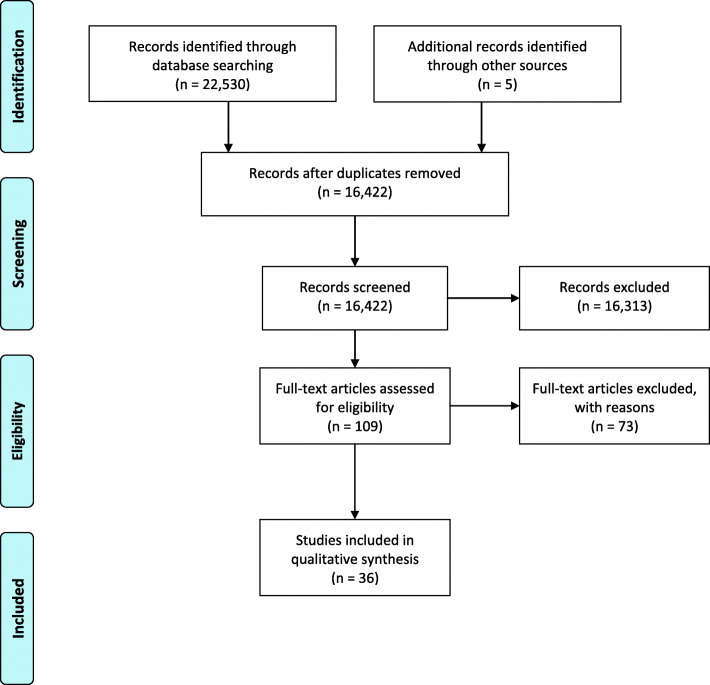
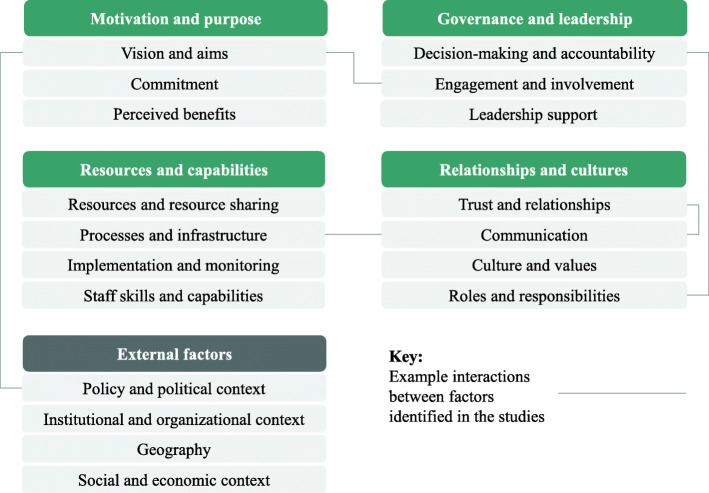
Background: Policymakers in many countries promote collaboration between health care organizations and other sectors as a route to improving population health. Local collaborations have been developed for decades. Yet little is known about the impact of cross-sector collaboration on health and health equity. Methods: We carried out a systematic review of reviews to synthesize evidence on the health impacts of collaboration between local health care and non-health care organizations, and to understand the factors affecting how these partnerships functioned. We searched four databases and included 36 studies (reviews) in our review. We extracted data from these studies and used Nvivo 12 to help categorize the data. We assessed risk of bias in the studies using standardized tools. We used a narrative approach to synthesizing and reporting the data. Results: The 36 studies we reviewed included evidence on varying forms of collaboration in diverse contexts. Some studies included data on collaborations with broad population health goals, such as preventing disease and reducing health inequalities. Others focused on collaborations with a narrower focus, such as better integration between health care and social services. Overall, there is little convincing evidence to suggest that collaboration between local health care and non-health care organizations improves health outcomes. Evidence of impact on health services is mixed. And evidence of impact on resource use and spending are limited and mixed. Despite this, many studies report on factors associated with better or worse collaboration. We grouped these into five domains: motivation and purpose, relationships and cultures, resources and capabilities, governance and leadership, and external factors. But data linking factors in these domains to collaboration outcomes is sparse. Conclusions: In theory, collaboration between local health care and non-health care organizations might contribute to better population health. But we know little about which kinds of collaborations work, for whom, and in what contexts. The benefits of collaboration may be hard to deliver, hard to measure, and overestimated by policymakers. Ultimately, local collaborations should be understood within their macro-level political and economic context, and as one component within a wider system of factors and interventions interacting to shape population health.
Overview
The claims and statistics of this paper haven’t been checked yet.
Free: it reads the open-access text and checks the first 5 claims that cite a source we can check. Create a free account to check every claim.
Integrity signals
Registry
Cites
Statistics
Figures
Verification
Claims the paper makes
The claims and statistics of this paper haven’t been checked yet.
Free: it reads the open-access text and checks the first 5 claims that cite a source we can check. Create a free account to check every claim.
Claims other papers make about this one
Each is checked against this paper’s own text: does it say what the citing paper says it does?
The source backs part of the claim, not all of it — or backs it for a different population, condition or comparison.
In the citing paper
“However, as raised by participants, the implementation of these partnerships can be complex, resulting in low uptake24 and evidence on their effectiveness in facilitating resource connection and follow-up is mixed.25”
From Food Insecurity Screening and Intervention Strategies in Pediatric Primary Care Practices: A Mixed Methods Study (2026) · cites this paper as [25]
Experimental — accuracy not yet measuredThe source backs part of the claim, not all of it — or backs it for a different population, condition or comparison.
In the citing paper
“Intersectoral collaboration is widely recognized as a crucial strategy for improving population health and is paramount in achieving health equity (25, 26);”
From Bridging Sectors and Disciplines to Gain a Critical Understanding of the Eco-Social Determinants of Health Inequities: The ESDHI-EU Conference (2025) · cites this paper as [25]
Experimental — accuracy not yet measuredThe cited source says what the claim attributes to it.
In the citing paper
“Intersectoral approaches recognize that health outcomes are influenced by factors beyond health care, including structural socioeconomic conditions and social class, public policies on education, social security, and living and working environments, among others (25).”
From Bridging Sectors and Disciplines to Gain a Critical Understanding of the Eco-Social Determinants of Health Inequities: The ESDHI-EU Conference (2025) · cites this paper as [25]
Self-check
Percentages, sums and reported differences re-computed from the paper’s own numbers.
The self-check needs the paper’s full text.
Citations
Cites
External Control of Organizations: Resource Dependence Perspective
(2011) · Organizational Behavior 6 · doi:10.4324/9781315701967-54 · Cited by 14,181
Shea, B. J., Reeves, B. C., Wells, G., Thuku, M., Hamel, C., Moran, J., Moher, D., Tugwell, P., Welch, V., Kristjansson, E., et al. (2017) · BMJ · doi:10.1136/bmj.j4008 · Cited by 10,636
The External Control of Organizations: A Resource Dependence Perspective
Reitz, H. J., Pfeffer, J., & Salancik, G. R. (1979) · The Academy of Management Review · doi:10.2307/257794 · Cited by 9,172
Qualitative research and evaluation methods
Patton, M. Q. (1980) · Cited by 7,076
PRESS Peer Review of Electronic Search Strategies: 2015 Guideline Statement
McGowan, J., Sampson, M., Salzwedel, D. M., Cogo, E., Foerster, V., & Lefebvre, C. (2016) · Journal of Clinical Epidemiology · doi:10.1016/j.jclinepi.2016.01.021 · Cited by 5,700 · cited 1×
“The search strategy was developed with a health services research information specialist and reviewed using Peer-Review for Electronic Search Strategies guidance [53], with feedback incorporated into the strategy.”
MethodThe social determinants of health: It’s time to consider the causes of the causes
Braveman, P., & Gottlieb, L. (2014) · Public Health Reports® · doi:10.1177/00333549141291s206 · Cited by 3,861
OTTAWA CHARTER FOR HEALTH PROMOTION
(1986) · Health Promotion International · doi:10.1093/heapro/1.4.405 · Cited by 3,848
Closing the gap in a generation: health equity through action on the social determinants of health
Marmot, M., Friel, S., Bell, R., Houweling, T. A., & Taylor, S. (2008) · The Lancet · doi:10.1016/s0140-6736(08)61690-6 · Cited by 3,247
Resource Dependence Theory: A Review
Hillman, A. J., Withers, M. C., & Collins, B. J. (2009) · Journal of Management · doi:10.1177/0149206309343469 · Cited by 3,178
Aromataris, E., Fernandez, R., Godfrey, C. M., Holly, C., Khalil, H., & Tungpunkom, P. (2015) · International Journal of Evidence-Based Healthcare · doi:10.1097/xeb.0000000000000055 · Cited by 2,587 · cited 1×
“Unlike most umbrella reviews [52], which review systematic reviews only, we reviewed systematic and other reviews (such as scoping reviews) of relevant literature.”
Background
Research works printed but not linked: 16
- Booske BC Athens JK Kinding DA County Health Rankings Working Paper: Different Perspectives for Assigning Weights to Determinants of Health 2010
- United Nations Partnerships for sustainable development goals: a legacy review towards realizing the 2030 Agenda 2015
- World Health Organization Bugs, drugs and smoke: stories from public health 2011 Geneva World Health Organization
- Public Health Agency of Canada, World Health Organization Health equity through intersectoral action: an analysis of 18 country case studies 2008
- Brown C Harrison D Burns H Ziglio E Governance for health equity: taking forward the equity values and goals of health 2020 in the WHO European region 2014 Copenhagen World Health Organization
- Wilson S Davison N Clarke M Casebourne J Joining up public services around local, citizen needs: perennial challenges and insights on how to tackle them 2015 London Institute for Government
- Audit Scotland Review of community health partnerships 2011 Edinburgh Audit Scotland
- Tremblay D Integrating cancer services for the elderly persons: where are we and where should we go? Support Care Cancer 2012 20 S192 S193
- Cameron A, Lart R, Bostock L, Coomber C. SCIE Research briefing 41: Factors that promote and hinder joint and integrated working between health and social care services. 2012. https://www.scie.org.uk/publications/briefings/briefing41/. 23750908
- Weatherly H Mason A Goddard M Wright K Edinburgh Financial integration across health and social care: evidence review 2010 Scottish Government Social Research
- Steyn P, Cordero J, Gichangi P, Smit J, Nkole T, Kiarie J, et al. Participatory interventions involving both community and health care providers for family planning and contraceptive services: a scoping review. Book of Abstracts. Eur J Contracept Reprod Health Care. 2006;21(sup1):1–151.
- Sainsbury Centre for Mental Health Taking your partners: using opportunities for inter-agency partnership in mental health 2000 London Sainsbury Centre for Mental Health
- Department of Health and Social Care Integration and innovation: working together to improve health and social care for all 2021
- Ham C Alderwick H Edwards N Gainsbury S Sustainability and transformation plans in London: an independent analysis of the October 2016 STPs 2017 London King’s Fund
- HM Treasury, Department of Health Tackling health inequalities: summary of the 2002 cross-cutting review 2002 London Department of Health
- Department of Health Tackling health inequalities: a programme for action 2003 London Department of Health
Cited by
Balancing confidentiality and care coordination: challenges in patient privacy
Ibrahim, A. M., Abdel‐Aziz, H. R., Mohamed, H. A. H., Zaghamir, D. E. F., Wahba, N. M. I., Hassan, G. A., Shaban, M., El-Nablaway, M., Aldughmi, O. N., & Aboelola, T. H. (2024) · BMC Nursing · doi:10.1186/s12912-024-02231-1 · Cited by 96
Such, E., Smith, K. E., Woods, H. B., & Meier, P. S. (2022) · International Journal of Health Policy and Management · doi:10.34172/ijhpm.2022.6550 · Cited by 95
Health systems and social services—a bridge too far?
Glied, S., & D’Aunno, T. (2023) · JAMA Health Forum · doi:10.1001/jamahealthforum.2023.3445 · Cited by 57
Thomson, L. J. M., & Chatterjee, H. J. (2024) · Frontiers in Public Health · doi:10.3389/fpubh.2023.1286479 · Cited by 67
A cure for everything and nothing? Local partnerships for improving health in England
Alderwick, H., Hutchings, A., & Mays, N. (2022) · BMJ · doi:10.1136/bmj-2022-070910 · Cited by 46
Self-citation
Metadata
- Authors
- Alderwick, H., Hutchings, A., Briggs, A., & Mays, N.
- Affiliations
- London School of Hygiene & Tropical Medicine (GB)
- University of Warwick (GB)
- Corresponding author
- Alderwick, Hugh
- Venue
- BMC Public Health
- Published
- 2021-04-19
- Volume
- 21
- Issue
- 1
- Pages
- 753-753
- ISSN
- 1471-2458 (ISSN-L)
- PMC
- PMC8054696
- OpenAlex
- W3153575792
- Semantic Scholar
- b8d4786a5d507e8ef59a16f76b58e16839cffd71
- Cited by
- 386
- References
- 166
- Citations by year
- 2026: 47 · 2025: 175 · 2024: 95 · 2023: 47 · 2022: 16 · 2021: 6
- FWCI
- 8.52
- Type
- journal article
- Language
- en
- Open access
- gold
- doi.org
- Licence
- cc-by
- creativecommons.org/licenses/by/4.0 (tdm)
- creativecommons.org/licenses/by/4.0 (vor)
- Locations
- BMC Public Health (publishedVersion, cc-by)
- PubMed Central (publishedVersion, cc-by)
- PubMed (publishedVersion)
- LSHTM Research Online (London School of Hygiene and Tropical Medicine) (acceptedVersion)
- DOAJ (DOAJ: Directory of Open Access Journals) (submittedVersion, cc-by-sa)
- Topics
- Health Sciences › Medicine › Public Health, Environmental and Occupational Health › Community Health and Development
- Health Sciences › Health Professions › General Health Professions › Interprofessional Education and Collaboration
- Health Sciences › Medicine › Public Health, Environmental and Occupational Health › Public Health Policies and Education
- Keywords
- intersectoral collaboration, local health services, health equity, population health, collaboration outcomes, determinants of cooperation, leadership and governance, health disparities
- MeSH terms
- Population Health, Delivery of Health Care, Health Facilities, Humans, Leadership, Review Literature as Topic, Social Work
About these checks
Registry, retraction, Cites and statistics results are computed, not judged, with one exception: a printed reference that no index lists is read once by a model before it counts as a citation error. Claims are extracted by a model and kept only when their quote appears verbatim in the text; each cited source is then checked, with a model’s help, for whether it says what the claim relies on. Those verdicts can be wrong — read the claim’s quote and the cited source before relying on one.
Statistics and arithmetic are recomputed, not judged.
Confidence bands are shown only for fields calibrated on our annotated test set. None is calibrated yet, so no band is shown.
What counts as a claim ›How we measure confidence ›How we check this ›
Are you an author, or do you see a problem with this page? Request a review
Data sources
Bibliographic data: Semantic Scholar, OpenAlex, Crossref.
Contains information from the Semantic Scholar Academic Graph Datasets, made available under the ODC Attribution License (ODC-BY 1.0).
Semantic Scholar’s data is described in: Kinney, R., et al. (2023). The Semantic Scholar Open Data Platform. arXiv:2301.10140.
