

Superspreading, overdispersion and their implications in the SARS-CoV-2 (COVID-19) pandemic: a systematic review and meta-analysis of the literature
Open accessThe DOI matches its Crossref record; 44 of the 44 references it cites were found in a registry or an index.
Abstract
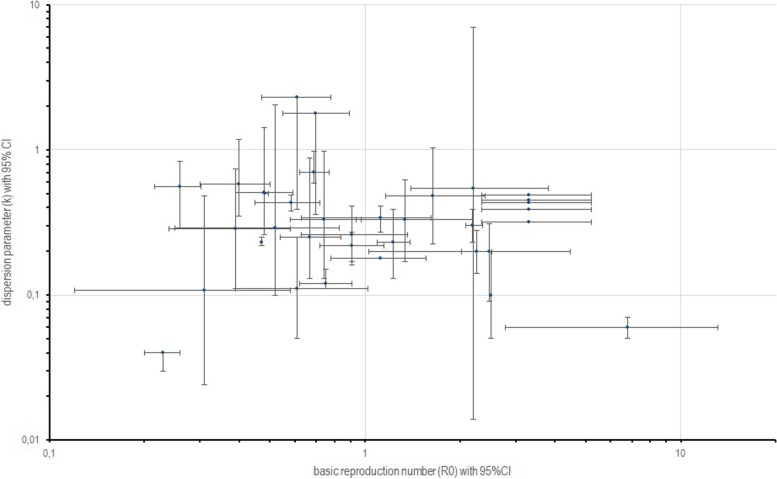
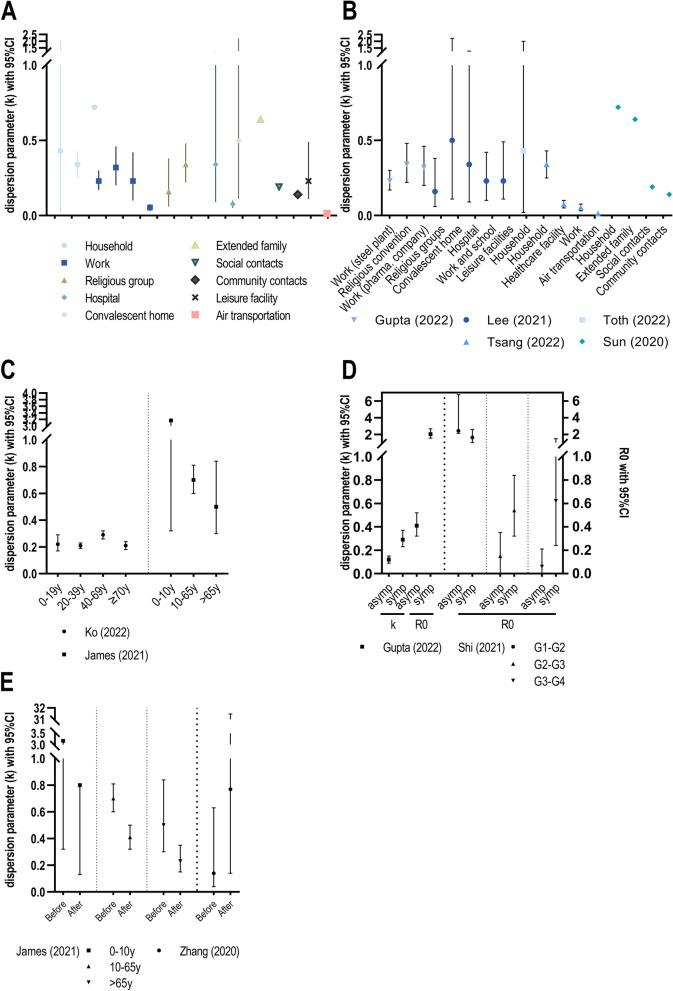
Background: A recurrent feature of infectious diseases is the observation that different individuals show different levels of secondary transmission. This inter-individual variation in transmission potential is often quantified by the dispersion parameter k. Low values of k indicate a high degree of variability and a greater probability of superspreading events. Understanding k for COVID-19 across contexts can assist policy makers prepare for future pandemics. Methods: A literature search following a systematic approach was carried out in PubMed, Embase, Web of Science, Cochrane Library, medRxiv, bioRxiv and arXiv to identify publications containing epidemiological findings on superspreading in COVID-19. Study characteristics, epidemiological data, including estimates for k and R0, and public health recommendations were extracted from relevant records. Results: The literature search yielded 28 peer-reviewed studies. The mean k estimates ranged from 0.04 to 2.97. Among the 28 studies, 93% reported mean k estimates lower than one, which is considered as marked heterogeneity in inter-individual transmission potential. Recommended control measures were specifically aimed at preventing superspreading events. The combination of forward and backward contact tracing, timely confirmation of cases, rapid case isolation, vaccination and preventive measures were suggested as important components to suppress superspreading. Conclusions: Superspreading events were a major feature in the pandemic of SARS-CoV-2. On the one hand, this made outbreaks potentially more explosive but on the other hand also more responsive to public health interventions. Going forward, understanding k is critical for tailoring public health measures to high-risk groups and settings where superspreading events occur.
Overview
The claims and statistics of this paper haven’t been checked yet.
Free: it reads the open-access text and checks the first 5 claims that cite a source we can check. Create a free account to check every claim.
Integrity signals
Registry
Cites
Statistics
Figures
Verification
Claims the paper makes
The claims and statistics of this paper haven’t been checked yet.
Free: it reads the open-access text and checks the first 5 claims that cite a source we can check. Create a free account to check every claim.
Claims other papers make about this one
Each is checked against this paper’s own text: does it say what the citing paper says it does?
The check wasn’t confident either way, so it gives no verdict — never disputed.
In the citing paper
“Thus, the superspreading of SARS-CoV-1 was more prominent than that of many other viruses, 35 including SARS-CoV-2.117”
From Severe acute respiratory syndrome (SARS) mathematical models and disease parameters: a systematic review (2025) · cites this paper as [117]
Experimental — accuracy not yet measured
Self-check
Percentages, sums and reported differences re-computed from the paper’s own numbers.
The self-check needs the paper’s full text.
Citations
Cites
Critical appraisal skills programme
Singh, J. (2013) · Journal of Pharmacology and Pharmacotherapeutics · doi:10.4103/0976-500x.107697 · Cited by 2,556
Superspreading and the effect of individual variation on disease emergence
Lloyd-Smith, J. O., Schreiber, S. J., Kopp, P. E., & Getz, W. M. (2005) · Nature · doi:10.1038/nature04153 · Cited by 2,514
Development of a critical appraisal tool to assess the quality of cross-sectional studies (AXIS)
Downes, M. J., Brennan, M. L., Williams, H. C., & Dean, R. S. (2016) · BMJ Open · doi:10.1136/bmjopen-2016-011458 · Cited by 2,376 · cited 1×
“The final set of identified studies was subjected to a critical quality appraisal checklist according to the Critical Appraisal Skills Programme (CASP) guidelines [15] and the quality of cross-sectional studies (AXIS) scale [16].”
MethodBi, Q., Wu, Y., Mei, S., Ye, C., Zou, X., Zhang, Z., Liu, X., Wei, L., Truelove, S. A., Zhang, T., et al. (2020) · The Lancet Infectious Diseases · doi:10.1016/s1473-3099(20)30287-5 · Cited by 1,958 · cited 3×
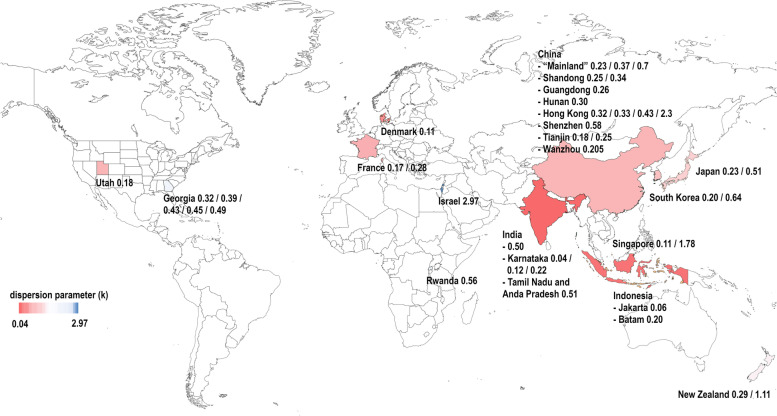
“Countries Studies investigated SARS-CoV-2 superspreading in 12 countries: China [9, 24, 36] (including specific reports on Hong Kong [9, 11, 19, 21, 28], Shenzhen [20], Tianjin [9, 37], Wanzhou [32] and the provinces of Hunan [33], Guangdong [38] and Shandong [35]), Denmark [6], France [8], India (regions of Karnataka…”
BackgroundRiou, J., & Althaus, C. L. (2020) · Eurosurveillance · doi:10.2807/1560-7917.es.2020.25.4.2000058 · Cited by 1,297
Woolhouse, M. E. J., Dye, C., Etard, J.-F., Smith, T., Charlwood, J. D., Garnett, G. P., Hagan, P., Hii, J. L. K., Ndhlovu, P. D., Quinnell, R. J., et al. (1997) · Proceedings of the National Academy of Sciences · doi:10.1073/pnas.94.1.338 · Cited by 1,194 · cited 2×
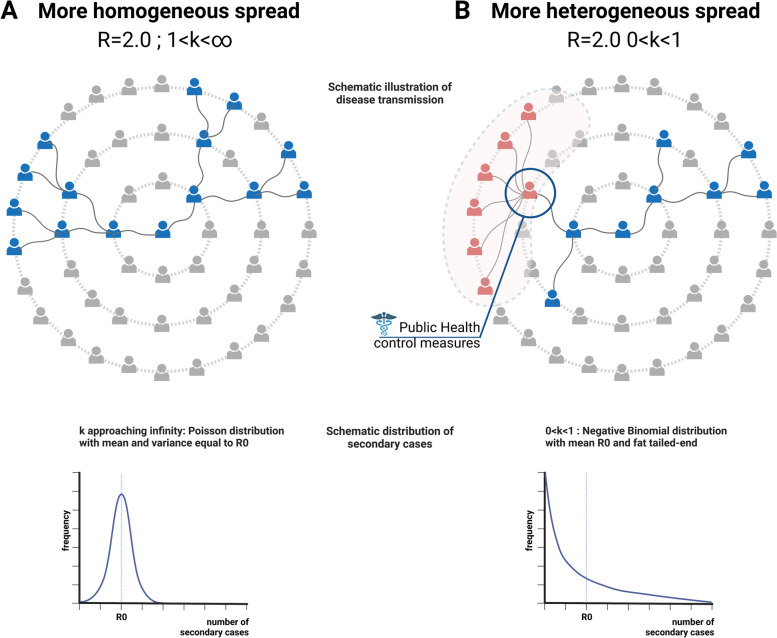
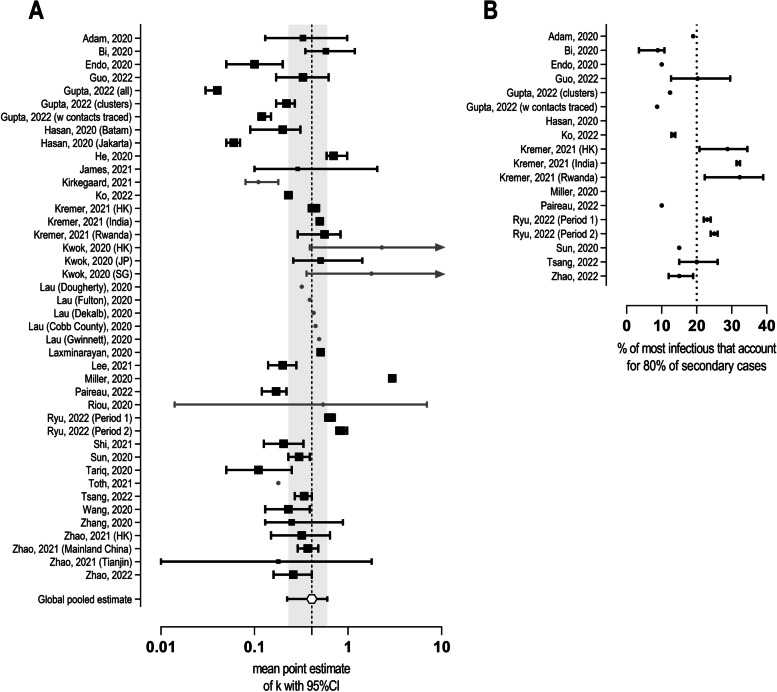
“In sexually transmitted and vector-borne diseases, studies often indicate the percentage of most infectious primary cases that account for 80% of secondary cases, serving as a surrogate marker for heterogeneity in individual infectiousness [5].”
BackgroundClustering and superspreading potential of SARS-CoV-2 infections in Hong Kong
Adam, D. C., Wu, P., Wong, J. Y., Lau, E. H. Y., Tsang, T. K., Cauchemez, S., Leung, G. M., & Cowling, B. J. (2020) · Nature Medicine · doi:10.1038/s41591-020-1092-0 · Cited by 643
Estimating the overdispersion in COVID-19 transmission using outbreak sizes outside China
Endo, A., Centre for the Mathematical Modelling of Infectious Diseases COVID-19 Working Group, Abbott, S., Kucharski, A. J., & Funk, S. (2020) · Wellcome Open Research · doi:10.12688/wellcomeopenres.15842.3 · Cited by 555
Self-citationEpidemiology and transmission dynamics of COVID-19 in two Indian states
Laxminarayan, R., Wahl, B., Dudala, S. R., Gopal, K., Mohan B, C., Neelima, S., Jawahar Reddy, K. S., Radhakrishnan, J., & Lewnard, J. A. (2020) · Science · doi:10.1126/science.abd7672 · Cited by 485 · cited 3×
“Countries Studies investigated SARS-CoV-2 superspreading in 12 countries: China [9, 24, 36] (including specific reports on Hong Kong [9, 11, 19, 21, 28], Shenzhen [20], Tianjin [9, 37], Wanzhou [32] and the provinces of Hunan [33], Guangdong [38] and Shandong [35]), Denmark [6], France [8], India (regions of Karnataka…”
BackgroundTransmission heterogeneities, kinetics, and controllability of SARS-CoV-2
Sun, K., Wang, W., Gao, L., Wang, Y., Luo, K., Ren, L., Zhan, Z., Chen, X., Zhao, S., Huang, Y., et al. (2021) · Science · doi:10.1126/science.abe2424 · Cited by 413 · cited 3×
“Countries Studies investigated SARS-CoV-2 superspreading in 12 countries: China [9, 24, 36] (including specific reports on Hong Kong [9, 11, 19, 21, 28], Shenzhen [20], Tianjin [9, 37], Wanzhou [32] and the provinces of Hunan [33], Guangdong [38] and Shandong [35]), Denmark [6], France [8], India (regions of Karnataka…”
BackgroundEstimating the overdispersion in COVID-19 transmission using outbreak sizes outside China
Endo, A., Centre for the Mathematical Modelling of Infectious Diseases COVID-19 Working Group, Abbott, S., Kucharski, A. J., & Funk, S. (2020) · Wellcome Open Research · doi:10.12688/wellcomeopenres.15842.1 · Cited by 328
Self-citationGalvani, A. P., & May, R. M. (2005) · Nature · doi:10.1038/438293a · Cited by 298 · cited 1×
“first described that the distribution of individual transmission potential around the basic reproduction number R0 is frequently right skewed or overdispersed [3, 4].”
BackgroundDong, E., Ratcliff, J., Goyea, T. D., Katz, A., Lau, R., Ng, T. K., Garcia, B., Bolt, E., Prata, S., Zhang, D., et al. (2022) · The Lancet Infectious Diseases · doi:10.1016/s1473-3099(22)00434-0 · Cited by 283
Althouse, B. M., Wenger, E. A., Miller, J. C., Scarpino, S. V., Allard, A., Hébert-Dufresne, L., & Hu, H. (2020) · PLOS Biology · doi:10.1371/journal.pbio.3000897 · Cited by 252
Lau, M. S. Y., Grenfell, B., Thomas, M., Bryan, M., Nelson, K., & Lopman, B. (2020) · Proceedings of the National Academy of Sciences · doi:10.1073/pnas.2011802117 · Cited by 227 · cited 6×
“The fifth type of dataset matched surveillance data (including demographic information and geolocation of the residence of cases) with aggregate high-volume mobility data of the population (obtained by Facebook users who enabled location services on their mobile phones) to infer viral spreading across the region [18].”
BackgroundInfluentialInference of R0 and Transmission Heterogeneity from the Size Distribution of Stuttering Chains
Blumberg, S., & Lloyd-Smith, J. O. (2013) · PLoS Computational Biology · doi:10.1371/journal.pcbi.1002993 · Cited by 189
Full genome viral sequences inform patterns of SARS-CoV-2 spread into and within Israel
Miller, D., Martin, M. A., Harel, N., Tirosh, O., Kustin, T., Meir, M., Sorek, N., Gefen-Halevi, S., Amit, S., Vorontsov, O. M., et al. (2020) · Nature Communications · doi:10.1038/s41467-020-19248-0 · Cited by 165 · cited 5×
“Studies investigated SARS-CoV-2 superspreading in 12 countries: China [9, 24, 36] (including specific reports on Hong Kong [9, 11, 19, 21, 28], Shenzhen [20], Tianjin [9, 37], Wanzhou [32] and the provinces of Hunan [33], Guangdong [38] and Shandong [35]), Denmark [6], France [8], India (regions of Karnataka [22], Tam…”
BackgroundMethodResultInfluentialWang, L., Didelot, X., Yang, J., Wong, G., Shi, Y., Liu, W., Gao, G. F., & Bi, Y. (2020) · Nature Communications · doi:10.1038/s41467-020-18836-4 · Cited by 138
Real-time monitoring the transmission potential of COVID-19 in Singapore, March 2020
Tariq, A., Lee, Y., Roosa, K. M., Blumberg, S., Yan, P., Ma, S., & Chowell, G. (2020) · BMC Medicine · doi:10.1186/s12916-020-01615-9 · Cited by 132
Evaluating Transmission Heterogeneity and Super-Spreading Event of COVID-19 in a Metropolis of China
Zhang, Y., Li, Y., Wang, L., Li, M., & Zhou, X. (2020) · International Journal of Environmental Research and Public Health · doi:10.3390/ijerph17103705 · Cited by 114 · cited 3×
“Countries Studies investigated SARS-CoV-2 superspreading in 12 countries: China [9, 24, 36] (including specific reports on Hong Kong [9, 11, 19, 21, 28], Shenzhen [20], Tianjin [9, 37], Wanzhou [32] and the provinces of Hunan [33], Guangdong [38] and Shandong [35]), Denmark [6], France [8], India (regions of Karnataka…”
BackgroundXu, X.-K., Liu, X. F., Wu, Y., Ali, S. T., Du, Z., Bosetti, P., Lau, E. H. Y., Cowling, B. J., & Wang, L. (2020) · Clinical Infectious Diseases · doi:10.1093/cid/ciaa790 · Cited by 105
Droguett, D. H. P., & Kronforst, M. R. (2020) · Nature Communications · doi:10.1038/s41467-019-13859-y · Cited by 93
Oshitani, H., & The Expert Members of The National COVID-19 Cluster Taskforce at The Ministry of Health, L. A. W. (2020) · Japanese Journal of Infectious Diseases · doi:10.7883/yoken.jjid.2020.363 · Cited by 87
Endo, A., Centre for the Mathematical Modelling of Infectious Diseases COVID-19 Working Group, Leclerc, Q. J., Knight, G. M., Medley, G. F., Atkins, K. E., Funk, S., & Kucharski, A. J. (2021) · Wellcome Open Research · doi:10.12688/wellcomeopenres.16344.3 · Cited by 83
Self-citationEffective control of SARS-CoV-2 transmission in Wanzhou, China
Shi, Q., Hu, Y., Peng, B., Tang, X.-J., Wang, W., Su, K., Luo, C., Wu, B., Zhang, F., Zhang, Y., et al. (2020) · Nature Medicine · doi:10.1038/s41591-020-01178-5 · Cited by 80
Endo, A., Centre for the Mathematical Modelling of Infectious Diseases COVID-19 Working Group, Leclerc, Q. J., Knight, G. M., Medley, G. F., Atkins, K. E., Funk, S., & Kucharski, A. J. (2020) · Wellcome Open Research · doi:10.12688/wellcomeopenres.16344.1 · Cited by 70
Self-citationSuperspreading in early transmissions of COVID-19 in Indonesia
Hasan, A., Susanto, H., Kasim, M., Nuraini, N., Lestari, B. W., Triany, D., & Widyastuti, W. (2020) · Scientific Reports · doi:10.1038/s41598-020-79352-5 · Cited by 60
Serial Interval and Transmission Dynamics during SARS-CoV-2 Delta Variant Predominance, South Korea
Ryu, S., Kim, D., Lim, J., Ali, S. T., & Cowling, B. J. (2021) · Emerging infectious diseases · doi:10.3201/eid2802.211774 · Cited by 47 · cited 6×
“South Korea Emerg Infect Dis.”
BackgroundInfluentialZhao, S., Shen, M., Musa, S. S., Guo, Z., Ran, J., Peng, Z., Zhao, Y., Chong, K. C., He, D., & Wang, M. H. (2021) · BMC Medical Research Methodology · doi:10.1186/s12874-021-01225-w · Cited by 43 · cited 14×
“Bi Q, Wu Y, Mei S, Ye C, Zou X, Zhang Z, et al. Epidemiology and transmission of COVID-19 in 391 cases and 1286 of their close contacts in Shenzhen, China: a retrospective cohort study.”
BackgroundInfluentialInferring super-spreading from transmission clusters of COVID-19 in Hong Kong, Japan, and Singapore
Kwok, K. O., Chan, H. H. H., Huang, Y., Hui, D. S. C., Tambyah, P. A., Wei, W., Chau, P. Y. K., Wong, S. Y. S., & Tang, J. W.-T. (2020) · Journal of Hospital Infection · doi:10.1016/j.jhin.2020.05.027 · Cited by 40 · cited 8×
“The authors hypothesise that the observation of greater susceptibility to superspreading might be explained with low prevalence of vaccination boosters at the time of investigation and only limited natural immunity due to a ’zero COVID-19’ policy in Hong Kong [21].”
BackgroundInfluentialLow dispersion in the infectiousness of COVID-19 cases implies difficulty in control
He, D., Zhao, S., Xu, X.-K., Lin, Q., Zhuang, Z., Cao, P., Wang, M. H., Lou, Y., Xiao, L., Wu, Y., et al. (2020) · BMC Public Health · doi:10.1186/s12889-020-09624-2 · Cited by 34 · cited 9×
“Bi Q, Wu Y, Mei S, Ye C, Zou X, Zhang Z, et al. Epidemiology and transmission of COVID-19 in 391 cases and 1286 of their close contacts in Shenzhen, China: a retrospective cohort study.”
BackgroundInfluentialQuantifying superspreading for COVID-19 using Poisson mixture distributions
Kremer, C., Torneri, A., Boesmans, S., Meuwissen, H., Verdonschot, S., Driessche, K. V., Althaus, C. L., Faes, C., & Hens, N. (2021) · Scientific Reports · doi:10.1038/s41598-021-93578-x · Cited by 34
Systematic review and meta‐analyses of superspreading of SARS‐CoV‐2 infections
Du, Z., Wang, C., Liu, C., Bai, Y., Pei, S., Adam, D. C., Wang, L., Wu, P., Lau, E. H. Y., & Cowling, B. J. (2022) · Transboundary and Emerging Diseases · doi:10.1111/tbed.14655 · Cited by 29 · cited 3×
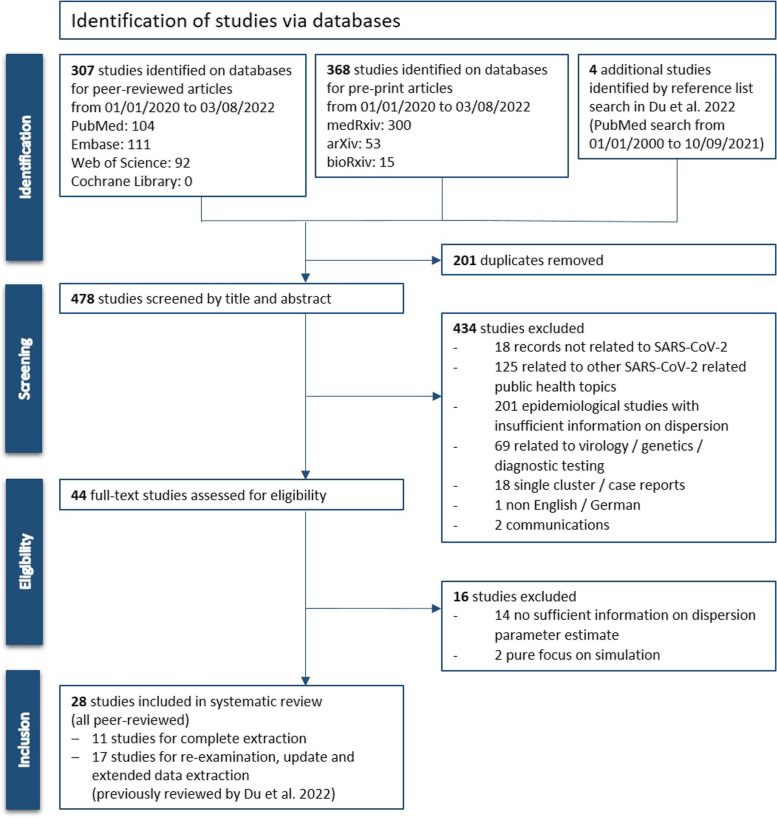
“A reference list search of the previous review [13] yielded an additional four studies that met inclusion criteria.”
MethodInfluentialSuperspreading quantified from bursty epidemic trajectories
Kirkegaard, J. B., & Sneppen, K. (2021) · Scientific Reports · doi:10.1038/s41598-021-03126-w · Cited by 25
Early chains of transmission of COVID-19 in France, January to March 2020
Paireau, J., Mailles, A., Eisenhauer, C., de Laval, F., Delon, F., Bosetti, P., Salje, H., Pontiès, V., & Cauchemez, S. (2022) · Eurosurveillance · doi:10.2807/1560-7917.es.2022.27.6.2001953 · Cited by 24 · cited 4×
“Countries Studies investigated SARS-CoV-2 superspreading in 12 countries: China [9, 24, 36] (including specific reports on Hong Kong [9, 11, 19, 21, 28], Shenzhen [20], Tianjin [9, 37], Wanzhou [32] and the provinces of Hunan [33], Guangdong [38] and Shandong [35]), Denmark [6], France [8], India (regions of Karnataka…”
BackgroundInfluentialModel-free estimation of COVID-19 transmission dynamics from a complete outbreak
James, A., Plank, M. J., Hendy, S. C., Binny, R. N., Lustig, A. G., & Steyn, N. (2021) · PLoS ONE · doi:10.1371/journal.pone.0238800 · Cited by 23 · cited 4×
“Countries Studies investigated SARS-CoV-2 superspreading in 12 countries: China [9, 24, 36] (including specific reports on Hong Kong [9, 11, 19, 21, 28], Shenzhen [20], Tianjin [9, 37], Wanzhou [32] and the provinces of Hunan [33], Guangdong [38] and Shandong [35]), Denmark [6], France [8], India (regions of Karnataka…”
BackgroundInfluentialKo, Y. K., Furuse, Y., Ninomiya, K., Otani, K., Akaba, H., Miyahara, R., Imamura, T., Imamura, T., Cook, A. R., Saito, M., et al. (2022) · International Journal of Infectious Diseases · doi:10.1016/j.ijid.2022.01.036 · Cited by 23 · cited 2×
“Countries Studies investigated SARS-CoV-2 superspreading in 12 countries: China [9, 24, 36] (including specific reports on Hong Kong [9, 11, 19, 21, 28], Shenzhen [20], Tianjin [9, 37], Wanzhou [32] and the provinces of Hunan [33], Guangdong [38] and Shandong [35]), Denmark [6], France [8], India (regions of Karnataka…”
BackgroundSuperspreading potential of COVID-19 outbreak seeded by Omicron variants of SARS-CoV-2 in Hong Kong
Guo, Z., Zhao, S., Lee, S. S., Mok, C. K. P., Wong, N. S., Wang, J., Jia, K. M., Wang, M. H., Yam, C. H. K., Chow, T. Y., et al. (2022) · Journal of Travel Medicine · doi:10.1093/jtm/taac049 · Cited by 21 · cited 7×
“The authors hypothesise that the observation of greater susceptibility to superspreading might be explained with low prevalence of vaccination boosters at the time of investigation and only limited natural immunity due to a ’zero COVID-19’ policy in Hong Kong [21].”
InfluentialZhao, S., Guo, Z., Chong, K. C., He, D., & Wang, M. H. (2022) · Journal of Travel Medicine · doi:10.1093/jtm/taac025 · Cited by 19 · cited 3×
“Countries Studies investigated SARS-CoV-2 superspreading in 12 countries: China [9, 24, 36] (including specific reports on Hong Kong [9, 11, 19, 21, 28], Shenzhen [20], Tianjin [9, 37], Wanzhou [32] and the provinces of Hunan [33], Guangdong [38] and Shandong [35]), Denmark [6], France [8], India (regions of Karnataka…”
Monitoring real-time transmission heterogeneity from incidence data
Zhang, Y., Britton, T., & Zhou, X. (2022) · PLoS Computational Biology · doi:10.1371/journal.pcbi.1010078 · Cited by 16
Analysis of Superspreading Potential from Transmission Clusters of COVID-19 in South Korea
Lee, H., Han, C. Y., Jung, J., & Lee, S. (2021) · International Journal of Environmental Research and Public Health · doi:10.3390/ijerph182412893 · Cited by 15 · cited 7×
“Both religious gatherings and hospitals or convalescent homes were identified as risk settings for superspreading [22, 29, 35].”
BackgroundResultInfluentialTsang, T. K., Fang, L., Zhang, A., Jiang, F., Ruan, S., Liu, L., Cowling, B. J., Liu, W. Y., & Yang, Y. (2022) · Epidemics · doi:10.1016/j.epidem.2022.100553 · Cited by 15
High variability in transmission of SARS-CoV-2 within households and implications for control
Toth, D. J. A., Beams, A. B., Keegan, L. T., Zhang, Y., Greene, T., Orleans, B., Seegert, N., Looney, A., Alder, S. C., & Samore, M. H. (2021) · PLoS ONE · doi:10.1371/journal.pone.0259097 · Cited by 13 · cited 5×
“As a fourth data source, a study investigating the variability of within household transmission, paired serological SARS-CoV-2 antibody test data with a household survey [10].”
BackgroundInfluentialGupta, M., Parameswaran, G. G., Sra, M. S., Mohanta, R., Patel, D. H., Gupta, A., Bansal, B., Jain, V., Mazumder, A., Arora, M., et al. (2022) · PLoS ONE · doi:10.1371/journal.pone.0270789 · Cited by 13 · cited 6×
“Both religious gatherings and hospitals or convalescent homes were identified as risk settings for superspreading [22, 29, 35].”
BackgroundInfluential
Cited by
Anish, T. S., Reghukumar, A., Radhakrishnan, C., Gupta, N., Yadav, P. D., Cherian, J. J., Sahay, R. R., Chenayil, S., S, A. K. A., Moorkoth, A. P., et al. (2024) · PLOS Global Public Health · doi:10.1371/journal.pgph.0003926 · Cited by 29
Revolutionizing infectious disease surveillance: Multi-omics technologies and AI-driven integration
Aswini, R., Saranya, B., Gayathri, K., & Elumalai, K. (2025) · Decoding Infection and Transmission · doi:10.1016/j.dcit.2025.100061 · Cited by 21
Inference of epidemic dynamics in the COVID-19 era and beyond
Cori, A., & Kucharski, A. J. (2024) · Epidemics · doi:10.1016/j.epidem.2024.100784 · Cited by 21
SARS-CoV-2 epidemiology, kinetics, and evolution: A narrative review
Alizon, S., & Sofonea, M. T. (2025) · Virulence · doi:10.1080/21505594.2025.2480633 · Cited by 16
“The importance of super-spreading events was later confirmed by several studies, with at least 26 events recorded in enough detail to be analysed [64].”
High-resolution epidemiological landscape from ~290,000 SARS-CoV-2 genomes from Denmark
Khurana, M. P., Curran-Sebastian, J. L., Scheidwasser, N., Morgenstern, C., Rasmussen, M., Fonager, J., Stegger, M., Tang, M. E., Juul, J. L., Escobar-Herrera, L. A., et al. (2024) · Nature Communications · doi:10.1038/s41467-024-51371-0 · Cited by 14
Metadata
- Authors
- Wegehaupt, O., Endo, A., & Vassall, A.
- Affiliations
- University of Freiburg (DE)
- London School of Hygiene & Tropical Medicine (GB)
- Amsterdam UMC Location University of Amsterdam (NL)
- Corresponding author
- Wegehaupt, Oliver
- Venue
- BMC Public Health
- Published
- 2023-05-30
- Volume
- 23
- Issue
- 1
- Pages
- 1003-1003
- ISSN
- 1471-2458 (ISSN-L)
- PMC
- PMC10227392
- OpenAlex
- W4378781879
- Semantic Scholar
- 3812485ac1c116c17bc6337c3ca6e27d50f8f0fc
- Cited by
- 45
- References
- 43
- Citations by year
- 2026: 10 · 2025: 16 · 2024: 17 · 2023: 2
- FWCI
- 2.60
- Type
- journal article
- Language
- en
- Open access
- gold
- doi.org
- Licence
- cc-by
- creativecommons.org/licenses/by/4.0 (tdm)
- creativecommons.org/licenses/by/4.0 (vor)
- Locations
- BMC Public Health (publishedVersion, cc-by)
- PubMed Central (publishedVersion, cc-by)
- PubMed (publishedVersion)
- LSHTM Research Online (London School of Hygiene and Tropical Medicine) (acceptedVersion)
- DOAJ (DOAJ: Directory of Open Access Journals) (submittedVersion, cc-by-sa)
- Funders
- Universitätsklinikum Freiburg
- Topics
- Physical Sciences › Mathematics › Modeling and Simulation › COVID-19 epidemiological studies
- Health Sciences › Medicine › Infectious Diseases › SARS-CoV-2 and COVID-19 Research
- Physical Sciences › Mathematics › Applied Mathematics › Mathematical and Theoretical Epidemiology and Ecology Models
- Keywords
- superspreading, overdispersion, SARS-CoV-2, COVID-19 pandemic, transmission heterogeneity, dispersion parameter, basic reproduction number, contact tracing, case isolation, vaccination, public health interventions
- MeSH terms
- COVID-19, SARS-CoV-2, Humans, Public Health, Contact Tracing, Pandemics
About these checks
Registry, retraction, Cites and statistics results are computed, not judged, with one exception: a printed reference that no index lists is read once by a model before it counts as a citation error. Claims are extracted by a model and kept only when their quote appears verbatim in the text; each cited source is then checked, with a model’s help, for whether it says what the claim relies on. Those verdicts can be wrong — read the claim’s quote and the cited source before relying on one.
Statistics and arithmetic are recomputed, not judged.
Confidence bands are shown only for fields calibrated on our annotated test set. None is calibrated yet, so no band is shown.
What counts as a claim ›How we measure confidence ›How we check this ›
Are you an author, or do you see a problem with this page? Request a review
Data sources
Bibliographic data: Semantic Scholar, OpenAlex, Crossref.
Contains information from the Semantic Scholar Academic Graph Datasets, made available under the ODC Attribution License (ODC-BY 1.0).
Semantic Scholar’s data is described in: Kinney, R., et al. (2023). The Semantic Scholar Open Data Platform. arXiv:2301.10140.
