

The DOI matches its Crossref record; the references it cites are not checked yet.
Mood profile in men and women of all ages is improved by leisure-time physical activity rather than work-related physical activity
Open accessPublished version of a preprint
Abstract
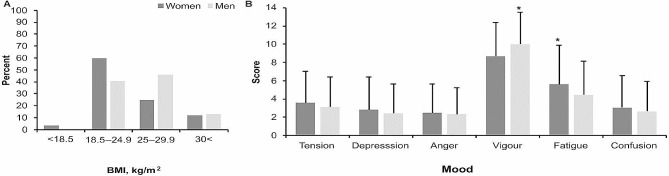
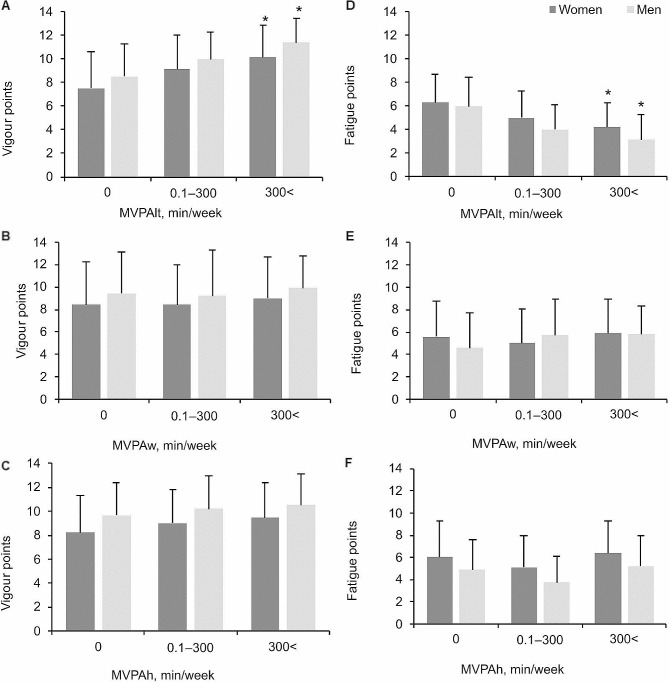
Background: The aim of our study was to determine how six mood indicators (vigour, fatigue, depression, anger, confusion, tension) depend on moderate to vigorous physical activity, walking time and sedentary time at work, after working hours and during leisure time, in men and women of different age groups. Methods: A total of 1,140 individuals aged 18 to 64 years participated in the study. The participants were enrolled in this cross-sectional survey using a snowball sampling method. An online questionnaire was shared through popular social networks and emails within the period October 2019 to June 2020. Mood responses were assessed using The Brunel Mood Scale-LTU. Physical activity was assessed using the long International Physical Activity Questionnaire. Descriptive analysis, a two-way analysis of variance, and linear regression analysis were used to interpret the data. Results: The survey results showed that vigour and fatigue correlated significantly only with leisure-time moderate to vigorous physical activity. The present results show a significant positive correlation between women and men moods and leisure-time moderate to vigorous physical activity, the length of time walking to work and back home, and negative correlation between moods and leisure-time sedentary behaviour. However, there was no significant correlation between moods and work-related moderate to vigorous physical activity and household moderate to vigorous physical activity, walking at work, and sitting duration at work. Conclusions: This study provides theoretical implications of the physical activity paradox, justifying the benefits of moderate to vigorous physical activity practiced in different circumstances. According to the regression analysis, exercising men in all age groups moved the most (had a higher moderate to vigorous physical activity level) during leisure time, the highest work-related moderate to vigorous physical activity was observed in men and women with lower education, and the highest household moderate to vigorous physical activity was observed in older age men and women living in rural areas. Clinicians and leaders at all levels of health care should consider the greater importance of leisure-time physical activity for mental health when choosing the most targeted physical activity recommendations for mood profile improvement in men and women of different age groups.
Overview
The claims and statistics of this paper haven’t been checked yet.
Run the check — free, no account needed. It reads the open-access text and checks the sources it cites.
Integrity signals
Registry
Cites
Statistics
Figures
Verification
Claims the paper makes
The claims and statistics of this paper haven’t been checked yet.
Run the check — free, no account needed. It reads the open-access text and checks the sources it cites.
Claims other papers make about this one
Each is checked against this paper’s own text: does it say what the citing paper says it does?
The source backs part of the claim, not all of it — or backs it for a different population, condition or comparison.
In the citing paper
“Regular exercise provides physical and mental health benefits,89,90 and walking and cycling can contribute to decreasing transport-related greenhouse gas emissions and air pollution when acting as substitutes for fossil fuel-based transportation (indicators 3.1.3 and 3.2.1).91”
From The 2024 report of the Lancet Countdown on health and climate change: facing record-breaking threats from delayed action (2024) · cites this paper as [90]
Experimental — accuracy not yet measured
Self-check
Percentages, sums and reported differences re-computed from the paper’s own numbers.
The self-check needs the paper’s full text.
Citations
The citation lists haven’t been fetched yet
References 29 · Cited by 17
Research works printed but not linked: 27
- Chekroud SR, Gueorguieva R, Zheutlin AB, et al. Association between physical exercise and mental health in 1·2 million individuals in the USA between 2011 and 2015: a cross-sectional study. Lancet Psychiatry. 2018;5(9):739–46. · DOI · Paper page
- García-Soidán JL, Leirós-Rodríguez R, Romo-Pérez V, Arufe-Giráldez V. Evolution of the habits of physical activity and television viewing in Spanish children and pre-adolescents between 1997 and 2017. Int J Environ Res Public Health. 2020;17(18):6836. · DOI
- Gross JJ, Uusberg H, Uusberg A. Mental illness and well-being: an affect regulation perspective. World Psychiatry. 2019;18(2):130–9. · DOI
- Gataūlinas A. Subjective well-being of Lithuanian society in the context of European Union countries. Vilnius: Vilniaus Universitetas; 2013.
- Terry PC, Skurvydas A, Lisinskiene A, et al. Validation of a Lithuanian-Language Version of the Brunel Mood Scale: the BRUMS-LTU. Int J Environ Res Public Health. 2022a;19(8):4867. · DOI
- Terry PC, Parsons-Smith RL, Skurvydas A, et al. Physical activity and healthy habits Influence Mood Profile clusters in a Lithuanian Population. Sustainability. 2022b;14:10006. · DOI
- Sties SW, Gonzáles AI, Netto AS, et al. Validation of the Brunel Mood Scale for cardiac rehabilitation program. Brazil J Sports Med. 2014;20:281–4.
- Brandt R, Herrero D, Massetti T, et al. The Brunel Mood Scale rating in mental health for physically active and apparently healthy populations. Health. 2016;8:125–32. · DOI
- LeUnes A, Burger J. Profile of Mood States research in sport and exercise psychology: past, present, and future. J Appl Sport Psychol. 2000;12:5–15. · DOI
- Terry PC, Parsons-Smith RL, King R, et al. Influence of sex, age, and education on mood profile clusters. PLoS ONE. 2021;16:e0245341. · DOI
- Holtermann A, Hansen JV, Burr H, et al. The health paradox of occupational and leisure-time physical activity. Br J Sports Med. 2012;46(4):291–5. · DOI
- Richard A, Martin B, Wanner M, et al. Effects of leisure-time and occupational physical activity on total mortality risk in NHANES III according to sex, ethnicity, central obesity, and age. J Phys Act Health. 2015;12(2):184–92. · DOI
- Coenen P, Huysmans MA, Holtermann A, et al. Do highly physically active workers die early? A systematic review with meta-analysis of data from 193 696 participants. Br J Sports Med. 2018;52(20):1320–6. · DOI · Paper page
- Coenen P, Huysmans MA, Holtermann A, et al. Towards a better understanding of the ‘physical activity paradox’: the need for a research agenda. Br J Sports Med. 2020;54(17):1055–7. · DOI
- Cillekens B, Lang M, van Mechelen W, et al. How does occupational physical activity influence health? An umbrella review of 23 health outcomes across 158 observational studies. Br J Sports Med. 2020;54(24):1474–81. · DOI
- Johansson MS, Holtermann A, Marott JL, et al. The physical activity health paradox and risk factors for cardiovascular disease: a cross-sectional compositional data analysis in the Copenhagen City Heart Study. PLoS ONE. 2022;17(4):e0267427. · DOI
- Cillekens B, Huysmans MA, Holtermann A, et al. Physical activity at work may not be health enhancing. A systematic review with meta-analysis on the association between occupational physical activity and cardiovascular disease mortality covering 23 studies with 655 892 participants. Scand J Work Environ Health. 2022;48(2):86–98. · DOI
- Janssen TI, Voelcker-Rehage C. Leisure-time physical activity, occupational physical activity and the physical activity paradox in healthcare workers: a systematic overview of the literature. Int J Nurs Stud. 2023;141:104470. · DOI
- Luo M, Gupta N, Holtermann A, et al. Revisiting the ‘physical activity paradox’ in a Chinese context: occupational physical activity and mortality in 142,302 urban working adults from the China Kadoorie Biobank study. Lancet Reg Health West Pac. 2022;23:100457. · DOI
- Holtermann A, Krause N, van der Beek AJ, et al. The physical activity paradox: six reasons why occupational physical activity (OPA) does not confer the cardiovascular health benefits that leisure time physical activity does. Br J Sports Med. 2018;52(3):149–50. · DOI · Paper page
- Dalene KE, Tarp J, Selmer RM, et al. Occupational physical activity and longevity in working men and women in Norway: a prospective cohort study. Lancet Public Health. 2021;6(6):e386–95. · DOI
- Prince SA, Rasmussen CL, Biswas A, et al. The effect of leisure time physical activity and sedentary behaviour on the health of workers with different occupational physical activity demands: a systematic review. Int J Behav Nutr Phys Act. 2021;18(1):100. · DOI
- Craig CL, Marshall AL, Sjostrom M, et al. International Physical Activity Questionnaire: 12-country reliability and validity. Med Sci Sports Exerc. 2003;35:1381–95. · DOI · Paper page
- Bassett DR Jr. International physical activity questionnaire: 12-country reliability and validity. Med Sci Sports Exerc. 2003;35(8):1396. · DOI
- Skurvydas A, Lisinskiene A, Lochbaum M, et al. Physical activity, stress, Depression, Emotional Intelligence, logical thinking, and overall health in a large Lithuanian from October 2019 to June 2020: age and gender differences adult sample. Int J Environ Res Public Health. 2021;18(23):12809. · DOI
- Skurvydas A, Lisinskiene A, Majauskiene D, et al. What types of Exercise are best for Emotional Intelligence and Logical thinking? Int J Environ Res Public Health. 2022;19(16):10076. · DOI
- García-Soidán JL, Boente Antela B, Leirós Rodríguez R. ¿Los menores españoles, en su tiempo libre, prefieren dispositivos electrónicos o actividad física? Sportis Sci J. 2020;6(2):347–64. · DOI
Metadata
- Authors
- Skurvydas, A., Istomina, N., Dadeliene, R., Majauskiene, D., Strazdaite, E., Lisinskiene, A., Valanciene, D., Uspuriene, A. B., & Sarkauskiene, A.
- Affiliations
- Vilnius University (LT)
- ORCID
- Skurvydas, Albertas
- Venue
- BMC Public Health
- Published
- 2024-02-21
- Volume
- 24
- Issue
- 1
- Pages
- 546-546
- ISSN
- 1471-2458 (ISSN-L)
- PMC
- PMC10882751
- OpenAlex
- W4391991440
- Cited by
- 17
- References
- 29
- Citations by year
- 2026: 6 · 2025: 8 · 2024: 3
- FWCI
- 4.84
- Type
- journal article
- Language
- en
- Open access
- gold
- doi.org
- Locations
- BMC Public Health (publishedVersion, cc-by)
- Research Square (acceptedVersion, cc-by)
- PubMed Central (publishedVersion, cc-by)
- PubMed (publishedVersion)
- DOAJ (DOAJ: Directory of Open Access Journals) (submittedVersion)
- Vytautas Magnus University (submittedVersion, cc-by)
- Topics
- Health Sciences › Medicine › Public Health, Environmental and Occupational Health › Physical Activity and Health
- Social Sciences › Life-span and Life-course Studies › Recreational Sport and Physical Activity
- Social Sciences › Business, Management and Accounting › Tourism, Leisure and Hospitality Management › Recreation, Leisure, Wilderness Management
- Keywords
- mood, leisure-time physical activity, work-related physical activity, sedentary behavior, vigor, fatigue, depression, anger, confusion, tension, walking to work, mental health, sex differences, age differences, household physical activity, educational attainment, rural residence
- MeSH terms
- Cross-Sectional Studies, Fatigue, Female, Humans, Leisure Activities, Male, Motor Activity, Exercise
About these checks
Registry, retraction, Cites and statistics results are computed, not judged, with one exception: a printed reference that no index lists is read once by a model before it counts as a citation error. Claims are extracted by a model and kept only when their quote appears verbatim in the text; each cited source is then checked, with a model’s help, for whether it says what the claim relies on. Those verdicts can be wrong — read the claim’s quote and the cited source before relying on one.
Statistics and arithmetic are recomputed, not judged.
Confidence bands are shown only for fields calibrated on our annotated test set. None is calibrated yet, so no band is shown.
What counts as a claim ›How we measure confidence ›How we check this ›
Are you an author, or do you see a problem with this page? Request a review
How to cite
Cite CoChat for the checks on this page, and the paper for its own findings.
- This page
- CoChat. (2026). Citation check: Mood profile in men and women of all ages is improved by leisure-time physical activity rather than work-related physical activity. https://app.cochat.ai/papers/10.1186/s12889-024-17806-5
- The paper
- Skurvydas, A., Istomina, N., Dadeliene, R., Majauskiene, D., Strazdaite, E., Lisinskiene, A., Valanciene, D., Uspuriene, A. B., & Sarkauskiene, A. (2024). Mood profile in men and women of all ages is improved by leisure-time physical activity rather than work-related physical activity. BMC Public Health. https://doi.org/10.1186/s12889-024-17806-5
