

Opportunistic screening for COPD among socially marginalized patients
Open accessPublished version of a preprint
The DOI matches its Crossref record; 19 of the 19 references it cites were found in a registry or an index; none of the 35 sources its claims cite is checked for support yet.
Abstract
Background: Chronic obstructive pulmonary disease (COPD) is a common disease associated with premature death. Tobacco exposure is the main risk factor, but lower socioeconomic status, early life insults, and occupational exposures are also important risk factors. Socially marginalized people, facing homelessness, substance use disorder, and mental illness, are likely to have a higher risk of developing COPD, and, furthermore, experience barriers to healthcare access and consequently poorer outcomes. Objective: This study aims to assess COPD prevalence and the impact of opportunistic screening among hospitalized patients who are in contact with hospital social nurses. These patients constitute a group of patients with a high prevalence of psychiatric and somatic diseases, substance use, low life expectancy, and are socially marginalized. Methods: The present prospective longitudinal study includes a clinical examination at baseline. Participants will have spirometry done and be interviewed regarding risk factors, socioeconomic conditions, and respiratory symptoms. The 5-year follow-up assessment incorporates data from baseline and register data over the 5 years, including information on morbidity, use of COPD medication, hospital contacts, mortality, and socioeconomic factors. Anticipated results: Referral for further diagnostic work-up and management after the screening, including COPD treatment and smoking cessation support, is expected to improve survival rates. The study is still enrolling patients. Trial registration: The study is registered at ClinicalTrials.gov , NCT04754308 with study status: “enrolling”.
Verifying this paper
7 of 9 steps done · this page updates itself — you can leave and come back
- Registry recordVerified
- Full textRead the full text
- Reference listQueued — the list appears here once it is fetched
- Reference checkChecking each cited work
- StatisticsRecomputed
- Claims57 claims anchored to a quote
- Cited sourcesChecked
- Self-checkChecked
- VerificationFindings verified
Overview
CoChat Summary
TL;DR
This is a prospective longitudinal study protocol assessing COPD prevalence and the 5-year impact of opportunistic screening among socially marginalized hospitalized patients in contact with social nurses in Denmark. It reports no results yet; the study is still enrolling.
Key findings
- No empirical findings are reported; the study status is “enrolling,” with anticipated completion of enrolment in 2024.
- The study hypothesizes that socially marginalized patients in contact with social nurses have at least a twofold higher prevalence of COPD than the general population, where the Danish background prevalence is stated as 4.3%.
- The power calculation assumes twice the background prevalence, with 80% power and a significance level of 0.05, requiring 511 patients.
- Planned outcomes include prevalence of post-bronchodilator FEV1/FVC <0.70, proportion diagnosed vs. undiagnosed COPD, referral uptake within 4 months, smoking cessation desire and support, and 5-year hospital contacts, COPD medication use, mortality, and socioeconomic factors.
Methods
- Prospective longitudinal study with baseline clinical examination and 5-year follow-up. Participants are recruited during hospitalization by social nurses at 11 hospitals in three Danish regions (Capital Region of Denmark, Region Zealand, and Central Denmark Region), starting April 19, 2021, and still enrolling.
- Inclusion criteria: patients aged 18 years or older seen by a social nurse, able to comply with study procedures, able to understand Danish, and able to provide informed consent. Exclusion criterion: patients without a Danish civil registration number. The target population comprises approximately 70,000 individuals in Denmark.
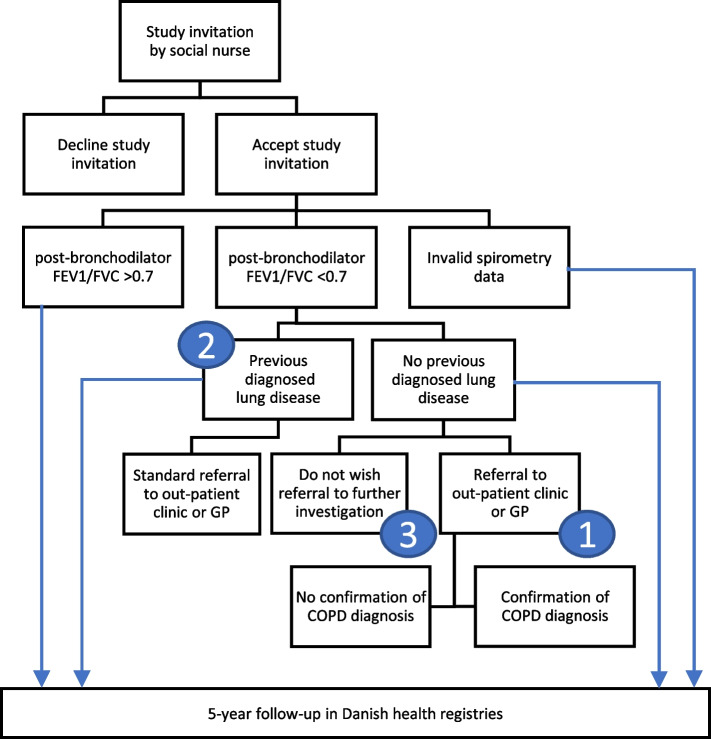
- Baseline includes interview/questionnaire on alcohol and substance use, housing, education, employment, and respiratory symptoms, plus post-bronchodilator spirometry using the NuvoAir device and AIR MD app. Participants with FEV1/FVC <0.7 or FEV1 and/or FVC <80% predicted are referred for further diagnostic work-up. Five-year follow-up uses national Danish registers. Analyses include comparing COPD prevalence to the general population using an unadjusted ratio of proportions, and comparing healthcare contact and medication rates among COPD groups using Poisson regression with confounders including age, smoking history, and comorbidities.
Limitations
- Stated: spirometry performed by social nurses rather than nurses with specialized respiratory training may cause measurement errors; handheld equipment may increase measurement errors; the study cannot make a definite COPD diagnosis but detects possible impairment or obstructive pattern; diagnosis verification is only available for patients attending the outpatient clinic, not general practice; post-bronchodilator airflow limitation may include a minority with conditions such as bronchiectasis; individuals with severe acute illness are excluded from COPD prevalence assessment; and social nurses’ subjective selection of patients (interacting with five to eight patients per day shift) may introduce selection bias between study sites.
- Evident from the text: no outcome data are yet available because the study is still enrolling, so all findings remain anticipated rather than observed.
Model-written summary. Check it against the paper before relying on it.
Integrity signals
Registry
Cites
Statistics
Figures
Verification
Claims the paper makes
0 Valid · 1 Not valid · 27 Not checked · 29 Own results and interpretations
In the paper
“emphasizes the critical importance of early detection for reducing disease progression and, consequently, morbidity [4].”
§ Opportunistic screening for COPD among socially marginalized patients > Introduction > Background and rationale
What the sources say
- Not checked yetcites [4] Ulrik CS Løkke A Dahl R Early detection of COPD in general practice Int J Chron Obstruct Pulmon Dis 2011 6 123 127 10.2147/COPD.S16929 21407825 PMC3048088 source
plainstates a cause- Asserted: passes — The authors put it forward as true.
- Checkable: passes — It can be checked against evidence.
- Load-bearing: passes — The paper’s conclusions depend on it.
- Based: passes — The paper gives a reason why it holds.
None of the sources cited for this claim have been checked yet.
In the paper
“The gradual onset of the disease, with as many as 85% of patients being diagnosed very late in its course [2, 3]”
§ Opportunistic screening for COPD among socially marginalized patients > Introduction > Background and rationale
What the sources say
- Not checked yetcites [2] Pleasants RA Riley IL Mannino DM Defining and targeting health disparities in chronic obstructive pulmonary disease Int J Chron Obstruct Pulmon Dis 2016 11 2475 2496 10.2147/COPD.S79077 27785005 PMC5065167 source
- Not checked yetcites [3] Jones RCM Price D Ryan D Opportunities to diagnose chronic obstructive pulmonary disease in routine care in the UK: a retrospective study of a clinical cohort Lancet Respir Med 2014 2 267 276 10.1016/S2213-2600(14)70008-6 24717623 source
plain- Asserted: passes — The authors put it forward as true.
- Checkable: passes — It can be checked against evidence.
- Load-bearing: passes — The paper’s conclusions depend on it.
- Based: passes — The paper gives a reason why it holds.
In the paper
“Previous studies have revealed a strong association between low socioeconomic status (SES) and the presence of COPD [2].”
§ Opportunistic screening for COPD among socially marginalized patients > Introduction > Background and rationale
What the sources say
- Not checked yetcites [2] Pleasants RA Riley IL Mannino DM Defining and targeting health disparities in chronic obstructive pulmonary disease Int J Chron Obstruct Pulmon Dis 2016 11 2475 2496 10.2147/COPD.S79077 27785005 PMC5065167 source
boostedstates an association- Asserted: passes — The authors put it forward as true.
- Checkable: passes — It can be checked against evidence.
- Load-bearing: unclear — It is unclear whether the paper’s conclusions depend on it.
- Based: passes — The paper gives a reason why it holds.
In the paper
“In Denmark, COPD is the disease that contributes most to social inequality in health [6].”
§ Opportunistic screening for COPD among socially marginalized patients > Introduction > Background and rationale
What the sources say
- Not checked yetcites [6] Haroon SM Jordan RE O’Beirne-Elliman J Effectiveness of case finding strategies for COPD in primary care: a systematic review and meta-analysis NPJ Prim Care Respir Med 2015 25 1 9 10.1038/npjpcrm.2015.56 PMC4551096 26313400 source
plainstates a cause- Asserted: passes — The authors put it forward as true.
- Checkable: passes — It can be checked against evidence.
- Load-bearing: unclear — It is unclear whether the paper’s conclusions depend on it.
- Based: passes — The paper gives a reason why it holds.
A check of a cited source is scheduled, or we don’t hold its full text yet; the claim is checked once it runs.
In the paper
“Smoking cessation is the most important intervention to prevent the disease from worsening”
§ Opportunistic screening for COPD among socially marginalized patients > Introduction > Background and rationale
What the sources say
- Not checked yetcites [2] Pleasants RA Riley IL Mannino DM Defining and targeting health disparities in chronic obstructive pulmonary disease Int J Chron Obstruct Pulmon Dis 2016 11 2475 2496 10.2147/COPD.S79077 27785005 PMC5065167 source
A check is scheduled.
- Not checked yetcites [5] Vogelmeier CF Criner GJ Martinez FJ Global strategy for the diagnosis, management, and prevention of chronic obstructive lung disease 2017 report. GOLD executive summary Am J Respir Crit Care Med 2017 195 557 582 10.1164/rccm.201701-0218PP 28128970 source
A check is scheduled.
plainstates a cause- Asserted: passes — The authors put it forward as true.
- Checkable: passes — It can be checked against evidence.
- Load-bearing: unclear — It is unclear whether the paper’s conclusions depend on it.
- Based: passes — The paper gives a reason why it holds.
- Not checked yet
6 more claims
Create a free account to see all 57 claims and to verify the 35 references still open.
- It may state two separate claims as one. 21
- Probably not a substantial claim. 36
Citations
Cites
Harris, P. A., Taylor, R., Thielke, R., Payne, J., Gonzalez, N., & Conde, J. G. (2009) · Journal of Biomedical Informatics · doi:10.1016/j.jbi.2008.08.010 · Cited by 51,384
(2001) · Cited by 5,455
The Danish Civil Registration System
Pedersen, C. B. (2011) · Scandinavian Journal of Public Health · doi:10.1177/1403494810387965 · Cited by 4,632
Development and first validation of the COPD Assessment Test
Jones, P. W., Harding, G., Berry, P., Wiklund, I., Chen, W.-H., & Kline Leidy, N. (2009) · European Respiratory Journal · doi:10.1183/09031936.00102509 · Cited by 3,198
Vogelmeier, C. F., Criner, G. J., Martinez, F. J., Anzueto, A., Barnes, P. J., Bourbeau, J., Celli, B. R., Chen, R., Decramer, M., Fabbri, L. M., et al. (2017) · American Journal of Respiratory and Critical Care Medicine · doi:10.1164/rccm.201701-0218pp · Cited by 3,187
Tam, N. T., Huy, N. T., Thoa, L. T. B., Long, N. P., Trang, N. T. H., Hirayama, K., & Karbwang, J. (2015) · Bulletin of the World Health Organization · doi:10.2471/blt.14.141390 · Cited by 315
Mackenbach, J. P., Valverde, J. R., Bopp, M., Brønnum-Hansen, H., Deboosere, P., Kalediene, R., Kovács, K., Leinsalu, M., Martikainen, P., Menvielle, G., et al. (2019) · The Lancet Public Health · doi:10.1016/s2468-2667(19)30147-1 · Cited by 300
Defining and targeting health disparities in chronic obstructive pulmonary disease
Pleasants, R., Riley, I., & Mannino, D. (2016) · International Journal of Chronic Obstructive Pulmonary Disease · doi:10.2147/copd.s79077 · Cited by 202
Jones, R. C. M., Price, D., Ryan, D., Sims, E. J., von Ziegenweidt, J., Mascarenhas, L., Burden, A., Halpin, D. M. G., Winter, R., Hill, S., et al. (2014) · The Lancet Respiratory Medicine · doi:10.1016/s2213-2600(14)70008-6 · Cited by 198
Lewer, D., Aldridge, R. W., Menezes, D., Sawyer, C., Zaninotto, P., Dedicoat, M., Ahmed, I., Luchenski, S., Hayward, A., & Story, A. (2019) · BMJ Open · doi:10.1136/bmjopen-2018-025192 · Cited by 159
Research works printed but not linked: 2
- Nilou FE Christoffersen NB Møller SR SUZY Udsat. Health profile for socially marginalized people in Denmark from 2007–2022 2022 Copenhagen, Denmark National Institute of Public Health
- Benjaminsen L Birkelund JF Enemark MH Socialt udsatte borgeres brug af velfærdssystemet. 199 2018
Cited by
Still being checked.
Metadata
- Authors
- Brünés, N., Lindstroem, M. B., Ulrik, C. S., Andersen, O., Lisby, M., Godtfredsen, N. S., Hansen, T. L., Pisinger, C., Graven, V., Marsaa, K., & Thomsen, L. H.
- Affiliations
- Hvidovre Hospital (DK)
- University of Copenhagen (DK)
- Aarhus University (DK)
- Frederiksberg Hospital (DK)
- University of Southern Denmark (DK)
- Copenhagen University Hospital (DK)
- Corresponding author
- Lindstroem, Mette Bendtz
- ORCID
- Venue
- BMC Pulmonary Medicine
- Published
- 2024-03-05
- Volume
- 24
- Issue
- 1
- Pages
- 113-113
- ISSN
- 1471-2466 (ISSN-L)
- PMC
- PMC10916054
- OpenAlex
- W4392473179
- Cited by
- 5
- References
- 19
- Citations by year
- 2026: 2 · 2025: 3
- FWCI
- 1.10
- Type
- journal article
- Language
- en
- Open access
- gold
- doi.org
- Licence
- cc-by
- creativecommons.org/licenses/by/4.0 (tdm)
- creativecommons.org/licenses/by/4.0 (vor)
- Locations
- BMC Pulmonary Medicine (publishedVersion, cc-by)
- Research Square (submittedVersion, cc-by)
- PubMed Central (publishedVersion, cc-by)
- University of Southern Denmark Research Portal (University of Southern Denmark) (publishedVersion, cc-by)
- PubMed (publishedVersion)
- Scopus (Elsevier) (publishedVersion, other-oa)
- Research at the University of Copenhagen (University of Copenhagen) (publishedVersion, cc-by)
- DOAJ (DOAJ: Directory of Open Access Journals) (submittedVersion)
- Funders
- Copenhagen University
- Topics
- Health Sciences › Medicine › Pulmonary and Respiratory Medicine › Chronic Obstructive Pulmonary Disease (COPD) Research
- Health Sciences › Medicine › Public Health, Environmental and Occupational Health › Smoking Behavior and Cessation
- Health Sciences › Medicine › Pulmonary and Respiratory Medicine › Asthma and respiratory diseases
- Keywords
- chronic obstructive pulmonary disease, opportunistic screening, homelessness, substance use disorders, mental illness, spirometry, COPD prevalence, smoking cessation, socioeconomic status, barriers to care, COPD mortality
- MeSH terms
- Hospitals, Humans, Longitudinal Studies, Mass Screening, Prospective Studies, Pulmonary Disease, Chronic Obstructive
About these checks
Registry, retraction, Cites and statistics results are computed, not judged, with one exception: a printed reference that no index lists is read once by a model before it counts as a citation error. Claims are extracted by a model and kept only when their quote appears verbatim in the text; each cited source is then checked, with a model’s help, for whether it says what the claim relies on. Those verdicts can be wrong — read the claim’s quote and the cited source before relying on one.
A language model drew the claims from the paper on 2026-11-25, under version 3 of the claim definition (model deepseek-v4.1-flash, prompt extract-v3).
A second model labelled each claim on 2026-11-25 (model jev-1.13-20260917, definition revision gold-guideline-v0.2).
Statistics and arithmetic are recomputed, not judged.
Confidence bands are shown only for fields calibrated on our annotated test set. None is calibrated yet, so no band is shown.
What counts as a claim ›How we measure confidence ›How we check this ›
Are you an author, or do you see a problem with this page? Request a review
How to cite
Cite CoChat for the checks on this page, and the paper for its own findings.
- This page
- CoChat. (2026). Citation check: Opportunistic screening for COPD among socially marginalized patients. https://app.cochat.ai/papers/10.1186/s12890-024-02927-9
- The paper
- Brünés, N., Lindstroem, M. B., Ulrik, C. S., Andersen, O., Lisby, M., Godtfredsen, N. S., Hansen, T. L., Pisinger, C., Graven, V., Marsaa, K., & Thomsen, L. H. (2024). Opportunistic screening for COPD among socially marginalized patients. BMC Pulmonary Medicine. https://doi.org/10.1186/s12890-024-02927-9
Data sources
Bibliographic data: Semantic Scholar, OpenAlex, Crossref.
Contains information from the Semantic Scholar Academic Graph Datasets, made available under the ODC Attribution License (ODC-BY 1.0).
Semantic Scholar’s data is described in: Kinney, R., et al. (2023). The Semantic Scholar Open Data Platform. arXiv:2301.10140.
