

Self-rated joint hypermobility: the five-part questionnaire evaluated in a Swedish non-clinical adult population
Open accessThe DOI matches its Crossref record; 16 of the 16 references it cites were found in a registry or an index.
Abstract
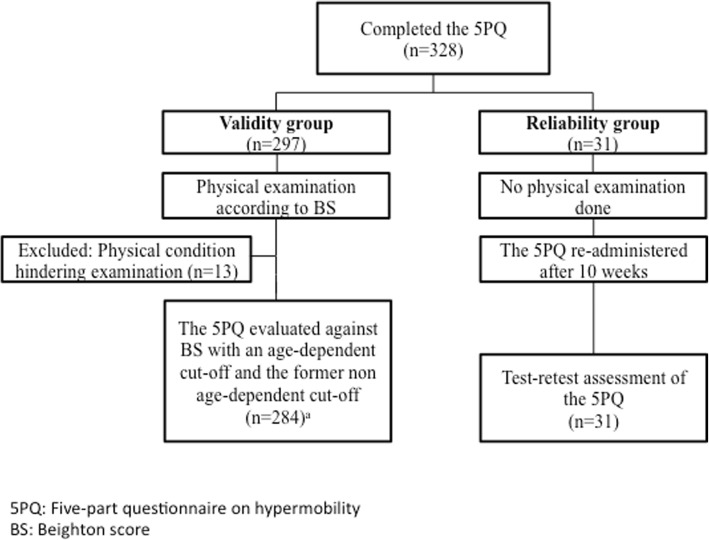
Background: The conventional way to identify generalised joint hypermobility is by a physical examination according to the Beighton Score. However, a physical examination is time-consuming in clinical practise and may be unfeasible in population-based studies. The self-assessment five-part questionnaire on hypermobility (5PQ) offers a more practicable way to identify GJH. The aim of this study was to test validity and reliability of the five-part questionnaire on hypermobility (5PQ) translated into Swedish on a non-clinical adult population. Methods: A structured procedure was used for the translation of the 5PQ into Swedish. The Beighton Score was used as reference standard for generalised joint hypermobility. Test-retest reliability was tested in a separate group who filled in the questionnaire twice with a ten-week interval. Participants consisted of a convenience sample recruited in Stockholm, Sweden (2017). Results: A total of 328 participants were included in the study, 297 participants in the validity group and 31 participants in the reliability group. When evaluated against a present Beighton Score with an age-dependent cut-off, the Swedish 5PQ attained a sensitivity of 91%, a specificity of 75% and an area under the curve of 0.87. The Swedish 5PQ showed substantial to almost perfect test-retest reliability. Conclusions: The Swedish 5PQ is a valid and reliable instrument to screen for or to identify generalised joint hypermobility.
Overview
The claims and statistics of this paper haven’t been checked yet.
Free: it reads the open-access text and checks the first 5 claims that cite a source we can check. Create a free account to check every claim.
Integrity signals
Registry
Cites
Statistics
Figures
Verification
Claims the paper makes
The claims and statistics of this paper haven’t been checked yet.
Free: it reads the open-access text and checks the first 5 claims that cite a source we can check. Create a free account to check every claim.
Claims other papers make about this one
Each is checked against this paper’s own text: does it say what the citing paper says it does?
The cited source says what the claim attributes to it.
In the citing paper
“The 5PQ is available in English (32), Portuguese (45), and Swedish (33) and its accessibility lends itself to large population-based surveys.”
From The Relationship Between Generalised Joint Hypermobility and Autism Spectrum Disorder in Adults: A Large, Cross-Sectional, Case Control Comparison (2022) · cites this paper as [33]
Self-check
Percentages, sums and reported differences re-computed from the paper’s own numbers.
The self-check needs the paper’s full text.
Citations
Cites
A guideline of selecting and reporting intraclass correlation coefficients for reliability research
Koo, T. K., & Li, M. Y. (2016) · Journal of Chiropractic Medicine · doi:10.1016/j.jcm.2016.02.012 · Cited by 31,709
The 2017 international classification of the Ehlers–Danlos syndromes
Malfait, F., Francomano, C., Byers, P., Belmont, J., Berglund, B., Black, J., Bloom, L., Bowen, J. M., Brady, A. F., Burrows, N. P., et al. (2017) · American Journal of Medical Genetics Part C: Seminars in Medical Genetics · doi:10.1002/ajmg.c.31552 · Cited by 1,936
Articular mobility in an African population.
Beighton, P., Solomon, L., & Soskolne, C. L. (1973) · Annals of the Rheumatic Diseases · doi:10.1136/ard.32.5.413 · Cited by 1,727
Buderer, N. M. F. (1996) · Academic Emergency Medicine · doi:10.1111/j.1553-2712.1996.tb03538.x · Cited by 921 · cited 1×
“This was based on a sample size calculation [7] with an expected sensitivity and specificity of 80% respectively; an expected prevalence of GJH of 20% and a desired absolute precision of 10%.”
MethodA framework for the classification of joint hypermobility and related conditions
Castori, M., Tinkle, B., Levy, H., Grahame, R., Malfait, F., & Hakim, A. (2017) · American Journal of Medical Genetics Part C: Seminars in Medical Genetics · doi:10.1002/ajmg.c.31539 · Cited by 602
Medical Statistics: A Guide to Data Analysis and Critical Appraisal
Peat, J. K., & Barton, B. (2005) · Cited by 339
Hakim, A., & Grahame, R. (2003) · International Journal of Clinical Practice · doi:10.1111/j.1742-1241.2003.tb10455.x · Cited by 312 · cited 10×
“The 5PQ was initially developed as a screening tool in patients at high risk [4] but has also been shown to be helpful for identifying GJH in population based studies [5].”
BackgroundMethodResultInfluentialHakim, A., & Grahame, R. (2003) · Best Practice & Research Clinical Rheumatology · doi:10.1016/j.berh.2003.08.001 · Cited by 289
Juul‐Kristensen, B., Schmedling, K., Rombaut, L., Lund, H., & Engelbert, R. H. H. (2017) · American Journal of Medical Genetics Part C: Seminars in Medical Genetics · doi:10.1002/ajmg.c.31540 · Cited by 229
The genetic epidemiology of joint hypermobility: A population study of female twins
Hakim, A. J., Cherkas, L. F., Grahame, R., Spector, T. D., & MacGregor, A. J. (2004) · Arthritis & Rheumatism · doi:10.1002/art.20376 · Cited by 161
Cited by
Seeley, M., Gallagher, C., Ong, E., Langdon, A., Chieng, J., Bailey, D., Page, A. J., Lim, H. S., & Lau, D. H. (2023) · The American Journal of Medicine · doi:10.1016/j.amjmed.2023.06.010 · Cited by 90
“A score ≥2 was deemed to show generalized joint hypermobility as per previously validated studies.(19)”
MethodGlans, M. R., Thelin, N., Humble, M. B., Elwin, M., & Bejerot, S. (2022) · Frontiers in Psychiatry · doi:10.3389/fpsyt.2021.803334 · Cited by 30
Self-citationGlans, M., Thelin, N., Humble, M. B., Elwin, M., & Bejerot, S. (2021) · Journal of Psychiatric Research · doi:10.1016/j.jpsychires.2021.07.006 · Cited by 27
Self-citationPostural Orthostatic Tachycardia Syndrome: A State-of-the-Art Review
Lau, D. H., Fedorowski, A., Raj, S. R., Schild, C., Pace, L., Blitshteyn, S., Raj, V., Boris, J. R., Kavi, L., Seeley, M., et al. (2026) · Heart Lung and Circulation · doi:10.1016/j.hlc.2025.09.004 · Cited by 27
Ali, A. A., Andrzejowski, P., Kanakaris, N. K., & Giannoudis, P. V. (2020) · Journal of Clinical Medicine · doi:10.3390/jcm9123992 · Cited by 25
Ahlqvist, K., Bjelland, E. K., Pingel, R., Schlager, A., Nilsson-Wikmar, L. B., & Kristiansson, P. (2020) · BMC Musculoskeletal Disorders · doi:10.1186/s12891-020-03486-w · Cited by 25
Ribeiro, J. A. D. S., Gomes, G., Aldred, A., Desuó, I. C., & Giacomini, L. A. (2024) · The Yale Journal of Biology and Medicine · doi:10.59249/wgrs1619 · Cited by 19
“Should the BS result in a score 1 point below the cutoff and the 5PQ remain positive, the diagnosis of GJH can still be made [34] (Table 1).”
BackgroundWard, J., Simner, J., Simpson, I., Rae, C. L., del Río, M., Eccles, J., & Racey, C. (2024) · Cerebral Cortex · doi:10.1093/cercor/bhae446 · Cited by 13
Schlager, A., Ahlqvist, K., Pingel, R., Nilsson-Wikmar, L. B., Olsson, C., & Kristiansson, P. (2020) · BMC Musculoskeletal Disorders · doi:10.1186/s12891-020-03524-7 · Cited by 11
Pasricha, P. J., McKnight, M., Villatoro, L. G., Barahona, G. A., Brinker, J., Hui, K. Y., Polydefkis, M. J., Burns, R., McMahan, Z. H., Gould, N. F., et al. (2024) · The American Journal of Gastroenterology · doi:10.14309/ajg.0000000000002910 · Cited by 11
Racey, C., Kampoureli, C. N., Bowen-Hill, O., Bauer, M., Simpson, I., Rae, C. L., del Río, M., Simner, J., & Ward, J. (2023) · Scientific Data · doi:10.1038/s41597-023-02664-4 · Cited by 11
“Hypermobility was assessed using the five-part questionnaire, 5PQ 32 .”
MethodAlexander, M. (2022) · doi:10.1101/2022.04.25.22274226 · Cited by 4
“…(95% CI 55.6–67.8) The false-positive rate was 38% The PPV and NPV ranged between 13.4 and 42.4% and between 90.3 and 99.2%, respectively The LR+ increased by 2.2 when using a cut-off level of ≥2 for the self-reported 5PQ Paediatric population (Glans et al., 2020): Sensitivity = 91% (95% CI 72, 99”
BackgroundInfluentialJones, E., & Carrieri, D. (2025) · Disability and Rehabilitation · doi:10.1080/09638288.2025.2517246 · Cited by 4
Tofts, L., Pacey, V., Williams, C., Welch, J. J., Shannon, B., & Chan, C. L. (2026) · Arthritis Care & Research · doi:10.1002/acr.70017 · Cited by 4
Wright, T. S., & Cygan, P. H. (2023) · Obstetrics and Gynecology · doi:10.1097/aog.0000000000005262 · Cited by 4
Taylor‐Gjevre, R. M., Nair, B., Lourens, J.-A., Leswick, D. A., & Obaid, H. (2022) · JCR Journal of Clinical Rheumatology · doi:10.1097/rhu.0000000000001892 · Cited by 3
Development, validation, and psychometric analysis of Foot and Ankle Flexibility Index (FAFI)
Martínez-Sebastián, C., Gijón-Noguerón, G., Ramos‐Petersen, L., Morales‐Asencio, J. M., Molina-García, C., & Evans, A. (2024) · Journal of Tissue Viability · doi:10.1016/j.jtv.2024.05.010 · Cited by 3
Atypical cortical regional homogeneity observed in graphene-colour synaesthesia and its subtypes.
Yeo, B. B. Y., & Yu, J.-H. (2025) · Cortex; a journal devoted to the study of the nervous system and behavior · doi:10.1016/j.cortex.2025.09.003 · Cited by 1
Full‐Season Injury Epidemiology in TeamGym —A Prospective Cohort Study Involving 474 Gymnasts
Anker‐Petersen, C., Clausen, M. B., Juul‐Kristensen, B., Hölmich, P., Juhl, C. B., & Thorborg, K. (2025) · Scandinavian Journal of Medicine and Science in Sports · doi:10.1111/sms.70135 · Cited by 2
Taş, S., Dikici, T. F., Aktaş, A., & Aracı, A. (2021) · Muscles Ligaments and Tendons Journal · doi:10.32098/mltj.04.2021.05 · Cited by 2
“The Beighton score, which was reported as a valid and reliable tool for assessing GJH (26, 27), was used to determine whether the participants had GJH.”
MethodUrinary Incontinence in Nulliparous Female Elite Athletes: A Mixed Methods Exploration
Gan, Z. S., Bilger, A., & Smith, A. L. (2024) · Urogynecology · doi:10.1097/spv.0000000000001573 · Cited by 1
Aranda-Sánchez, M., Huaco, M. D., & Bravo-Cucci, S. D. (2023) · Medwave · doi:10.5867/medwave.2023.01.2575 · Cited by 1
Anker‐Petersen, C., Clausen, M. B., Juul‐Kristensen, B., Hölmich, P., & Thorborg, K. (2025) · Physical Therapy in Sport · doi:10.1016/j.ptsp.2025.04.001 · Cited by 1
Nishanth, S., & Saravanamuttu, U. (2022) · Cureus · doi:10.7759/cureus.26148
“He scored 3 points out of 5 which is more than 90% specific to benign joint hypermobility syndrome [7].”
BackgroundMethodInfluentialHypermobilität – Stellenwert in der Rheumatologie
Braun, J. (2025) · Zeitschrift für Rheumatologie · doi:10.1007/s00393-025-01707-y
“…Scoring-Methoden im Rahmen einer kör-perlichen Untersuchung [12, 15, 17–19], aber auch ein Screening mit einem Frage-bogen [20, 21] gibt, kann die Messung der funktionellen Instabilität bzw. das Vertrau-endesPatientenindasbetreffendeGelenk anhand eines weiteren Fragebogens…”
ABORDAGEM ATUAL E PERSPECTIVAS NA SÍNDROME DE HIPERLAXIDADE ARTICULAR EM ADULTOS JOVENS
Gunther, C. B. P., Leite, L. D. A., de Souza, J. V. G., & Franco, C. I. F. (2025) · A R International Health Beacon Journal · doi:10.70779/arihbj.v2i11.366
Frequency of Hypermobility in Patients with Ulnar Entrapment Neuropathy
Bucak, Ö. F., Çiftkaya, P. Ö., Özcan-Ekşi, E. E., & Ofluoğlu, D. (2025) · Journal of Academic Research in Medicine · doi:10.4274/jarem.galenos.2025.88155
ФІЗИЧНА ТЕРАПІЯ ПРИ ГІПЕРМОБІЛЬНОСТІ СУГЛОБІВ В ОСІБ МОЛОДОГО ВІКУ
Ситник, О. А., Хорішко, В. Т., & Колесник, А. С. (2025) · Health & Education · doi:10.32782/health-2025.3.31
Glans, M., Humble, M. B., Elwin, M., & Bejerot, S. (2020) · Figshare · doi:10.6084/m9.figshare.11998863
Self-citationSchlager, A. (2024) · DiVA (Digitala Vetenskapliga Arkivet)
Hypermobilitet hos svenska varmblodshästar
Lindqvist, E. (2024) · Epsilon Archive for Student Projects (Swedish University of Agricultural Sciences)
Joint Pain Outcomes After Metabolic and Bariatric Surgery in Patients With and Without Hypermobility
Schubert-Hjalmarsson, E., Albertsson, L., Englund, E., & Olsén, M. F. (2026) · Obesity Science & Practice · doi:10.1002/osp4.70115
“Although previous Swedish studies indicate that the 5PQ functions appropriately as a screening tool [13], the addition of objective assessments can improve future research validity and/or reliability.”
InfluentialWang, Y., Li, X., & Wang, Y. (2026) · Scientific Reports · doi:10.1038/s41598-026-45970-8
Seeley, M., Tran, D. X. A., Marathe, J., Sharma, S., Wilson, G., Atkins, S., Lau, D. H., Gallagher, C., & Psaltis, P. J. (2026) · medRxiv · doi:10.64898/2026.04.21.26351434
The significance of hypermobility syndromes for rheumatology
Braun, J. (2026) · Exploration of Musculoskeletal Diseases · doi:10.37349/emd.2026.1007139
Joint hypermobility as a possible factor for evaluating injury prevention
Shevets, V. P., Атаман, Ю. О., & Ataman, Y. O. (2022) · Electronic Institutional Repository of Zaporizhzhya National Technical University (Zaporizhzhya National Technical University)
Metadata
- Authors
- Glans, M., Humble, M. B., Elwin, M., & Bejerot, S.
- Affiliations
- Örebro University (SE)
- Corresponding author
- Glans, Martin
- Venue
- BMC Musculoskeletal Disorders
- Published
- 2020-03-17
- Volume
- 21
- Issue
- 1
- Pages
- 174-174
- ISSN
- 1471-2474 (ISSN-L)
- PMC
- PMC7079417
- OpenAlex
- W3011518322
- Cited by
- 30
- References
- 16
- Citations by year
- 2026: 4 · 2025: 8 · 2024: 5 · 2023: 4 · 2022: 4 · 2021: 2 · 2020: 3
- FWCI
- 1.90
- Type
- journal article
- Language
- en
- Open access
- gold
- doi.org
- Licence
- cc-by
- creativecommons.org/licenses/by/4.0/ (tdm)
- creativecommons.org/licenses/by/4.0/ (vor)
- Locations
- BMC Musculoskeletal Disorders (publishedVersion, cc-by)
- PubMed Central (publishedVersion, cc-by)
- PubMed (publishedVersion)
- DOAJ (DOAJ: Directory of Open Access Journals) (submittedVersion, cc-by-sa)
- Funders
- Vetenskapsrådet (K2012- 62X-22130-04-6)
- Topics
- Life Sciences › Biochemistry, Genetics and Molecular Biology › Genetics › Connective tissue disorders research
- Health Sciences › Health Professions › Physical Therapy, Sports Therapy and Rehabilitation › Musculoskeletal pain and rehabilitation
- Health Sciences › Dentistry › Periodontics › Oral and gingival health research
- Keywords
- generalized joint hypermobility, Beighton score, questionnaire translation, Swedish translation, test-retest reliability, diagnostic validity, screening tool, non-clinical adults
- MeSH terms
- Adult, Female, Humans, Joint Instability, Male, Population Surveillance, Surveys and Questionnaires, Sweden, Translating, Young Adult, Self Report
About these checks
Registry, retraction, Cites and statistics results are computed, not judged, with one exception: a printed reference that no index lists is read once by a model before it counts as a citation error. Claims are extracted by a model and kept only when their quote appears verbatim in the text; each cited source is then checked, with a model’s help, for whether it says what the claim relies on. Those verdicts can be wrong — read the claim’s quote and the cited source before relying on one.
Statistics and arithmetic are recomputed, not judged.
Confidence bands are shown only for fields calibrated on our annotated test set. None is calibrated yet, so no band is shown.
What counts as a claim ›How we measure confidence ›How we check this ›
Are you an author, or do you see a problem with this page? Request a review
Data sources
Bibliographic data: Semantic Scholar, OpenAlex, Crossref.
Contains information from the Semantic Scholar Academic Graph Datasets, made available under the ODC Attribution License (ODC-BY 1.0).
Semantic Scholar’s data is described in: Kinney, R., et al. (2023). The Semantic Scholar Open Data Platform. arXiv:2301.10140.
