

The DOI matches its Crossref record; 37 of the 38 references it cites were found in a registry or an index.
Effect of real-time ultrasound imaging for biofeedback on trunk muscle contraction in healthy subjects: a preliminary study
Open accessPublished version of a preprint
Abstract
Background: Real-time ultrasound imaging (RUSI) has been increasingly used as a form of biofeedback when instructing and re-training muscle contraction. However, the effectiveness of the RUSI on a single sustained contraction of the lumbar multifidus (LM) and transversus abdominis (TrA) has rarely been reported. This preliminary study aimed to determine if the use of RUSI, as visual biofeedback, could enhance the ability of activation and continuous contraction of the trunk muscles including LM and TrA. Methods: Forty healthy individuals were included and randomly assigned into the experimental group and control group. All subjects performed a preferential activation of the LM and/or TrA (maintained the constraction of LM and/or TrA for 30 s and then relaxed for 2 min), while those in the experimental group also received visual feedback provided by RUSI. The thickness of LM and/or TrA at rest and during contraction (T c-max , T 15s , and T 30s ) were extracted and recorded. The experiment was repeated three times. Results: No significant differences were found in the thickness of LM at rest ( P > 0.999), T c-max (P > 0.999), and T 15s ( P = 0.414) between the two groups. However, the ability to recruit LM muscle contraction differed between groups at T 30s ( P = 0.006), with subjects in the experimental group that received visual ultrasound biofeedback maintaining a relative maximum contraction. Besides, no significant differences were found in the TrA muscle thickness at rest ( P > 0.999) and T c-max ( P > 0.999) between the two groups. However, significant differences of contraction thickness were found at T 15s ( P = 0.031) and T 30s ( P = 0.010) between the two groups during the Abdominal Drawing-in Maneuver (ADIM), with greater TrA muscle contraction thickness in the experimental group. Conclusions: RUSI can be used to provide visual biofeedback, which can promote continuous contraction, and improve the ability to activate the LM and TrA muscles in healthy subjects.
Overview
The claims and statistics of this paper haven’t been checked yet.
Run the check — free, no account needed. It reads the open-access text and checks the sources it cites.
Integrity signals
Registry
Cites
Statistics
Figures
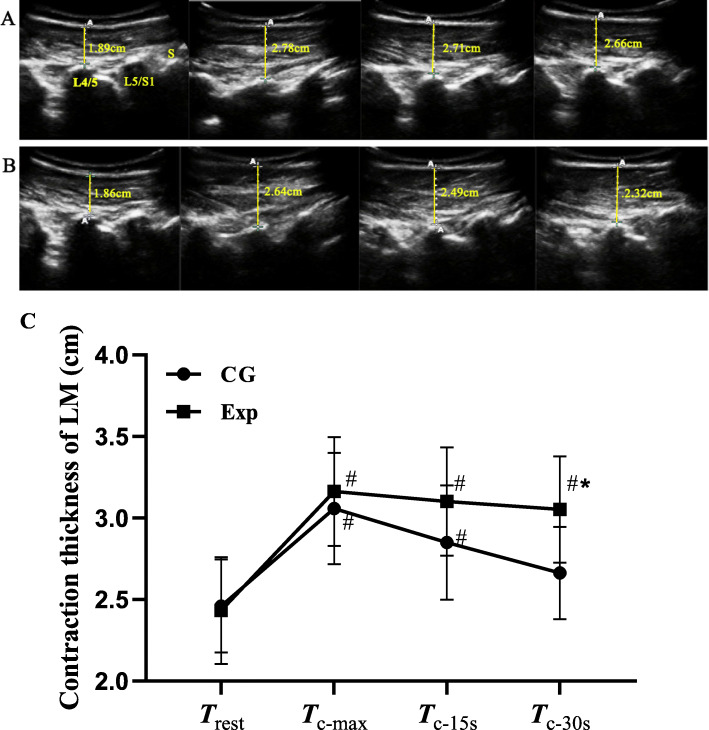
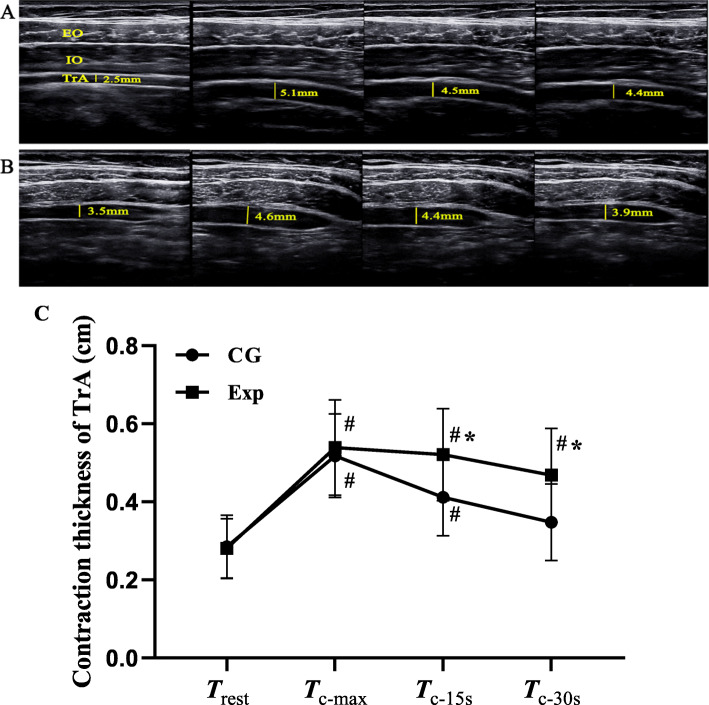
Verification
Claims the paper makes
The claims and statistics of this paper haven’t been checked yet.
Run the check — free, no account needed. It reads the open-access text and checks the sources it cites.
Claims other papers make about this one
Each is checked against this paper’s own text: does it say what the citing paper says it does?
The source backs part of the claim, not all of it — or backs it for a different population, condition or comparison.
In the citing paper
“TrA and LM muscle thickness will be directly measured by ultrasound, and the thickness change rate between the contractile and resting states will be calculated to predict the postural stability from the perspective of muscle morphology [28].”
From Effect of m-health-based core stability exercise combined with self-compassion training for patients with non-specific chronic low back pain: study protocol for a randomized controlled trial (2022) · cites this paper as [28]
Experimental — accuracy not yet measured
Self-check
Percentages, sums and reported differences re-computed from the paper’s own numbers.
The self-check needs the paper’s full text.
Citations
Cites
The Stabilizing System of the Spine. Part I. Function, Dysfunction, Adaptation, and Enhancement
Panjabi, M. M. (1992) · Journal of Spinal Disorders · doi:10.1097/00002517-199212000-00001 · Cited by 2,180
Inefficient Muscular Stabilization of the Lumbar Spine Associated With Low Back Pain
Hodges, P. W., & Richardson, C. A. (1996) · Spine · doi:10.1097/00007632-199611150-00014 · Cited by 1,804
The Stabilizing System of the Spine. Part II. Neutral Zone and Instability Hypothesis
Panjabi, M. M. (1992) · Journal of Spinal Disorders · doi:10.1097/00002517-199212000-00002 · Cited by 1,576
Motor Learning and Control : Concepts and Applications
Magill, R. A. (2020) · Civil War Book Review · Cited by 1,307
Clinical spinal instability and low back pain
Panjabi, M. M. (2003) · Journal of Electromyography and Kinesiology · doi:10.1016/s1050-6411(03)00044-0 · Cited by 991
Hides, J. A., Stokes, M. J., Saide, M., Jull, G. A., & Cooper, D. H. (1994) · Spine · doi:10.1097/00007632-199401001-00009 · Cited by 918
Hodges, P. W., & Richardson, C. A. (1999) · Archives of Physical Medicine and Rehabilitation · doi:10.1016/s0003-9993(99)90052-7 · Cited by 631
The Use of Ultrasound Imaging of the Abdominal Drawing-in Maneuver in Subjects With Low Back Pain
Teyhen, D. S., Miltenberger, C. E., Deiters, H. M., Toro, Y. M. D., Pulliam, J. N., Childs, J. D., Boyles, R. E., & Flynn, T. W. (2005) · Journal of Orthopaedic and Sports Physical Therapy · doi:10.2519/jospt.2005.35.6.346 · Cited by 415
MacDonald, D. A., Moseley, G. L., & Hodges, P. W. (2009) · Pain · doi:10.1016/j.pain.2008.12.002 · Cited by 368
Motor Control Exercise for Persistent, Nonspecific Low Back Pain: A Systematic Review
Macedo, L. G., Maher, C. G., Latimer, J., & McAuley, J. H. (2008) · Physical Therapy · doi:10.2522/ptj.20080103 · Cited by 366
Hides, J. A., Wilson, S. J., Stanton, W. R., McMahon, S., Keto, H., McMahon, K. L., Bryant, M., & Richardson, C. A. (2006) · Spine · doi:10.1097/01.brs.0000202740.86338.df · Cited by 344
The effect of chronic low back pain on size and contraction of the lumbar multifidus muscle
Wallwork, T. L., Stanton, W. R., Freke, M., & Hides, J. A. (2008) · Manual Therapy · doi:10.1016/j.math.2008.09.006 · Cited by 327
Ward, S. R., Kim, C. W., Eng, C. M., Gottschalk, L. J., Tomiya, A., Garfin, S. R., & Lieber, R. L. (2009) · Journal of Bone and Joint Surgery · doi:10.2106/jbjs.g.01311 · Cited by 312
Measurement of lumbar multifidus muscle contraction with rehabilitative ultrasound imaging
Kiesel, K. B., Uhl, T. L., Underwood, F. B., Rodd, D., & Nitz, A. J. (2006) · Manual Therapy · doi:10.1016/j.math.2006.06.011 · Cited by 290
Specific stabilisation exercise for spinal and pelvic pain: A systematic review
Ferreira, P. H., Ferreira, M. L., Maher, C. G., Herbert, R., & Refshauge, K. M. (2006) · Australian Journal of Physiotherapy · doi:10.1016/s0004-9514(06)70043-5 · Cited by 285
Rehabilitative Ultrasound Imaging of the Abdominal Muscles
Teyhen, D. S., Gill, N. W., Whittaker, J. L., Henry, S. M., Hides, J. A., & Hodges, P. W. (2007) · Journal of Orthopaedic and Sports Physical Therapy · doi:10.2519/jospt.2007.2558 · Cited by 264
Henry, S. M., & Westervelt, K. (2005) · Journal of Orthopaedic and Sports Physical Therapy · doi:10.2519/jospt.2005.35.6.338 · Cited by 189
Van, K. A. T., Hides, J. A., & Richardson, C. A. (2006) · Journal of Orthopaedic and Sports Physical Therapy · doi:10.2519/jospt.2006.2304 · Cited by 170
Rehabilitative ultrasound measurement of select trunk muscle activation during induced pain
Kiesel, K. B., Uhl, T. L., Underwood, F. B., & Nitz, A. J. (2007) · Manual Therapy · doi:10.1016/j.math.2006.10.003 · Cited by 130
Teyhen, D. S., Bluemle, L. N., Dolbeer, J. A., Baker, S. E., Molloy, J. M., Whittaker, J. L., & Childs, J. D. (2009) · Journal of Orthopaedic and Sports Physical Therapy · doi:10.2519/jospt.2009.3128 · Cited by 110
Vasseljen, O., Unsgaard‐Tøndel, M., Westad, C., & Mork, P. J. (2011) · Spine · doi:10.1097/brs.0b013e318241377c · Cited by 100
Rehabilitative Ultrasound Imaging Symposium, May 8-10, 2006, San Antonio, Texas
Teyhen, D. S. (2006) · Journal of Orthopaedic and Sports Physical Therapy · doi:10.2519/jospt.2006.0301 · Cited by 94
Vasseljen, O., Dahl, H. H., Mork, P. J., & Torp, H. G. (2006) · Clinical Biomechanics · doi:10.1016/j.clinbiomech.2006.05.003 · Cited by 76
Sweeney, N., O'Sullivan, C. M., & Kelly, G. A. (2014) · Manual Therapy · doi:10.1016/j.math.2014.04.009 · Cited by 68
Klizienė, I., Sipavičienė, S., Klizas, Š., & Imbrasienė, D. (2015) · Journal of Back and Musculoskeletal Rehabilitation · doi:10.3233/bmr-150596 · Cited by 58
Rehabilitative Ultrasound Imaging Symposium San Antonio, TX, May 8-10, 2006.
Teyhen, D. S. (2006) · PubMed · Cited by 50
Jhu, J.-L., Chai, H., Jan, M., Wang, C., Shau, Y., & Wang, S. (2010) · Journal of Orthopaedic and Sports Physical Therapy · doi:10.2519/jospt.2010.3000 · Cited by 48
Self-citationZhang, S., Xu, Y., Han, X., Wu, W., Tang, Y., & Wang, C. (2018) · Scientific Reports · doi:10.1038/s41598-018-24550-5 · Cited by 44
Self-citationDjordjević, O. C., Konstantinović, L. M., Miljković, N., & Bijelić, G. (2014) · Clinical Journal of Pain · doi:10.1097/ajp.0000000000000179 · Cited by 42
Rehabilitative ultrasound imaging
Teyhen, D. S., & Koppenhaver, S. L. (2011) · Journal of physiotherapy · doi:10.1016/s1836-9553(11)70044-3 · Cited by 41
Lee, D. H., Hong, S. K., Lee, Y., Kim, C., Hwang, J.-M., Lee, Z., Kim, J. M., & Park, D. (2018) · Medicine · doi:10.1097/md.0000000000011369 · Cited by 41
Taghipour, M., Bandpei, M. A. M., Behtash, H., Abdollahi, I., Rajabzadeh, F., Pourahmadi, M., & Emami, M. (2018) · Journal of Ultrasound in Medicine · doi:10.1002/jum.14661 · Cited by 37
Park, S. D. (2013) · Journal of Physical Therapy Science · doi:10.1589/jpts.25.845 · Cited by 30
Biscarini, A., Contemori, S., & Grolla, G. (2018) · Journal of Sport Rehabilitation · doi:10.1123/jsr.2018-0089 · Cited by 23
Changes in Muscle Thickness After Exercise and Biofeedback in People With Low Back Pain
Partner, S. L., Sutherlin, M. A., Acocello, S. N., SALIBA, S. A., Magrum, E. M., & Hart, J. M. (2014) · Journal of Sport Rehabilitation · doi:10.1123/jsr.2013-0057 · Cited by 22
Lee, J.-Y., & Lee, D.-Y. (2018) · Journal of Back and Musculoskeletal Rehabilitation · doi:10.3233/bmr-171080 · Cited by 14
Current Uses of Ultrasound Imaging in Musculoskeletal Rehabilitation
Jopowicz, R., Jopowicz, M., Czarnocki, Ł., Deszczyński, J., & Deszczyński, J. (2017) · Ortopedia Traumatologia Rehabilitacja · doi:10.5604/01.3001.0010.7036 · Cited by 10
Cited by
Sorted by citations
Ultrasound Imaging as a Visual Biofeedback Tool in Rehabilitation: An Updated Systematic Review
Valera‐Calero, J. A., Fernández‐de‐las‐Peñas, C., Varol, U., Ortega‐Santiago, R., Gallego‐Sendarrubias, G. M., & Arias‐Buría, J. L. (2021) · International Journal of Environmental Research and Public Health · doi:10.3390/ijerph18147554 · Cited by 48
Fuming, Z., Weihui, X., Jiajia, Y., Shufeng, L., Yiyi, Z., Wenjian, L., Yan, L., Zhicheng, L., Siyun, Z., Yingmin, Z., et al. (2022) · Trials · doi:10.1186/s13063-022-06258-0 · Cited by 9
“Lumbar core muscle function assessment TrA and LM muscle thickness will be directly measured by ultrasound, and the thickness change rate between the contractile and resting states will be calculated to predict the postural stability from the perspective of muscle morphology [28].”
MethodSelf-citationPerotti, L., Stamm, O., Mesletzky, L., Vorwerg, S., Fournelle, M., & Müller‐Werdan, U. (2023) · International Journal of Environmental Research and Public Health · doi:10.3390/ijerph20064927 · Cited by 10
Lumbar multifidus muscle ultrasound imaging: Is handheld technology reliable?
Elliott-Burke, T., Dillon, T., Bailey, J., Miller, S., Joos, R., & Epstein, J. (2023) · Musculoskeletal Science and Practice · doi:10.1016/j.msksp.2023.102771 · Cited by 7
Li, X., Zhao, J., Lv, Q., Tian, Y., Zhang, L., & Liu, T. (2022) · The Anatomical Record · doi:10.1002/ar.24889 · Cited by 6
Metadata
- Authors
- Lin, S., Zhu, B., Zheng, Y., Huang, G., Zeng, Q., & Wang, C.
- Affiliations
- Sun Yat-sen University (CN)
- Second Affiliated Hospital of Guangzhou Medical University (CN)
- Zhujiang Hospital (CN)
- Corresponding author
- Wang, Chuhuai
- Venue
- BMC Musculoskeletal Disorders
- Published
- 2021-02-05
- Volume
- 22
- Issue
- 1
- Pages
- 142-142
- ISSN
- 1471-2474 (ISSN-L)
- PMC
- PMC7863267
- OpenAlex
- W3038174144
- Cited by
- 20
- References
- 38
- Citations by year
- 2026: 3 · 2025: 6 · 2024: 2 · 2023: 3 · 2022: 3 · 2021: 3
- FWCI
- 0.83
- Type
- journal article
- Language
- en
- Update notices
- correction (2021-06-30)
- Open access
- gold
- doi.org
- Locations
- BMC Musculoskeletal Disorders (publishedVersion, cc-by)
- Research Square (acceptedVersion, cc-by)
- Europe PMC (PubMed Central) (publishedVersion, other-oa)
- PubMed Central (publishedVersion, cc-by)
- PubMed (publishedVersion)
- DOAJ (DOAJ: Directory of Open Access Journals) (submittedVersion, cc-by-sa)
- Funders
- Guangzhou Science and Technology Program key projects (201704020122)
- Topics
- Physical Sciences › Engineering › Biomedical Engineering › Muscle activation and electromyography studies
- Health Sciences › Health Professions › Physical Therapy, Sports Therapy and Rehabilitation › Musculoskeletal pain and rehabilitation
- Health Sciences › Health Professions › Physical Therapy, Sports Therapy and Rehabilitation › Myofascial pain diagnosis and treatment
- Keywords
- real-time ultrasound, ultrasound biofeedback, visual feedback, lumbar multifidus, transversus abdominis, muscle activation, sustained contraction, abdominal drawing-in maneuver, muscle thickness
- MeSH terms
- Abdominal Muscles, Biofeedback, Psychology, Humans, Muscle Contraction, Ultrasonography, Low Back Pain, Healthy Volunteers
About these checks
Registry, retraction, Cites and statistics results are computed, not judged, with one exception: a printed reference that no index lists is read once by a model before it counts as a citation error. Claims are extracted by a model and kept only when their quote appears verbatim in the text; each cited source is then checked, with a model’s help, for whether it says what the claim relies on. Those verdicts can be wrong — read the claim’s quote and the cited source before relying on one.
Statistics and arithmetic are recomputed, not judged.
Confidence bands are shown only for fields calibrated on our annotated test set. None is calibrated yet, so no band is shown.
What counts as a claim ›How we measure confidence ›How we check this ›
Are you an author, or do you see a problem with this page? Request a review
