

The DOI matches its Crossref record; 35 of the 35 references it cites were found in a registry or an index.
Forgotten ureteral stents: a systematic review of literature
Open accessAbstract
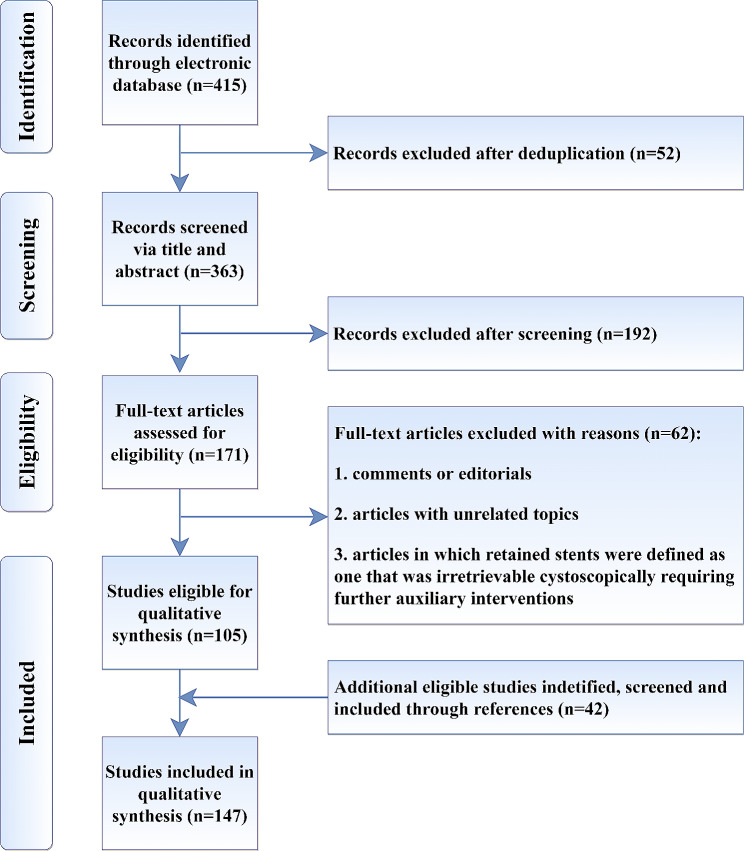
Background: The forgotten ureteral stents (FUS) is one of the late complications of stent placement. This systematic review summarized different aspects of FUS and focused on the problems and solutions related to FUS. Methods: This systematic review was conducted in accordance with the Preferred Reporting Items for Systematic Reviews and Meta-analyses (PRISMA) statement. PubMed® and Embase® were searched from inception until October 1st, 2022. Eligible studies were those defining FUS as a stent unintentionally left in situ longer than at least 2 months. Results: Total 147 studies with 1292 patients were finally included. The mean indwelling time of FUS was 33.5 months (range from 3 months to 32 years). The most common initial cause for stent placement was adjunct treatment to urolithiasis (79.2%). The major forgetting reasons were patient-related (83.9%), which included poor compliance, lapse in memory, and misconceptions about the necessity of timely removal. Primary presenting complaints were flank pain (37.3%), lower urinary tract symptoms (33.3%), and hematuria (22.8%). Encrustation (80.8%) and urinary tract infections (40.2%) were the most common complications detected in patients with FUS. Computed tomography evolving as a preferred imaging test (76.1%) was indispensable for evaluating encrustation, migration, fracture and other complicated situations in patients with FUS. Besides, evaluation of kidney function and infection status was also of great importance. Multiple and multimodal procedures (59.0%) were often necessitated to achieve the stent-free status, and were mostly endoscopic procedures. Cystoscope was most commonly used (64.8%). Retrograde ureteroscopy (43.4%) and antegrade stent removal (31.6%) were often used when dealing with more complicated situations. Extracorporeal shockwave lithotripsy (30.4%) was often used as adjunctive to other endoscopic procedures, but it sometimes failed. The decision regarding the choice of treatment is based on the volume and site of encrustation, the direction of migration, the site of fracture, kidney function and other urinary comorbidities. Conclusions: FUS not only pose hazard to patients’ health, but also impose a huge economic burden on medical care. Thorough preoperative evaluation is fundamental to developing the treatment strategy. The management of FUS should be individualized using different treatment modalities with their advantages to minimize patients’ morbidities. Prevention is better than cure. Strengthening health education and setting a tracking program are of great importance to the prevention of FUS.
Overview
The claims and statistics of this paper haven’t been checked yet.
Run the check — free, no account needed. It reads the open-access text and checks the sources it cites.
Integrity signals
Registry
Cites
Statistics
Figures
Verification
Claims the paper makes
The claims and statistics of this paper haven’t been checked yet.
Run the check — free, no account needed. It reads the open-access text and checks the sources it cites.
Claims other papers make about this one
Each is checked against this paper’s own text: does it say what the citing paper says it does?
The check wasn’t confident either way, so it gives no verdict — never disputed.
In the citing paper
“Studies examining content related to kidney stones14, esophageal cancer15, knee osteoarthritis16, and myopia prevention17 have consistently found that the overall information quality is suboptimal”
From Quality, reliability, and treatment misinformation risk of epilepsy content on Chinese short-video platforms TikTok (Douyin) and Bilibili: a cross-sectional analysis (2026) · cites this paper as [14]
Experimental — accuracy not yet measuredThe check wasn’t confident either way, so it gives no verdict — never disputed.
In the citing paper
“videos shorter than 15 s were excluded as their ultra-short format cannot deliver complete, clinically meaningful health information, with prior systematic reviews of short-video health content demonstrating that over 90% of videos shorter than 15 s contain incomplete, out-of-context, or misleading health claims”
From Quality, reliability, and treatment misinformation risk of epilepsy content on Chinese short-video platforms TikTok (Douyin) and Bilibili: a cross-sectional analysis (2026) · cites this paper as [14]
Experimental — accuracy not yet measured
Self-check
Percentages, sums and reported differences re-computed from the paper’s own numbers.
The self-check needs the paper’s full text.
Citations
Cites
The PRISMA 2020 statement: An updated guideline for reporting systematic reviews
Page, M. J., McKenzie, J. E., Bossuyt, P. M., Boutron, I., Hoffmann, T. C., Mulrow, C. D., Shamseer, L., Tetzlaff, J. M., Akl, E. A., Brennan, S. E., et al. (2021) · Journal of Clinical Epidemiology · doi:10.1016/j.jclinepi.2021.03.001 · Cited by 4,265
Clinical Use of Long-Term Indwelling Silicone Rubber Ureteral Splints Inserted Cystoscopically
Zimskind, P. D., Fetter, T. R., & Wilkerson, J. L. (1967) · The Journal of Urology · doi:10.1016/s0022-5347(17)63130-6 · Cited by 538
Experience with new double J ureteral catheter stent
Finney, R. P. (2002) · Journal of Urology · doi:10.1016/s0022-5347(02)80361-5 · Cited by 273
Ureteral stent-associated complications—where we are and where we are going
Lange, D., Bidnur, S., Hoag, N. A., et al. (2014) · Nature Reviews Urology · doi:10.1038/nrurol.2014.340 · Cited by 236
Advances in Ureteral Stent Design and Materials
Mosayyebi, A., Manes, C., Carugo, D., & Somani, B. K. (2018) · Current Urology Reports · doi:10.1007/s11934-018-0779-y · Cited by 150
Ureteric stents: Overview of current clinical applications and economic implications
Sali, G. M., & Joshi, H. B. (2019) · International Journal of Urology · doi:10.1111/iju.14119 · Cited by 117
Acosta-Miranda, A. M., Milner, J., & TURK, T. M. T. (2009) · Journal of Endourology · doi:10.1089/end.2008.0214 · Cited by 105
Tips and Tricks for the Management of Retained Ureteral Stents
Lam, J. S., & Gupta, M. (2002) · Journal of Endourology · doi:10.1089/08927790260472881 · Cited by 99
OPTIMAL PREVENTION AND MANAGEMENT OF PROXIMAL URETERAL STENT MIGRATION AND REMIGRATION
Breau, R. H., & Norman, R. W. (2001) · The Journal of Urology · doi:10.1016/s0022-5347(05)65858-2 · Cited by 92
Biofilm formation on ureteral stents – incidence, clinical impact and prevention
Zumstein, V., Betschart, P., Albrich, W. C., Buhmann, M. T., Ren, Q., Schmid, H., & Abt, D. (2017) · Swiss Medical Weekly · doi:10.4414/smw.2017.14408 · Cited by 84
Sancaktutar, A. A., Söylemez, H., Bozkurt, Y., et al. (2011) · Urological Research · doi:10.1007/s00240-011-0409-3 · Cited by 75
Endourological Management of Forgotten Encrusted Ureteral Stents
Murthy, K. V. R., Reddy, S. J., & Prasad, D. (2010) · International braz j urol · doi:10.1590/s1677-55382010000400005 · Cited by 56
The Impact of Proximal Stone Burden on the Management of Encrusted and Retained Ureteral Stents
Weedin, J. W., Coburn, M. C., & Link, R. E. (2010) · The Journal of Urology · doi:10.1016/j.juro.2010.09.085 · Cited by 55
Adanur, Ş., & Özkaya, F. (2016) · Renal Failure · doi:10.3109/0886022x.2016.1172928 · Cited by 54
Kidney, Ureter, and Bladder (KUB): A Novel Grading System for Encrusted Ureteral Stents
Arenas, J., Shen, J. K., Keheila, M., et al. (2016) · Urology · doi:10.1016/j.urology.2016.06.050 · Cited by 52
Forgotten Ureteral Stents Causing Renal Failure: Multimodal Endourologic Treatment
Aron, M., Ansari, M. S. A., Singh, I., et al. (2006) · Journal of Endourology · doi:10.1089/end.2006.20.423 · Cited by 36
Polat, H., Yucel, M. O., Utanğaç, M. M., et al. (2017) · Balkan Medical Journal · doi:10.4274/balkanmedj.2015.1562 · Cited by 28
Endoscopic, Single-Session Management of Encrusted, Forgotten Ureteral Stents
Ulker, V., & Çelik, O. (2019) · Medicina · doi:10.3390/medicina55030058 · Cited by 25
Kartal, İ. G., Baylan, B., Gök, A., et al. (2018) · Urology journal./Urology jornal. · doi:10.22037/uj.v0i0.4592 · Cited by 22
The risk factors and complications of forgotten double-J stents
Lin, T.-F., Lin, W.-R., Chen, M., et al. (2019) · Journal of the Chinese Medical Association · doi:10.1097/jcma.0000000000000161 · Cited by 22
Yeh, C.-C., Chen, C.-H., Lin, C.-H., et al. (2004) · The Journal of Urology · doi:10.1097/01.ju.0000106520.15509.d9 · Cited by 21
Zahran, M. H., Harraz, . M., Taha, D., et al. (2015) · Journal of Endourology · doi:10.1089/end.2015.0047 · Cited by 18
Novel Use of the Epic Electronic Medical Record Platform to Identify Lost Ureteral Stents
Javier-DesLoges, J. F., Johnson, K. K., Kenney, P. A., & Motamedinia, P. (2019) · Journal of Endourology · doi:10.1089/end.2019.0382 · Cited by 18
The Forgotten Ureteral Stent in Children: From Diagnosis to Treatment
Sancaktutar, A. A., Adanur, Ş., Reşorlu, B., et al. (2012) · The Journal of Urology · doi:10.1016/j.juro.2012.09.089 · Cited by 16
A Simple Two-stage “Bailout” Technique for the Removal of an Unyielding Ureteric Stent
Mistry, K., Pal, P., & Chitale, S. V. (2013) · Urology · doi:10.1016/j.urology.2013.02.036 · Cited by 12
Extracorporeal shock wave lithotripsy in the primary treatment of encrusted ureteral stents
İrkılata, L., Özgür, B. C., Sancaktutar, A. A., et al. (2015) · Urolithiasis · doi:10.1007/s00240-015-0782-4 · Cited by 10
Extrusion of Double J Stent: A Rare Complication
Shivde, S. R., Joshi, P. M., & Jamkhandikar, R. (2008) · Urology · doi:10.1016/j.urology.2008.02.017 · Cited by 9
Forgotten Ureteral Stents: An Avoidable Morbidity.
Murtaza, B., & Alvi, S. (2016) · PubMed · Cited by 7
Tawfeek, A. M., Elmoazen, M., Saafan, A. M., et al. (2020) · International Urology and Nephrology · doi:10.1007/s11255-020-02639-z · Cited by 7
Pühse, G., Piechota, H., Scheffold, C., et al. (2007) · European Urology · doi:10.1016/j.eururo.2007.01.040 · Cited by 6
Forgotten Ureteral Double-J Stent Complicated by Severe Encrustation in the Bladder
Coulier, B., & Lefebvre, G. (2016) · Journal of the Belgian Society of Radiology · doi:10.5334/jbr-btr.1179 · Cited by 6
A rare complication of forgotten ureteral stent.
Murtaza, B., Niaz, W. A., Akmal, M., et al. (2011) · PubMed · Cited by 5
A Forgotten Ureteral Stent: Potential Risks for the Urinary Function
Distler, F. A., Veelken, R. A., Wagner, A., et al. (2021) · Urologia Internationalis · doi:10.1159/000518503 · Cited by 4
Case Report: A Calculus-Free Ureteral Stent Forgotten for 29 Years
Tang, C., Qu, G., Yang, G., et al. (2022) · Frontiers in Surgery · doi:10.3389/fsurg.2022.878660 · Cited by 4
Carbin, D. D., & Anitha, F. S. (2019) · Cureus · doi:10.7759/cureus.4294 · Cited by 2
Cited by
Zhang, Y.-J., Guo, Y.-Y., & Wang, Y. (2026) · Scientific Reports · doi:10.1038/s41598-026-52532-5 · Cited by 3
Metadata
- Authors
- Wang, X., Ji, Z., Yang, P., Li, J., & Tian, Y.
- Affiliations
- Capital Medical University (CN)
- Corresponding author
- Tian, Ye
- Venue
- BMC Urology
- Published
- 2024-03-05
- Volume
- 24
- Issue
- 1
- Pages
- 52-52
- ISSN
- 1471-2490 (ISSN-L)
- PMC
- PMC10913558
- OpenAlex
- W4392471434
- Cited by
- 30
- References
- 35
- Citations by year
- 2026: 11 · 2025: 16 · 2024: 3
- FWCI
- 2.21
- Type
- journal article
- Language
- en
- Open access
- gold
- doi.org
- Licence
- cc-by
- creativecommons.org/licenses/by/4.0 (tdm)
- creativecommons.org/licenses/by/4.0 (vor)
- Locations
- BMC Urology (publishedVersion, cc-by)
- PubMed Central (publishedVersion, cc-by)
- PubMed (publishedVersion)
- DOAJ (DOAJ: Directory of Open Access Journals) (submittedVersion)
- Funders
- Capital’s Funds for Health Improvement and Research (2022-2-1102)
- Beijing Natural Science Foundation (7232027)
- Topics
- Health Sciences › Medicine › Urology › Kidney Stones and Urolithiasis Treatments
- Health Sciences › Medicine › Urology › Ureteral procedures and complications
- Health Sciences › Medicine › Gastroenterology › Gallbladder and Bile Duct Disorders
- Keywords
- forgotten ureteral stent, ureteral stent complications, stent encrustation, stent migration, stent fracture, urolithiasis, stent removal, retrograde ureteroscopy, extracorporeal shock wave lithotripsy, medication adherence, flank pain, hematuria, urinary tract infection, computed tomography
- MeSH terms
- Foreign Bodies, Hematuria, Humans, Lithotripsy, Stents, Ureteroscopy, Cystoscopes, Fractures, Bone, Urolithiasis
About these checks
Registry, retraction, Cites and statistics results are computed, not judged, with one exception: a printed reference that no index lists is read once by a model before it counts as a citation error. Claims are extracted by a model and kept only when their quote appears verbatim in the text; each cited source is then checked, with a model’s help, for whether it says what the claim relies on. Those verdicts can be wrong — read the claim’s quote and the cited source before relying on one.
Statistics and arithmetic are recomputed, not judged.
Confidence bands are shown only for fields calibrated on our annotated test set. None is calibrated yet, so no band is shown.
What counts as a claim ›How we measure confidence ›How we check this ›
Are you an author, or do you see a problem with this page? Request a review
Data sources
Bibliographic data: Semantic Scholar, OpenAlex, Crossref.
Contains information from the Semantic Scholar Academic Graph Datasets, made available under the ODC Attribution License (ODC-BY 1.0).
Semantic Scholar’s data is described in: Kinney, R., et al. (2023). The Semantic Scholar Open Data Platform. arXiv:2301.10140.
