

Effects of androgen therapy on final adult height in boys with constitutional delay of growth and puberty: a meta-analysis of retrospective cohort studies
Open accessThe DOI matches its Crossref record; 28 of the 28 references it cites were found in a registry or an index; none of the 20 sources its claims cite is checked for support yet.
Abstract
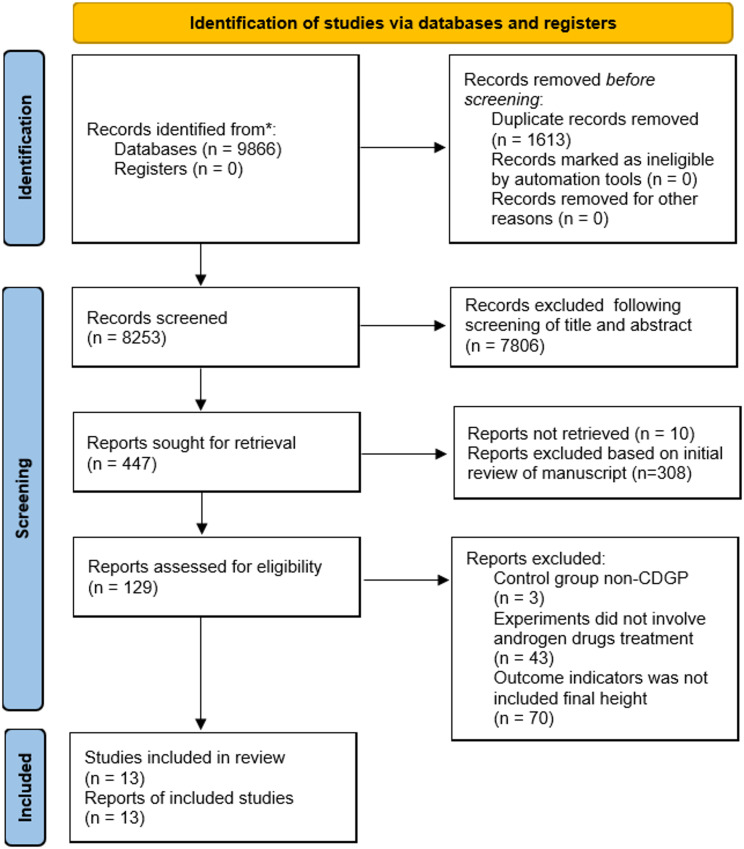
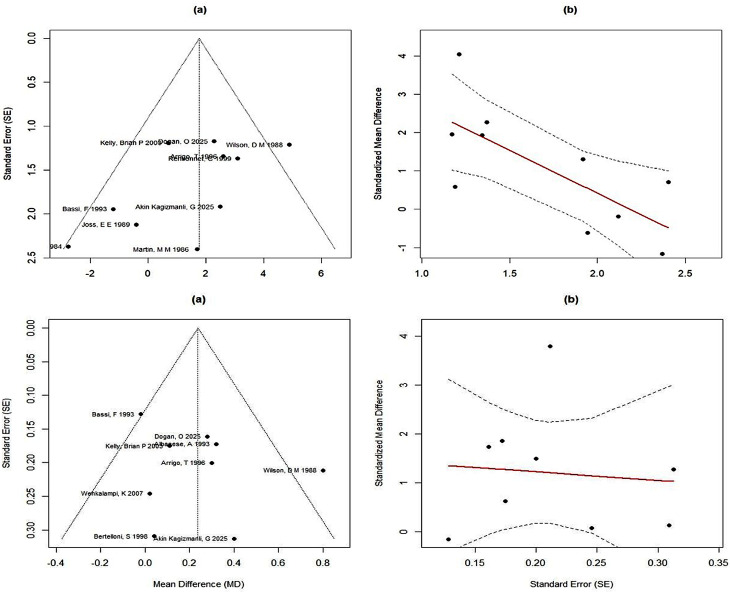
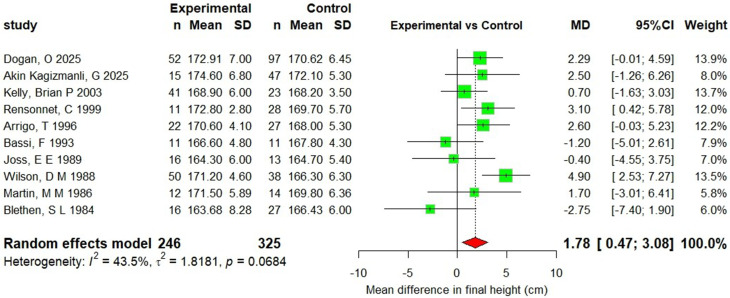
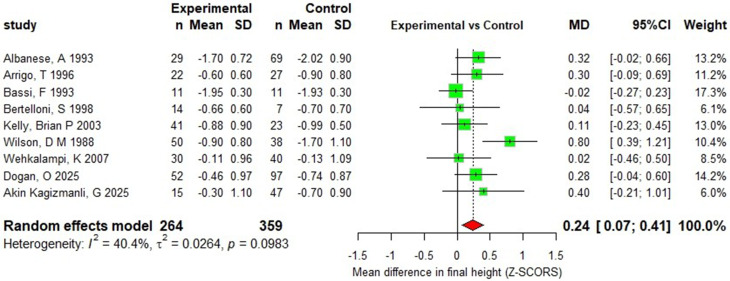
OBJECTIVE: To systematically evaluate the effect of short-term androgen therapy on final adult height in boys with constitutional delay of growth and puberty (CDGP). METHODS: Original studies investigating androgen therapy in children with CDGP and reporting final adult height as an outcome were retrieved from PubMed, Embase, Web of Science, and SpringerLink. The search period extended from database inception to September 2025. EndNote 20.0 was used for duplicate removal, and study quality was assessed using the Newcastle-Ottawa Scale (NOS). Literature screening, data extraction, and quality assessment were independently conducted by two researchers, with discrepancies resolved through consultation with a third researcher. Meta-analysis was performed using R 4.5.2 and Review Manager 5.4.1. RESULTS: A total of 13 eligible retrospective cohort studies involving 803 patients were included. Sensitivity analyses demonstrated good robustness of the pooled results, and Egger's tests indicated no significant publication bias (P1 = 0.0794, P2 = 0.3982). Meta-analysis showed that, compared with untreated controls, androgen therapy-including testosterone and oxandrolone-significantly increased measured final adult height [MD = 1.78 cm, 95% CI (0.47, 3.08), P = 0.0076] and significantly improved final height Z-scores [MD = 0.24, 95% CI (0.07, 0.41), P = 0.0057]. Subgroup analyses revealed that the low-dose regimen yielded the most favorable effect [MD = 1.88 cm, 95% CI (0.63, 3.12), P = 0.003], whereas the medium-dose [MD = 1.17 cm, 95% CI (-0.90, 3.25), P = 0.268] and high-dose regimens [MD = 1.68 cm, 95% CI (-5.07, 8.42), P = 0.626] showed no statistically significant benefit. Short-course therapy was associated with greater improvement in final adult height compared with long-course therapy [MD = 2.70 cm, 95% CI (1.30, 4.09), P < 0.001]. In addition, testosterone demonstrated superior efficacy compared with oxandrolone [MD = 2.64 cm, 95% CI (1.44, 3.80), P < 0.001]. CONCLUSION: Short-term androgen therapy can improve final adult height in boys with CDGP, with low-dose, short-course testosterone regimens appearing to be the most favorable option. Given the limited number and retrospective nature of the included studies, these findings require further confirmation through high-quality comparative studies. CLINICAL TRIAL NUMBER: Not applicable.
Overview
CoChat Summary
TL;DR
This meta-analysis of 13 retrospective cohort studies involving 803 boys with constitutional delay of growth and puberty (CDGP) found that short-term androgen therapy significantly increased measured final adult height and final height Z-scores versus untreated controls. Low-dose, short-course testosterone appeared most favorable, but the authors caution that the limited retrospective evidence requires confirmation.
Key findings
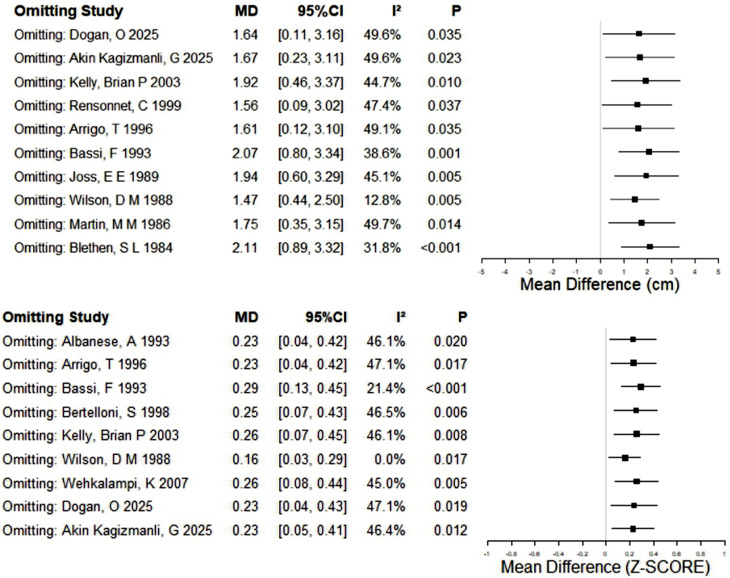
- Among 10 studies reporting final adult height in centimeters, androgen-treated boys had significantly greater final adult height than untreated controls: MD = 1.78 cm, 95% CI (0.47, 3.08), P = 0.0076, with moderate heterogeneity (I² = 43.5%). After excluding Wilson et al. 1988, the effect remained significant: MD = 1.47 cm, 95% CI (0.44, 2.50), P = 0.0052, I² = 12.8%.
- Among 9 studies reporting final height Z-scores, androgen therapy significantly improved Z-scores: MD = 0.24, 95% CI (0.07, 0.41), P = 0.0057; after excluding Wilson et al. 1988, MD = 0.16, 95% CI (0.03, 0.29), P = 0.0171, I² = 0.0%.
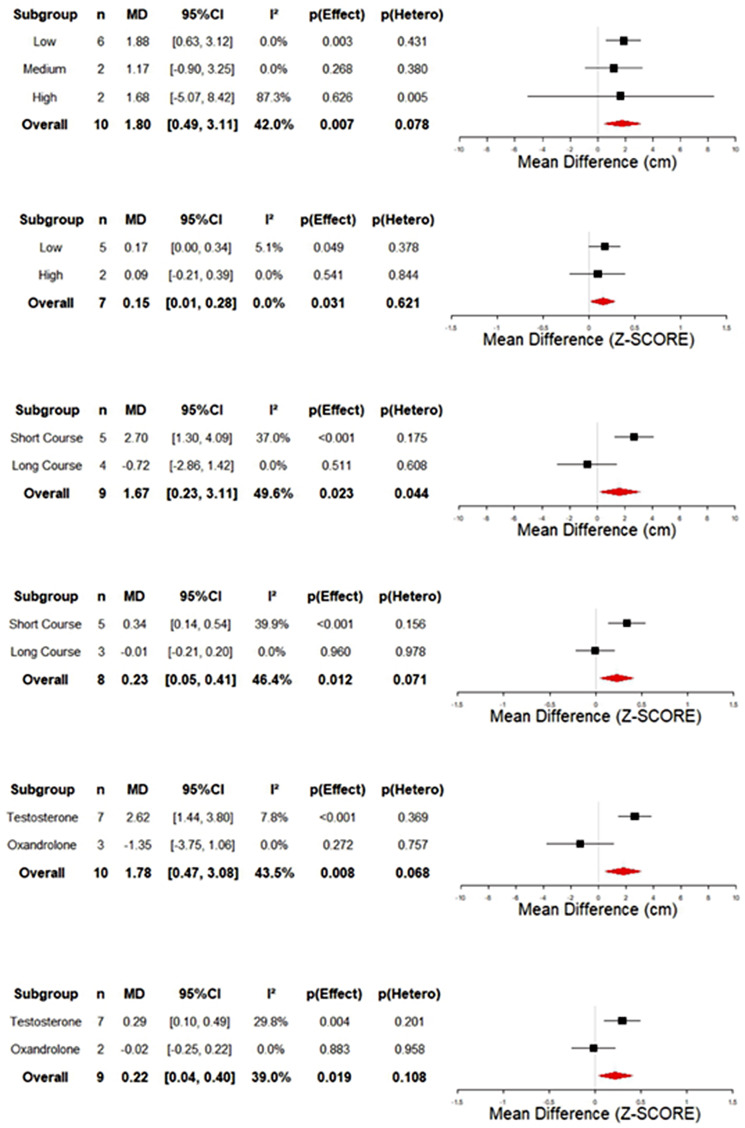
- Subgroup analyses showed low-dose therapy had the most favorable effect [MD = 1.88 cm, 95% CI (0.63, 3.12), P = 0.003], while medium-dose [MD = 1.17 cm, 95% CI (-0.90, 3.25), P = 0.268] and high-dose [MD = 1.68 cm, 95% CI (-5.07, 8.42), P = 0.626] regimens were not statistically significant. Short-course therapy was associated with greater improvement than long-course therapy [MD = 2.70 cm, 95% CI (1.30, 4.09), P < 0.001], and testosterone was superior to oxandrolone [abstract reports MD = 2.64 cm; results text reports MD = 2.62 cm; 95% CI (1.44, 3.80), P < 0.001].
- Egger’s tests indicated no significant publication bias (P = 0.0794 and P = 0.3982), and E-values were 2.31 (lower 95% CI 2.04) and 2.35 (lower 95% CI 2.14).
Methods
- Systematic review and meta-analysis of retrospective cohort studies; searched PubMed, Embase, Web of Science, and SpringerLink from database inception to September 30, 2025; prospectively registered in PROSPERO (CRD420251236539); quality assessed with the Newcastle–Ottawa Scale, including studies scoring ≥ 7.
- Included 13 retrospective cohort studies with 803 patients: boys with confirmed CDGP who had not yet reached final adult height; interventions included testosterone esters, non-testosterone anabolic androgens such as oxandrolone or stanozolol, or no pharmacological intervention; primary outcomes were measured final adult height (cm) or final adult height SDS/Z-scores.
- Random-effects models were used in R 4.5.2 and Review Manager 5.4.1; heterogeneity assessed with Q test and I²; sensitivity analysis used leave-one-out; publication bias assessed with Egger’s test; E-values calculated for continuous outcomes.
Limitations
- Stated in the paper: the limited number and retrospective nature of included studies mean findings require confirmation; risk of bias intrinsic to retrospective designs cannot be fully eliminated; overall sample size was relatively small, possibly reducing statistical power; several studies did not comprehensively report baseline confounders such as bone age, parental height, or target height; four studies did not clearly define final adult height or used ambiguous definitions; the wide publication span (1984–2025) may reflect temporal confounding; the testosterone-versus-oxandrolone comparison was based on a small sample and higher risk of bias.
- Stated in the paper: the high-dose subgroup had substantial heterogeneity (I² = 87.3%, P = 0.005), and Wilson et al. 1988 was identified as the major source of heterogeneity, partly because some final-height data were based on self-reported measurements.
- Evident from the text: all included studies were retrospective cohorts, with no randomized controlled trials followed to final adult height; the authors note that nearly all RCTs have limited follow-up of 1–3 years after treatment initiation and have not comprehensively reported final adult height outcomes.
Model-written summary. Check it against the paper before relying on it.
Integrity signals
Registry
Cites
Statistics
Figures
Verification
Claims the paper makes
0 Valid · 0 Not valid · 16 Not checked · 38 Own results and interpretations
A result the paper reports from its own data — it cites no other source for it, so there is none to check. The quote shows it is in the paper.
In the paper
“Sensitivity analyses using a leave-one-out approach showed no directional changes in the pooled MDs or their 95% CIs for either outcome.”
§ Effects of androgen therapy on final adult height in boys with constitutional delay of growth and puberty: a meta-analysis of retrospective cohort studies > Results > Effect of androgen therapy on primary outcomes
plain- Asserted: passes — The authors put it forward as true.
- Checkable: passes — It can be checked against evidence.
- Load-bearing: passes — The paper’s conclusions depend on it.
- Based: passes — The paper gives a reason why it holds.
A result the paper reports from its own data — it cites no other source for it, so there is none to check. The quote shows it is in the paper.
In the paper
“In addition, testosterone therapy was associated with a greater increase in final adult height than non-aromatizable androgens such as oxandrolone [MD = 2.62 cm, 95% CI (1.44, 3.80), P < 0.001].”
§ Effects of androgen therapy on final adult height in boys with constitutional delay of growth and puberty: a meta-analysis of retrospective cohort studies > Results > Subgroup analyses
plainstates an association- Asserted: passes — The authors put it forward as true.
- Checkable: passes — It can be checked against evidence.
- Load-bearing: passes — The paper’s conclusions depend on it.
- Based: passes — The paper gives a reason why it holds.
A result the paper reports from its own data — it cites no other source for it, so there is none to check. The quote shows it is in the paper.
In the paper
“Furthermore, short-term treatment was associated with a significantly greater improvement in final adult height [MD = 2.70 cm, 95% CI (1.30, 4.09), P < 0.001] compared with long-term treatment.”
§ Effects of androgen therapy on final adult height in boys with constitutional delay of growth and puberty: a meta-analysis of retrospective cohort studies > Results > Subgroup analyses
plainstates an association- Asserted: passes — The authors put it forward as true.
- Checkable: passes — It can be checked against evidence.
- Load-bearing: passes — The paper’s conclusions depend on it.
- Based: passes — The paper gives a reason why it holds.
A result the paper reports from its own data — it cites no other source for it, so there is none to check. The quote shows it is in the paper.
In the paper
“with moderate heterogeneity (I² = 40.4%, P = 0.0983).”
§ Effects of androgen therapy on final adult height in boys with constitutional delay of growth and puberty: a meta-analysis of retrospective cohort studies > Results > Effect of androgen therapy on primary outcomes
plainn = 9- Asserted: passes — The authors put it forward as true.
- Checkable: passes — It can be checked against evidence.
- Load-bearing: unclear — It is unclear whether the paper’s conclusions depend on it.
- Based: passes — The paper gives a reason why it holds.
A result the paper reports from its own data — it cites no other source for it, so there is none to check. The quote shows it is in the paper.
In the paper
“For Z-scores, the low-dose group continued to show significant improvement in final adult height [MD = 0.17, 95% CI (0.00, 0.34), P = 0.049], consistent with the findings above.”
§ Effects of androgen therapy on final adult height in boys with constitutional delay of growth and puberty: a meta-analysis of retrospective cohort studies > Results > Subgroup analyses
plainstates a cause- Asserted: passes — The authors put it forward as true.
- Checkable: passes — It can be checked against evidence.
- Load-bearing: passes — The paper’s conclusions depend on it.
- Based: passes — The paper gives a reason why it holds.
21 more claims
Create a free account to see all 54 claims and to verify the 20 references still open.
- It may state two separate claims as one. 20
- Probably not a substantial claim. 16
Self-check
Percentages, sums and reported differences re-computed from the paper’s own numbers.
Each contradiction between two passages listed here was confirmed by an independent check.
Rated minor: it would not touch a result — a value no result rests on, a p-value that stays on the same side of the significance level, or a conflict that is clerical, resolved elsewhere in the paper, or outside its own findings.
In the paper
§ Effects of androgen therapy on final adult height in boys with constitutional delay of growth and puberty: a meta-analysis of retrospective cohort studies > Abstract > Results
“testosterone demonstrated superior efficacy compared with oxandrolone [MD = 2.64 cm, 95% CI (1.44, 3.80), P < 0.001]”
§ Effects of androgen therapy on final adult height in boys with constitutional delay of growth and puberty: a meta-analysis of retrospective cohort studies > Results > Subgroup analyses
“testosterone therapy was associated with a greater increase in final adult height than non-aromatizable androgens such as oxandrolone [MD = 2.62 cm, 95% CI (1.44, 3.80), P < 0.001]”
Rated minor: it would not touch a result — a value no result rests on, a p-value that stays on the same side of the significance level, or a conflict that is clerical, resolved elsewhere in the paper, or outside its own findings.
In the paper
§ Effects of androgen therapy on final adult height in boys with constitutional delay of growth and puberty: a meta-analysis of retrospective cohort studies > Introduction
“Some randomized controlled trials have demonstrated that testosterone therapy improves first-year height velocity and predicted adult height in boys with CDGP [7]”
§ Effects of androgen therapy on final adult height in boys with constitutional delay of growth and puberty: a meta-analysis of retrospective cohort studies > Discussion
“a 2017 study showed that testosterone improves first-year height velocity without affecting predicted adult height [7]”
Citations
Cites
Sensitivity analysis in observational research: Introducing the E-value
VanderWeele, T. J., & Ding, P. (2017) · Annals of Internal Medicine · doi:10.7326/m16-2607 · Cited by 6,350 · cited 1×
“Additionally, E-values were calculated using the method proposed by VanderWeele et al. [9] for continuous outcomes to evaluate the potential influence of unmeasured confounding on the observed associations.”
Estrogens and androgens in skeletal physiology and pathophysiology
Almeida, M., Laurent, M. R., Dubois, V., Claessens, F., O'Brien, C. A., Bouillon, R., Vanderschueren, D., & Manolagas, S. C. (2017) · Physiological Reviews · doi:10.1152/physrev.00033.2015 · Cited by 860 · cited 1×
“Testosterone supplementation can mimic pubertal initiation, promoting chondrocyte proliferation and bone mineralization; however, excessive doses increase aromatization to estrogen, accelerate bone-age maturation, and shorten the growth period [25].”
Final height in boys with untreated constitutional delay in growth and puberty.
Crowne, E. C., Shalet, S. M., Wallace, W. H., Eminson, D. M., & Price, D. A. (1990) · Archives of Disease in Childhood · doi:10.1136/adc.65.10.1109 · Cited by 173 · cited 1×
“Consequently, untreated patients often fail to fully realize their growth potential, and their final adult height may fall short of both their mid-parental target height and that of peers with normally timed puberty [5, 6].”
Delayed Puberty—Phenotypic Diversity, Molecular Genetic Mechanisms, and Recent Discoveries
Howard, S. R., & Dunkel, L. (2019) · Endocrine Reviews · doi:10.1210/er.2018-00248 · Cited by 134 · cited 1×
“Clinically, patients most commonly present at their initial visit with complaints of “delayed height development in boys” or “primary amenorrhea in girls,” typically exhibiting a height delay of 2–3 years relative to chronological age while remaining consistent with bone age [3, 4].”
Bertelloni, S. (1998) · Journal of Clinical Endocrinology & Metabolism · doi:10.1210/jc.83.12.4280 · Cited by 126
Does constitutional delayed puberty cause segmental disproportion and short stature?
Albanese, A., & Stanhope, R. G. (1993) · European Journal of Pediatrics · doi:10.1007/bf01956736 · Cited by 69
Abitbol, L., Zborovski, S., & Palmert, M. R. (2016) · Archives of Disease in Childhood · doi:10.1136/archdischild-2015-310375 · Cited by 68 · cited 1×
“CDGP occurs predominantly in boys, accounting for approximately 53% of cases of delayed male pubertal development, and is considered a self-limiting condition [1].”
Wehkalampi, K., Vangonen, K., Laine, T., & Dunkel, L. (2007) · Hormone Research in Paediatrics · doi:10.1159/000101011 · Cited by 54
Oxandrolone in Constitutionally Delayed Growth, a Longitudinal Study up to Final Height*
Joss, E. E., SCHMIDT, H. A., & Zuppinger, K. A. (1989) · The Journal of Clinical Endocrinology & Metabolism · doi:10.1210/jcem-69-6-1109 · Cited by 53
Comparison of Predicted and Adult Heights in Short Boys: Effect of Androgen Therapy
Blethen, S. L., Gaines, S., & Weldon, V. V. (1984) · Pediatric Research · doi:10.1203/00006450-198405000-00015 · Cited by 46
Metadata
- Authors
- Wang, L., Dong, T., Zhou, T., & Liu, X.
- Affiliations
- First Affiliated Hospital of Anhui Medical University (CN)
- Corresponding author
- Liu, Xiaojing
- ORCID
- Zhou, Tingting
- Venue
- BMC Endocrine Disorders
- Published
- 2026-04-03
- Volume
- 26
- Issue
- 1
- Pages
- 141
- ISSN
- 1472-6823 (ISSN-L)
- PMC
- PMC13173941
- OpenAlex
- W7148816521
- Cited by
- 0
- References
- 28
- FWCI
- 0.00
- Type
- journal article
- Language
- en
- Open access
- gold
- doi.org
- Licence
- cc-by-nc-nd
- creativecommons.org/licenses/by-nc-nd/4.0 (tdm)
- creativecommons.org/licenses/by-nc-nd/4.0 (vor, 41 d)
- Locations
- BMC Endocrine Disorders (publishedVersion, cc-by-nc-nd)
- PubMed Central (publishedVersion, cc-by-nc-nd)
- PubMed (publishedVersion)
- DOAJ (DOAJ: Directory of Open Access Journals) (submittedVersion)
- Topics
- Health Sciences › Medicine › Reproductive Medicine › Hypothalamic control of reproductive hormones
- Health Sciences › Medicine › Endocrinology, Diabetes and Metabolism › Hormonal and reproductive studies
- Health Sciences › Medicine › Endocrinology, Diabetes and Metabolism › Growth Hormone and Insulin-like Growth Factors
- Keywords
- androgen therapy, constitutional delay of growth and puberty, adult height, testosterone, oxandrolone, short-course treatment, low-dose regimen, boys, growth hormone, puberty onset, height z-score, treatment efficacy comparison, dose-response relationship, pubertal growth spurt
- MeSH terms
- Androgens, Body Height, Child, Growth Disorders, Humans, Male, Puberty, Delayed, Retrospective Studies, Testosterone
About these checks
Registry, retraction, Cites and statistics results are computed, not judged, with one exception: a printed reference that no index lists is read once by a model before it counts as a citation error. Claims are extracted by a model and kept only when their quote appears verbatim in the text; each cited source is then checked, with a model’s help, for whether it says what the claim relies on. Those verdicts can be wrong — read the claim’s quote and the cited source before relying on one.
A language model drew the claims from the paper on 2026-11-28, under version 3 of the claim definition (model deepseek-v4.1-flash, prompt extract-v3).
A second model labelled each claim on 2026-11-28 (model jev-1.13-20260917, definition revision gold-guideline-v0.2).
Statistics and arithmetic are recomputed, not judged.
Confidence bands are shown only for fields calibrated on our annotated test set. None is calibrated yet, so no band is shown.
What counts as a claim ›How we measure confidence ›How we check this ›
Are you an author, or do you see a problem with this page? Request a review
How to cite
Cite CoChat for the checks on this page, and the paper for its own findings.
- This page
- CoChat. (2026). Citation check: Effects of androgen therapy on final adult height in boys with constitutional delay of growth and puberty: a meta-analysis of retrospective cohort studies. https://app.cochat.ai/papers/10.1186/s12902-026-02253-7
- The paper
- Wang, L., Dong, T., Zhou, T., & Liu, X. (2026). Effects of androgen therapy on final adult height in boys with constitutional delay of growth and puberty: a meta-analysis of retrospective cohort studies. BMC Endocrine Disorders. https://doi.org/10.1186/s12902-026-02253-7
Data sources
Bibliographic data: Semantic Scholar, OpenAlex, Crossref.
Contains information from the Semantic Scholar Academic Graph Datasets, made available under the ODC Attribution License (ODC-BY 1.0).
Semantic Scholar’s data is described in: Kinney, R., et al. (2023). The Semantic Scholar Open Data Platform. arXiv:2301.10140.
