

Toothbrushing: to the best of one’s abilities is possibly not good enough
Open accessThe DOI matches its Crossref record; 19 of the 19 references it cites were found in a registry or an index.
Abstract
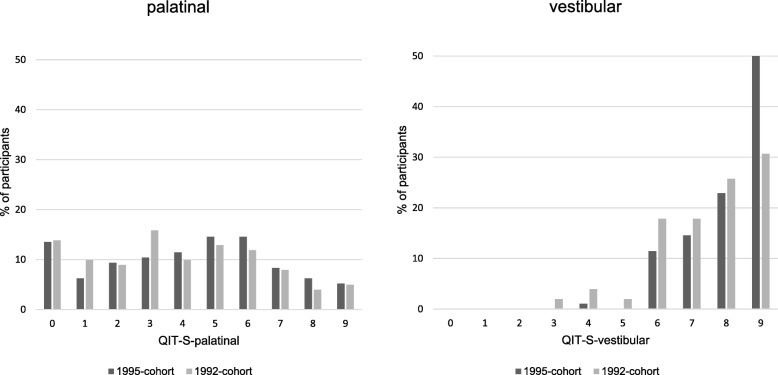
BACKGROUND: Weaknesses in toothbrushing performance can be seen when young adults are instructed to perform habitual toothbrushing. Nothing is known about toothbrushing behavior when instructed to perform to the best abilities. The present study analyzes such behavior and compares it to habitual behavior. METHODS: A random sample of N = 98 young adults born in 1995 was examined in 2014/2015.They were asked to perform oral hygiene to the best of their abilities in front of a camera. Videos were analyzed regarding details of brushing behavior. A quality index was developed which describes the extent of the neglect of brushing on palatinal and vestibular surfaces. Data were compared to those of an earlier study of young adults (born in 1992, examined in 2011, N = 101) who were asked to perform oral hygiene as they habitually do. RESULTS: The 1995 cohort (best abilities) brushed their teeth significantly longer than the 1992 cohort (habitual brushing). This was due to significant longer brushing at vestibular and occlusal surfaces. Neglect of palatinal surfaces was similar in both cohorts. Groups did not differ regarding brushing movements. 40% of the brushing time on lateral surfaces was spent with scrubbing movements despite opposing advice in common oral hygiene instructions. CONCLUSIONS: Toothbrushing to the best of one's abilities might still not be good enough. Young adults apparently lack a reasonable concept of what is meant by high quality toothbrushing. More efforts should thus be undertaken to explain them (and adults) this concept.
Overview
The claims and statistics of this paper haven’t been checked yet.
Free: it reads the open-access text and checks the first 5 claims that cite a source we can check. Create a free account to check every claim.
Integrity signals
Registry
Cites
Statistics
Figures
Verification
Claims the paper makes
The claims and statistics of this paper haven’t been checked yet.
Free: it reads the open-access text and checks the first 5 claims that cite a source we can check. Create a free account to check every claim.
Claims other papers make about this one
Each is checked against this paper’s own text: does it say what the citing paper says it does?
The cited source says what the claim attributes to it.
In the citing paper
“Despite the importance of patient-delivered oral hygiene measures, often insufficient to fully prevent and/or control disease, in part due to suboptimal delivery of home care. 13”
Self-check
Percentages, sums and reported differences re-computed from the paper’s own numbers.
The self-check needs the paper’s full text.
Citations
Cites
Tonetti, M. S., Jepsen, S., Jin, L., & Otomo‐Corgel, J. (2017) · Journal of Clinical Periodontology · doi:10.1111/jcpe.12732 · Cited by 1,329
Petersen, P. E., & Ogawa, H. (2012) · Periodontology 2000 · doi:10.1111/j.1600-0757.2011.00425.x · Cited by 819
Global burden of oral diseases: emerging concepts, management and interplay with systemic health
Jin, L., Lamster, I., Greenspan, J., Pitts, N., Scully, C., & Warnakulasuriya, S. (2016) · Oral Diseases · doi:10.1111/odi.12428 · Cited by 764
Mejàre, I., Stenlund, H., & Zelezny-Holmlund, C. (2004) · Caries Research · doi:10.1159/000075937 · Cited by 221
the DMS V Surveillance Investigators’ Group, Jordan, R. A., Bodechtel, C., Hertrampf, K., Hoffmann, T., Kocher, T., Nitschke, I., Schiffner, U., Stark, H., Zimmer, S., et al. (2014) · BMC Oral Health · doi:10.1186/1472-6831-14-161 · Cited by 192
Toothbrushing and flossing behaviour in young adults—a video observation
Winterfeld, T., Schlueter, N., Harnacke, D., Illig, J., Margraf‐Stiksrud, J., Deinzer, R., & Ganß, C. (2014) · Clinical Oral Investigations · doi:10.1007/s00784-014-1306-2 · Cited by 110
Self-citationDeinzer, R., Micheelis, W., Granrath, N., & Hoffmann, T. K. (2009) · Journal Of Clinical Periodontology · doi:10.1111/j.1600-051x.2009.01452.x · Cited by 88
Self-citationHarnacke, D., Mitter, S., Lehner, M., Munzert, J., & Deinzer, R. (2012) · PLoS ONE · doi:10.1371/journal.pone.0037072 · Cited by 76
Self-citationOral and Written Instruction of Oral Hygiene: A Randomized Trial
Harnacke, D., Beldoch, M., Bohn, G., Seghaoui, O., Hegel, N., & Deinzer, R. (2012) · Journal of Periodontology · doi:10.1902/jop.2012.110550 · Cited by 64
Self-citationEstablishment of a New Marginal Plaque Index With High Sensitivity for Changes in Oral Hygiene
Deinzer, R., Jahns, S., & Harnacke, D. (2014) · Journal of Periodontology · doi:10.1902/jop.2014.140285 · Cited by 60
Self-citationTrends in toothbrushing in 20 countries/regions from 1994 to 2010
Honkala, S., Vereecken, C. A., Niclasen, B. V.-L., & Honkala, E. J. (2015) · European Journal of Public Health · doi:10.1093/eurpub/ckv013 · Cited by 56
Harnacke, D., Stein, K., Stein, P., Margraf‐Stiksrud, J., & Deinzer, R. (2016) · Journal Of Clinical Periodontology · doi:10.1111/jcpe.12489 · Cited by 48
Self-citationHarnacke, D., Winterfeld, T., Erhardt, J., Schlueter, N., Ganss, C., Margraf‐Stiksrud, J., & Deinzer, R. (2014) · Journal of Periodontology · doi:10.1902/jop.2014.140152 · Cited by 35
Self-citationHigh Plaque Levels after Thorough Toothbrushing: What Impedes Efficacy?
Ebel, S., Blättermann, H., Weik, U., Margraf‐Stiksrud, J., & Deinzer, R. (2018) · JDR Clinical & Translational Research · doi:10.1177/2380084418813310 · Cited by 35
Self-citationStenlund, H. C., Mejàre, I., & Källestål, C. (2003) · Community Dentistry And Oral Epidemiology · doi:10.1034/j.1600-0528.2003.00015.x · Cited by 34
Deinzer, R., Harnacke, D., Mengel, R., Telzer, M., Lotzmann, U., & Wöstmann, B. (2016) · Journal of Periodontology · doi:10.1902/jop.2016.160099 · Cited by 31
Self-citationDeinzer, R., Schmidt, R., Harnacke, D., Meyle, J., Ziebolz, D., Hoffmann, T. K., & Wöstmann, B. (2017) · Clinical Oral Investigations · doi:10.1007/s00784-017-2160-9 · Cited by 20
Self-citation[Decline of caries prevalence in Swiss military recruits between 1970 and 1996].
Gd, M., Steiner, M., Tm, M., & Rm, W. (2001) · PubMed · Cited by 8
Rückgang der Kariesprävalenz bei Schweizer Rekruten von 1970 bis 1996
Menghini, G., Steiner, M., Marthaler, T. M., & Weber, R. M. (2001) · Zurich Open Repository and Archive (University of Zurich) · doi:10.5167/uzh-1606 · Cited by 3
Research works printed but not linked: 7
- Jordan AR Micheelis W Fünfte Deutsche Mundgesundheitsstudie (DMS V) [Fifth German Oral Health Study] 2016 Köln, Germany Deutscher Zahnärzte Verlag DÄV PMC4417261 25547464
- Hoffmann T Micheelis W Schiffner U Parodontalerkrankungen [Periodontal Diseases] Vierte Deutsche Mundgesundheitsstudie (DMS IV) [Fourth Oral Healh Study (DMS IV)] 2006 Köln, Germany Deutscher Zahnärzte Verlag DÄV 266 289
- American Dental Association General Recommendations for the Prevention of Caries and Gingivitis 2018
- European Federation of Periodontology Guidelines for effective prevention of periodontal diseases 2017
- World Dental Federation Caries Prevention and Management Chairside Guide 2018
- Canadian Dental Association Flossing & Brushing 2018
- Muller-Bolla M Courson F Manière-Ezvan A Viargues P Toothbrushing: which methods to use? Rev Odont Stomat 2011 40 239 260
Cited by
Deinzer, R., Cordes, O., Weber, J., Hassebrauck, L., Weik, U., Krämer, N., Pieper, K., & Margraf‐Stiksrud, J. (2019) · BMC Oral Health · doi:10.1186/s12903-019-0755-z · Cited by 100
Self-citationCharacterizing the Content Related to Oral Health Education on TikTok
Fraticelli, L., Smentek, C., Tardivo, D., Masson, J., Clément, C., Roy, S., Dussart, C., Bourgeois, D. M., & Carrouel, F. (2021) · International Journal of Environmental Research and Public Health · doi:10.3390/ijerph182413260 · Cited by 69
Delivery of biologics: Topical administration
Kulchar, R. J., SINGH, R. K., Ding, S., Alexander, E., Leong, K. W., & Daniell, H. (2023) · Biomaterials · doi:10.1016/j.biomaterials.2023.122312 · Cited by 64
mTeeth: Identifying Brushing Teeth Surfaces Using Wrist-Worn Inertial Sensors
Akther, S., Saleheen, N., Saha, M., Shetty, V., & Kumar, S. (2021) · Proceedings of the ACM on Interactive Mobile Wearable and Ubiquitous Technologies · doi:10.1145/3463494 · Cited by 52
Eidenhardt, Z., Ritsert, A., Subramanian, S. S., Ebel, S., Margraf‐Stiksrud, J., & Deinzer, R. (2021) · BMC Oral Health · doi:10.1186/s12903-021-01692-z · Cited by 46
Self-citation
Metadata
- Authors
- Deinzer, R., Ebel, S., Blättermann, H., Weik, U., & Margraf-Stiksrud, J.
- Affiliations
- Justus-Liebig-Universität Gießen (DE)
- Corresponding author
- Deinzer, Renate
- Venue
- BMC Oral Health
- Published
- 2018-10-19
- Volume
- 18
- Issue
- 1
- Pages
- 167-167
- ISSN
- 1472-6831 (ISSN-L)
- PMC
- PMC6194646
- OpenAlex
- W2897987218
- Cited by
- 57
- References
- 19
- Citations by year
- 2026: 6 · 2025: 4 · 2024: 11 · 2023: 11 · 2022: 11 · 2021: 6 · 2020: 4 · 2019: 3 · 2018: 1
- FWCI
- 3.94
- Type
- journal article
- Language
- en
- Open access
- gold
- doi.org
- Licence
- cc-by
- creativecommons.org/licenses/by/4.0/ (tdm)
- Locations
- BMC Oral Health (publishedVersion, cc-by)
- Europe PMC (PubMed Central) (publishedVersion, other-oa)
- PubMed Central (publishedVersion, cc-by)
- PubMed (publishedVersion)
- DOAJ (DOAJ: Directory of Open Access Journals) (submittedVersion, cc-by-sa)
- University writing server of the Justus Liebig University Giessen (Justus-Liebig-Universität Gießen) (submittedVersion, cc-by)
- Topics
- Health Sciences › Dentistry › General Dentistry › Dental Health and Care Utilization
- Health Sciences › Dentistry › Periodontics › Oral microbiology and periodontitis research
- Health Sciences › Dentistry › General Dentistry › Oral Health Pathology and Treatment
- Keywords
- toothbrushing, oral hygiene habits, young adults, brushing duration, dental hygiene education, brushing technique
- MeSH terms
- Female, Germany, Humans, Male, Toothbrushing, Video Recording, Health Behavior, Young Adult
About these checks
Registry, retraction, Cites and statistics results are computed, not judged, with one exception: a printed reference that no index lists is read once by a model before it counts as a citation error. Claims are extracted by a model and kept only when their quote appears verbatim in the text; each cited source is then checked, with a model’s help, for whether it says what the claim relies on. Those verdicts can be wrong — read the claim’s quote and the cited source before relying on one.
Statistics and arithmetic are recomputed, not judged.
Confidence bands are shown only for fields calibrated on our annotated test set. None is calibrated yet, so no band is shown.
What counts as a claim ›How we measure confidence ›How we check this ›
Are you an author, or do you see a problem with this page? Request a review
Data sources
Bibliographic data: Semantic Scholar, OpenAlex, Crossref.
Contains information from the Semantic Scholar Academic Graph Datasets, made available under the ODC Attribution License (ODC-BY 1.0).
Semantic Scholar’s data is described in: Kinney, R., et al. (2023). The Semantic Scholar Open Data Platform. arXiv:2301.10140.
