

A proof of principle investigation of a novel enzyme formulation on dental calculus deposition: a 4-week randomized human clinical trial
Open accessThe DOI matches its Crossref record; 14 of the 14 references it cites were found in a registry or an index; 4 of the 4 sources its claims cite were checked for support.
Abstract
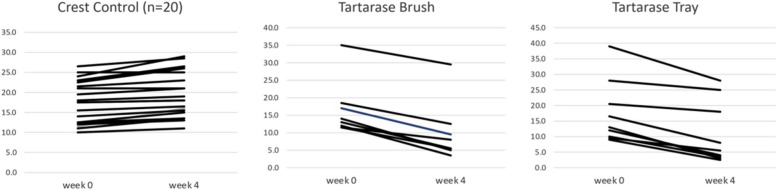
Background: The dissolution of dental calculus, safely and at home, is among the more challenging issues facing the over-the-counter healthcare industry. Pontis Biologics, Inc. has developed novel model of calculus development and structure and has formulated a dentifrice (Tartarase™) using digestive enzymes as active ingredients that is shown to dissolve dental calculus in this Proof of Principle clinical trial. Methods: This investigation was designed to evaluate the safety and efficacy of a novel enzyme formulation to remove existing calculus deposits in 4 weeks, measured using the Volpe-Manhold Index (V-MI) on lingual surfaces of 6 lower anterior teeth. The test formulation was compared to Crest Cavity Protection, as a control dentifrice. A total of 40 randomized test subjects began the study with 20 assigned to the control dentifrice and 20 assigned to the Tartarase groups (ten each, one brushing with Tartarase twice daily and one brushed with Tartarase and wore a dental tray filled with Tartarase for 30 min then brushed again with Tartarase, once daily). Results: The Crest group experienced a 12% increase in calculus, in contrast to the results of both Tartarase groups that experienced a 40% reduction in calculus in 4 weeks of unsupervised at home use of the Tartarase toothpaste formulation. Conclusions: This proof of principle study demonstrates that a dentifrice, formulated along the lines of the Tartarase material, is capable of combating calculus accumulation using the same oral hygiene habits that are common worldwide. Trial registration: This trial was registered retrospectively at clinicaltrials.gov and has the Unique Identification Number: NCT06139835, 14/11/2023.
Overview
CoChat Summary
TL;DR
In a 4-week randomized proof-of-principle trial, a novel enzyme dentifrice (Tartarase) reduced existing dental calculus by about 40% in both test groups, while the Crest control group increased calculus by about 12%. The authors conclude Tartarase may remove calculus under normal at-home oral hygiene habits, but larger and longer studies are needed.
Key findings
- Tartarase Brushing reduced Volpe-Manhold Index (V-MI) calculus by 40.4% and Tartarase Brushing + Tray by 38.1% from baseline to week 4; the Crest control group had a 12.2% increase. Both Tartarase groups were statistically different from control (ANCOVA p < 0.001).
- Within-group longitudinal reductions in the two Tartarase groups were statistically significant (p < 0.001); all 17 Tartarase completers demonstrated a reduction in calculus.
- The paper reports no serious adverse events and states Tartarase was well tolerated, while also reporting 5 examiner-observed AEs (4 attributed to toothbrush abrasion, 1 mild inflamed papilla) and 3 self-reported AEs; all resolved within the 5-day re-evaluation period.
- Oral cleanliness questionnaire positive endorsements of “4” or “5” were 75% for Tartarase Brush only, 67% for Tartarase Brush + Tray, and 50% for control; the paper states these differences were not statistically significant.
Methods
- Parallel-group, examiner-blind, randomized, three-treatment proof-of-principle clinical trial; 40 adults were randomized (20 Crest control, 10 Tartarase brushing, 10 Tartarase brush + tray), and 37 completed. Participants used products unsupervised at home for 4 weeks after a supervised first use.
- Eligibility required at least 9 mm total dental calculus on the lingual surfaces of six mandibular anterior teeth by V-MI and a dental cleaning 2–6 months prior. The Tartarase formulation contained DNase 1 and chymotrypsin; the control was Crest Cavity Protection.
- Efficacy was measured by V-MI on the lingual surfaces of six lower anterior teeth at baseline, 2 weeks, and 4 weeks. Between-group comparisons used ANCOVA with baseline as covariate; within-group changes used one-sample t-tests; significance was set at 0.05, two-sided.
Limitations
- The authors state this was a 4-week proof-of-principle study; it is not known how fast all dental calculus would be eliminated once structural integrity is disrupted, and a longer 6-month study in subjects who had not had a dental cleaning in the past year is needed.
- The authors state the correct dosage and proper delivery vehicle still need to be determined; the tray group did not outperform brushing, possibly because enzyme products inhibit forward reactions and in vitro reactions completed in < 5 min.
- Evident from the text: the sample was small with unequal groups (20 vs 10 vs 10), attrition occurred in the Tartarase arms (8/10 brushing and 9/10 tray completed), the investigational product did not contain fluoride while all participants were asked to use a fluoride toothpaste, and the study coordinator was unblinded.
Model-written summary. Check it against the paper before relying on it.
Integrity signals
Registry
Cites
Statistics
Figures
Verification
Claims the paper makes
3 Valid · 2 Not valid · 0 Not checked · 42 Own results and interpretations
At least one cited source doesn’t support this claim or points to a different paper, and none confirmed it — see the verdicts below.
In the paper
“Current toothpastes are ineffective at preventing dental calculus formation [11].”
§ A proof of principle investigation of a novel enzyme formulation on dental calculus deposition: a 4-week randomized human clinical trial > Background
What the sources say
- Disputedcites [11] Al-Hashedi AA Dubreuil N Schwinghamer T Dorzhiyeva S Anweigi L Emami E Tamimi F Aragonite toothpaste for management of dental calculus: A double-blinded randomized controlled clinical trial Clin Exp Dent Res 2022 8 4 863 874 10.1002/cre2.559 35419985 PMC9382037 sourceExperimental — accuracy not yet measured
The Introduction (page not supplied) says toothpastes with anticalculus agents are effective at reducing calculus deposition, although they do not remove calculus already formed. The Discussion’s “Prevention of calculus formation” section (page not supplied) reports reductions in calculus formation with several toothpaste ingredients, contrary to the claim that current toothpastes are ineffective at prevention. (LLM, conf=0.90)
Checked by a reasoning model — may be wrong.
plain- Asserted: passes — The authors put it forward as true.
- Checkable: passes — It can be checked against evidence.
- Load-bearing: passes — The paper’s conclusions depend on it.
- Based: passes — The paper gives a reason why it holds.
- Disputed
Every source the paper cites for this claim was checked and supports it.
In the paper
“However, more than 40% of plaque will not be removed, even by a well-trained person [10]”
§ A proof of principle investigation of a novel enzyme formulation on dental calculus deposition: a 4-week randomized human clinical trial > Background
What the sources say
- Supportedcites [10] Hayasaki H Saitoh I Nakakura-Ohshima K Tooth brushing for oral prophylaxis Jpn Dent Sci Rev 2014 50 69 77 10.1016/j.jdsr.2014.04.001 source
Section 4.1 reports that brushing instruction and practice reduced plaque scores by 42% on average, with reductions ranging from 30% to 53% depending on the plaque index. That leaves more than 40% of baseline plaque scores after brushing, including at the upper end of the reported range. (LLM, conf=0.86)
plain- Asserted: passes — The authors put it forward as true.
- Checkable: passes — It can be checked against evidence.
- Load-bearing: passes — The paper’s conclusions depend on it.
- Based: passes — The paper gives a reason why it holds.
- Supported
A result the paper reports from its own data — it cites no other source for it, so there is none to check. The quote shows it is in the paper.
In the paper
“Tartarase was well tolerated.”
§ A proof of principle investigation of a novel enzyme formulation on dental calculus deposition: a 4-week randomized human clinical trial > Results > Safety
boosted- Asserted: passes — The authors put it forward as true.
- Checkable: passes — It can be checked against evidence.
- Load-bearing: passes — The paper’s conclusions depend on it.
- Based: passes — The paper gives a reason why it holds.
A result the paper reports from its own data — it cites no other source for it, so there is none to check. The quote shows it is in the paper.
In the paper
“were statistically different from the Crest control group (p < 0.001)”
§ A proof of principle investigation of a novel enzyme formulation on dental calculus deposition: a 4-week randomized human clinical trial > Results > Efficacy
plain- Asserted: passes — The authors put it forward as true.
- Checkable: passes — It can be checked against evidence.
- Load-bearing: passes — The paper’s conclusions depend on it.
- Based: passes — The paper gives a reason why it holds.
A result the paper reports from its own data — it cites no other source for it, so there is none to check. The quote shows it is in the paper.
In the paper
“There were no oral hard tissue changes noted during the 4-week trial.”
§ A proof of principle investigation of a novel enzyme formulation on dental calculus deposition: a 4-week randomized human clinical trial > Results > Safety
plain- Asserted: passes — The authors put it forward as true.
- Checkable: passes — It can be checked against evidence.
- Load-bearing: unclear — It is unclear whether the paper’s conclusions depend on it.
- Based: passes — The paper gives a reason why it holds.
19 more claims
Create a free account to see all 47 claims and every source verdict.
- Probably not a substantial claim. 12
- It may state two separate claims as one. 11
- The quote only partly states this claim. 3
Self-check
Percentages, sums and reported differences re-computed from the paper’s own numbers.
Each contradiction between two passages listed here was confirmed by an independent check.
Rated major: it would touch a result — a value a result rests on, reported and recomputed p-values on opposite sides of the significance level, two passages that conflict with no sign which is right, or a cited work retracted before this paper was published.
In the paper
§ A proof of principle investigation of a novel enzyme formulation on dental calculus deposition: a 4-week randomized human clinical trial > Results > Safety
“No safety issues were noted from the use of Tartarase and there were no AEs nor any serious AEs.”
§ A proof of principle investigation of a novel enzyme formulation on dental calculus deposition: a 4-week randomized human clinical trial > Results > Safety
“There were 5 AEs based upon oral examination (4 AEs were attributed to toothbrush abrasion and the other was an inflamed papilla (mild) on anterior of the tongue).”
Rated minor: it would not touch a result — a value no result rests on, a p-value that stays on the same side of the significance level, or a conflict that is clerical, resolved elsewhere in the paper, or outside its own findings.
In the paper
§ A proof of principle investigation of a novel enzyme formulation on dental calculus deposition: a 4-week randomized human clinical trial > Discussion
“Lastly, the single AE noted (erythema) by the examiner was most likely caused by brushing 4X per day in the Tartarase brushing group (vs. 2X in the Crest control group).”
§ A proof of principle investigation of a novel enzyme formulation on dental calculus deposition: a 4-week randomized human clinical trial > Results > Safety
“There were 5 AEs based upon oral examination (4 AEs were attributed to toothbrush abrasion and the other was an inflamed papilla (mild) on anterior of the tongue).”
Rated minor: it would not touch a result — a value no result rests on, a p-value that stays on the same side of the significance level, or a conflict that is clerical, resolved elsewhere in the paper, or outside its own findings.
In the paper
§ A proof of principle investigation of a novel enzyme formulation on dental calculus deposition: a 4-week randomized human clinical trial > Results > Efficacy
“The results for both Tartarase treatment groups were comparable and all 17 assigned to the experimental product demonstrated a reduction in calculus (Fig. 1).”
§ A proof of principle investigation of a novel enzyme formulation on dental calculus deposition: a 4-week randomized human clinical trial > Methods > Sample size and randomization
“| Randomized | 20 | 10 | 10 | 40 | | Completed | 20 | 8 | 9 | 37 |”
Citations
Cites
Eke, P. I., Thornton-Evans, G. O., Wei, L., Borgnakke, W. S., Dye, B. A., & Genco, R. J. (2018) · The Journal of the American Dental Association · doi:10.1016/j.adaj.2018.04.023 · Cited by 650
Polymicrobial synergy and dysbiosis in inflammatory disease
Lamont, R. J., & Hajishengallis, G. (2015) · Trends in Molecular Medicine · doi:10.1016/j.molmed.2014.11.004 · Cited by 585 · cited 1×
“Bacteria living in dental biofilms are the primary etiological factors of periodontal diseases [6].”
BackgroundMucin-bacterial interactions in the human oral cavity and digestive tract
Derrien, M., van Passel, M. W. J., van de Bovenkamp, J. H. B., Schipper, R., de Vos, W., & Dekker, J. (2010) · Gut Microbes · doi:10.4161/gmic.1.4.12778 · Cited by 556
The dental plaque biofilm matrix
Jakubovics, N. S., Goodman, S. D., Mashburn‐Warren, L., Stafford, G. P., & Cieplik, F. (2021) · Periodontology 2000 · doi:10.1111/prd.12361 · Cited by 488 · cited 1×
“Other, more complex models have been proposed for calculus structure, incorporating macromolecular associations that are supported by molecular analysis [13].”
BackgroundLin, M., Griffin, S. O., Gooch, B. F., Espinoza, L., Liang, W., Li, C.-H., Thornton‐Evans, G. O., Junger, M. L., Robison, V. A., Fleming, E., et al. (2019) · Cited by 296
In Vivo Calculus Assessment: Part I A Method and Its Examiner Reproducibility
Volpe, A. R., Manhold, J. H., & Hazen, S. P. (1965) · Journal of Periodontology · doi:10.1902/jop.1965.36.4.292 · Cited by 134
Adams, S. E., Arnold, D., Murphy, B., Carroll, P., Green, A. K., Smith, A. M., Marsh, P. D., Chen, T., Marriott, R. E., & Brading, M. G. (2017) · Scientific Reports · doi:10.1038/srep43344 · Cited by 111 · cited 1×
“These substances improve the quality of the oral microbiome, but do not impact calculus accumulation [9].”
BackgroundOral Microorganisms and Biofilms: New Insights to Defeat the Main Etiologic Factor of Oral Diseases
Bertolini, M., Costa, R. L. G. F. D. C., Barão, V. A. R., Villar, C. C., Retamal‐Valdes, B., Feres, M., & Souza, J. G. S. (2022) · Microorganisms · doi:10.3390/microorganisms10122413 · Cited by 109 · cited 1×
“This leads to a mineral discrepancy between acidic biofilm fluid and tooth, resulting in loss of tooth mineral composition, clinically noted as loss of tooth structure and cavitations [8].”
BackgroundTooth brushing for oral prophylaxis
Hayasaki, H., Saitoh, I., Nakakura-Ohshima, K., Hanasaki, M., Nogami, Y., Nakajima, T., Inada, E., Iwasaki, T., Iwase, Y., Sawami, T., et al. (2014) · Japanese Dental Science Review · doi:10.1016/j.jdsr.2014.04.001 · Cited by 81 · cited 1×
“However, more than 40% of plaque will not be removed, even by a well-trained person [10], and, in general proceeds to become mineralized forming dental calculus.”
BackgroundTriclosan/copolymer containing toothpastes for oral health
Riley, P., & Lamont, T. (2013) · Cochrane Database of Systematic Reviews · doi:10.1002/14651858.cd010514.pub2 · Cited by 79 · cited 1×
“Both groups formed measurable amounts of dental calculus though the triclosan/copolymer tooth-paste group had 15% less dental calculus formed (it slows but does not prevent the formation of dental calculus) [12].”
BackgroundThe association between subgingival periodontal pathogens and systemic inflammation
Winning, L., Patterson, C. C., Cullen, K. M., Stevenson, K. A., Lundy, F. T., Kee, F., & Linden, G. J. (2015) · Journal of Clinical Periodontology · doi:10.1111/jcpe.12450 · Cited by 58 · cited 1×
“Importantly, oral health diseases exert systemic manifestations beyond the oral cavity such as diabetes, cardiovascular disease, and pre-term babies with low birth weights [4].”
BackgroundValen, H., & Scheie, A. A. (2018) · European Journal of Oral Sciences · doi:10.1111/eos.12425 · Cited by 42
Jones, C., Macfarlane, T. V., Milsom, K. M., Ratcliffe, P., Wyllie, A., & Tickle, M. (2013) · BMC Oral Health · doi:10.1186/1472-6831-13-50 · Cited by 13 · cited 1×
“In addition, a questionnaire was selected using a five-point subjective scale to evaluate oral cleanliness (1 = least clean and 5 = cleanest) [15] and was included as an exploratory endpoint.”
MethodAl‐Hashedi, A. A., Dubreuil, N., Schwinghamer, T., Dorzhiyeva, S., Anweigi, L., Emami, E., & Tamimi, F. (2022) · Clinical and Experimental Dental Research · doi:10.1002/cre2.559 · Cited by 9 · cited 3×
“Figure 4 in [11] demonstrates that 6 months following scaling and use of the Dr. D-Tart toothpaste, calculus accumulation, assessed by the Volpe-Manhold calculus index, increased by 0.87 mm.”
BackgroundMethodInfluential
Metadata
- Authors
- Milleman, K. R., Deener, G., Milleman, J. L., Mish, B., Schuller, R., & Mynarcik, D.
- Affiliations
- Salus (United States) (US)
- Corresponding author
- Mynarcik, Dennis
- Venue
- BMC Oral Health
- Published
- 2024-06-22
- Volume
- 24
- Issue
- 1
- Pages
- 720-720
- ISSN
- 1472-6831 (ISSN-L)
- PMC
- PMC11193251
- OpenAlex
- W4399918421
- Cited by
- 0
- References
- 14
- FWCI
- 0.00
- Type
- journal article
- Language
- en
- Open access
- gold
- dx.doi.org
- Licence
- cc-by
- creativecommons.org/licenses/by/4.0 (tdm)
- creativecommons.org/licenses/by/4.0 (vor)
- Locations
- BMC Oral Health (publishedVersion, cc-by)
- PubMed Central (publishedVersion, cc-by-nc-sa)
- PubMed (publishedVersion)
- DOAJ (DOAJ: Directory of Open Access Journals) (submittedVersion, cc-by-sa)
- Funders
- Pontis Biologics, Inc. (PB2022-01)
- Topics
- Health Sciences › Dentistry › Periodontics › Oral microbiology and periodontitis research
- Health Sciences › Dentistry › General Dentistry › Dental Health and Care Utilization
- Health Sciences › Dentistry › General Dentistry › Dental Erosion and Treatment
- Keywords
- dental calculus, digestive enzymes, toothpaste, oral hygiene, dental plaque
- MeSH terms
- Proof of Concept Study, Adult, Dental Calculus, Dentifrices, Female, Humans, Male, Middle Aged, Toothbrushing
About these checks
Registry, retraction, Cites and statistics results are computed, not judged, with one exception: a printed reference that no index lists is read once by a model before it counts as a citation error. Claims are extracted by a model and kept only when their quote appears verbatim in the text; each cited source is then checked, with a model’s help, for whether it says what the claim relies on. Those verdicts can be wrong — read the claim’s quote and the cited source before relying on one.
The claim verdicts this report counts are experimental: their accuracy is not yet measured.
A language model drew the claims from the paper on 2026-10-10, under version 3 of the claim definition (model deepseek-v4.1-flash, prompt extract-v3).
A second model labelled each claim on 2026-10-10 (model jev-1.13-20260917, definition revision gold-guideline-v0.2).
Cited sources are checked with a language model’s help (gpt-6-sol).
Statistics and arithmetic are recomputed, not judged.
Confidence bands are shown only for fields calibrated on our annotated test set. None is calibrated yet, so no band is shown.
What counts as a claim ›How we measure confidence ›How we check this ›
Are you an author, or do you see a problem with this page? Request a review
Data sources
Bibliographic data: Semantic Scholar, OpenAlex, Crossref.
Contains information from the Semantic Scholar Academic Graph Datasets, made available under the ODC Attribution License (ODC-BY 1.0).
Semantic Scholar’s data is described in: Kinney, R., et al. (2023). The Semantic Scholar Open Data Platform. arXiv:2301.10140.
