

The DOI matches its Crossref record; 1 of the 1 references it cites were found in a registry or an index.
Prevalence of child marriage and associated factors among reproductive age women in Harari regional state, eastern Ethiopia, 2022: a community-based study
Open accessAbstract
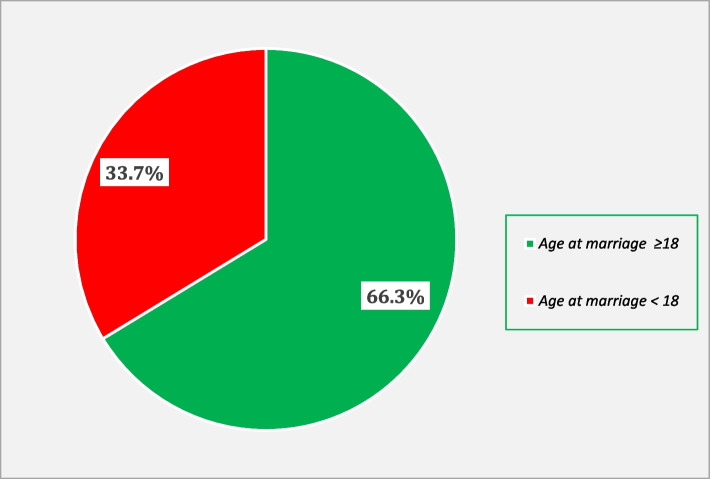
Introduction: Child marriage is a union before the age of 18 and a violation of human right. Around 21% of young women in the world married before reaching the age of 18. Every year, 10 million girls under the age of 18 are married. Child marriage causes lifetime suffering, and its abolition was one component of the Sustainable Development Goal to achieve gender equality and empower women and girls. However; abolition of child marriage by 2030 will not happen because its prevalence in the community has remained stable. Objective: To assess the prevalence of child marriage and its associated factors among reproductive-age women from March 7 to April 5, 2022 in Harari Regional State, eastern Ethiopia. Methods: Community-based cross-sectional study was conducted from March 7 to April 5, 2022 among the reproductive age group in the Harari Region state, Eastern Ethiopia. A systematic random sampling technique was used to find study participants. Data were obtained by face-to-face interview using a pre-tested structured questionnaire, input into EpiData version 3.1 and analyzed using Stata version 16. The proportion with 95% confidence interval (CI) and the summery measure were used to report the prevalence. A multivariable logistic regression analysis model was used to examine associated factors, and the results were provided as an adjusted odds ratio (AOR) with a 95% confidence interval. Result: In this study 986 were responded to the interview, making response rate of 99.6%. The median age of study participants was 22 years. The prevalence of child marriage was 33.7% [95% CI: 30.8–36.7] in this study. Being a Muslim (AOR = 2.30, 95% CI = 1.26, 4.19), diploma or higher level of education (AOR = 0.26, 95%CI = .10, 0.70), rural residence (AOR = 5.39, 95% CI = 3.71, 7.82), a marriage arranged by others (AOR = 2.68, 95% CI = 1.49, 4.82) and not knowing legal age of marriage (AOR = 4.49, 95% CI = 2.57, 7.85) were significantly associated with child marriage. Conclusion: According to this report, nearly one out of every three women engages in child marriage. The practice was more common among those with lower educational attainment, those who lived in rural areas, people who were unaware of the legal age of marriage, and those whose engagement was decided by others. Focusing on strategies that allow for intervention in these factors is beneficial in ending child marriage, which has a direct and indirect impact on women's health and educational achievement.
Overview
The claims and statistics of this paper haven’t been checked yet.
Run the check — free, no account needed. It reads the open-access text and checks the sources it cites.
Integrity signals
Registry
Cites
Statistics
Figures
Verification
Claims the paper makes
The claims and statistics of this paper haven’t been checked yet.
Run the check — free, no account needed. It reads the open-access text and checks the sources it cites.
Claims other papers make about this one
Each is checked against this paper’s own text: does it say what the citing paper says it does?
The source backs part of the claim, not all of it — or backs it for a different population, condition or comparison.
In the citing paper
“A multistage sampling procedure was used to select 711 participants.”
From Predictors of age at first marriage among rural women in the West Guji Zone, Southern Ethiopia, 2024: a community-based cross-sectional study (2025) · cites this paper as [18]
Experimental — accuracy not yet measuredThe source backs part of the claim, not all of it — or backs it for a different population, condition or comparison.
In the citing paper
“Risk factors contributing to early marriage include women's education, employment opportunities, family wealth, family size, religion, rural residence, marriage decisions, media exposure, social norms, fear of pregnancy, awareness of the legal marriage age, family conflict, and virginityassociated stigma 9,11-21 .”
From Predictors of age at first marriage among rural women in the West Guji Zone, Southern Ethiopia, 2024: a community-based cross-sectional study (2025) · cites this paper as [18]
Experimental — accuracy not yet measuredThe cited source says what the claim attributes to it.
In the citing paper
“Furthermore, research has shown that rural women are more likely to marry early than their urban counterparts 18,24 .”
From Predictors of age at first marriage among rural women in the West Guji Zone, Southern Ethiopia, 2024: a community-based cross-sectional study (2025) · cites this paper as [18]
Self-check
Percentages, sums and reported differences re-computed from the paper’s own numbers.
The self-check needs the paper’s full text.
Citations
Cites
Alem, A. Z., Yeshaw, Y., Kebede, S. A., Liyew, A. M., Tesema, G. A., Agegnehu, C. D., & Teshale, A. B. (2020) · BMC Women's Health · doi:10.1186/s12905-020-01070-x · Cited by 39 · cited 1×
“Early marriage is commonly reported in Tigray, Amhara, and Afar regions [15].”
Background
Research works printed but not linked: 26
- Erulkar A. Early marriage, marital relations and intimate partner violence in Ethiopia. Int Perspect Sex Reprod Health. 2013;39(1):6-13. · DOI
- Yaya S, Odusina EK, Bishwajit G. Prevalence of child marriage and its impact on fertility outcomes in 34 sub-Saharan African countries. BMC Int Health Hum Rights. 2019;19(1):33. · DOI
- Efevbera Y, et al. Girl child marriage, socioeconomic status, and undernutrition: evidence from 35 countries in Sub-Saharan Africa. BMC medicine. 2019;17(1):1–12. · DOI
- Koski A, et al. Has child marriage declined in sub-Saharan Africa? An analysis of trends in 31 countries. Popul Dev Rev. 2017:7-29. · DOI
- Liang M, et al. New estimations of child marriage: Evidence from 98 low- and middle-income countries. PLoS ONE. 2021;16(10): e0258378. · DOI
- Hotchkiss DR, et al. Risk factors associated with the practice of child marriage among Roma girls in Serbia. BMC Int Health Hum Rights. 2016;16(1):1–10. · DOI
- Montazeri S, et al. Determinants of early marriage from married girls’ perspectives in Iranian setting: a qualitative study. J Environ Public Health. 2016;2016. · DOI
- Mengistu MM. Early marriage in Ethiopia: so little done but so much to do. Bus Manag. 2017;9(3):1.
- Bezie M, Addisu D. Determinants of early marriage among married women in Injibara town, north West Ethiopia: community-based cross-sectional study. BMC Womens Health. 2019;19(1):134. · DOI · Paper page
- Tekile AK, Woya AA, Basha GW. Determinants of early marriage among female children in Amhara Region. Ethiopia Afr Health Sci. 2020;20(3):1190–5. · DOI · Paper page
- Marshall EP, et al. Child marriage in Ethiopia. London: Overseas Development Institute (ODI); 2016.
- Scott S, et al. Early marriage and early childbearing in South Asia: trends, inequalities, and drivers from 2005 to 2018. Ann N Y Acad Sci. 2021;1491(1):60. · DOI
- Workineh S, Kibretb GD, Degu G. Determinants of early marriage among female children in Sinan district, Northwest Ethiopia. Health Sci J. 2015;9(6):1.
- Aychiluhm, et al. Early Marriage and Its Determinants among Married Reproductive Age Group Women in Amhara Regional State, Ethiopia: A Multilevel Analysis. BioMed Res Int. 2021;2021:1969721. · DOI · Paper page
- Bezie M, Addisu D. Determinants of early marriage among married women in Injibara town, north West Ethiopia: community-based cross-sectional study. BMC Womens Health. 2019;19(1):1–6. · DOI · Paper page
- Hamed A, Yousef F. Prevalence, health and social hazards, and attitude toward early marriage in ever-married women, Sohag, Upper Egypt. J Egypt Public Health Assoc. 2017;92(4):228–34. · DOI
- Tekile AK, Woya AA, Basha GW. Determinants of early marriage among female children in Amhara Region. Ethiopia African Health Sciences. 2020;20(3):1190–5. · DOI · Paper page
- Efevbera Y, et al. Child marriage and underweight in sub-Saharan Africa: a 35 country cross-national study. J Adolesc Health. 2018;62(2):S25–6. · DOI
- Liang M, et al. New estimations of child marriage: Evidence from 98 low-and middle-income countries. PLoS ONE. 2021;16(10):e0258378. · DOI
- Emirie G, Jones N, Kebede M. ‘The School Was Closed, So When They Brought Me A Husband I Couldn’t Say No’: Exploring the Gendered Experiences of Child Marriage Amongst Adolescent Girls and Boys in Ethiopia. Eur J Dev Res. 2021;33(5):1252–73. · DOI
- Kamal SM, et al. Child marriage in Bangladesh: trends and determinants. J Biosoc Sci. 2015;47(1):120–39. · DOI
- Hossain MG, Mahumud RA, Saw A. Prevalence of child marriage among Bangladeshi women and trend of change over time. J Biosoc Sci. 2016;48(4):530–8. · DOI
- Segal-Engelchin D, Huss E, Massry N. The experience of early marriage: Perspectives of engaged and married Muslim women in Israel. J Adolesc Res. 2016;31(6):725–49. · DOI
- Ali A. Socio-demographic factors affecting child marriage in Sudan. J Women’s Health Care. 2014;3(163):2167-0420.1000163.
- Paul P. Effects of education and poverty on the prevalence of girl child marriage in India: A district–level analysis. Child Youth Serv Rev. 2019;100:16–21. · DOI
- Tollman SM, et al. What are the effects of the fifth revision of the Declaration of Helsinki? Fair partnerships support ethical researchGains and losses for rights of consumer and research participantsResearch will be impededSome clauses will hinder development of new drugs and vaccines. BMJ. 2001;323(7326):1417–23. · DOI
Cited by
Sorted by citations
Gelchu, S., & Wirtu, D. (2025) · Ethiopian Journal of Reproductive Health · doi:10.69614/ejrh.v17i01.846
“The data collection instrument was adapted from relevant literature12,18,30.”
Metadata
- Authors
- Lami, M., Negash, A., Eyeberu, A., Birhanu, A., Debella, A., Getachew, T., Berhanu, B., Balis, B., Bete, T., Abdeta, T., Nigussie, S., Bogale, K., Bekele Dechasa, D., Sertsu, A., Gemechu, K., Wodaje, D., Nigussie, K., Alemu, A., Kibret, H., Bayu, K., Meseret, F., Abinew, Y., Wondimneh, F., Dirirsa, G., Gobena, A., Husen, J., Alemu, A., & Dessie, Y.
- Affiliations
- Haramaya University (ET)
- Corresponding author
- Negash, Abraham
- ORCID
- Venue
- BMC Women's Health
- Published
- 2023-05-16
- Volume
- 23
- Issue
- 1
- Pages
- 267-267
- ISSN
- 1472-6874 (ISSN-L)
- PMC
- PMC10186769
- OpenAlex
- W4376871524
- Cited by
- 15
- References
- 1
- Citations by year
- 2026: 6 · 2025: 7 · 2024: 1 · 2023: 1
- FWCI
- 6.45
- Type
- journal article
- Language
- en
- Open access
- gold
- doi.org
- Locations
- BMC Women s Health (publishedVersion, cc-by)
- PubMed Central (publishedVersion, cc-by)
- PubMed (publishedVersion)
- DOAJ (DOAJ: Directory of Open Access Journals) (submittedVersion, cc-by-sa)
- Funders
- Haramaya University
- Topics
- Social Sciences › Sociology and Political Science › Marriage and Family Dynamics
- Health Sciences › Medicine › Public Health, Environmental and Occupational Health › Adolescent Sexual and Reproductive Health
- Health Sciences › Medicine › Pediatrics, Perinatology and Child Health › Global Maternal and Child Health
- Keywords
- early marriage, prevalence, women of reproductive age, Harari region, arranged marriage, minimum marriage age, religious affiliation, maternal education, rural residence, associated factors, gender equality, women's empowerment, human rights violations, Sustainable Development Goal 5, Ethiopia, East Africa, gender-based violence, domestic violence, intimate partner violence, sexual violence, child sexual abuse, child labor, child marriage prevention
- MeSH terms
- Adult, Child, Cross-Sectional Studies, Ethiopia, Female, Humans, Marriage, Prevalence, Women's Health, Young Adult
About these checks
Registry, retraction, Cites and statistics results are computed, not judged, with one exception: a printed reference that no index lists is read once by a model before it counts as a citation error. Claims are extracted by a model and kept only when their quote appears verbatim in the text; each cited source is then checked, with a model’s help, for whether it says what the claim relies on. Those verdicts can be wrong — read the claim’s quote and the cited source before relying on one.
Statistics and arithmetic are recomputed, not judged.
Confidence bands are shown only for fields calibrated on our annotated test set. None is calibrated yet, so no band is shown.
What counts as a claim ›How we measure confidence ›How we check this ›
Are you an author, or do you see a problem with this page? Request a review
How to cite
Cite CoChat for the checks on this page, and the paper for its own findings.
- This page
- CoChat. (2026). Citation check: Prevalence of child marriage and associated factors among reproductive age women in Harari regional state, eastern Ethiopia, 2022: a community-based study. https://app.cochat.ai/papers/10.1186/s12905-023-02409-w
- The paper
- Lami, M., Negash, A., Eyeberu, A., Birhanu, A., Debella, A., Getachew, T., Berhanu, B., Balis, B., Bete, T., Abdeta, T., Nigussie, S., Bogale, K., Bekele Dechasa, D., Sertsu, A., Gemechu, K., Wodaje, D., Nigussie, K., Alemu, A., Kibret, H., . . . Dessie, Y. (2023). Prevalence of child marriage and associated factors among reproductive age women in Harari regional state, eastern Ethiopia, 2022: a community-based study. BMC Women's Health. https://doi.org/10.1186/s12905-023-02409-w
