

The DOI matches its Crossref record; 28 of the 30 references it cites were found in a registry or an index.
Comparison of the efficacy of aroma-acupressure and aromatherapy for the treatment of dementia-associated agitation
Open accessAbstract
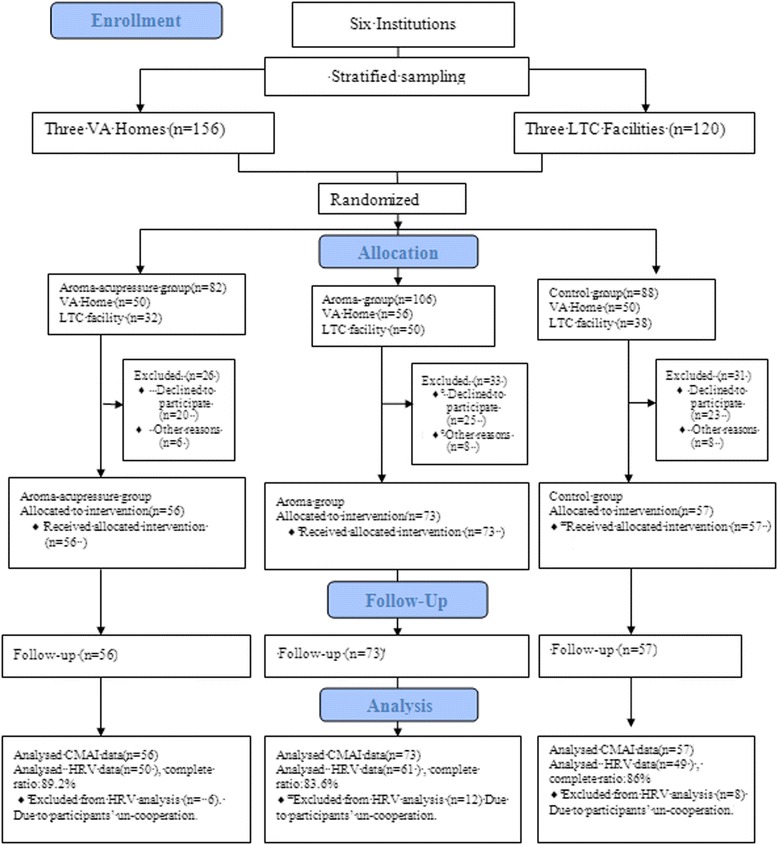
BACKGROUND: One of the most common symptoms observed in patients with dementia is agitation, and several non-pharmacological treatments have been used to control this symptom. However, because of limitations in research design, the benefit of non-pharmacological treatments has only been demonstrated in certain cases. The purpose of this study was to compare aroma-acupressure and aromatherapy with respect to their effects on agitation in patients with dementia. METHODS: In this experimental study, the participants were randomly assigned to three groups: 56 patients were included in the aroma-acupressure group, 73 patients in the aromatherapy group, and 57 patients in the control group who received daily routine as usual without intervention. The Cohen-Mansfield Agitation Inventory (CMAI) scale and the heart rate variability (HRV) index were used to assess differences in agitation. The CMAI was used in the pre-test, post-test and post-three-week test, and the HRV was used in the pre-test, the post-test and the post-three-week test as well as every week during the four-week interventions. RESULTS: The CMAI scores were significantly lower in the aroma-acupressure and aromatherapy groups compared with the control group in the post-test and post-three-week assessments. Sympathetic nervous activity was significantly lower in the fourth week in the aroma-acupressure group and in the second week in the aromatherapy group, whereas parasympathetic nervous activity increased from the second week to the fourth week in the aroma-acupressure group and in the fourth week in the aromatherapy group. CONCLUSIONS: Aroma-acupressure had a greater effect than aromatherapy on agitation in patients with dementia. However, agitation was improved in both of the groups, which allowed the patients with dementia to become more relaxed. Future studies should continue to assess the benefits of aroma-acupressure and aromatherapy for the treatment of agitation in dementia patients. TRIAL REGISTRATION: ChiCTR-TRC-14004810; Date of registration: 2014/6/12.
Overview
The claims and statistics of this paper haven’t been checked yet.
Run the check — free, no account needed. It reads the open-access text and checks the sources it cites.
Integrity signals
Registry
Cites
Statistics
Figures
Verification
Claims the paper makes
The claims and statistics of this paper haven’t been checked yet.
Run the check — free, no account needed. It reads the open-access text and checks the sources it cites.
Claims other papers make about this one
Each is checked against this paper’s own text: does it say what the citing paper says it does?
The source backs part of the claim, not all of it — or backs it for a different population, condition or comparison.
In the citing paper
“Nonpharmacological alternatives, including music therapy, aromatherapy, art therapy, behavioral therapy, reality orientation, tailored activities, and physical exercises, have shown promising results for the management of BPSD [21–23].”
From Nonpharmacological Interventions to Reduce Behavioral and Psychological Symptoms of Dementia: A Systematic Review (2015) · cites this paper as [21]
Experimental — accuracy not yet measuredThe cited source says what the claim attributes to it.
In the citing paper
“Aromatherapy may be beneficial to agitated patients with dementia [21, 27, 31].”
From Nonpharmacological Interventions to Reduce Behavioral and Psychological Symptoms of Dementia: A Systematic Review (2015) · cites this paper as [21]
The cited source says what the claim attributes to it.
In the citing paper
“Results showed that aroma-acupressure and aromatherapy had significant effect in reducing agitation (p < 0.01 and p = 0.01, resp.) when compared to the control group.”
From Nonpharmacological Interventions to Reduce Behavioral and Psychological Symptoms of Dementia: A Systematic Review (2015) · cites this paper as [21]
In the citing paper
“Indeed, aromatherapy has been used to address BPSD (181–186) and sleep disturbances (187–189) and to stimulate motivational behavior (190).”
From The Multidisciplinary Approach to Alzheimer’s Disease and Dementia. A Narrative Review of Non-Pharmacological Treatment (2018) · cites this paper as [185]
Self-check
Percentages, sums and reported differences re-computed from the paper’s own numbers.
The self-check needs the paper’s full text.
Citations
Cites
Agitated Behaviors in the Elderly: I. A Conceptual Review
Cohen‐Mansfield, J., & Billig, N. (1986) · Journal of the American Geriatrics Society · doi:10.1111/j.1532-5415.1986.tb04302.x · Cited by 717
Antipsychotic Drug Use and Mortality in Older Adults with Dementia
Gill, S. S., Bronskill, S. E., Normand, S.-L. T., Anderson, G. M., Sykora, K., Lam, K., Bell, C. M., Lee, P. E., Fischer, H. D., Herrmann, N., et al. (2007) · Annals of Internal Medicine · doi:10.7326/0003-4819-146-11-200706050-00006 · Cited by 624
Ballard, C. G., O'Brien, J. T., Reichelt, K., & Perry, E. K. (2002) · The Journal of Clinical Psychiatry · doi:10.4088/jcp.v63n0703 · Cited by 396
Olfactory Impairment in Presymptomatic Alzheimer's Disease
Wilson, R. S., Arnold, S. E., Schneider, J. A., Boyle, P. A., Buchman, A. S., & Bennett, D. A. (2009) · Annals of the New York Academy of Sciences · doi:10.1111/j.1749-6632.2009.04013.x · Cited by 237
Lavender oil as a treatment for agitated behaviour in severe dementia: a placebo controlled study
Holmes, C., Hopkins, V., Hensford, C., MacLaughlin, V., Wilkinson, D., & Rosenvinge, H. (2002) · International Journal of Geriatric Psychiatry · doi:10.1002/gps.593 · Cited by 202
Imaging biological structures with fluorescence photoactivation localization microscopy
Gould, T. J., Verkhusha, V. V., & Hess, S. T. (2009) · Nature Protocols · doi:10.1038/nprot.2008.246 · Cited by 195
Relaxing Effect of Rose Oil on Humans
Hongratanaworakit, T. (2009) · Natural Product Communications · doi:10.1177/1934578x0900400226 · Cited by 124
A Controlled Trial of Aromatherapy for Agitation in Nursing Home Patients with Dementia
Snow, L. A., Hovanec, L., & Brandt, J. (2004) · The Journal of Alternative and Complementary Medicine · doi:10.1089/1075553041323696 · Cited by 117
Yip, Y. B., & Tse, S. H. M. (2004) · Complementary Therapies in Medicine · doi:10.1016/j.ctim.2003.12.003 · Cited by 91
Lin, L., Yang, M., Kao, C., Wu, S., Tang, S., & Lin, J. (2009) · Journal of the American Geriatrics Society · doi:10.1111/j.1532-5415.2009.02271.x · Cited by 84
Self-citation
Cited by
Sorted by citations
Zucchella, C., Sinforiani, E., Tamburin, S., Federico, A., Mantovani, E., Bernini, S., Casale, R., & Bartolo, M. (2018) · Frontiers in Neurology · doi:10.3389/fneur.2018.01058 · Cited by 297
Oliveira, A. M. D., Radanovic, M., Mello, P. C. H. D., Buchain, P. C., Vizzotto, A. D. B., Celestino, D. L., Stella, F., Piersol, C. V., & Forlenza, O. V. (2015) · BioMed Research International · doi:10.1155/2015/218980 · Cited by 247
Packheiser, J., Hartmann, H., Fredriksen, K., Gazzola, V., Keysers, C., & Michon, F. (2024) · Nature Human Behaviour · doi:10.1038/s41562-024-01841-8 · Cited by 166
Ijaopo, E. O. (2017) · Translational Psychiatry · doi:10.1038/tp.2017.199 · Cited by 114
Liu, K. Y., Elliott, T., Knowles, M., & Howard, R. (2022) · Ageing Research Reviews · doi:10.1016/j.arr.2021.101539 · Cited by 84
Metadata
- Authors
- Yang, M.-H., Lin, L.-C., Wu, S.-C., Chiu, J.-H., Wang, P.-N., & Lin, J.-G.
- Affiliations
- National Yang Ming University (TW)
- China Medical University (TW)
- Corresponding author
- Lin, Li-Chan
- Venue
- BMC Complementary and Alternative Medicine
- Published
- 2015-03-29
- Volume
- 15
- Issue
- 1
- Pages
- 93-93
- ISSN
- 1472-6882 (ISSN-L)
- PMC
- PMC4381454
- OpenAlex
- W1973219304
- Cited by
- 123
- References
- 30
- Citations by year
- 2026: 6 · 2025: 9 · 2024: 7 · 2023: 9 · 2022: 8 · 2021: 10 · 2020: 35 · 2019: 12 · 2018: 11 · 2017: 12 · 2016: 2 · 2015: 2
- FWCI
- 7.30
- Type
- journal article
- Language
- en
- Open access
- gold
- doi.org
- Locations
- BMC Complementary and Alternative Medicine (publishedVersion, cc-by)
- Europe PMC (PubMed Central) (publishedVersion, cc-by)
- PubMed Central (publishedVersion, cc-by)
- PubMed (publishedVersion)
- Topics
- Health Sciences › Medicine › Psychiatry and Mental health › Dementia and Cognitive Impairment Research
- Health Sciences › Medicine › Complementary and alternative medicine › Acupuncture Treatment Research Studies
- Health Sciences › Medicine › Complementary and alternative medicine › Medicinal Plant Extracts Effects
- Keywords
- dementia, agitation, aromatherapy, non-pharmacological treatment, heart rate variability, sympathetic activity, parasympathetic activity, Cohen-Mansfield Agitation Inventory
- MeSH terms
- Aged, Aged, 80 and over, Dementia, Female, Heart Rate, Humans, Male, Psychomotor Agitation, Treatment Outcome, Acupressure, Aromatherapy
About these checks
Registry, retraction, Cites and statistics results are computed, not judged, with one exception: a printed reference that no index lists is read once by a model before it counts as a citation error. Claims are extracted by a model and kept only when their quote appears verbatim in the text; each cited source is then checked, with a model’s help, for whether it says what the claim relies on. Those verdicts can be wrong — read the claim’s quote and the cited source before relying on one.
Statistics and arithmetic are recomputed, not judged.
Confidence bands are shown only for fields calibrated on our annotated test set. None is calibrated yet, so no band is shown.
What counts as a claim ›How we measure confidence ›How we check this ›
Are you an author, or do you see a problem with this page? Request a review
