

Mindfulness, perceived stress, and subjective well-being: a correlational study in primary care health professionals
Open accessThe DOI matches its Crossref record; 31 of the 31 references it cites were found in a registry or an index; 3 of the 26 sources its claims cite were checked for support.
Abstract
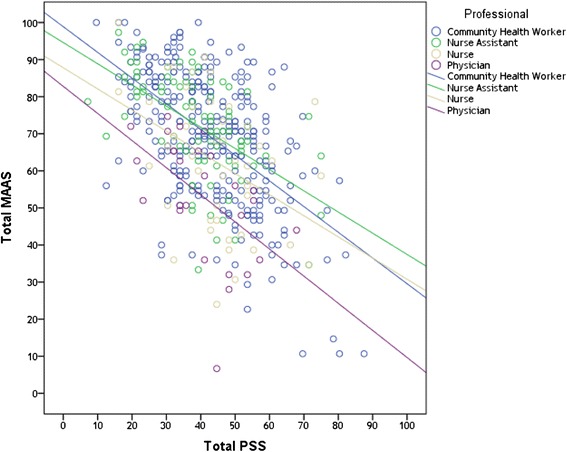
BACKGROUND: Primary health care professionals (PHPs) usually report high levels of distress and burnout symptoms related to job strain. Mindfulness, defined as non-judgmental-present-moment awareness, seems to be a moderator in the causal association between life stressors and well-being. This study aimed to verify correlations among self-reported mindfulness, perceived stress (PS), and subjective well-being (SW) in Brazilian PHPs. METHODS: We performed a correlational cross-sectional study in a purposive sample of Brazilian PHPs (physicians, nurses, nursing assistants, and community health workers), working in community-oriented primary care programs (known locally as "Family Health Programs"). We used validated self-reporting instruments: the Mindful Attention Awareness Scale (MAAS), the Perceived Stress Scale (PSS), and the Subjective Well-being Scale (SWS). We performed a multivariate analysis of variance (MANOVA), through regression coefficients (beta) in relation to the professional category (nursing assistant), in addition to the length of time in the same job (under than 6 months) that had indicated the lowest level of PS. RESULTS: Participants (n=450) comprised community health workers (65.8%), nursing assistants (18%), registered nurses (10.0%), and doctors (family physicians) (6.0%); 94% were female and 83.1% had worked in the same position for more than one year. MANOVA regression analysis showed differences across professional categories and length of time in the same job position in relation to mindfulness, PS, and SW. Nurses demonstrated lower levels of mindfulness, higher PS, and SW negative affect, as well as lower SW positive affect. Being at work for 1 year or longer showed a clear association with higher PS and lower SW positive affect, and no significance with mindfulness levels. Pearson's coefficient values indicated strong negative correlations between mindfulness and PS, and medium correlations between mindfulness and SW. CONCLUSION: In this study, there were clear correlations between mindfulness, PS, and SW across different primary care professional categories and time in the same job position, suggesting specific vulnerabilities that should be addressed through the development of staff awareness, stress prevention, and well-being interventions.
Overview
CoChat Summary
## TL;DR
This cross-sectional correlational study in 450 Brazilian primary care health professionals found that higher mindfulness was strongly associated with lower perceived stress and better subjective well-being. Differences also appeared by professional category and time in job, with nurses and longer-tenured staff generally showing worse stress/well-being profiles.
## Key findings
- The analyzed sample was n = 450: 65.8% community health workers, 18% nursing assistants, 10.0% registered nurses, and 6.0% family physicians; 94% were female and 83.1% had been in the same position for more than one year.
- Internal consistency for the scales was reported as good, with all Cronbach’s alphas ≥ 0.85 in this sample.
- Mindfulness and perceived stress were strongly negatively correlated: r = −0.541, p < 0.001. Mindfulness was positively correlated with subjective well-being positive affect (r = 0.451, p < 0.001) and satisfaction with life (r = 0.380, p < 0.001), and negatively correlated with negative affect (r = −0.468, p < 0.001).
- Professional differences were observed: family physicians had the lowest mindfulness scores (β = −20.1, p < 0.001), while registered nurses showed higher perceived stress (β = 5.5, p = 0.032), lower positive affect (β = −6.5, p = 0.039), and higher negative affect (β = 10.9, p = 0.002). Being in the job for 1 year or longer was associated with lower positive affect (β = −9.0, p < 0.001), higher negative affect (β = 5.3, p = 0.020), and lower satisfaction with life (β = −5.0, p = 0.023).
## Methods
- Design: Cross-sectional correlational study of Brazilian primary health care professionals working in community-oriented primary care facilities in Sapopemba, São Paulo, with data collected from October 2011 to February 2012.
- Sample/data: Total eligible population was N = 570; 450 agreed to participate. Included family physicians, registered nurses, nursing assistants, and community health workers on permanent contracts, not on leave, and volunteering.
- Analysis: Descriptive statistics; internal consistency for MAAS using Cronbach’s alpha and item-rest statistics; MANOVA with regression coefficients by professional category (nursing assistant as reference) and time in job (under 6 months as reference); Pearson correlations between MAAS, PSS, and SWS, controlling for professional category and job tenure.
## Limitations
- The paper states several limitations: the cross-sectional design does not establish causal direction; the sample had unequal category sizes (especially many CHWs and few FPs); the study relied on self-report questionnaires; and data were collected in only one region of São Paulo.
- The paper also notes that answering instruments in the workplace may have introduced social desirability bias.
- Evident from the text: the exclusion of professionals on leave or absent due to health problems may have omitted workers with more severe stress-related issues.
Model-written summary. Check it against the paper before relying on it.
Integrity signals
Registry
Cites
Statistics
Figures
Verification
Claims the paper makes
3 Valid · 0 Not valid · 16 Not checked · 38 Own results and interpretations
Every source the paper cites for this claim was checked and supports it.
In the paper
“The Brazilian MAAS [16] showed adequate internal consistency (α = 0.83).”
§ Mindfulness, perceived stress, and subjective well-being: a correlational study in primary care health professionals > Methods > Measures We used instruments validated for the Brazilian Portuguese language and population; all described below:I.General socio-demographic questionnaire for sample characterization was applied to determine sex; age; professional category; type of employment/type of contract; educational level; training for FHS job; time working in the job; family income; relationship status.II.The Mindful Attention Awareness Scale (MAAS) [6] is a unidimensional, 15-item instrument, rated on a 6-point Likert scale (almost always to almost never). Higher scores indicate increased mindfulness, related to the level of awareness and attention to present events. An example item is, “I find myself preoccupied with the future or the past”. The Brazilian MAAS [16] showed adequate internal consistency (α = 0.83).III.Perceived Stress Scale (PSS) [17] is a 14-item instrument rated on a 4-point Likert scale (almost never to always), which evaluates the perception of stressful events. An example item is, “In the last month, how often have you felt nervous and stressed?” We added the scores of all questions to calculate total scores, inversely calculating Items with positive connotation against the stress (0 = 4, 1 = 3, 2 = 2, 3 = 1, 4 = 0). The PSS showed adequate internal consistency (α = 0.82).IV.Subjective Well-being Scale (SWS) is a 62-item instrument (developed in Brazil) divided into 3 subscales, all showing good internal consistency (α): positive affect (SWS_PA) (α = 0.95), negative affect (SWS_NA) (α = 0.95), and satisfaction with life (SWS_SL) (α = 0.90) [18]. The affects subscales are a 5-point Likert-type scale (not at all to extremely), consisting of 22 items of positive affect (e.g., “happy”) and 26 items of negative affect (e.g., “sad”). The third subscale is a 5-point Likert-type scale (I totally disagree to I totally agree), consisting of 14 items of satisfaction with life (e.g., “I am unsatisfied with my life”). Total scores are calculated by the sum of all items and reversed items were recoded (1 = 5, 2 = 4, 3 = 3, 4 = 2, 5 = 1). To simplify comparability between the instruments, we transformed all scores into a one-hundred-point scale (0–100 points, with 100 meaning the highest level of mindfulness, PSS, and SWS).
What the sources say
- Supportedcites [16] Barros VV, Kozasa EH, Souza ICW, Ronzani TM. Evidence of Validity of the Brazilian Version of the Mindful Attention Awareness Scale (MAAS). Psicologia Reflexão e Crítica 2014, In press. source
The Reliability-MAAS section reports Cronbach’s alpha of .83 for the Brazilian MAAS’s 15-item total scale. The Discussion describes this reliability as high, supporting the characterization of its internal consistency as adequate. (LLM, conf=0.95)
plain- Asserted: passes — The authors put it forward as true.
- Checkable: passes — It can be checked against evidence.
- Load-bearing: unclear — It is unclear whether the paper’s conclusions depend on it.
- Based: passes — The paper gives a reason why it holds.
- Supported
The sources with a verdict support this claim; the rest weren’t checked yet, have no full text we could read, or their verdicts aren’t rated yet.
In the paper
“We used instruments validated for the Brazilian Portuguese language and population; all described below:”
§ Mindfulness, perceived stress, and subjective well-being: a correlational study in primary care health professionals > Methods > Measures We used instruments validated for the Brazilian Portuguese language and population; all described below:I.General socio-demographic questionnaire for sample characterization was applied to determine sex; age; professional category; type of employment/type of contract; educational level; training for FHS job; time working in the job; family income; relationship status.II.The Mindful Attention Awareness Scale (MAAS) [6] is a unidimensional, 15-item instrument, rated on a 6-point Likert scale (almost always to almost never). Higher scores indicate increased mindfulness, related to the level of awareness and attention to present events. An example item is, “I find myself preoccupied with the future or the past”. The Brazilian MAAS [16] showed adequate internal consistency (α = 0.83).III.Perceived Stress Scale (PSS) [17] is a 14-item instrument rated on a 4-point Likert scale (almost never to always), which evaluates the perception of stressful events. An example item is, “In the last month, how often have you felt nervous and stressed?” We added the scores of all questions to calculate total scores, inversely calculating Items with positive connotation against the stress (0 = 4, 1 = 3, 2 = 2, 3 = 1, 4 = 0). The PSS showed adequate internal consistency (α = 0.82).IV.Subjective Well-being Scale (SWS) is a 62-item instrument (developed in Brazil) divided into 3 subscales, all showing good internal consistency (α): positive affect (SWS_PA) (α = 0.95), negative affect (SWS_NA) (α = 0.95), and satisfaction with life (SWS_SL) (α = 0.90) [18]. The affects subscales are a 5-point Likert-type scale (not at all to extremely), consisting of 22 items of positive affect (e.g., “happy”) and 26 items of negative affect (e.g., “sad”). The third subscale is a 5-point Likert-type scale (I totally disagree to I totally agree), consisting of 14 items of satisfaction with life (e.g., “I am unsatisfied with my life”). Total scores are calculated by the sum of all items and reversed items were recoded (1 = 5, 2 = 4, 3 = 3, 4 = 2, 5 = 1). To simplify comparability between the instruments, we transformed all scores into a one-hundred-point scale (0–100 points, with 100 meaning the highest level of mindfulness, PSS, and SWS).
What the sources say
- Supportedcites [16] Barros VV, Kozasa EH, Souza ICW, Ronzani TM. Evidence of Validity of the Brazilian Version of the Mindful Attention Awareness Scale (MAAS). Psicologia Reflexão e Crítica 2014, In press. source
The cited work IS the Brazilian Portuguese validation of the instrument: the Abstract states the objective was 'to translate, adapt and present evidences of validity of the MAAS for the Brazilian reality' among a general-community, meditator, college-student and tobacco-smoker population; the Procedures describe translation and cultural adaptation per Beaton et al. (2002) and Soares (2011); the Results give the final version in Portuguese; and the Discussion reports 'the MAAS showed satisfactory levels of validity and reliability'. The paper also documents Brazilian validation of the other instruments it used (SWBS via Albuquerque & Tróccoli, 2004; Fagerström via Carmo & Pueyo, 2002), consistent with the citing sentence's plural framing, though the source's own caution that confirmatory factor analysis is still needed is not carried into the claim. (LLM, conf=0.86)
- Not checked yetcites [17] Luft CDB Sanches SO Mazo GZ Andrade AA Brazilian version of the Perceived Stress Scale: translation and validation for the elderly Rev Saude Publica 2007 41 4 606 15 10.1590/S0034-89102007000400015 17589759 source
- Not checked yetcites [18] Albuquerque AS Tróccoli BT Development of a subjective wellbeing scale Psic: Teor e Pesq 2004 20 2 153 164
plain- Asserted: passes — The authors put it forward as true.
- Checkable: passes — It can be checked against evidence.
- Load-bearing: unclear — It is unclear whether the paper’s conclusions depend on it.
- Based: passes — The paper gives a reason why it holds.
- Supported
The cited sources support only part of this claim — read each source’s verdict below.
In the paper
“the literature on CHWs demonstrates this type of professional to be the most vulnerable to burnout due to the propensity of becoming enmeshed with the suffering showed by service users [9, 19]”
§ Mindfulness, perceived stress, and subjective well-being: a correlational study in primary care health professionals > Discussion This study looked at the relationship of perceived stress, subjective well-being, and mindfulness across different PHP categories. The professional category distribution and socio-demographic features of participants were expected in PHP services in Brazil [11]. When focusing on the levels of perceived stress and subjective well-being, our results showed higher levels of stress predominantly in RNs and CHWs. This is congruent to previous research showing that in the FHS, these categories are at most risk of developing burnout [10]. Both RNs and CHWs also displayed low levels of subjective well-being, and showed the lowest levels of positive affect and significant negative affect, which reinforces evidence showing that both categories are under strain. RNs play a significant role in the FHS health model, with high levels of responsibility and workload: planning, managing, and coordinating services, as well as holding supervisory roles and delivering further training for CHWs and NAs. Furthermore, during data collection we noticed that many community-oriented primary care units had an absence of FPs, increasing the workload under the responsibility of RNs. On the other hand, the CHW’s role includes living and working directly within the community (normally associated with complex needs, violence, poverty, infectious disease). In addition, the literature on CHWs demonstrates this type of professional to be the most vulnerable to burnout due to the propensity of becoming enmeshed with the suffering showed by service users [9, 19]; which may explains our results of CHWs displaying significantly low SW_ satisfaction with life. Broadening our discussion of well-being and stress on PHPs, the UK National Health Services recognized the need for service managers to focus on staff well-being, through the implementation of interventions aiming at a good relationship with the team, good management, and organizational structure [20]. Similarly, the literature on PHP teams working in the FHS in Brazil, reports power struggles, conflicts of opinion, and lack of service organization as risk factors contributing to high levels of stress [11, 21]. As such, our results show that compared to being in the job for under 6 months, being in the job for over one year meant higher PS and negative affect, as well as lower positive affect and satisfaction with life. An interesting line of research could be how these feelings of discomfort might evolve into the different burnout types over time, as a potential curvilinear relationship between time in job and burnout is expected [22]. With regard to the Brazilian version of MAAS on this population, the scale had good correlations with relational constructs, which is consistent with previous research [16]. The internal consistency of the scale was within the average range (0.80 to 0.90), proposed by the author of the original MAAS [6]. As expected, MAAS mindfulness was positively correlated to SW_Satisfaction with life and SW_Positive Affect, and was negatively correlated to PS and SW_Negative affect. The construct of MAAS mindfulness relates to the ability of one performing with present moment attention and awareness [6]. Our findings that RNs and FPs show the lowest levels of mindfulness are congruent with previous research linking levels of stress to poor attention performance, deficient communication, work disorganization, and lack of productivity in PHPs working in the FHS [10]. Mindfulness also refers to openness to experience, and mindfulness-based programs have been demonstrated to increase the clarity of values and ability to withstand exposure [23], to one’s capacity to sustain openness to unpleasant/pleasant dynamics, without becoming cut off from awareness of the present moment. This, in theory, leads to a more real and healthier experience, based on acceptance of reality rather than its suppression [24]. The concept of acceptance involving mindfulness, as a prerequisite to the relationship between health professionals and patients is emphasized by Schmidt [24], linking acceptance to empathy in his statement: “accepting, warm-hearted relationship with self is primary to any healing intention” ([24]; p. S7), as the capacity of one connecting with one’s own suffering, to then connecting with the suffering of others. Empathy was found to be a mediator between mindfulness and PS, showing dispositional mindfulness to have an indirect effect on PS mediated through the regulation of emotion and the ability of critical care personnel to use emotions (e.g., empathy) [25]. This could explain the high mean values of MAAS mindfulness in CHWs working for the Brazilian health service. This category, although not classified as working with critical care, is considered to be working under the highest levels of stress as a result of “being part of” and “direct work with” a vulnerable community. And empathy is evident through statements reported from qualitative research studying this population: “I keep looking at that big queue of patients and I keep thinking - What if it was me there…” ([26]; p.1309). However, taking into consideration the challenges of providing service and the poor working conditions reported by research on PHPs working in the FHS, it was striking that mean values of SW_Positive Affect and SW_ Satisfaction with Life, exceeded mean values of Perceived Stress and SW _Negative Affect.
What the sources say
- Partly supportedcites [9] Camelo SHH Angerami ELS Symptoms of stress in workers from five family health centres Rev Lat Am Enfermagem 2004 12 1 14 21 10.1590/S0104-11692004000100003 15122400 sourceExperimental — accuracy not yet measured
The discussion (page not specified in our copy) says community health workers were more vulnerable than other team members to symptoms of stress because of their close involvement with the community, particularly if they lacked adequate preparation. It also describes contact with users’ suffering and the emotional bonds that can develop. The study measured stress symptoms, not burnout, and does not establish that community health workers are the most vulnerable to burnout generally. (LLM, conf=0.87)
- Not checked yetcites [19] Camelo SHH Galon T Marziale MHP Work-related illness and health management strategies among community health workers Rev Enferm UERJ 2012 20 1 661 7
boostedstates a cause- Asserted: passes — The authors put it forward as true.
- Checkable: passes — It can be checked against evidence.
- Load-bearing: unclear — It is unclear whether the paper’s conclusions depend on it.
- Based: passes — The paper gives a reason why it holds.
- Rests on an assumption not shown here.
- Partly supported
A result the paper reports from its own data — it cites no other source for it, so there is none to check. The quote shows it is in the paper.
In the paper
“No significant difference was found between GPs and NAs (β = −1.5, p = 0.705).”
§ Mindfulness, perceived stress, and subjective well-being: a correlational study in primary care health professionals > Results > Professional categories and length of service
plain- Asserted: passes — The authors put it forward as true.
- Checkable: passes — It can be checked against evidence.
- Load-bearing: unclear — It is unclear whether the paper’s conclusions depend on it.
- Based: passes — The paper gives a reason why it holds.
A result the paper reports from its own data — it cites no other source for it, so there is none to check. The quote shows it is in the paper.
In the paper
“CHWs showed the lowest satisfaction with life (β = −7.9, p < 0.001)”
§ Mindfulness, perceived stress, and subjective well-being: a correlational study in primary care health professionals > Results > Professional categories and length of service
plainstates an association- Asserted: passes — The authors put it forward as true.
- Checkable: passes — It can be checked against evidence.
- Load-bearing: unclear — It is unclear whether the paper’s conclusions depend on it.
- Based: passes — The paper gives a reason why it holds.
17 more claims
Create a free account to see all 57 claims and to verify the 23 references still open.
- The quote only partly states this claim. 13
- It may state two separate claims as one. 12
- Probably not a substantial claim. 13
Citations
Cites
The benefits of being present: Mindfulness and its role in psychological well-being
Brown, K. W., & Ryan, R. M. (2003) · Journal of Personality and Social Psychology · doi:10.1037/0022-3514.84.4.822 · Cited by 13,448 · cited 6×
“The Mindful Attention Awareness Scale (MAAS) [6] is a unidimensional, 15-item instrument, rated on a 6-point Likert scale (almost always to almost never).”
BackgroundMethodInfluentialMindfulness-based interventions in context: Past, present, and future
Kabat-Zinn, J. (2003) · Clinical Psychology: Science and Practice · doi:10.1093/clipsy.bpg016 · Cited by 8,615
Mindfulness-based interventions in context: Past, present, and future.
Kabat-Zinn, J. (2003) · Clinical Psychology: Science and Practice · doi:10.1093/clipsy/bpg016 · Cited by 8,612
Mindfulness training as a clinical intervention: a conceptual and empirical review
Baer, R. A. (2003) · Clinical Psychology: Science and Practice · doi:10.1093/clipsy.bpg015 · Cited by 4,577 · cited 1×
“Mindfulness has its roots in Buddhist philosophy, but its current construct goes beyond religious concepts [4] and can be improved by attention training and meditation [4, 5].”
BackgroundMindfulness training as a clinical intervention: A conceptual and empirical review.
Baer, R. A. (2003) · Clinical Psychology: Science and Practice · doi:10.1093/clipsy/bpg015 · Cited by 4,576
Kabat-Zinn, J. (1982) · General Hospital Psychiatry · doi:10.1016/0163-8343(82)90026-3 · Cited by 4,255
Shapiro, S. L., Carlson, L. E., Astin, J. A., & Freedman, B. (2006) · Journal of Clinical Psychology · doi:10.1002/jclp.20237 · Cited by 4,002 · cited 1×
“Mindfulness also refers to openness to experience, and mindfulness-based programs have been demonstrated to increase the clarity of values and ability to withstand exposure [23], to one’s capacity to sustain openness to unpleasant/pleasant dynamics, without becoming cut off from awareness of the present moment.”
BackgroundMindfulness-based stress reduction for health care professionals: results from a randomized trial
Shapiro, S. L., Astin, J. A., Bishop, S. R., & Cordova, M. (2005) · International Journal of Stress Management · doi:10.1037/1072-5245.12.2.164 · Cited by 1,323 · cited 1×
“Evidence taken from samples of PHPs worldwide has shown, however, that an 8-week Mindfulness-Based Stress Reduction (MBSR) [3] intervention, based on exercises of meditation, attention control to experience without elaboration, affective attitude of openness, and other coping strategies, decreased PS, distress, and bu…”
BackgroundIrving, J. A., Dobkin, P. L., & Park, J. (2009) · Complementary Therapies in Clinical Practice · doi:10.1016/j.ctcp.2009.01.002 · Cited by 531 · cited 2×
“Irving, Dobkin and Park’s review on MBSR and health professionals also showed significant evidence of better physical and mental health after completion of MBSR programs [2].”
BackgroundVersão brasileira da Escala de Estresse Percebido: tradução e validação para idosos
Luft, C. D. B., Sanches, S. D. O., Mazo, G. Z., & Andrade, A. (2007) · Revista de Saúde Pública · doi:10.1590/s0034-89102007000400015 · Cited by 449
Desenvolvimento de uma escala de bem-estar subjetivo
Albuquerque, A. S., & Tróccoli, B. T. (2004) · Psicologia: Teoria e Pesquisa · doi:10.1590/s0102-37722004000200008 · Cited by 394
Richards, K. C., Campenni, C. E., & Muse-Burke, J. L. (2010) · Journal of Mental Health Counseling · doi:10.17744/mehc.32.3.0n31v88304423806 · Cited by 320 · cited 1×
“sionals [1], as a result of positive research evidence on mindfulness in this population [2].”
BackgroundDispositional mindfulness and the attenuation of neural responses to emotional stimuli
Brown, K. W., Goodman, R. J., & Inzlicht, M. (2013) · Social Cognitive and Affective Neuroscience · doi:10.1093/scan/nss004 · Cited by 267 · cited 1×
“For instance, cortisol in saliva for the investigation into mindfulness and stress [6, 28], and event-related brain potential (ERP) markers as measures for mindfulness [29] and subjective well-being [30].”
BackgroundCortisol as a marker for improvement in mindfulness-based stress reduction
Matousek, R. H., Dobkin, P. L., & Pruessner, J. (2010) · Complementary Therapies in Clinical Practice · doi:10.1016/j.ctcp.2009.06.004 · Cited by 233 · cited 1×
“For instance, cortisol in saliva for the investigation into mindfulness and stress [6, 28], and event-related brain potential (ERP) markers as measures for mindfulness [29] and subjective well-being [30].”
BackgroundDispositional mindfulness and perceived stress: The role of emotional intelligence
Bao, X., Xue, S., & Kong, F. (2015) · Personality and Individual Differences · doi:10.1016/j.paid.2015.01.007 · Cited by 171 · cited 1×
“, empathy) [25].”
Validity evidence of the brazilian version of the Mindful Attention Awareness Scale (MAAS)
Barros, V. V. D., Kozasa, E. H., Souza, I. C. W. D., & Ronzani, T. M. (2015) · Psicologia: Reflexão e Crítica · doi:10.1590/1678-7153.201528110 · Cited by 109
Self-citationBardeen, J. R., Fergus, T. A., & Orcutt, H. K. (2013) · Behavior Therapy · doi:10.1016/j.beth.2013.04.001 · Cited by 106 · cited 1×
“One possibility may relate to experiential avoidance, which is a psychological process in which individuals block situations and stimuli for self-protection from exposure to high levels of stress [27].”
BackgroundEsgotamento entre profissionais da Atenção Primária à Saúde
Martins, L. F., Laport, T. J., Menezes, V. D. P., Medeiros, P. B., & Ronzani, T. M. (2014) · Ciência & Saúde Coletiva · doi:10.1590/1413-812320141912.03202013 · Cited by 105
Self-citationSintomas de estresse nos trabalhadores atuantes em cinco núcleos de saúde da família
Camelo, S. H. H., & Angerami, E. L. S. (2004) · Revista Latino-Americana de Enfermagem · doi:10.1590/s0104-11692004000100003 · Cited by 93
Síndrome de Burnout entre os trabalhadores da Estratégia de Saúde da Família
Trindade, L. D. L., & Lautert, L. (2010) · Revista da Escola de Enfermagem da USP · doi:10.1590/s0080-62342010000200005 · Cited by 79 · cited 3×
“Age was also another factor [8], specifically in PHPs aged 29 years or less [12].”
BackgroundPrograma Saúde da Família: a experiência de equipe multiprofissional
de Oliveira, É. M., & Spiri, W. C. (2006) · Revista de Saúde Pública · doi:10.1590/s0034-89102006000500025 · Cited by 73
Mindfulness and Healing Intention: Concepts, Practice, and Research Evaluation
Schmidt, S. (2004) · The Journal of Alternative and Complementary Medicine · doi:10.1089/1075553042245917 · Cited by 70
Montero-Marín, J., García-Campayo, J., Fajó-Pascual, M., Carrasco, J. M., Gascón, S., Gili, M., & Mayoral-Cleries, F. (2011) · BMC Psychiatry · doi:10.1186/1471-244x-11-49 · Cited by 69 · cited 1×
“An interesting line of research could be how these feelings of discomfort might evolve into the different burnout types over time, as a potential curvilinear relationship between time in job and burnout is expected [22].”
BackgroundTomasi, E., Facchini, L. A., Piccini, R. X., Thumé, E., Silveira, D. S. D., Siqueira, F. V., Rodrigues, M. A., Paniz, V. V., & Teixeira, V. A. (2008) · Cadernos de Saúde Pública · doi:10.1590/s0102-311x2008001300023 · Cited by 67
O agente comunitário de saúde: formação, inserção e práticas
Nascimento, E. P. L., & Corrêa, C. R. S. (2008) · Cadernos de Saúde Pública · doi:10.1590/s0102-311x2008000600011 · Cited by 67
Yuan, J., Zhang, J., Zhou, X., Yang, J., Meng, X., Zhang, Q., & Li, H. (2011) · Cognitive Affective & Behavioral Neuroscience · doi:10.3758/s13415-011-0064-8 · Cited by 61
Kanno, N. D. P., Bellodi, P. L., & Tess, B. H. (2012) · Saúde e Sociedade · doi:10.1590/s0104-12902012000400008 · Cited by 41
Caracterização das equipes da Saúde da Família e de seu processo de trabalho
de Marqui, A. B. T., Jahn, A. D. C., Resta, D. G., Colomé, I. C. D. S., da Rosa, N., & Zanon, T. (2010) · Revista da Escola de Enfermagem da USP · doi:10.1590/s0080-62342010000400014 · Cited by 34
Caracterização das equipes da Saúde da Família e de seu processo de trabalho
de Marqui, A. B. T., Jahn, A. D. C., Resta, D. G., et al. (2010) · LA Referencia (Red Federada de Repositorios Institucionales de Publicaciones Científicas) · Cited by 30
Formas de adoecimento pelo trabalho dos agentes comunitários de saúde e estratégias de gerenciamento
Camelo, S. H. H., Galon, T., & Marziale, M. H. P. (2012) · LA Referencia (Red Federada de Repositorios Institucionales de Publicaciones Científicas) · Cited by 8
[Working with families within the Family Health Program: nurse's practice in Maringá - Paraná].
Oliveira, R. G., & Marcon, S. S. (2007) · PubMed · doi:10.1590/s0080-62342007000100009 · Cited by 4 · cited 1×
“Age was also another factor [8], specifically in PHPs aged 29 years or less [12].”
Background
Research works printed but not linked: 4
- Leonelli LB Evaluation of stress levels and quality of life in primary health professionals 2013 Brazil Preventive Medicine Department, Federal University of Sao Paulo
- Albuquerque AS Tróccoli BT Development of a subjective wellbeing scale Psic: Teor e Pesq 2004 20 2 153 164
- Camelo SHH Galon T Marziale MHP Work-related illness and health management strategies among community health workers Rev Enferm UERJ 2012 20 1 661 7
- The Health and Wellbeing Review team Final report 2009 Leeds UK Department of Health
Cited by
Síndrome de burnout em profissionais da saúde: revisão integrativa
Jarruche, L. T., & Mucci, S. (2021) · Revista Bioética · doi:10.1590/1983-80422021291456 · Cited by 139
Being Creative Makes You Happier: The Positive Effect of Creativity on Subjective Well-Being
Tan, C. Y., Chuah, C.-Q., Lee, S.-T., & Tan, C. (2021) · International Journal of Environmental Research and Public Health · doi:10.3390/ijerph18147244 · Cited by 145
“As studies on different populations have consistently found that stress is negatively associated with happiness [68,69] and subjective well-being [63,64] stress was included as a covariate variable in the present study to exclude its confounding effect on the relationship between creativity and subjective well-being.”
BackgroundBurnout in Pediatric Residents: Three Years of National Survey Data
Kemper, K. J., Schwartz, A., Wilson, P. M., Mahan, J. D., Schubert, C. J., Staples, B. B., McClafferty, H. H., Serwint, J. R., & Batra, M. (2020) · PEDIATRICS · doi:10.1542/peds.2019-1030 · Cited by 126
“Yes 335 (45) 380 (41) 407 (41) 432 (37) 425 (41) 454 (38) No 404 (55) 545 (59) 582 (59) 732 (63) 611 (59) 751 (62) Errors or death, n (%) Major error in past 3 mo ,.”
Montero-Marin, J., Zubiaga, F., Cereceda, M., Piva Demarzo, M. M., Trenc, P., & Garcia-Campayo, J. (2016) · PLOS ONE · doi:10.1371/journal.pone.0157499 · Cited by 110
“In general, primary care personnel usually report high levels of distress related to job strain [39], which is an occupational hazard for healthcare providers, and has been related to poorer quality of care, worse patient safety and outcomes, low health status, greater intention to leave the practice, and high levels…”
BackgroundSelf-citationRamirez-Baena, L., Ortega-Campos, E., Gomez-Urquiza, J. L., Cañadas-De la Fuente, G. R., De la Fuente-Solana, E. I., & Cañadas-De la Fuente, G. A. (2019) · Journal of Clinical Medicine · doi:10.3390/jcm8010092 · Cited by 94
Metadata
- Authors
- Atanes, A. C. M., Andreoni, S., Hirayama, M. S., Montero-Marin, J., Barros, V. V., Ronzani, T. M., Kozasa, E. H., Soler, J., Cebolla, A., Garcia-Campayo, J., & Demarzo, M. M. P.
- Affiliations
- Universidade Federal de São Paulo (BR)
- Universidade Federal de Juiz de Fora (BR)
- Universitat Autònoma de Barcelona (ES)
- Universitat Jaume I (ES)
- Corresponding author
- Demarzo, Marcelo M. P.
- ORCID
- Venue
- BMC Complementary and Alternative Medicine
- Published
- 2015-09-02
- Volume
- 15
- Issue
- 1
- Pages
- 303-303
- ISSN
- 1472-6882 (ISSN-L)
- PMC
- PMC4557919
- OpenAlex
- W1868379823
- Cited by
- 133
- References
- 31
- Citations by year
- 2026: 3 · 2025: 10 · 2024: 11 · 2023: 8 · 2022: 18 · 2021: 23 · 2020: 16 · 2019: 16 · 2018: 14 · 2017: 7 · 2016: 6 · 2015: 1
- FWCI
- 11.57
- Type
- journal article
- Language
- en
- Open access
- gold
- doi.org
- Licence
- Locations
- BMC Complementary and Alternative Medicine (publishedVersion, cc-by)
- Europe PMC (PubMed Central) (publishedVersion, cc-by)
- PubMed Central (publishedVersion, cc-by)
- PubMed (publishedVersion)
- Repositori UJI (Universitat Jaume I) (publishedVersion, cc-by-sa)
- Dipòsit Digital de Documents de la UAB (Universitat Autònoma de Barcelona) (submittedVersion, cc-by-nc)
- LA Referencia (Red Federada de Repositorios Institucionales de Publicaciones Científicas) (submittedVersion, cc-by-sa)
- LA Referencia (Red Federada de Repositorios Institucionales de Publicaciones Científicas) (submittedVersion, cc-by-nc)
- Repository of Digital Objects for Teaching Research and Culture (University of Valencia) (submittedVersion, other-oa)
- Zaguan (Universidad de Zaragoza) (submittedVersion, cc-by)
- Funders
- Coordenação de Aperfeiçoamento de Pessoal de Nível Superior
- Universidade de São Paulo
- Topics
- Social Sciences › Psychology › Clinical Psychology › Mindfulness and Compassion Interventions
- Health Sciences › Health Professions › General Health Professions › Healthcare professionals’ stress and burnout
- Social Sciences › Psychology › Social Psychology › Stress and Burnout Research
- Keywords
- mindfulness, perceived stress, subjective well-being, primary care providers, nurses, community health workers, job strain, burnout, job tenure, positive and negative affect, Family Health Strategy, occupational stress
- MeSH terms
- Brazil, Burnout, Professional, Cross-Sectional Studies, Female, Health Personnel, Humans, Male, Primary Health Care, Stress, Psychological, Mindfulness
About these checks
Registry, retraction, Cites and statistics results are computed, not judged, with one exception: a printed reference that no index lists is read once by a model before it counts as a citation error. Claims are extracted by a model and kept only when their quote appears verbatim in the text; each cited source is then checked, with a model’s help, for whether it says what the claim relies on. Those verdicts can be wrong — read the claim’s quote and the cited source before relying on one.
The claim verdicts this report counts are experimental: their accuracy is not yet measured.
A language model drew the claims from the paper on 2026-10-11, under version 3 of the claim definition (model deepseek-v4.1-flash, prompt extract-v3).
A second model labelled each claim on 2026-10-11 (model jev-1.13-20260917, definition revision gold-guideline-v0.2).
Cited sources are checked with a language model’s help (gpt-6-sol and qwen3.8-omni-flash).
Statistics and arithmetic are recomputed, not judged.
Confidence bands are shown only for fields calibrated on our annotated test set. None is calibrated yet, so no band is shown.
What counts as a claim ›How we measure confidence ›How we check this ›
Are you an author, or do you see a problem with this page? Request a review
Data sources
Bibliographic data: Semantic Scholar, OpenAlex, Crossref.
Contains information from the Semantic Scholar Academic Graph Datasets, made available under the ODC Attribution License (ODC-BY 1.0).
Semantic Scholar’s data is described in: Kinney, R., et al. (2023). The Semantic Scholar Open Data Platform. arXiv:2301.10140.
