

The DOI matches its Crossref record; 18 of the 18 references it cites were found in a registry or an index.
Chemical composition and some biological activities of the essential oils from basil Ocimum different cultivars
Open accessAbstract
BACKGROUND: The plants belonging to the Ocimum genus of the Lamiaceae family are considered to be a rich source of essential oils which have expressed biological activity and use in different area of human activity. There is a great variety of chemotypes within the same basil species. Essential oils from three different cultivars of basil, O. basilicum var. purpureum, O. basilicum var. thyrsiflora, and O. citriodorum Vis. were the subjects of our investigations. METHODS: The oils were obtained by steam distillation in a Clevenger-type apparatus. The gas chromatography mass selective analysis was used to determine their chemical composition. The antioxidant activities of these essential oils were measured using 1,1-diphenyl-2-picrylhydrazyl assays; the tyrosinase inhibition abilities of the given group of oils were also assessed spectophotometrically, and the antimicrobial activity of the essential oils was determined by the agar diffusion method, minimal inhibitory concentrations were expressed. RESULTS: According to the results, the qualitative and quantitative composition of essential oils was quite different: O. basilicum var. purpureum essential oil contained 57.3% methyl-chavicol (estragol); O. basilicum var. thyrsiflora oil had 68.0% linalool. The main constituents of O. citriodorum oil were nerol (23.0%) and citral (20.7%). The highest antioxidant activity was demonstrated by O. basilicum var. thyrsiflora essential oil. This oil has also exhibited the highest tyrosinase inhibition level, whereas the oil from O. citriodorum cultivar demonstrated the highest antimicrobial activity. CONCLUSIONS: The results obtained indicate that these essential oils have antioxidant, antibacterial and antifungal activity and can be used as natural antioxidant and antimicrobial agents in medicine, food industry and cosmetics.
Overview
The claims and statistics of this paper haven’t been checked yet.
Run the check — free, no account needed. It reads the open-access text and checks the sources it cites.
Integrity signals
Registry
Cites
Statistics
Figures
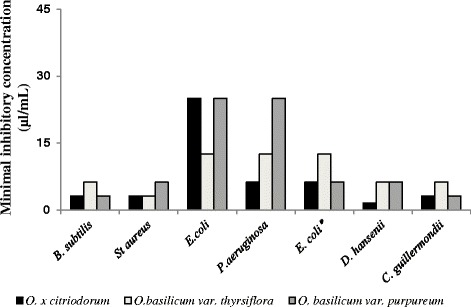
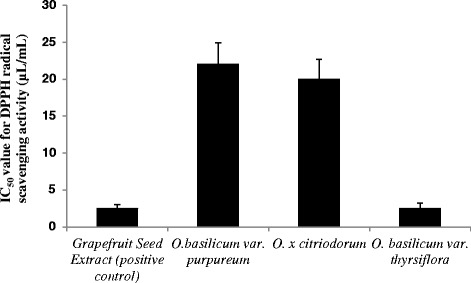
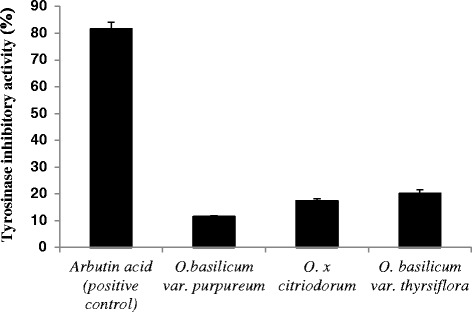
Verification
Claims the paper makes
The claims and statistics of this paper haven’t been checked yet.
Run the check — free, no account needed. It reads the open-access text and checks the sources it cites.
Claims other papers make about this one
Each is checked against this paper’s own text: does it say what the citing paper says it does?
The source backs part of the claim, not all of it — or backs it for a different population, condition or comparison.
In the citing paper
“Furthermore, classification based on volatile oil composition requires the distillation and fractionation of oils, and the chemotype classification based on only one major volatile oil is erroneous as one plant may contain two or more chemical compounds in nearly equal amounts [15,20,21].”
From Comprehensive Metabolomic Fingerprinting Combined with Chemometrics Identifies Species- and Variety-Specific Variation of Medicinal Herbs: An Ocimum Study (2023) · cites this paper as [20]
Experimental — accuracy not yet measured
Self-check
Percentages, sums and reported differences re-computed from the paper’s own numbers.
The self-check needs the paper’s full text.
Citations
Cites
Kong, H. H., Oh, J., Deming, C., Conlan, S., Grice, E. A., Beatson, M. A., Nomicos, E., Polley, E. C., Komarow, H. D., Program, N. C. S., et al. (2012) · Genome Research · doi:10.1101/gr.131029.111 · Cited by 1,808
Apak, R., Gorinstein, S., Böhm, V., Schaich, K. M., Özyürek, M., & Güçlü, K. (2013) · Pure and Applied Chemistry · doi:10.1351/pac-rep-12-07-15 · Cited by 589
Koeduka, T., Fridman, E., Gang, D. R., Vassão, D. G., Jackson, B. L., Kish, C. M., Orlova, I., Spassova, S. M., Lewis, N., Noel, J. P., et al. (2006) · Proceedings of the National Academy of Sciences · doi:10.1073/pnas.0603732103 · Cited by 418
Flavors and fragrances: A world perspective
Ames, J. (1989) · Food Chemistry · doi:10.1016/0308-8146(89)90017-4 · Cited by 382
Marotti, M., Piccaglia, R., & Giovanelli, E. (1996) · Journal of Agricultural and Food Chemistry · doi:10.1021/jf9601067 · Cited by 297
Composition and antibacterial activities of essential oils of seven Ocimum taxa
Carović‐Stanko, K., Orlić, S., Politeo, O., Strikić, F., Kolak, I., Miloš, M., & Šatović, Z. (2009) · Food Chemistry · doi:10.1016/j.foodchem.2009.06.010 · Cited by 255
Klimánková, E., Holadová, K., Hajšlová, J., Čajka, T., Poustka, J., & Koudela, M. (2007) · Food Chemistry · doi:10.1016/j.foodchem.2007.07.062 · Cited by 189
Liu, K., Chen, Q., Liu, Y., Zhou, X., & Wang, X. (2012) · Journal of Food Science · doi:10.1111/j.1750-3841.2012.02924.x · Cited by 168
Joshi, R. K. (2014) · Ancient Science of Life · doi:10.4103/0257-7941.144618 · Cited by 153
Sokovi, M., Marin, P. D., Brki, D., & Griensven, L. J. L. D. V. (2007) · Cited by 89
Research works printed but not linked: 3
- Patel JB, Cockerill FR, Alder J, Bradford PA, Eliopoulos GM, Hardy DJ, Hindler JA, Jenkins SG, Lewis JS, Miller LA, Powell M, Swenson JM, Traczewski MM, Turnidge JD, Weinstein MP, Zimmer BL. Performance Standards for Antimicrobial Susceptibility Testing; Twenty-Fourth Informational Supplement. CLSI document M100-S24. Wayne, PA: Clinical and Laboratory Standards Institute; 2014.
- Sishu R, Tadesse S, Bucar F, Asres K. Composition and the antioxidant activity of the essential oils of Ocimum basilicum var. thyrsiflorum and Ocimum americanum. Int J Essent Oil Ther. 2010;4:64–8.
- Baron S. Medical Microbiology. 4th edition, Chapter 6, University of Texas, 1996.
Cited by
Sorted by citations
Essential Oils of Lamiaceae Family Plants as Antifungals
Karpiński, T. M. M. (2020) · Biomolecules · doi:10.3390/biom10010103 · Cited by 224
Composition and Potential Health Benefits of Pomegranate: A Review
Vučić, V., Grabež, M., Trchоunian, A., & Arsić, A. (2019) · Current Pharmaceutical Design · doi:10.2174/1381612825666190708183941 · Cited by 207
Moghrovyan, A., Sahakyan, N. Z., Babayan, A. M., Chichoyan, N., Petrosyan, M. T., & Trchоunian, A. (2019) · Current Pharmaceutical Design · doi:10.2174/1381612825666190702095612 · Cited by 111
Self-citationSkrypnik, L. N., Novikova, A., & Tokupova, E. (2019) · Plants · doi:10.3390/plants8110458 · Cited by 93
da Silva, W. M. F., Kringel, D. H., de Souza, E. J. D., Zavareze, E. D. R., & Dias, Á. R. G. (2021) · Food and Bioprocess Technology · doi:10.1007/s11947-021-02690-3 · Cited by 95
Metadata
- Authors
- Avetisyan, A., Markosian, A., Petrosyan, M., Sahakyan, N., Babayan, A., Aloyan, S., & Trchounian, A.
- Affiliations
- Yerevan State University (AM)
- Venue
- BMC Complementary and Alternative Medicine
- Published
- 2017-01-19
- Volume
- 17
- Issue
- 1
- Pages
- 60-60
- ISSN
- 1472-6882 (ISSN-L)
- PMC
- PMC5248495
- OpenAlex
- W2573674331
- Cited by
- 186
- References
- 18
- Citations by year
- 2026: 18 · 2025: 13 · 2024: 15 · 2023: 36 · 2022: 25 · 2021: 32 · 2020: 17 · 2019: 15 · 2018: 13 · 2017: 2
- FWCI
- 14.47
- Type
- journal article
- Language
- en
- Open access
- gold
- doi.org
- Licence
- cc-by
- Locations
- BMC Complementary and Alternative Medicine (publishedVersion, cc-by)
- Europe PMC (PubMed Central) (publishedVersion, cc-by)
- PubMed Central (publishedVersion, cc-by)
- PubMed (publishedVersion)
- Funders
- State Committee of Science (Basic support)
- Topics
- Life Sciences › Agricultural and Biological Sciences › Food Science › Essential Oils and Antimicrobial Activity
- Life Sciences › Agricultural and Biological Sciences › Plant Science › Insect Pest Control Strategies
- Health Sciences › Medicine › Complementary and alternative medicine › Phytochemicals and Medicinal Plants
- Keywords
- basil essential oil, chemotypes, estragole, linalool, nerol, citral, antioxidant activity, tyrosinase inhibition, antimicrobial activity, antifungal activity, natural antioxidants, natural antimicrobials
- MeSH terms
- Anti-Infective Agents, Colorimetry, Oils, Volatile, Plant Oils, Species Specificity, Monophenol Monooxygenase, Free Radical Scavengers, Ocimum
About these checks
Registry, retraction, Cites and statistics results are computed, not judged, with one exception: a printed reference that no index lists is read once by a model before it counts as a citation error. Claims are extracted by a model and kept only when their quote appears verbatim in the text; each cited source is then checked, with a model’s help, for whether it says what the claim relies on. Those verdicts can be wrong — read the claim’s quote and the cited source before relying on one.
Statistics and arithmetic are recomputed, not judged.
Confidence bands are shown only for fields calibrated on our annotated test set. None is calibrated yet, so no band is shown.
What counts as a claim ›How we measure confidence ›How we check this ›
Are you an author, or do you see a problem with this page? Request a review
