

How do medical students engaging in elective courses on acupuncture and homeopathy differ from unselected students? A survey
Open accessThe DOI matches its Crossref record; 26 of the 27 references it cites were found in a registry or an index.
Abstract
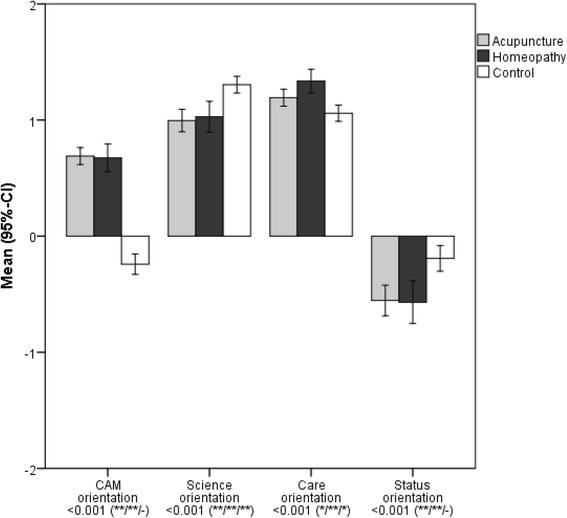
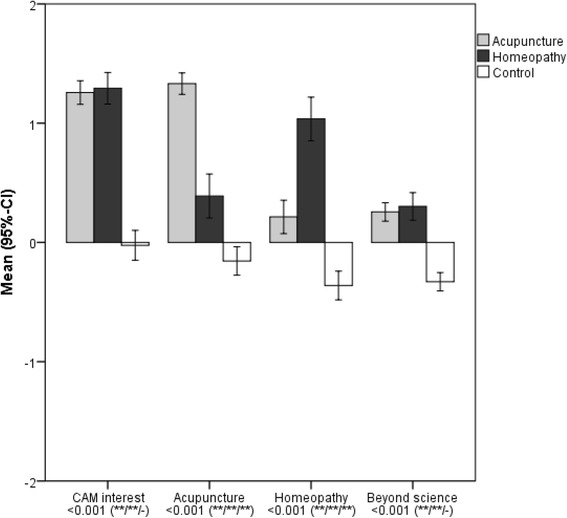
BACKGROUND: We aimed to investigate whether students at German medical schools participating in elective courses on acupuncture and homeopathy differ from an unselected group of students regarding attitudes and personality traits. METHODS: Elective courses on acupuncture and homeopathy in the academic half-year 2013/14 all over Germany were identified and participants invited to fill in a questionnaire including nineteen questions on attitudes towards Complementary and Alternative Medicine (CAM), orientation towards science, care and status orientation, and a short validated instrument (Big-Five-Inventory-10) to measure personality traits (extraversion, neuroticism, openness, conscientiousness, and agreeableness). Participants of a mandatory family medicine course at one university served as unselected control group. RESULTS: Two hundred twenty and 113 students from elective courses on acupuncture and homeopathy, respectively, and 315 control students participated (response rate 93%). Students participating in elective courses had much more positive attitudes towards CAM, somewhat lower science and status orientation, and somewhat higher care orientation than control group students (all p-values for three-group comparisons < 0.001). There were no differences between the three groups regarding personality traits with the exception of lower values for agreeableness in controls (p = 0.009). CONCLUSIONS: The findings of this study show that attitudes of students participating in elective courses on acupuncture or homeopathy at German medical schools differ to a considerable degree from the attitudes of unselected students.
Overview
The claims and statistics of this paper haven’t been checked yet.
Free: it reads the open-access text and checks the first 5 claims that cite a source we can check. Create a free account to check every claim.
Integrity signals
Registry
Cites
Statistics
Figures
Verification
Claims the paper makes
The claims and statistics of this paper haven’t been checked yet.
Free: it reads the open-access text and checks the first 5 claims that cite a source we can check. Create a free account to check every claim.
Claims other papers make about this one
Each is checked against this paper’s own text: does it say what the citing paper says it does?
The check wasn’t confident either way, so it gives no verdict — never disputed.
In the citing paper
“Jocham et al. (56) documented that approximately one in five medical students reported personal use of homeopathic products, with a higher prevalence among female students, a finding consistent with the sex difference observed in the present sample (females 23.10% vs. males 16.92%).”
From Health misinformation, digital health literacy, and attitudes toward science among university students: an exploratory cross-sectional survey (2026) · cites this paper as [56]
Experimental — accuracy not yet measured
Self-check
Percentages, sums and reported differences re-computed from the paper’s own numbers.
The self-check needs the paper’s full text.
Citations
Cites
Rammstedt, B., & John, O. P. (2007) · Journal of Research in Personality · doi:10.1016/j.jrp.2006.02.001 · Cited by 4,244
Acupuncture for Chronic Pain: Individual Patient Data Meta-analysis
Vickers, A. J., Cronin, A. M., Maschino, A. C., Lewith, G., MacPherson, H., Foster, N. E., Sherman, K. J., Witt, C. M., Linde, K., & Acupuncture Trialists' Collaboration, F. T. (2012) · Archives of Internal Medicine · doi:10.1001/archinternmed.2012.3654 · Cited by 985
Self-citationNahin, R. L., Barnes, P. M., Stussman, B. J., & Bloom, B. E. (2009) · PubMed · Cited by 673
A Review of the Incorporation of Complementary and Alternative Medicine by Mainstream Physicians
Astin, J. A., Marie, A., Pelletier, K. R., Hansen, E., & Haskell, W. L. (1998) · Archives of Internal Medicine · doi:10.1001/archinte.158.21.2303 · Cited by 460 · cited 1×
“Yet, the use of CAM therapies is not only widespread in the general population in many industrialized countries [3, 4] but also considerable among physicians, particularly those working in primary care [5, 6].”
A Systematic Literature Review of Complementary and Alternative Medicine Prevalence in EU
Eardley, S., Bishop, F. L., Prescott, P., Cardini, F., Brinkhaus, B., Santos-Rey, K., Vas, J., von Ammon, K., Hegyi, G., Dragan, S., et al. (2012) · Complementary Medicine Research · doi:10.1159/000342708 · Cited by 253 · cited 1×
“Yet, the use of CAM therapies is not only widespread in the general population in many industrialized countries [3, 4] but also considerable among physicians, particularly those working in primary care [5, 6].”
Mathie, R. T., Lloyd, S. M., Legg, L. A., Clausen, J., Moss, S., Davidson, J. R., & Ford, I. (2014) · Systematic Reviews · doi:10.1186/2046-4053-3-142 · Cited by 227 · cited 1×
“[11] to proving that homeopathy does not work [12].”
Agledahl, K. M., Gulbrandsen, P., Førde, R., & Wifstad, Å. (2011) · Journal of Medical Ethics · doi:10.1136/jme.2010.041988 · Cited by 140 · cited 1×
“Understanding how a CAM therapy in a specific situation might better address the subjective needs of patients [29] can help to understand fundamental limitations of how modern medical practice approaches the patient [30].”
Medical Students' Attitudes About Complementary and Alternative Medicine
Furnham, A., & McGill, C. (2003) · The Journal of Alternative and Complementary Medicine · doi:10.1089/10755530360623392 · Cited by 116 · cited 1×
“[13, 14]), but we are not aware of any studies comparing characteristics and views of students actually engaging in elective courses on such therapies to those of “average” students.”
Placebo interventions, placebo effects and clinical practice
Linde, K., Fässler, M., & Meissner, K. (2011) · Philosophical Transactions of the Royal Society B: Biological Sciences · doi:10.1098/rstb.2010.0383 · Cited by 98 · cited 1×
“They also make understandable that although placebo effects are seen as positive in clinical practice when they are associated with active treatments, placebo interventions or interventions without “specific” effects pose major ethical and professional problems [27, 28].”
Self-citationMedical Student Attitudes toward Complementary, Alternative and Integrative Medicine
Abbott, R. B., Hui, K.-K. P., Hays, R. D., Mandel, J., Goldstein, M., Winegarden, B., Glaser, D. N., & Brunton, L. L. (2011) · Evidence-based Complementary and Alternative Medicine · doi:10.1093/ecam/nep195 · Cited by 92 · cited 1×
“[13, 14]), but we are not aware of any studies comparing characteristics and views of students actually engaging in elective courses on such therapies to those of “average” students.”
Trick or treatment: the undeniable facts about alternative medicine
(2009) · Choice Reviews Online · doi:10.5860/choice.46-3292 · Cited by 87
Alternative Medicine: A “Mirror Image” for Scientific Reasoning in Conventional Medicine
Vandenbroucke, J. P., & de Craen, A. J. M. (2001) · Annals of Internal Medicine · doi:10.7326/0003-4819-135-7-200110020-00010 · Cited by 78 · cited 1×
“For example, it has been argued that CAM can serve as a “mirror image” helping to understand scientific reasoning [24].”
What Should Students Learn about Complementary and Alternative Medicine?
Gaster, B., Unterborn, J. N., Scott, R. B., & Schneeweiss, R. (2007) · Academic Medicine · doi:10.1097/acm.0b013e318149eb56 · Cited by 70 · cited 1×
“Given the wide use of CAM it makes sense that medical students learn about the basic principles, risks and state of the evidence on the most important therapies in order to be able to give competent advice to their patients [7].”
Pruskil, S., Burgwinkel, P., Georg, W., Keil, T. O. P., & Kiessling, C. (2009) · Medical Teacher · doi:10.1080/01421590802637925 · Cited by 63 · cited 1×
“Also other studies have shown that many medical students are open to more or less non-conventional views [19, 21].”
Placebo Controls and Epistemic Control in Orthodox Medicine
Sullivan, M. D. (1993) · Journal of Medicine and Philosophy · doi:10.1093/jmp/18.2.213 · Cited by 59 · cited 1×
“They also make understandable that although placebo effects are seen as positive in clinical practice when they are associated with active treatments, placebo interventions or interventions without “specific” effects pose major ethical and professional problems [27, 28].”
Plausibility and evidence: the case of homeopathy
Rutten, L., Mathie, R. T., Fisher, P., Goossens, M. E., & Wassenhoven, M. V. (2012) · Medicine Health Care and Philosophy · doi:10.1007/s11019-012-9413-9 · Cited by 52 · cited 1×
“Discussing CAM examples when teaching evidencebased medicine makes clear how prior beliefs and mechanistic theories shape the interpretation of data [25, 26].”
A new competency model for general practice: implications for selection, training, and careers
Patterson, F., Tavabie, A., Denney, M., Kerrin, M., Ashworth, V., Koczwara, A., & MacLeod, S. (2013) · British Journal of General Practice · doi:10.3399/bjgp13x667196 · Cited by 43 · cited 1×
“Competency models for general practice emphasize empathy and perspective taking as key domains [23].”
Linde, K., Alscher, A., Friedrichs, C., Wagenpfeil, S., Karsch-Völk, M., & Schneider, A. (2014) · Family Practice · doi:10.1093/fampra/cmu071 · Cited by 43 · cited 3×
“Two therapies which are very widely used are acupuncture and homeopathy [6].”
Self-citationBrinkhaus, B., Witt, C. M., Jena, S., Bockelbrink, A., Ortiz, M., & Willich, S. N. (2010) · Wiener Medizinische Wochenschrift · doi:10.1007/s10354-010-0834-x · Cited by 41 · cited 1×
“To what extent and how CAM is taught within the mandatory basic curriculum at German medical schools is unclear but likely to be minimal [9].”
An Evaluation of the Evidence in “Evidence-Based” Integrative Medicine Programs
Marcus, D. M., & McCullough, L. B. (2009) · Academic Medicine · doi:10.1097/acm.0b013e3181b185f4 · Cited by 41 · cited 1×
“However, it has been criticized that many CAM courses at medical schools go beyond a critical introduction and actually teach basics how such therapies can be practiced in a rather uncritical manner [8].”
Medical students' attitudes towards science and gross anatomy, and the relationship to personality
Plaisant, O., Stephens, S., Apaydın, N., Courtois, R., Lignier, B., Loukas, M., & Moxham, B. J. (2013) · Journal of Anatomy · doi:10.1111/joa.12043 · Cited by 25 · cited 1×
“Also other studies have shown that many medical students are open to more or less non-conventional views [19, 21].”
The faulty statistics of complementary alternative medicine (CAM)
Pandolfi, M., & Carreras, G. (2014) · European Journal of Internal Medicine · doi:10.1016/j.ejim.2014.05.014 · Cited by 19 · cited 1×
“Discussing CAM examples when teaching evidencebased medicine makes clear how prior beliefs and mechanistic theories shape the interpretation of data [25, 26].”
What is it about homeopathy that patients value? and what can family medicine learn from this?
Schmacke, N., Müller, V., & Stamer, M. (2014) · PubMed · Cited by 13
Đogaš, Z., Kardum, G., Mirić, L., Ševo, V., Tolić, T., Ursić, A., Vasiljević, P., & Zekić, S. (2003) · PubMed · Cited by 10
Mrdeša-Rogulj, Z., Baloevic, E., Đogaš, Z., Kardum, G., Hren, D., Marušić, A., & Marušić, M. (2007) · Wiener klinische Wochenschrift · doi:10.1007/s00508-007-0777-4 · Cited by 9 · cited 1×
“Croatian surveys among students and doctors also found a negative correlation between attitudes towards CAM and science [18, 22].”
Students' View of Evidence-Based Medicine: A Survey in Switzerland
Kaderli, R. M., Burghardt, L. R., Hansali, C., & Businger, A. P. (2012) · Archives of Clinical and Experimental Surgery (ACES) · doi:10.5455/aces.20120217124737 · Cited by 8
Research works printed but not linked: 1
- Anonymous Lancet 2005 366 690
Cited by
Prescott, S. L., Logan, A. C., & Katz, D. L. (2019) · International Journal of Environmental Research and Public Health · doi:10.3390/ijerph16020238 · Cited by 45
“Research is beginning to tease out the motivations of students who enter medical school as they relate to money and status, and connect these to characteristics such as low agreeableness and intolerance of opposing views [95].”
BackgroundGolden Age of Medicine 2.0: Lifestyle Medicine and Planetary Health Prioritized
Logan, A. C., Prescott, S. L., & Katz, D. L. (2019) · Journal of Lifestyle Medicine · doi:10.15280/jlm.2019.9.2.75 · Cited by 36
“Who is in it for the status and financial rewards? Some research shows that medical students with an overt dislike of integrative medicine score higher on status motivations and lower on agreeableness [133] (of relevance here because lower agreeableness often correlates with higher authoritarianism, SDO and Machiavell…”
BackgroundPrescott, S. L., & Logan, A. C. (2018) · Challenges · doi:10.3390/challe9010010 · Cited by 25
Use of Personality Frameworks in Health Science Education
Childs‐Kean, L. M., Edwards, M., & Smith, M. D. (2020) · American Journal of Pharmaceutical Education · doi:10.5688/ajpe7231 · Cited by 13
“Pharmacy students with higher levels of “agreeableness” were found to have lower levels of depression(25) and to take longer to complete examinations,(26) while medical students demonstrated an interest in homeopathy and acupuncture elective courses and in rural medical specialties.(27,28) Finally, neuroticism was hig…”
BackgroundWalker, A. J., Croker, R., Bacon, S., Ernst, E. K., Curtis, H. J., & Goldacre, B. M. (2018) · Journal of the Royal Society of Medicine · doi:10.1177/0141076818765779 · Cited by 9
Metadata
- Authors
- Jocham, A., Kriston, L., Berberat, P. O., Schneider, A., & Linde, K.
- Affiliations
- TUM Klinikum (DE)
- University Medical Center Hamburg-Eppendorf (DE)
- Technical University of Munich (DE)
- Corresponding author
- Linde, Klaus
- Venue
- BMC Complementary and Alternative Medicine
- Published
- 2017-03-09
- Volume
- 17
- Issue
- 1
- Pages
- 148-148
- ISSN
- 1472-6882 (ISSN-L)
- PMC
- PMC5343393
- OpenAlex
- W2594847072
- Semantic Scholar
- 2eea8df7f02f92876c486d4789dd8c197bc5838d
- Cited by
- 17
- References
- 27
- Citations by year
- 2026: 1 · 2025: 3 · 2023: 1 · 2022: 1 · 2020: 3 · 2019: 3 · 2018: 2 · 2017: 3
- FWCI
- 4.46
- Type
- journal article
- Language
- en
- Open access
- gold
- doi.org
- Licence
- cc-by
- Locations
- BMC Complementary and Alternative Medicine (publishedVersion, cc-by)
- PubMed Central (publishedVersion, cc-by)
- PubMed (publishedVersion)
- mediaTUM – the media and publications repository of the Technical University Munich (Technical University Munich) (submittedVersion)
- mediaTUM – the media and publications repository of the Technical University Munich (Technical University Munich) (submittedVersion, other-oa)
- Funders
- Karl und Veronica Carstens-Stiftung
- Topics
- Health Sciences › Medicine › Complementary and alternative medicine › Complementary and Alternative Medicine Studies
- Social Sciences › Education › Innovations in Medical Education
- Health Sciences › Medicine › Complementary and alternative medicine › Traditional Chinese Medicine Studies
- Keywords
- medical students, acupuncture, homeopathy, elective courses, complementary and alternative medicine, personality traits, Big Five personality traits, science orientation, care orientation, status orientation, German medical schools
- MeSH terms
- Adult, Attitude of Health Personnel, Cross-Sectional Studies, Female, Germany, Homeopathy, Humans, Male, Personality, Students, Medical, Acupuncture, Young Adult
About these checks
Registry, retraction, Cites and statistics results are computed, not judged, with one exception: a printed reference that no index lists is read once by a model before it counts as a citation error. Claims are extracted by a model and kept only when their quote appears verbatim in the text; each cited source is then checked, with a model’s help, for whether it says what the claim relies on. Those verdicts can be wrong — read the claim’s quote and the cited source before relying on one.
Statistics and arithmetic are recomputed, not judged.
Confidence bands are shown only for fields calibrated on our annotated test set. None is calibrated yet, so no band is shown.
What counts as a claim ›How we measure confidence ›How we check this ›
Are you an author, or do you see a problem with this page? Request a review
Data sources
Bibliographic data: Semantic Scholar, OpenAlex, Crossref.
Contains information from the Semantic Scholar Academic Graph Datasets, made available under the ODC Attribution License (ODC-BY 1.0).
Semantic Scholar’s data is described in: Kinney, R., et al. (2023). The Semantic Scholar Open Data Platform. arXiv:2301.10140.
