

The DOI matches its Crossref record; 31 of the 31 references it cites were found in a registry or an index; none of the 2 sources its claims cite is checked for support yet.
Infectious complications following probiotic ingestion: a potentially underestimated problem? A systematic review of reports and case series
Open accessAbstract
BACKGROUND: Little is studied about complications related to probiotic ingestion. This study proposes to present a synthesis and critical evaluation of the reports and series of cases on the infectious complications related to the ingestion of probiotics, which can raise awareness for the prescribing and use of probiotics for certain groups of patients. METHODS: Systematic review of reports and series of cases researched in the PubMed, SciELO and Scopus databases published until August 2018. The references of the articles were investigated manually for the search of cross references. SPSS version 23.0 was used for descriptive statistics and univariate analysis. RESULTS: We found 60 case reports and 7 case series, making up a total of 93 patients. Fungemia was the most common infectious complications with 35 (37.6%) cases. The genus Saccharomyces was the most frequent with 47 (50.6%) cases, followed by Lactobacillus, Bifidobacterium, Bacillus, Pedioccocus and Escherichia with 26 (27.9%), 12 (12.8%), 5 (5.4%), 2 (2.2%) and 1 (1.1%) case, respectively. Adults over 60 years of age, Clostridium difficile colitis, antibiotic use and Saccharomyces infections were associated with overall mortality. HIV infections, immunosuppressive drugs, solid organ transplantation, deep intravenous lines, enteral or parenteral nutrition were not associated with death. CONCLUSION: The use of probiotics cannot be considered risk-free and should be carefully evaluated for some patient groups. TRIAL REGISTRATION: CRD42016042289.
Overview
AI snapshot
Written from the paper’s full text.
TL;DR
This systematic review of 60 case reports and 7 case series (93 patients, 1976–2018) found infectious complications after probiotic ingestion, most commonly fungemia and Saccharomyces infection. Mortality was associated with age >60 years, C. difficile colitis, antibiotic use, and Saccharomyces infection.
Key findings
- Among 93 patients, fungemia was most common at 35 (37.6%), followed by sepsis 29 (31.2%), bacteremia 19 (20.4%), endocarditis 4, and abscess 3; pneumonia, pleural empyema, and septic arthritis each occurred in 1 case.
- Saccharomyces was the most frequent genus with 47 (50.6%) cases, including S. cerevisiae 41 (44.1%), S. boulardii 5 (5.4%), and Saccharomyces spp. 1 (1.1%); Lactobacillus accounted for 26 (27.9%), Bifidobacterium 12 (12.8%), Bacillus 5 (5.4%), Pediococcus 2 (2.2%), and Escherichia coli 1 (1.1%).
- All-cause mortality was 19.6% (18 cases) and was associated with age >60 years (OR 6.25, 95% CI 1.89–20.1; p=0.003), C. difficile colitis (OR 11.8, 95% CI 2.89–48.81; p<0.001), antibiotic use (OR 9.75, 95% CI 1.51–17.11; p=0.002), and Saccharomyces spp. (OR 4.9, 95% CI 1.30–15.48; p=0.03). HIV infection, immunosuppressive drugs, solid organ transplantation, deep intravenous lines, and enteral or parenteral nutrition were not associated with death.
- Blood was the most frequent isolation site, in 87 (93.5%) cases.
Methods
- Systematic review of case reports and case series searched in PubMed, SciELO, and Scopus from inception to August 8, 2018, with manual reference cross-checking; no language restriction; reported per PRISMA and registered at PROSPERO (CRD42016042289).
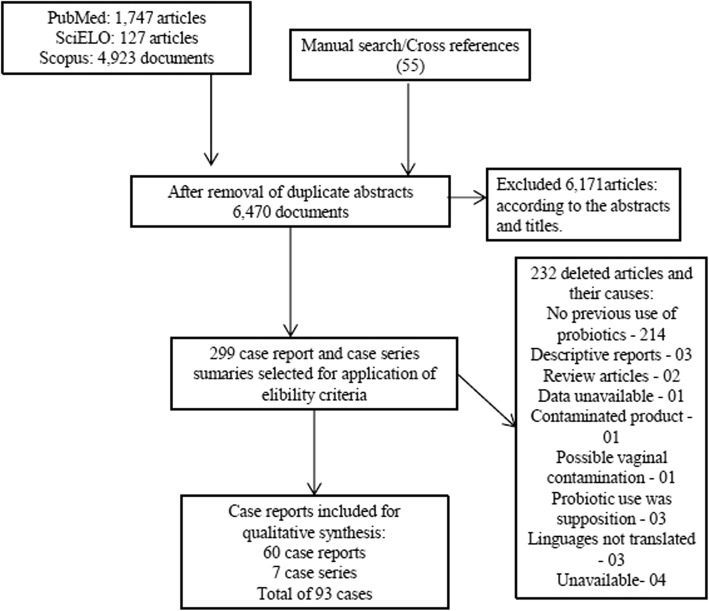
- Included infections after probiotic ingestion, including bacteremia/fungemia, sepsis, endocarditis, and abscess; 6797 records plus 55 cross-references yielded 67 articles (60 case reports, 7 case series) corresponding to 93 patients.
- Descriptive statistics and univariate analysis used SPSS version 23.0; categorical variables compared with chi-square and Fisher’s exact tests, continuous variables with Mann-Whitney test, two-tailed p<0.05; risk of bias assessed with a modified National Institutes of Health tool.
Limitations
- The paper states possible publication bias, with more serious cases more likely published, but also notes that case reports are increasingly difficult to publish, so other serious cases may not have reached public knowledge.
- The paper states that the mortality analysis did not consider other factors such as numbers and types of comorbidity, and that the review is not intended to discourage probiotic use.
- Evident from the text: case reports and case series cannot establish causality or incidence, and there is no denominator of all probiotic users; risk of bias was mostly “fair” (7/67, 10.4%, were “good”; none “poor”).
Model-written summary. Check it against the paper before relying on it.
Integrity signals
Registry
Cites
Statistics
Figures
Verification
Claims the paper makes
60 Own result · 6 Own interpretation · 4 Own method · 2 Not checked yet · 1 No basis given
A result the paper reports from its own data — it cites no other source for it, so there is none to check. The quote shows it is in the paper.
In the paper
“Adults over 60 years of age, Clostridium difficile colitis, antibiotic use and Saccharomyces infections were associated with overall mortality.”
- Also stated in: § Conclusion · plain
“Mortality was associated with age > 60 years, C. difficile colitis, current antimicrobial use and Saccharomyces infection.”
§ Infectious complications following probiotic ingestion: a potentially underestimated problem? A systematic review of reports and case series > Abstract > Results
plaincorrelationaln = 93- Asserted: passes — The authors put it forward as true.
- Checkable: passes — It can be checked against evidence.
- Load-bearing: passes — The paper’s conclusions depend on it.
- Based: passes — The paper gives a reason why it holds.
- Also stated in: § Conclusion · plain
A result the paper reports from its own data — it cites no other source for it, so there is none to check. The quote shows it is in the paper.
In the paper
“HIV infections, immunosuppressive drugs, solid organ transplantation, deep intravenous lines, enteral or parenteral nutrition were not associated with death.”
§ Infectious complications following probiotic ingestion: a potentially underestimated problem? A systematic review of reports and case series > Abstract > Results
plain- Asserted: passes — The authors put it forward as true.
- Checkable: passes — It can be checked against evidence.
- Load-bearing: unclear — It is unclear whether the paper’s conclusions depend on it.
- Based: passes — The paper gives a reason why it holds.
A result the paper reports from its own data — it cites no other source for it, so there is none to check. The quote shows it is in the paper.
In the paper
“followed by endocarditis and abscess, with 4 and 3 cases, respectively.”
§ Infectious complications following probiotic ingestion: a potentially underestimated problem? A systematic review of reports and case series > Results > Occurrence of infectious complications
plainn = 4- Asserted: passes — The authors put it forward as true.
- Checkable: passes — It can be checked against evidence.
- Load-bearing: unclear — It is unclear whether the paper’s conclusions depend on it.
- Based: passes — The paper gives a reason why it holds.
A result the paper reports from its own data — it cites no other source for it, so there is none to check. The quote shows it is in the paper.
In the paper
“Adults over 60 years of age, Clostridium difficile colitis, antibiotic use and Saccharomyces infections were associated with overall mortality.”
- Also stated in: § Conclusion · plain
“Mortality was associated with age > 60 years, C. difficile colitis, current antimicrobial use and Saccharomyces infection.”
§ Infectious complications following probiotic ingestion: a potentially underestimated problem? A systematic review of reports and case series > Abstract > Results
plaincorrelational- Asserted: passes — The authors put it forward as true.
- Checkable: passes — It can be checked against evidence.
- Load-bearing: passes — The paper’s conclusions depend on it.
- Based: passes — The paper gives a reason why it holds.
- Also stated in: § Conclusion · plain
A result the paper reports from its own data — it cites no other source for it, so there is none to check. The quote shows it is in the paper.
In the paper
“followed by Lactobacillus, Bifidobacterium, Bacillus, Pedioccocus and Escherichia with 26 (27.9%), 12 (12.8%), 5 (5.4%), 2 (2.2%) and 1 (1.1%) case, respectively.”
- Also stated in: § Probiotic microorganisms involved in infectious complications · plain
“Of the 12 patients with infectious complications due to Bifidobacterium spp.”
§ Infectious complications following probiotic ingestion: a potentially underestimated problem? A systematic review of reports and case series > Abstract > Results
plainn = 12- Asserted: passes — The authors put it forward as true.
- Checkable: passes — It can be checked against evidence.
- Load-bearing: unclear — It is unclear whether the paper’s conclusions depend on it.
- Based: passes — The paper gives a reason why it holds.
- Also stated in: § Probiotic microorganisms involved in infectious complications · plain
A result the paper reports from its own data — it cites no other source for it, so there is none to check. The quote shows it is in the paper.
In the paper
“bacteremia was responsible for 19 (20.4%) of cases”
§ Infectious complications following probiotic ingestion: a potentially underestimated problem? A systematic review of reports and case series > Results > Occurrence of infectious complications
plain- Asserted: passes — The authors put it forward as true.
- Checkable: passes — It can be checked against evidence.
- Load-bearing: unclear — It is unclear whether the paper’s conclusions depend on it.
- Based: passes — The paper gives a reason why it holds.
A result the paper reports from its own data — it cites no other source for it, so there is none to check. The quote shows it is in the paper.
In the paper
“HIV infections, immunosuppressive drugs, solid organ transplantation, deep intravenous lines, enteral or parenteral nutrition were not associated with death.”
§ Infectious complications following probiotic ingestion: a potentially underestimated problem? A systematic review of reports and case series > Abstract > Results
plain- Asserted: passes — The authors put it forward as true.
- Checkable: passes — It can be checked against evidence.
- Load-bearing: unclear — It is unclear whether the paper’s conclusions depend on it.
- Based: passes — The paper gives a reason why it holds.
A result the paper reports from its own data — it cites no other source for it, so there is none to check. The quote shows it is in the paper.
In the paper
“followed by endocarditis and abscess, with 4 and 3 cases, respectively.”
§ Infectious complications following probiotic ingestion: a potentially underestimated problem? A systematic review of reports and case series > Results > Occurrence of infectious complications
plainn = 3- Asserted: passes — The authors put it forward as true.
- Checkable: passes — It can be checked against evidence.
- Load-bearing: unclear — It is unclear whether the paper’s conclusions depend on it.
- Based: passes — The paper gives a reason why it holds.
A result the paper reports from its own data — it cites no other source for it, so there is none to check. The quote shows it is in the paper.
In the paper
“HIV infections, immunosuppressive drugs, solid organ transplantation, deep intravenous lines, enteral or parenteral nutrition were not associated with death.”
§ Infectious complications following probiotic ingestion: a potentially underestimated problem? A systematic review of reports and case series > Abstract > Results
plain- Asserted: passes — The authors put it forward as true.
- Checkable: passes — It can be checked against evidence.
- Load-bearing: unclear — It is unclear whether the paper’s conclusions depend on it.
- Based: passes — The paper gives a reason why it holds.
A result the paper reports from its own data — it cites no other source for it, so there is none to check. The quote shows it is in the paper.
In the paper
“Sepsis was identified in 29 (31.2%) patients;”
§ Infectious complications following probiotic ingestion: a potentially underestimated problem? A systematic review of reports and case series > Results > Occurrence of infectious complications
plain- Asserted: passes — The authors put it forward as true.
- Checkable: passes — It can be checked against evidence.
- Load-bearing: unclear — It is unclear whether the paper’s conclusions depend on it.
- Based: passes — The paper gives a reason why it holds.
A result the paper reports from its own data — it cites no other source for it, so there is none to check. The quote shows it is in the paper.
In the paper
“HIV infections, immunosuppressive drugs, solid organ transplantation, deep intravenous lines, enteral or parenteral nutrition were not associated with death.”
§ Infectious complications following probiotic ingestion: a potentially underestimated problem? A systematic review of reports and case series > Abstract > Results
plain- Asserted: passes — The authors put it forward as true.
- Checkable: passes — It can be checked against evidence.
- Load-bearing: unclear — It is unclear whether the paper’s conclusions depend on it.
- Based: passes — The paper gives a reason why it holds.
A result the paper reports from its own data — it cites no other source for it, so there is none to check. The quote shows it is in the paper.
In the paper
“Adults over 60 years of age, Clostridium difficile colitis, antibiotic use and Saccharomyces infections were associated with overall mortality.”
- Also stated in: § Conclusion · plain
“Mortality was associated with age > 60 years, C. difficile colitis, current antimicrobial use and Saccharomyces infection.”
§ Infectious complications following probiotic ingestion: a potentially underestimated problem? A systematic review of reports and case series > Abstract > Results
plaincorrelational- Asserted: passes — The authors put it forward as true.
- Checkable: passes — It can be checked against evidence.
- Load-bearing: passes — The paper’s conclusions depend on it.
- Based: passes — The paper gives a reason why it holds.
- Also stated in: § Conclusion · plain
A result the paper reports from its own data — it cites no other source for it, so there is none to check. The quote shows it is in the paper.
In the paper
“followed by Lactobacillus, Bifidobacterium, Bacillus, Pedioccocus and Escherichia with 26 (27.9%), 12 (12.8%), 5 (5.4%), 2 (2.2%) and 1 (1.1%) case, respectively.”
§ Infectious complications following probiotic ingestion: a potentially underestimated problem? A systematic review of reports and case series > Abstract > Results
plain- Asserted: passes — The authors put it forward as true.
- Checkable: passes — It can be checked against evidence.
- Load-bearing: unclear — It is unclear whether the paper’s conclusions depend on it.
- Based: passes — The paper gives a reason why it holds.
A result the paper reports from its own data — it cites no other source for it, so there is none to check. The quote shows it is in the paper.
In the paper
“Adults over 60 years of age, Clostridium difficile colitis, antibiotic use and Saccharomyces infections were associated with overall mortality.”
- Also stated in: § Conclusion · plain
“Mortality was associated with age > 60 years, C. difficile colitis, current antimicrobial use and Saccharomyces infection.”
§ Infectious complications following probiotic ingestion: a potentially underestimated problem? A systematic review of reports and case series > Abstract > Results
plaincorrelationaln = 93- Asserted: passes — The authors put it forward as true.
- Checkable: passes — It can be checked against evidence.
- Load-bearing: passes — The paper’s conclusions depend on it.
- Based: passes — The paper gives a reason why it holds.
- Also stated in: § Conclusion · plain
A result the paper reports from its own data — it cites no other source for it, so there is none to check. The quote shows it is in the paper.
In the paper
“HIV infections, immunosuppressive drugs, solid organ transplantation, deep intravenous lines, enteral or parenteral nutrition were not associated with death.”
§ Infectious complications following probiotic ingestion: a potentially underestimated problem? A systematic review of reports and case series > Abstract > Results
plain- Asserted: passes — The authors put it forward as true.
- Checkable: passes — It can be checked against evidence.
- Load-bearing: unclear — It is unclear whether the paper’s conclusions depend on it.
- Based: passes — The paper gives a reason why it holds.
A result the paper reports from its own data — it cites no other source for it, so there is none to check. The quote shows it is in the paper.
In the paper
“followed by Lactobacillus, Bifidobacterium, Bacillus, Pedioccocus and Escherichia with 26 (27.9%), 12 (12.8%), 5 (5.4%), 2 (2.2%) and 1 (1.1%) case, respectively.”
- Also stated in: § Probiotic microorganisms involved in infectious complications · plain
“Lactobacillus spp. were the etiologic agents in 26 episodes of infectious complications after probiotic use”
§ Infectious complications following probiotic ingestion: a potentially underestimated problem? A systematic review of reports and case series > Abstract > Results
plain- Asserted: passes — The authors put it forward as true.
- Checkable: passes — It can be checked against evidence.
- Load-bearing: unclear — It is unclear whether the paper’s conclusions depend on it.
- Based: passes — The paper gives a reason why it holds.
- Also stated in: § Probiotic microorganisms involved in infectious complications · plain
A result the paper reports from its own data — it cites no other source for it, so there is none to check. The quote shows it is in the paper.
In the paper
“The mean age was higher in the group that died, as were the prevalence of C. difficile colitis and antibiotic use during the infectious complication.”
§ Infectious complications following probiotic ingestion: a potentially underestimated problem? A systematic review of reports and case series > Results > Factors associated with mortality
plaincorrelational- Asserted: passes — The authors put it forward as true.
- Checkable: passes — It can be checked against evidence.
- Load-bearing: unclear — It is unclear whether the paper’s conclusions depend on it.
- Based: passes — The paper gives a reason why it holds.
A result the paper reports from its own data — it cites no other source for it, so there is none to check. The quote shows it is in the paper.
In the paper
“Three of the 5 affected patients died.”
§ Infectious complications following probiotic ingestion: a potentially underestimated problem? A systematic review of reports and case series > Results > Probiotic microorganisms involved in infectious complications
plainn = 5- Asserted: passes — The authors put it forward as true.
- Checkable: passes — It can be checked against evidence.
- Load-bearing: unclear — It is unclear whether the paper’s conclusions depend on it.
- Based: passes — The paper gives a reason why it holds.
A result the paper reports from its own data — it cites no other source for it, so there is none to check. The quote shows it is in the paper.
In the paper
“Death occurred in only 1 (3.8%) case.”
§ Infectious complications following probiotic ingestion: a potentially underestimated problem? A systematic review of reports and case series > Results > Probiotic microorganisms involved in infectious complications
plainn = 27- Asserted: passes — The authors put it forward as true.
- Checkable: passes — It can be checked against evidence.
- Load-bearing: unclear — It is unclear whether the paper’s conclusions depend on it.
- Based: passes — The paper gives a reason why it holds.
A result the paper reports from its own data — it cites no other source for it, so there is none to check. The quote shows it is in the paper.
In the paper
“All-cause mortality was 15% (14 cases).”
§ Infectious complications following probiotic ingestion: a potentially underestimated problem? A systematic review of reports and case series > Results > Probiotic microorganisms involved in infectious complications
plainn = 14- Asserted: passes — The authors put it forward as true.
- Checkable: passes — It can be checked against evidence.
- Load-bearing: unclear — It is unclear whether the paper’s conclusions depend on it.
- Based: passes — The paper gives a reason why it holds.
A result the paper reports from its own data — it cites no other source for it, so there is none to check. The quote shows it is in the paper.
In the paper
“In 27 cases, the probiotic microorganisms in the medications were compatible with the isolates found in the blood samples of the patient.”
§ Infectious complications following probiotic ingestion: a potentially underestimated problem? A systematic review of reports and case series > Results > Probiotic microorganisms involved in infectious complications
plaincorrelationaln = 27- Asserted: passes — The authors put it forward as true.
- Checkable: passes — It can be checked against evidence.
- Load-bearing: unclear — It is unclear whether the paper’s conclusions depend on it.
- Based: passes — The paper gives a reason why it holds.
- Rests on an assumption: Compatibility between a microorganism isolated from a patient and the probiotic product taken indicates that the probiotic caused the infection.
A result the paper reports from its own data — it cites no other source for it, so there is none to check. The quote shows it is in the paper.
In the paper
“The group of patients with infectious complications by Saccharomyces spp. had a higher death rate (Table 3).”
§ Infectious complications following probiotic ingestion: a potentially underestimated problem? A systematic review of reports and case series > Results > Factors associated with mortality
plaincorrelational- Asserted: passes — The authors put it forward as true.
- Checkable: passes — It can be checked against evidence.
- Load-bearing: unclear — It is unclear whether the paper’s conclusions depend on it.
- Based: passes — The paper gives a reason why it holds.
A result the paper reports from its own data — it cites no other source for it, so there is none to check. The quote shows it is in the paper.
In the paper
“At least 40 (43%) of the cases were on antimicrobial therapy at the time of the infectious complications and 11 (11.8%) had C. difficile colitis.”
§ Infectious complications following probiotic ingestion: a potentially underestimated problem? A systematic review of reports and case series > Results > Gender and age distribution, and associated conditions
plain- Asserted: passes — The authors put it forward as true.
- Checkable: passes — It can be checked against evidence.
- Load-bearing: unclear — It is unclear whether the paper’s conclusions depend on it.
- Based: passes — The paper gives a reason why it holds.
A result the paper reports from its own data — it cites no other source for it, so there is none to check. The quote shows it is in the paper.
In the paper
“Of the 12 patients with infectious complications due to Bifidobacterium spp., 10 were newborns (9 preterm).”
§ Infectious complications following probiotic ingestion: a potentially underestimated problem? A systematic review of reports and case series > Results > Probiotic microorganisms involved in infectious complications
plainn = 12- Asserted: passes — The authors put it forward as true.
- Checkable: passes — It can be checked against evidence.
- Load-bearing: unclear — It is unclear whether the paper’s conclusions depend on it.
- Based: passes — The paper gives a reason why it holds.
A result the paper reports from its own data — it cites no other source for it, so there is none to check. The quote shows it is in the paper.
In the paper
“The mean age was higher in the group that died, as were the prevalence of C. difficile colitis and antibiotic use during the infectious complication.”
§ Infectious complications following probiotic ingestion: a potentially underestimated problem? A systematic review of reports and case series > Results > Factors associated with mortality
plaincorrelational- Asserted: passes — The authors put it forward as true.
- Checkable: passes — It can be checked against evidence.
- Load-bearing: unclear — It is unclear whether the paper’s conclusions depend on it.
- Based: passes — The paper gives a reason why it holds.
A result the paper reports from its own data — it cites no other source for it, so there is none to check. The quote shows it is in the paper.
In the paper
“There were no deaths in this group.”
§ Infectious complications following probiotic ingestion: a potentially underestimated problem? A systematic review of reports and case series > Results > Probiotic microorganisms involved in infectious complications
plainn = 12- Asserted: passes — The authors put it forward as true.
- Checkable: passes — It can be checked against evidence.
- Load-bearing: unclear — It is unclear whether the paper’s conclusions depend on it.
- Based: passes — The paper gives a reason why it holds.
A result the paper reports from its own data — it cites no other source for it, so there is none to check. The quote shows it is in the paper.
In the paper
“In 15 cases, additional methods showed that the microorganisms isolated from biological samples were compatible with the probiotics taken by the patients.”
§ Infectious complications following probiotic ingestion: a potentially underestimated problem? A systematic review of reports and case series > Results > Probiotic microorganisms involved in infectious complications
plaincorrelationaln = 15- Asserted: passes — The authors put it forward as true.
- Checkable: passes — It can be checked against evidence.
- Load-bearing: unclear — It is unclear whether the paper’s conclusions depend on it.
- Based: passes — The paper gives a reason why it holds.
- Rests on an assumption: Compatibility between a microorganism isolated from a patient and the probiotic product taken indicates that the probiotic caused the infection.
A result the paper reports from its own data — it cites no other source for it, so there is none to check. The quote shows it is in the paper.
In the paper
“The mean age was higher in the group that died, as were the prevalence of C. difficile colitis and antibiotic use during the infectious complication.”
§ Infectious complications following probiotic ingestion: a potentially underestimated problem? A systematic review of reports and case series > Results > Factors associated with mortality
plaincorrelational- Asserted: passes — The authors put it forward as true.
- Checkable: passes — It can be checked against evidence.
- Load-bearing: unclear — It is unclear whether the paper’s conclusions depend on it.
- Based: passes — The paper gives a reason why it holds.
A result the paper reports from its own data — it cites no other source for it, so there is none to check. The quote shows it is in the paper.
In the paper
“All-cause mortality was 19.6% (18 cases) and it was 22.8% among the 57 cases where there was compatibility between probiotics and the isolated microorganisms in the biological samples.”
§ Infectious complications following probiotic ingestion: a potentially underestimated problem? A systematic review of reports and case series > Results > Gender and age distribution, and associated conditions
plainn = 57- Asserted: passes — The authors put it forward as true.
- Checkable: passes — It can be checked against evidence.
- Load-bearing: unclear — It is unclear whether the paper’s conclusions depend on it.
- Based: passes — The paper gives a reason why it holds.
A result the paper reports from its own data — it cites no other source for it, so there is none to check. The quote shows it is in the paper.
In the paper
“When evaluating sepsis only, 39.3% were caused by these fungi.”
§ Infectious complications following probiotic ingestion: a potentially underestimated problem? A systematic review of reports and case series > Discussion
plaindirect- Asserted: passes — The authors put it forward as true.
- Checkable: passes — It can be checked against evidence.
- Load-bearing: unclear — It is unclear whether the paper’s conclusions depend on it.
- Based: passes — The paper gives a reason why it holds.
A result the paper reports from its own data — it cites no other source for it, so there is none to check. The quote shows it is in the paper.
In the paper
“Blood was the most frequent site of isolation of probiotic microorganisms (Table 2).”
§ Infectious complications following probiotic ingestion: a potentially underestimated problem? A systematic review of reports and case series > Results > Gender and age distribution, and associated conditions
plain- Asserted: passes — The authors put it forward as true.
- Checkable: passes — It can be checked against evidence.
- Load-bearing: unclear — It is unclear whether the paper’s conclusions depend on it.
- Based: passes — The paper gives a reason why it holds.
A result the paper reports from its own data — it cites no other source for it, so there is none to check. The quote shows it is in the paper.
In the paper
“All-cause mortality was 19.6% (18 cases) and it was 22.8% among the 57 cases where there was compatibility between probiotics and the isolated microorganisms in the biological samples.”
§ Infectious complications following probiotic ingestion: a potentially underestimated problem? A systematic review of reports and case series > Results > Gender and age distribution, and associated conditions
plainn = 18- Asserted: passes — The authors put it forward as true.
- Checkable: passes — It can be checked against evidence.
- Load-bearing: unclear — It is unclear whether the paper’s conclusions depend on it.
- Based: passes — The paper gives a reason why it holds.
A result the paper reports from its own data — it cites no other source for it, so there is none to check. The quote shows it is in the paper.
In the paper
“At least 40 (43%) of the cases were on antimicrobial therapy at the time of the infectious complications and 11 (11.8%) had C. difficile colitis.”
§ Infectious complications following probiotic ingestion: a potentially underestimated problem? A systematic review of reports and case series > Results > Gender and age distribution, and associated conditions
plain- Asserted: passes — The authors put it forward as true.
- Checkable: passes — It can be checked against evidence.
- Load-bearing: unclear — It is unclear whether the paper’s conclusions depend on it.
- Based: passes — The paper gives a reason why it holds.
A conclusion the paper draws from its own results — it cites no other source for it, so there is none to check. The quote shows it is in the paper.
In the paper
“The use of probiotics cannot be considered risk-free and should be carefully evaluated for some patient groups.”
- Also stated in: § Discussion · plain
“Therefore, to assume that probiotic intake is completely risk-free is not true.”
- Also stated in: § Conclusion · plain
“the use of probiotics cannot be considered risk free and should be carefully evaluated for high- risk groups of patients.”
§ Infectious complications following probiotic ingestion: a potentially underestimated problem? A systematic review of reports and case series > Abstract > Conclusion
plain- Asserted: passes — The authors put it forward as true.
- Checkable: passes — It can be checked against evidence.
- Load-bearing: passes — The paper’s conclusions depend on it.
- Based: passes — The paper gives a reason why it holds.
- Also stated in: § Discussion · plain
A conclusion the paper draws from its own results — it cites no other source for it, so there is none to check. The quote shows it is in the paper.
In the paper
“However, the cases described here are infections with high mortality rates such as endocarditis and sepsis.”
§ Infectious complications following probiotic ingestion: a potentially underestimated problem? A systematic review of reports and case series > Discussion
plain- Asserted: passes — The authors put it forward as true.
- Checkable: passes — It can be checked against evidence.
- Load-bearing: passes — The paper’s conclusions depend on it.
- Based: passes — The paper gives a reason why it holds.
What the paper did — it cites no source for this, so there is none to check. The quote shows it is in the paper.
In the paper
“Although the analysis suggests that the genus Saccharomyces is associated with higher overall mortality, we know that other factors were not considered, such as the numbers and types of comorbidity.”
§ Infectious complications following probiotic ingestion: a potentially underestimated problem? A systematic review of reports and case series > Discussion
plain- Asserted: passes — The authors put it forward as true.
- Checkable: passes — It can be checked against evidence.
- Load-bearing: passes — The paper’s conclusions depend on it.
- Based: passes — The paper gives a reason why it holds.
- It may state two separate claims as one. 18
- Probably not a substantial claim. 23
A result the paper reports from its own data — it cites no other source for it, so there is none to check. The quote shows it is in the paper.
In the paper
“The genus Saccharomyces was the most frequent with 47 (50.6%) cases”
- Also stated in: § Probiotic microorganisms involved in infectious complications · plain
“Among the 93 cases, 47 (50.5%) were due to Saccharomyces, making it the most frequent genus in this review.”
§ Infectious complications following probiotic ingestion: a potentially underestimated problem? A systematic review of reports and case series > Abstract > Results
plainn = 47- Asserted: passes — The authors put it forward as true.
- Checkable: passes — It can be checked against evidence.
- Load-bearing: unclear — It is unclear whether the paper’s conclusions depend on it.
- Based: passes — The paper gives a reason why it holds.
It may state two separate claims as one.
- Also stated in: § Probiotic microorganisms involved in infectious complications · plain
A result the paper reports from its own data — it cites no other source for it, so there is none to check. The quote shows it is in the paper.
In the paper
“followed by Lactobacillus, Bifidobacterium, Bacillus, Pedioccocus and Escherichia with 26 (27.9%), 12 (12.8%), 5 (5.4%), 2 (2.2%) and 1 (1.1%) case, respectively.”
§ Infectious complications following probiotic ingestion: a potentially underestimated problem? A systematic review of reports and case series > Abstract > Results
plain- Asserted: passes — The authors put it forward as true.
- Checkable: passes — It can be checked against evidence.
- Load-bearing: fails — The paper’s conclusions may not depend on it.
- Based: passes — The paper gives a reason why it holds.
Probably not a substantial claim. The paper’s conclusions may not depend on it.
A result the paper reports from its own data — it cites no other source for it, so there is none to check. The quote shows it is in the paper.
In the paper
“Pneumonia, pleural empyema and septic arthritis were present in only one case each.”
§ Infectious complications following probiotic ingestion: a potentially underestimated problem? A systematic review of reports and case series > Results > Occurrence of infectious complications
plainn = 3- Asserted: passes — The authors put it forward as true.
- Checkable: passes — It can be checked against evidence.
- Load-bearing: unclear — It is unclear whether the paper’s conclusions depend on it.
- Based: passes — The paper gives a reason why it holds.
It may state two separate claims as one.
A result the paper reports from its own data — it cites no other source for it, so there is none to check. The quote shows it is in the paper.
In the paper
“Fungemia was the most common infectious complications with 35 (37.6%) cases.”
- Also stated in: § Occurrence of infectious complications · plain
“Fungemia was most commonly observed condition, with 35 (37.6%) of the cases.”
§ Infectious complications following probiotic ingestion: a potentially underestimated problem? A systematic review of reports and case series > Abstract > Results
plainn = 93- Asserted: passes — The authors put it forward as true.
- Checkable: passes — It can be checked against evidence.
- Load-bearing: unclear — It is unclear whether the paper’s conclusions depend on it.
- Based: passes — The paper gives a reason why it holds.
It may state two separate claims as one.
- Also stated in: § Occurrence of infectious complications · plain
A result the paper reports from its own data — it cites no other source for it, so there is none to check. The quote shows it is in the paper.
In the paper
“Of the 67 articles included in the synthesis, 7 (10.4%) were classified as “good” and the remaining as “fair”. None were classified as “poor”.”
§ Infectious complications following probiotic ingestion: a potentially underestimated problem? A systematic review of reports and case series > Results > Risk of bias assessment
plain- Asserted: passes — The authors put it forward as true.
- Checkable: passes — It can be checked against evidence.
- Load-bearing: unclear — It is unclear whether the paper’s conclusions depend on it.
- Based: passes — The paper gives a reason why it holds.
It may state two separate claims as one.
A result the paper reports from its own data — it cites no other source for it, so there is none to check. The quote shows it is in the paper.
In the paper
“followed by Lactobacillus, Bifidobacterium, Bacillus, Pedioccocus and Escherichia with 26 (27.9%), 12 (12.8%), 5 (5.4%), 2 (2.2%) and 1 (1.1%) case, respectively.”
§ Infectious complications following probiotic ingestion: a potentially underestimated problem? A systematic review of reports and case series > Abstract > Results
plainSingle case- Asserted: passes — The authors put it forward as true.
- Checkable: passes — It can be checked against evidence.
- Load-bearing: fails — The paper’s conclusions may not depend on it.
- Based: passes — The paper gives a reason why it holds.
Probably not a substantial claim. The paper’s conclusions may not depend on it.
A result the paper reports from its own data — it cites no other source for it, so there is none to check. The quote shows it is in the paper.
In the paper
“We found 60 case reports and 7 case series, making up a total of 93 patients.”
- Also stated in: § Database search · plain
“We included 60 case reports and 7 case series, corresponding to 93 patients (Additional file 1).”
§ Infectious complications following probiotic ingestion: a potentially underestimated problem? A systematic review of reports and case series > Abstract > Results
plainn = 93- Asserted: passes — The authors put it forward as true.
- Checkable: passes — It can be checked against evidence.
- Load-bearing: passes — The paper’s conclusions depend on it.
- Based: passes — The paper gives a reason why it holds.
It may state two separate claims as one.
- Also stated in: § Database search · plain
A result the paper reports from its own data — it cites no other source for it, so there is none to check. The quote shows it is in the paper.
In the paper
“Central venous access, enteral nutrition and parenteral nutrition were present in 59 (63.5%), 52 (56%) and 14 (15%), respectively, of all cases.”
§ Infectious complications following probiotic ingestion: a potentially underestimated problem? A systematic review of reports and case series > Results > Gender and age distribution, and associated conditions
plain- Asserted: passes — The authors put it forward as true.
- Checkable: passes — It can be checked against evidence.
- Load-bearing: fails — The paper’s conclusions may not depend on it.
- Based: passes — The paper gives a reason why it holds.
Probably not a substantial claim. The paper’s conclusions may not depend on it.
A result the paper reports from its own data — it cites no other source for it, so there is none to check. The quote shows it is in the paper.
In the paper
“Patients on immunosuppressive drugs (corticosteroids, chemotherapy and immunobiologicals) accounted for 14 (15%) patients.”
§ Infectious complications following probiotic ingestion: a potentially underestimated problem? A systematic review of reports and case series > Results > Gender and age distribution, and associated conditions
plain- Asserted: passes — The authors put it forward as true.
- Checkable: passes — It can be checked against evidence.
- Load-bearing: fails — The paper’s conclusions may not depend on it.
- Based: passes — The paper gives a reason why it holds.
Probably not a substantial claim. The paper’s conclusions may not depend on it.
A result the paper reports from its own data — it cites no other source for it, so there is none to check. The quote shows it is in the paper.
In the paper
“The genus Saccharomyces was also positively associated with mortality, since 3/4 of patients who died had probiotics belonging to this genus as the etiological agent of the infectious complications found.”
§ Infectious complications following probiotic ingestion: a potentially underestimated problem? A systematic review of reports and case series > Discussion
plaincorrelationaln = 4- Asserted: passes — The authors put it forward as true.
- Checkable: passes — It can be checked against evidence.
- Load-bearing: passes — The paper’s conclusions depend on it.
- Based: passes — The paper gives a reason why it holds.
It may state two separate claims as one.
A result the paper reports from its own data — it cites no other source for it, so there is none to check. The quote shows it is in the paper.
In the paper
“Two patients had received solid organ transplantation and 5 (5.4%) had been previously diagnosed as HIV infected.”
§ Infectious complications following probiotic ingestion: a potentially underestimated problem? A systematic review of reports and case series > Results > Gender and age distribution, and associated conditions
plainn = 2- Asserted: passes — The authors put it forward as true.
- Checkable: passes — It can be checked against evidence.
- Load-bearing: fails — The paper’s conclusions may not depend on it.
- Based: passes — The paper gives a reason why it holds.
Probably not a substantial claim. The paper’s conclusions may not depend on it. It may state two separate claims as one.
A result the paper reports from its own data — it cites no other source for it, so there is none to check. The quote shows it is in the paper.
In the paper
“Bacteremia accounted 20.4% of the infectious complications and the genus Lactobacillus was responsible for 42% of these.”
§ Infectious complications following probiotic ingestion: a potentially underestimated problem? A systematic review of reports and case series > Discussion
plainn = 8- Asserted: passes — The authors put it forward as true.
- Checkable: passes — It can be checked against evidence.
- Load-bearing: unclear — It is unclear whether the paper’s conclusions depend on it.
- Based: passes — The paper gives a reason why it holds.
It may state two separate claims as one.
A result the paper reports from its own data — it cites no other source for it, so there is none to check. The quote shows it is in the paper.
In the paper
“In 10 patients the indication for the use of probiotic was to prevent necrotizing enterocolitis (NE) and at least 4 of them ended up developing this complication, despite probiotic prophylaxis.”
§ Infectious complications following probiotic ingestion: a potentially underestimated problem? A systematic review of reports and case series > Discussion
plainn = 10- Asserted: passes — The authors put it forward as true.
- Checkable: passes — It can be checked against evidence.
- Load-bearing: passes — The paper’s conclusions depend on it.
- Based: passes — The paper gives a reason why it holds.
It may state two separate claims as one.
The paper states this without a source or data behind it here, so there is nothing to check it against. The quote shows it is in the paper.
In the paper
“Ten preterm infants had extremely low birth weight and half had sepsis, four patients had bacteremia and only one had fungemia.”
§ Infectious complications following probiotic ingestion: a potentially underestimated problem? A systematic review of reports and case series > Discussion
plainn = 10- Asserted: passes — The authors put it forward as true.
- Checkable: passes — It can be checked against evidence.
- Load-bearing: unclear — It is unclear whether the paper’s conclusions depend on it.
- Based: passes — The paper gives a reason why it holds.
It may state two separate claims as one.
A result the paper reports from its own data — it cites no other source for it, so there is none to check. The quote shows it is in the paper.
In the paper
“Between 2011 and 2017, there were 39 cases.”
§ Infectious complications following probiotic ingestion: a potentially underestimated problem? A systematic review of reports and case series > Results > Geographical distribution of the manuscripts
plainn = 39- Asserted: passes — The authors put it forward as true.
- Checkable: passes — It can be checked against evidence.
- Load-bearing: fails — The paper’s conclusions may not depend on it.
- Based: passes — The paper gives a reason why it holds.
Probably not a substantial claim. The paper’s conclusions may not depend on it.
A result the paper reports from its own data — it cites no other source for it, so there is none to check. The quote shows it is in the paper.
In the paper
“Central venous access, enteral nutrition and parenteral nutrition were present in 59 (63.5%), 52 (56%) and 14 (15%), respectively, of all cases.”
§ Infectious complications following probiotic ingestion: a potentially underestimated problem? A systematic review of reports and case series > Results > Gender and age distribution, and associated conditions
plain- Asserted: passes — The authors put it forward as true.
- Checkable: passes — It can be checked against evidence.
- Load-bearing: fails — The paper’s conclusions may not depend on it.
- Based: passes — The paper gives a reason why it holds.
Probably not a substantial claim. The paper’s conclusions may not depend on it.
A result the paper reports from its own data — it cites no other source for it, so there is none to check. The quote shows it is in the paper.
In the paper
“The earliest case dated back to 1976, and we observed a progressive increase in the following decades of 80, 90 and 00, with 4,16 and 33 cases, respectively.”
§ Infectious complications following probiotic ingestion: a potentially underestimated problem? A systematic review of reports and case series > Results > Geographical distribution of the manuscripts
plaincorrelationaln = 33- Asserted: passes — The authors put it forward as true.
- Checkable: passes — It can be checked against evidence.
- Load-bearing: unclear — It is unclear whether the paper’s conclusions depend on it.
- Based: passes — The paper gives a reason why it holds.
It may state two separate claims as one.
A result the paper reports from its own data — it cites no other source for it, so there is none to check. The quote shows it is in the paper.
In the paper
“Central venous access, enteral nutrition and parenteral nutrition were present in 59 (63.5%), 52 (56%) and 14 (15%), respectively, of all cases.”
§ Infectious complications following probiotic ingestion: a potentially underestimated problem? A systematic review of reports and case series > Results > Gender and age distribution, and associated conditions
plain- Asserted: passes — The authors put it forward as true.
- Checkable: passes — It can be checked against evidence.
- Load-bearing: fails — The paper’s conclusions may not depend on it.
- Based: passes — The paper gives a reason why it holds.
Probably not a substantial claim. The paper’s conclusions may not depend on it.
A result the paper reports from its own data — it cites no other source for it, so there is none to check. The quote shows it is in the paper.
In the paper
“In our review, 12 samples of Saccharomyces spp. had antimicrobial susceptibility testing and 10 of them were sensitive to azoles.”
§ Infectious complications following probiotic ingestion: a potentially underestimated problem? A systematic review of reports and case series > Discussion
plainn = 12- Asserted: passes — The authors put it forward as true.
- Checkable: passes — It can be checked against evidence.
- Load-bearing: unclear — It is unclear whether the paper’s conclusions depend on it.
- Based: passes — The paper gives a reason why it holds.
It may state two separate claims as one.
A result the paper reports from its own data — it cites no other source for it, so there is none to check. The quote shows it is in the paper.
In the paper
“Each of the five continents had at least one case.”
§ Infectious complications following probiotic ingestion: a potentially underestimated problem? A systematic review of reports and case series > Results > Geographical distribution of the manuscripts
plainn = 93- Asserted: passes — The authors put it forward as true.
- Checkable: passes — It can be checked against evidence.
- Load-bearing: fails — The paper’s conclusions may not depend on it.
- Based: passes — The paper gives a reason why it holds.
Probably not a substantial claim. The paper’s conclusions may not depend on it.
A result the paper reports from its own data — it cites no other source for it, so there is none to check. The quote shows it is in the paper.
In the paper
“Males had a slightly higher prevalence, corresponding to 53 (57%) of the cases.”
§ Infectious complications following probiotic ingestion: a potentially underestimated problem? A systematic review of reports and case series > Results > Gender and age distribution, and associated conditions
plaincorrelationaln = 57- Asserted: passes — The authors put it forward as true.
- Checkable: passes — It can be checked against evidence.
- Load-bearing: fails — The paper’s conclusions may not depend on it.
- Based: passes — The paper gives a reason why it holds.
Probably not a substantial claim. The paper’s conclusions may not depend on it.
A result the paper reports from its own data — it cites no other source for it, so there is none to check. The quote shows it is in the paper.
In the paper
“Of the 60 reports and 7 series of cases involving 93 patients, most were from Europe (61; 65.6%) and 17 (18.3%) from the United States and Canada.”
§ Infectious complications following probiotic ingestion: a potentially underestimated problem? A systematic review of reports and case series > Results > Geographical distribution of the manuscripts
plainn = 93- Asserted: passes — The authors put it forward as true.
- Checkable: passes — It can be checked against evidence.
- Load-bearing: fails — The paper’s conclusions may not depend on it.
- Based: passes — The paper gives a reason why it holds.
Probably not a substantial claim. The paper’s conclusions may not depend on it. It may state two separate claims as one.
A result the paper reports from its own data — it cites no other source for it, so there is none to check. The quote shows it is in the paper.
In the paper
“Elderly (defined as adults over 60 years of age) and children younger than 1 year were reported in 33 (35.5%) and 25 (26.7%) cases, respectively.”
§ Infectious complications following probiotic ingestion: a potentially underestimated problem? A systematic review of reports and case series > Results > Gender and age distribution, and associated conditions
plain- Asserted: passes — The authors put it forward as true.
- Checkable: passes — It can be checked against evidence.
- Load-bearing: fails — The paper’s conclusions may not depend on it.
- Based: passes — The paper gives a reason why it holds.
Probably not a substantial claim. The paper’s conclusions may not depend on it.
A result the paper reports from its own data — it cites no other source for it, so there is none to check. The quote shows it is in the paper.
In the paper
“We observed that of the 8 patients with Lactobacillus bacteremia, 4 were immunosuppressed - 2 with HIV infection; 3 underwent intestinal invasive procedures and 1 had diverticular disease of the colon.”
§ Infectious complications following probiotic ingestion: a potentially underestimated problem? A systematic review of reports and case series > Discussion
plainn = 8- Asserted: passes — The authors put it forward as true.
- Checkable: passes — It can be checked against evidence.
- Load-bearing: unclear — It is unclear whether the paper’s conclusions depend on it.
- Based: passes — The paper gives a reason why it holds.
It may state two separate claims as one.
A result the paper reports from its own data — it cites no other source for it, so there is none to check. The quote shows it is in the paper.
In the paper
“Of patients younger than 1 year, 17 (68%) were premature (Additional file 1: Table S8).”
§ Infectious complications following probiotic ingestion: a potentially underestimated problem? A systematic review of reports and case series > Results > Gender and age distribution, and associated conditions
plain- Asserted: passes — The authors put it forward as true.
- Checkable: passes — It can be checked against evidence.
- Load-bearing: fails — The paper’s conclusions may not depend on it.
- Based: passes — The paper gives a reason why it holds.
Probably not a substantial claim. The paper’s conclusions may not depend on it.
A result the paper reports from its own data — it cites no other source for it, so there is none to check. The quote shows it is in the paper.
In the paper
“In our review, 26.7% of the patients were younger than 1 year of age and practically two-thirds of them premature.”
§ Infectious complications following probiotic ingestion: a potentially underestimated problem? A systematic review of reports and case series > Discussion
plain- Asserted: passes — The authors put it forward as true.
- Checkable: passes — It can be checked against evidence.
- Load-bearing: unclear — It is unclear whether the paper’s conclusions depend on it.
- Based: passes — The paper gives a reason why it holds.
It may state two separate claims as one.
A result the paper reports from its own data — it cites no other source for it, so there is none to check. The quote shows it is in the paper.
In the paper
“Elderly (defined as adults over 60 years of age) and children younger than 1 year were reported in 33 (35.5%) and 25 (26.7%) cases, respectively.”
§ Infectious complications following probiotic ingestion: a potentially underestimated problem? A systematic review of reports and case series > Results > Gender and age distribution, and associated conditions
plain- Asserted: passes — The authors put it forward as true.
- Checkable: passes — It can be checked against evidence.
- Load-bearing: fails — The paper’s conclusions may not depend on it.
- Based: passes — The paper gives a reason why it holds.
Probably not a substantial claim. The paper’s conclusions may not depend on it.
A result the paper reports from its own data — it cites no other source for it, so there is none to check. The quote shows it is in the paper.
In the paper
“Neoplasia was described in 10 (10.7%) and of these, 4 (40%) were of hematologic malignancies.”
§ Infectious complications following probiotic ingestion: a potentially underestimated problem? A systematic review of reports and case series > Results > Gender and age distribution, and associated conditions
plain- Asserted: passes — The authors put it forward as true.
- Checkable: passes — It can be checked against evidence.
- Load-bearing: unclear — It is unclear whether the paper’s conclusions depend on it.
- Based: passes — The paper gives a reason why it holds.
It may state two separate claims as one.
In the paper
“The description of this systematic review was based on the Preferred Reporting Items for Systematic Reviews and Meta-Analyzes – PRISMA [9].”
§ Infectious complications following probiotic ingestion: a potentially underestimated problem? A systematic review of reports and case series > Methods
What the sources say
- Not checked yetcites [9] Liberati A, Altman DG, Mulrow C, Gøtzsche PC, Ioannidis JP, Clarke M, Devereaux PJ, Kleijnen J, Moher D. The PRISMA statement for reporting systematic reviews and meta-analyses of studies that evaluate health care interventions: explanation and elaboration. J Clin Epidemiol. 2009;62(10):1–34. source
plain- Asserted: passes — The authors put it forward as true.
- Checkable: passes — It can be checked against evidence.
- Load-bearing: fails — The paper’s conclusions may not depend on it.
- Based: passes — The paper gives a reason why it holds.
Probably not a substantial claim. The paper’s conclusions may not depend on it.
In the paper
“A modified National Institutes of Health Tool [14] was to use to evaluate the risk of bias in the retrieved articles (see Additional file 1).”
§ Infectious complications following probiotic ingestion: a potentially underestimated problem? A systematic review of reports and case series > Methods > Risk of bias assessment
What the sources say
- Not checked yetcites [14] NIH. Quality assessment tool for case series studies. In: National Heart, Lung, and Blood Institute; 2014. https://www.nhlbi.nih.gov/health-topics/study-quality-assessment-tools . Acessed 28 June 2016.
plain- Asserted: passes — The authors put it forward as true.
- Checkable: passes — It can be checked against evidence.
- Load-bearing: fails — The paper’s conclusions may not depend on it.
- Based: passes — The paper gives a reason why it holds.
Probably not a substantial claim. The paper’s conclusions may not depend on it.
What the paper did — it cites no source for this, so there is none to check. The quote shows it is in the paper.
In the paper
“Potentially relevant titles and abstracts were selected and their articles evaluated independently by Rafael Lessa da Costa and Jose Moreira. The divergences were resolved by consensus and, whenever necessary, by a third reviewer (Cristiane Lamas or Andrea De Lorenzo).”
§ Infectious complications following probiotic ingestion: a potentially underestimated problem? A systematic review of reports and case series > Methods > Strategies for the search of studies and eligibility criteria
plain- Asserted: passes — The authors put it forward as true.
- Checkable: passes — It can be checked against evidence.
- Load-bearing: fails — The paper’s conclusions may not depend on it.
- Based: passes — The paper gives a reason why it holds.
Probably not a substantial claim. The paper’s conclusions may not depend on it. It may state two separate claims as one.
What the paper did — it cites no source for this, so there is none to check. The quote shows it is in the paper.
In the paper
“At this stage, the divergences were resolved by consensus and, when necessary, by the third reviewer.”
§ Infectious complications following probiotic ingestion: a potentially underestimated problem? A systematic review of reports and case series > Methods > Data extraction
plain- Asserted: passes — The authors put it forward as true.
- Checkable: passes — It can be checked against evidence.
- Load-bearing: fails — The paper’s conclusions may not depend on it.
- Based: passes — The paper gives a reason why it holds.
Probably not a substantial claim. The paper’s conclusions may not depend on it. It may state two separate claims as one.
What the paper did — it cites no source for this, so there is none to check. The quote shows it is in the paper.
In the paper
“The study was registered at PROSPERO (CRD42016042289).”
§ Infectious complications following probiotic ingestion: a potentially underestimated problem? A systematic review of reports and case series > Methods
plain- Asserted: passes — The authors put it forward as true.
- Checkable: passes — It can be checked against evidence.
- Load-bearing: fails — The paper’s conclusions may not depend on it.
- Based: passes — The paper gives a reason why it holds.
Probably not a substantial claim. The paper’s conclusions may not depend on it.
A conclusion the paper draws from its own results — it cites no other source for it, so there is none to check. The quote shows it is in the paper.
In the paper
“on the other, due to the mentioned limitation for the publication of case reports, several other serious cases may not have reached public knowledge.”
§ Infectious complications following probiotic ingestion: a potentially underestimated problem? A systematic review of reports and case series > Discussion
hedgedconditional- Asserted: passes — The authors put it forward as true.
- Checkable: fails — It may be too vague to check against evidence.
- Load-bearing: passes — The paper’s conclusions depend on it.
- Based: passes — The paper gives a reason why it holds.
Probably not a substantial claim. It may be too vague to check against evidence.
- Rests on an assumption: Case reports are increasingly difficult to publish.
A conclusion the paper draws from its own results — it cites no other source for it, so there is none to check. The quote shows it is in the paper.
In the paper
“The proportion of cases of infectious complications is small when the total number of people who use probiotics is considered.”
§ Infectious complications following probiotic ingestion: a potentially underestimated problem? A systematic review of reports and case series > Discussion
plain- Asserted: passes — The authors put it forward as true.
- Checkable: passes — It can be checked against evidence.
- Load-bearing: fails — The paper’s conclusions may not depend on it.
- Based: fails — The paper may give no reason why it holds.
Probably not a substantial claim. The paper’s conclusions may not depend on it. The paper may give no reason why it holds.
- Rests on an assumption: The total number of people who use probiotics is large enough that the proportion of infectious complications is small.
A conclusion the paper draws from its own results — it cites no other source for it, so there is none to check. The quote shows it is in the paper.
In the paper
“So, although on one hand there is the possibility of publication bias, with more serious cases having been published”
§ Infectious complications following probiotic ingestion: a potentially underestimated problem? A systematic review of reports and case series > Discussion
hedgedconditional- Asserted: passes — The authors put it forward as true.
- Checkable: passes — It can be checked against evidence.
- Load-bearing: fails — The paper’s conclusions may not depend on it.
- Based: passes — The paper gives a reason why it holds.
Probably not a substantial claim. The paper’s conclusions may not depend on it.
A conclusion the paper draws from its own results — it cites no other source for it, so there is none to check. The quote shows it is in the paper.
In the paper
“Probiotics were often used in the context of excessive antibiotic use, and a more judicious use of antibiotics is critical”
§ Infectious complications following probiotic ingestion: a potentially underestimated problem? A systematic review of reports and case series > Conclusion
plaincorrelational- Asserted: passes — The authors put it forward as true.
- Checkable: passes — It can be checked against evidence.
- Load-bearing: fails — The paper’s conclusions may not depend on it.
- Based: fails — The paper may give no reason why it holds.
Probably not a substantial claim. The paper’s conclusions may not depend on it. The paper may give no reason why it holds.
The paper relies on this without support.
Compatibility between a microorganism isolated from a patient and the probiotic product taken indicates that the probiotic caused the infection.
“In 27 cases, the probiotic microorganisms in the medications were compatible with the isolates found in the blood samples of the patient.”
“In 15 cases, additional methods showed that the microorganisms isolated from biological samples were compatible with the probiotics taken by the patients.”
The paper relies on this without support.
Case reports are increasingly difficult to publish.
“We believe that these cases represent only a small proportion of existing cases, since case reports are increasingly difficult to publish.”
The paper relies on this without support.
The total number of people who use probiotics is large enough that the proportion of infectious complications is small.
“The proportion of cases of infectious complications is small when the total number of people who use probiotics is considered.”
Claims other papers make about this one
Each is checked against this paper’s own text: does it say what the citing paper says it does?
The source backs part of the claim, not all of it — or backs it for a different population, condition or comparison.
In the citing paper
“For example, one report on observational results described 93 cases of serious infections (with a 15% mortality rate), with fungemia (37.6% of cases), sepsis (31.2%), bacteremia (20.4%), endocarditis, and abscesses [74,75].”
From Current Concepts in Probiotic Safety and Efficacy (2026) · cites this paper as [74]
Experimental — accuracy not yet measuredThe source backs part of the claim, not all of it — or backs it for a different population, condition or comparison.
In the citing paper
“Age over 60 years, infections such as Clostridioides difficile, antibiotic exposure, immunosuppression, and the use of Saccharomyces or Lactobacillus (especially L. rhamnosus) all appear to increase the risk [74].”
From Current Concepts in Probiotic Safety and Efficacy (2026) · cites this paper as [74]
Experimental — accuracy not yet measuredThe cited source says what the claim attributes to it.
In the citing paper
“Some findings are isolated, based on single clinical cases, such as sepsis development in patients with established intravenous catheters [74].”
From Current Concepts in Probiotic Safety and Efficacy (2026) · cites this paper as [74]
Self-check
Percentages, sums and reported differences re-computed from the paper’s own numbers.
Each contradiction between two passages listed here was confirmed by an independent check.
Rated major: it would touch a result — a value a result rests on, reported and recomputed p-values on opposite sides of the significance level, two passages that conflict with no sign which is right, or a cited work retracted before this paper was published.
In the paper
“All-cause mortality was 15% (14 cases).”
§ Infectious complications following probiotic ingestion: a potentially underestimated problem? A systematic review of reports and case series > Results > Probiotic microorganisms involved in infectious complications
Reported 15 · recomputed 29.787234
Rated minor: it would not touch a result — a value no result rests on, a p-value that stays on the same side of the significance level, or a conflict that is clerical, resolved elsewhere in the paper, or outside its own findings.
In the paper
§ Infectious complications following probiotic ingestion: a potentially underestimated problem? A systematic review of reports and case series > Results > Gender and age distribution, and associated conditions
“Two patients had received solid organ transplantation”
§ Infectious complications following probiotic ingestion: a potentially underestimated problem? A systematic review of reports and case series > Results > Factors associated with mortality
“| Solid organ transplant | 2 (2.7) | 1 (5.5) | 0.55 | – |”
Rated minor: it would not touch a result — a value no result rests on, a p-value that stays on the same side of the significance level, or a conflict that is clerical, resolved elsewhere in the paper, or outside its own findings.
In the paper
§ Infectious complications following probiotic ingestion: a potentially underestimated problem? A systematic review of reports and case series > Results > Gender and age distribution, and associated conditions
“Patients on immunosuppressive drugs (corticosteroids, chemotherapy and immunobiologicals) accounted for 14 (15%) patients.”
§ Infectious complications following probiotic ingestion: a potentially underestimated problem? A systematic review of reports and case series > Results > Factors associated with mortality
“| Immunosuppressive drugs | 15 (20.2) | 5 (27.8) | 0.89 | – |”
Citations
Cites
Liberati, A., Altman, D. G., Tetzlaff, J., Mulrow, C., Gøtzsche, P. C., Ioannidis, J. P. A., Clarke, M., Devereaux, P. J., Kleijnen, J., & Moher, D. (2009) · PLoS Medicine · doi:10.1371/journal.pmed.1000100 · Cited by 28,164
Dermyshi, E., Wang, Y., Yan, C., Hong, W., Qiu, G., Gong, X., & Zhang, T. (2017) · Neonatology · doi:10.1159/000454668 · Cited by 24,586
Bone, R. C., BALK, R. A., Cerra, F. B., Dellinger, R. P., Fein, A. M., Knaus, W. A., Schein, R. M. H., & Sibbald, W. J. (1992) · CHEST Journal · doi:10.1378/chest.101.6.1644 · Cited by 13,335
Liberati, A., Altman, D. G., Tetzlaff, J., Mulrow, C., Gøtzsche, P. C., Ioannidis, J. P. A., Clarke, M., Devereaux, P. J., Kleijnen, J., & Moher, D. (2009) · Journal of Clinical Epidemiology · doi:10.1016/j.jclinepi.2009.06.006 · Cited by 10,578
American College of Chest Physicians/Society of Critical Care Medicine Consensus Conference
(1992) · Critical Care Medicine · doi:10.1097/00003246-199206000-00025 · Cited by 5,134
Severe Sepsis and Septic Shock
Angus, D. C., & van der Poll, T. (2013) · New England Journal of Medicine · doi:10.1056/nejmra1208623 · Cited by 4,119
Durack, D. T., Lukes, A. S., Bright, D. K., & Service, D. E. (1994) · The American Journal of Medicine · doi:10.1016/0002-9343(94)90143-0 · Cited by 2,572
Probiotics in primary prevention of atopic disease: a randomised placebo-controlled trial
Kalliomäki, M. A., Salminen, S., Arvilommi, H. S., Kero, P. O., Koskinen, P. J., & Isolauri, E. (2001) · The Lancet · doi:10.1016/s0140-6736(00)04259-8 · Cited by 2,443
Principles and Practice of Infectious Diseases.
(1985) · Annals of Internal Medicine · doi:10.7326/0003-4819-103-1-169_2 · Cited by 1,576
Research works printed but not linked: 1
- FAO/WHO. Evaluation of health and nutritional properties of powder milk and live lactic acid bacteria. Food and Agriculture Organization of the United Nations and World Health Organization Expert Consultation Report, 2001.
Cited by
Sorted by citations
(BIOHAZ), E. P. O. B. H., Koutsoumanis, K., Allende, A., Álvarez‐Ordóñez, A., Bolton, D., Bover‐Cid, S., Chemaly, M., Davies, R., Cesare, A. D., Hilbert, F., et al. (2021) · EFSA Journal · doi:10.2903/j.efsa.2021.6377 · Cited by 446
Paraprobiotics: A New Perspective for Functional Foods and Nutraceuticals
Siciliano, R. A., Reale, A., Mazzeo, M. F., Morandi, S., Silvetti, T., & Brasca, M. (2021) · Nutrients · doi:10.3390/nu13041225 · Cited by 270
Probiotics and Preterm Infants
van den Akker, C. H. P., van Goudoever, J. B., Shamir, R., Domellöf, M., Embleton, N. D., Hojsak, I., Lapillonne, A., Mihatsch, W., Canani, R. B., Bronský, J., et al. (2020) · Journal of Pediatric Gastroenterology and Nutrition · doi:10.1097/mpg.0000000000002655 · Cited by 239
Reappraisal of probiotics’ safety in human
Sotoudegan, F., Daniali, M., Hassani, S., Nikfar, S., & Abdollahi, M. (2019) · Food and Chemical Toxicology · doi:10.1016/j.fct.2019.04.032 · Cited by 154
Members of the Lactobacillus Genus Complex (LGC) as Opportunistic Pathogens: A Review
Rossi, F., Amadoro, C., & Colavita, G. (2019) · Microorganisms · doi:10.3390/microorganisms7050126 · Cited by 97
Metadata
- Authors
- Costa, R. L., Moreira, J., Lorenzo, A., & Lamas, C. C.
- Affiliations
- Instituto Nacional de Cardiologia (BR)
- Corresponding author
- Costa, Rafael Lessa
- Venue
- BMC Complementary and Alternative Medicine
- Published
- 2018-12
- Volume
- 18
- Issue
- 1
- Pages
- 329-329
- ISSN
- 1472-6882 (ISSN-L)
- PMC
- PMC6292120
- OpenAlex
- W2905075966
- Semantic Scholar
- a43371345fa412734a8f54d6d0ca41882d8de45d
- Cited by
- 105
- References
- 31
- Citations by year
- 2026: 20 · 2025: 15 · 2024: 12 · 2023: 6 · 2022: 10 · 2021: 20 · 2020: 15 · 2019: 7
- FWCI
- 1.06
- Type
- journal article
- Language
- en
- Open access
- gold
- doi.org
- Licence
- Locations
- BMC Complementary and Alternative Medicine (publishedVersion, cc-by)
- Europe PMC (PubMed Central) (publishedVersion, other-oa)
- PubMed Central (publishedVersion, cc-by)
- PubMed (publishedVersion)
- Arca - Repositório Institucional da Fiocruz (publishedVersion, other-oa)
- Americanae (AECID Library) (submittedVersion, other-oa)
- DOAJ (DOAJ: Directory of Open Access Journals) (submittedVersion, cc-by-sa)
- LA Referencia (Red Federada de Repositorios Institucionales de Publicaciones Científicas) (submittedVersion, other-oa)
- Funders
- Coordenação de Aperfeiçoamento de Pessoal de Nível Superior
- Conselho Nacional de Desenvolvimento Científico e Tecnológico
- Fundação Carlos Chagas Filho de Amparo à Pesquisa do Estado do Rio de Janeiro (202.782/2015)
- National Institutes of Health
- Topics
- Life Sciences › Agricultural and Biological Sciences › Food Science › Probiotics and Fermented Foods
- Health Sciences › Medicine › Infectious Diseases › Antifungal resistance and susceptibility
- Health Sciences › Medicine › Complementary and alternative medicine › Complementary and Alternative Medicine Studies
- Keywords
- probiotics, infectious complications, fungemia, Saccharomyces, Lactobacillus, Bifidobacterium, Bacillus, Clostridium difficile colitis, mortality, antibiotic use, immunosuppression, elderly patients, probiotic safety
- MeSH terms
- Administration, Oral, Adolescent, Adult, Aged, Aged, 80 and over, Bifidobacterium, Child, Child, Preschool, Female, Humans, Infant, Infant, Newborn, Lactobacillus, Male, Middle Aged, Mycoses, Saccharomyces, Gram-Positive Bacterial Infections, Probiotics, Young Adult
About these checks
Registry, retraction, Cites and statistics results are computed, not judged, with one exception: a printed reference that no index lists is read once by a model before it counts as a citation error. Claims are extracted by a model and kept only when their quote appears verbatim in the text; each cited source is then checked, with a model’s help, for whether it says what the claim relies on. Those verdicts can be wrong — read the claim’s quote and the cited source before relying on one.
A language model drew the claims from the paper on 2026-10-09, under version 3 of the claim definition (model deepseek-v4.1-flash, prompt extract-v3).
A second model labelled each claim on 2026-10-09 (model jev-1.13-20260917, definition revision gold-guideline-v0.2).
Statistics and arithmetic are recomputed, not judged.
Confidence bands are shown only for fields calibrated on our annotated test set. None is calibrated yet, so no band is shown.
What counts as a claim ›How we measure confidence ›How we check this ›
Are you an author, or do you see a problem with this page? Request a review
