

The DOI matches its Crossref record; 29 of the 29 references it cites were found in a registry or an index.
Implementation of flipped classroom combined with problem-based learning: an approach to promote learning about hyperthyroidism in the endocrinology internship
Open accessAbstract
BACKGROUND: With the development of medicine, new teaching methods, such as flipped classroom and problem-based learning (PBL), have received much attention in medical education. However, the implementation of flipped classroom combined with PBL in endocrinology education has not been well investigated. Considering that both two teaching methods may complement each other, therefore, the aim of this study was to evaluate students' learning effectiveness acceptability of the pedagogy between traditional lecture-based teaching methods and the combination of flipped classrooms with PBL teaching methods in the endocrinology internship. METHODS: 74 fourth-year medical students at the Bengbu Medical College were enrolled in the endocrinology internship. Hyperthyroidism was chosen for the content of this study. The participants were randomly allocated into either the combination group of flipped classroom with PBL (CG) or the traditional lecture-based classroom group (TG). Both a pre-quiz and a post-quiz were conducted before and after the classes, respectively. All questions in the quizzes were classified into two aspects, basic theoretical knowledge and clinical case analyses based on the Bloom's Taxonomy. The scores were compared and students were required to complete the questionnaire to evaluate their perceptions and experience. RESULTS: The mean post-quiz scores of both the TG and the CG were higher than those of the pre-quiz. Additionally, the post-quiz showed that students in the CG had significantly higher scores in the TG. Further analysis found that after class, only the difference in clinical case analysis between CG and TG was significant. The scores of all items in the questionnaires were higher in the CG than in the TG. More students agreed that the combined teaching method could help to improve their performance, at the same time, it could increase their workload. CONCLUSIONS: The combination of the flipped classroom and PBL teaching approach could be a better option over the traditional lecture-based classroom in the teaching of hyperthyroidism during endocrinology internship, although it can increase students' workload. To be widely accepted and implemented, further optimizations are required.
Overview
The claims and statistics of this paper haven’t been checked yet.
Run the check — free, no account needed. It reads the open-access text and checks the sources it cites.
Integrity signals
Registry
Cites
Statistics
Figures
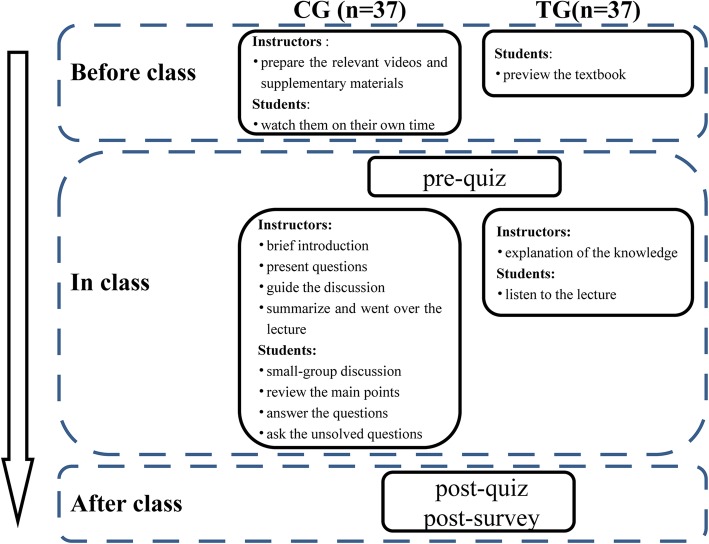
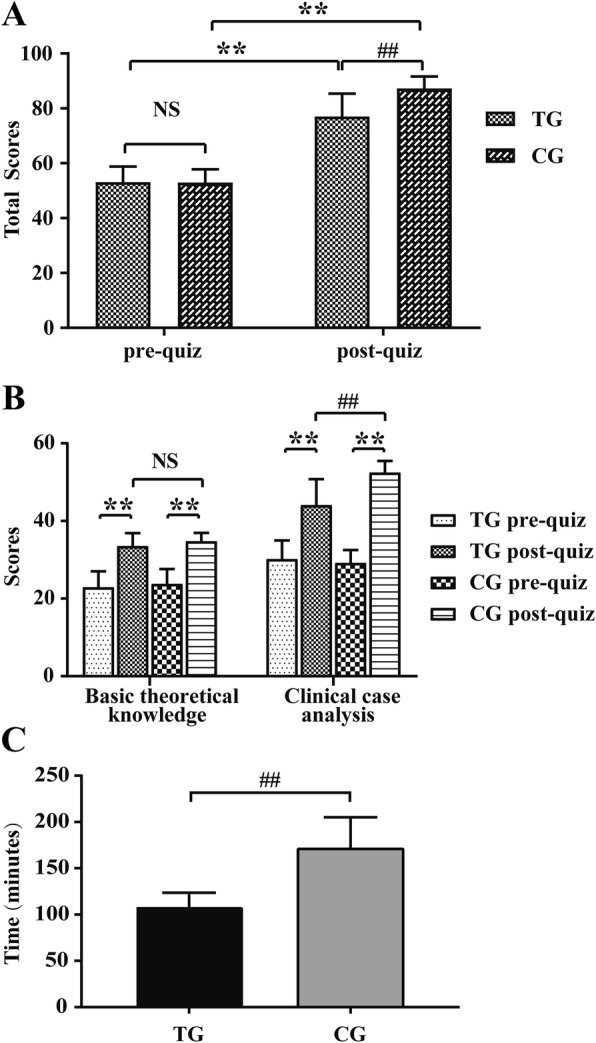
Verification
Claims the paper makes
The claims and statistics of this paper haven’t been checked yet.
Run the check — free, no account needed. It reads the open-access text and checks the sources it cites.
Claims other papers make about this one
Each is checked against this paper’s own text: does it say what the citing paper says it does?
The cited source doesn’t support the claim as written.
In the citing paper
“but in 9 studies the overall satisfaction scores for the PBL program were neutral [76, 111–116] or negative [117, 118].”
From Effectiveness of problem-based learning methodology in undergraduate medical education: a scoping review (2022) · cites this paper as [76]
Checked by a reasoning model — may be wrong.
Experimental — accuracy not yet measured
Self-check
Percentages, sums and reported differences re-computed from the paper’s own numbers.
The self-check needs the paper’s full text.
Citations
Cites
(2001) · Cited by 13,930
Flip Your Classroom: Reach Every Student in Every Class Every Day
Sams, A., & Bergmann, J. (2012) · Medical Entomology and Zoology · Cited by 3,810
Effectiveness of Problem-based Learning Curricula: Research and Theory
Colliver, J. A. (2000) · Academic Medicine · doi:10.1097/00001888-200003000-00017 · Cited by 917
A systematic review of the effectiveness of flipped classrooms in medical education
Chen, F., Lui, A. M., & Martinelli, S. M. (2017) · Medical Education · doi:10.1111/medu.13272 · Cited by 822
McLean, S. F. (2016) · Journal of Medical Education and Curricular Development · doi:10.4137/jmecd.s20377 · Cited by 759
The evidence for ‘flipping out’: A systematic review of the flipped classroom in nursing education
Betihavas, V., Bridgman, H., Kornhaber, R. A., & Cross, M. (2015) · Nurse Education Today · doi:10.1016/j.nedt.2015.12.010 · Cited by 658
Advances in medical education and practice: student perceptions of the flipped classroom
Ramnanan, C. J., & Pound, L. D. (2017) · Advances in Medical Education and Practice · doi:10.2147/amep.s109037 · Cited by 349
Twelve tips for “flipping” the classroom
Moffett, J. (2014) · Medical Teacher · doi:10.3109/0142159x.2014.943710 · Cited by 307
Team-based learning (TBL) in the medical curriculum: better than PBL?
Burgess, A. W., Bleasel, J. F., Haq, I., Roberts, C., Garsia, R. J., Robertson, T., & Mellis, C. (2017) · BMC Medical Education · doi:10.1186/s12909-017-1068-z · Cited by 235
Morton, D. A., & Colbert‐Getz, J. M. (2016) · Anatomical Sciences Education · doi:10.1002/ase.1635 · Cited by 234
Tolks, D., Schäfer, C., Raupach, T., Kruse, L., Sarikas, A., Gerhardt‐Szép, S., Kllauer, G., Lemos, M., Fischer, M. R., Eichner, B., et al. (2016) · Europe PMC (PubMed Central) · doi:10.3205/zma001045 · Cited by 227
Comparison between flipped classroom and lecture-based classroom in ophthalmology clerkship
Fen, T., Chen, C., Zhu, Y., Zuo, C., Zhong, Y., Wang, N., Zhou, L., Zou, Y., & Liang, D. (2017) · Medical Education Online · doi:10.1080/10872981.2017.1395679 · Cited by 204
Computer assisted learning. A Review
Schittek, M., Mattheos, N., Lyon, H. C., & Attström, R. (2001) · European Journal Of Dental Education · doi:10.1034/j.1600-0579.2001.050301.x · Cited by 160
The flipped classroom: now or never?
Hawks, S. J. (2014) · PubMed · Cited by 130
Burgess, A. W., Roberts, C., Ayton, T., & Mellis, C. (2018) · BMC Medical Education · doi:10.1186/s12909-018-1172-8 · Cited by 123
Facing the challenges in ophthalmology clerkship teaching: Is flipped classroom the answer?
Lin, Y., Zhu, Y., Chen, C., Wang, W., Chen, T., Li, T., Li, Y., Liu, B., Lian, Y., Lü, L., et al. (2017) · PLoS ONE · doi:10.1371/journal.pone.0174829 · Cited by 106
Electronic Curriculum Implementation at North American Dental Schools
Hendricson, W. D., Panagakos, F. S., Eisenberg, E. S., McDonald, J. L., Guest, G. F., Jones, P. C., Johnson, L. A., & Cintron, L. (2004) · Journal of Dental Education · doi:10.1002/j.0022-0337.2004.68.10.tb03851.x · Cited by 88
Advances in medical education and practice: student perceptions of the flipped classroom
Sait, M. S., Siddiqui, Z., & Ashraf, Y. (2017) · Advances in Medical Education and Practice · doi:10.2147/amep.s133328 · Cited by 68
Lucas, K. H., Testman, J. A., Hoyland, M. N., Kimble, A. M., & Euler, M. L. (2013) · American Journal of Pharmaceutical Education · doi:10.5688/ajpe778171 · Cited by 57
The Future of the Lecture in Neurology Education
Schaefer, S. M., Dominguez, M., & Moeller, J. J. (2018) · Seminars in Neurology · doi:10.1055/s-0038-1667042 · Cited by 55
Evaluation of a flipped classroom approach to learning introductory epidemiology
Shiau, S., Kahn, L. G., Platt, J., Li, C., Guzman, J. T., Kornhauser, Z. G. C., Keyes, K. M., & Martins, S. S. (2018) · BMC Medical Education · doi:10.1186/s12909-018-1150-1 · Cited by 54
The effectiveness of PBL: the debate continues. Is meta‐analysis helpful?
Farrow, R., & Norman, G. R. (2003) · Medical Education · doi:10.1046/j.1365-2923.2003.01725.x · Cited by 47
Revisiting ‘Foundations of problem‐based learning: some explanatory notes’
Servant, V. F. C., & Schmidt, H. G. (2016) · Medical Education · doi:10.1111/medu.12803 · Cited by 30
Kandi, V., & Basireddy, P. R. (2018) · Cureus · doi:10.7759/cureus.2029 · Cited by 25
An integrated problem-based curriculum for biochemistry teaching in medical sciences
Puri, D. (2002) · Indian Journal of Clinical Biochemistry · doi:10.1007/bf02867971 · Cited by 22
Effects of problem‐based learning in paediatric education in China: a meta‐analysis
Gao, X., Luo, S., Mu, D., Xiong, Y., Guanjian, L., & Wan, C. (2016) · Journal of Evidence-Based Medicine · doi:10.1111/jebm.12190 · Cited by 22
Kumar, N., Kanchan, T., Unnikrishnan, B., Thapar, R., Mithra, P., Kulkarni, V., Holla, R., Bhagawan, D., & Radhakrishnan, Y. (2017) · Indian Journal of Pharmacology · doi:10.4103/ijp.ijp_492_16 · Cited by 14
Flipping the Classroom in Medical Student Education: Does Priming Work?
Rose, E., Jhun, P., Baluzy, M., Hauck, A., Huang, J., Wagner, J., Kearl, Y. L., Behar, S., & Claudius, I. A. (2018) · Western Journal of Emergency Medicine · doi:10.5811/westjem.2017.8.35162 · Cited by 13
Deshpande, A. N., Naik, K., Poonacha, K., Dave, B. H., Joshi, N., & Mehta, D. (2019) · Applied Medical Research · doi:10.5455/amr.20180406075050 · Cited by 5
Research works printed but not linked: 6
- Hu X, Chen W, Sun W, Yu L, Shi Z, Jin G. Application of the teaching method combining PBL with CBL in resident standardization training in the department of endocrinology. Chinese J Gen Prac. 2017;15(7):1236–8.
- Zhou R, Li C, Chen L, Wu X. Application of flipped classroom combined with PBL in physiology teaching. Basic Med Educ. 2018;20(1):12–4.
- Yang R, Jia Q, Wang Y, Ma S, Gao Q, Guan S. Application of flipped classroom combined with problem-based learning teaching mode in the teaching of the structure and function of human body. J Qiqihar University of Medicine. 2017;38(1):89–90.
- Ma X, Huang Y, Song Z, Zhang X. Application of PBL combined flipped classroom in biochemistry and molecular biology teaching. J Jining Medical University. 2018(5):375–8.
- Sun M, Zhao W, Tan S, Zhang F, Bu R. Application of PBL combined with flipped classroom in internship instruction in the department of urology. Basic Med Educ. 2018;20(8):680–3.
- Mi W, Dong Z, Lian W, Shi T, Jie W. Studying on the application of flipped classroom model on PBL in teaching of preventive medicine. The Chinese Health Serv Manage. 2017;34(8):615–8.
Cited by
Sorted by citations
Trullàs, J. C., Blay, C., Sarri, E., & Pujol, R. (2022) · BMC Medical Education · doi:10.1186/s12909-022-03154-8 · Cited by 473
Zhao, W., He, L., Deng, W., Zhu, J., Su, A., & Zhang, Y. (2020) · BMC Medical Education · doi:10.1186/s12909-020-02306-y · Cited by 295
The link between flipped and active learning: a scoping review
Li, R., Lund, A., & Nordsteien, A. (2021) · Teaching in Higher Education · doi:10.1080/13562517.2021.1943655 · Cited by 152
Naing, C. M., Whittaker, M. A., Aung, H. H., Chellappan, D. K., & Riegelman, A. (2023) · Campbell Systematic Reviews · doi:10.1002/cl2.1339 · Cited by 76
Flipped classroom improves nursing students’ theoretical learning in China: A meta-analysis
Li, B., Cao, N., Ren, C.-X., Chu, X., Zhou, H., & Guo, B. (2020) · PLoS ONE · doi:10.1371/journal.pone.0237926 · Cited by 68
Metadata
- Authors
- Hu, X., Zhang, H., Song, Y., Wu, C., Yang, Q., Shi, Z., Zhang, X., & Chen, W.
- Affiliations
- Bengbu Medical College (CN)
- First Affiliated Hospital of Bengbu Medical College (CN)
- Corresponding author
- Hu, Xiaolei
- Chen, Weidong
- Venue
- BMC Medical Education
- Published
- 2019-07-30
- Volume
- 19
- Issue
- 1
- Pages
- 290-290
- ISSN
- 1472-6920 (ISSN-L)
- PMC
- PMC6668058
- OpenAlex
- W2965171981
- Cited by
- 105
- References
- 29
- Citations by year
- 2026: 7 · 2025: 11 · 2024: 20 · 2023: 18 · 2022: 21 · 2021: 9 · 2020: 18 · 2019: 1
- FWCI
- 33.08
- Type
- journal article
- Language
- en
- Open access
- gold
- doi.org
- Locations
- BMC Medical Education (publishedVersion, cc-by)
- Europe PMC (PubMed Central) (publishedVersion, cc-by)
- PubMed Central (publishedVersion, cc-by)
- PubMed (publishedVersion)
- DOAJ (DOAJ: Directory of Open Access Journals) (submittedVersion, cc-by-sa)
- Funders
- Quality Project for Undergraduate Teaching, Bengbu Medical College (2017jyxm62)
- Topics
- Social Sciences › Education › Innovative Teaching Methods
- Social Sciences › Education › Innovations in Medical Education
- Social Sciences › Education › Problem and Project Based Learning
- Keywords
- flipped classroom, problem-based learning, hyperthyroidism, medical students, lecture method comparison, clinical case analysis, Bloom's taxonomy, student perceptions, student workload
- MeSH terms
- China, Endocrinology, Female, Humans, Hyperthyroidism, Internship and Residency, Male, Surveys and Questionnaires, Students, Medical, Teaching, Problem-Based Learning, Young Adult
About these checks
Registry, retraction, Cites and statistics results are computed, not judged, with one exception: a printed reference that no index lists is read once by a model before it counts as a citation error. Claims are extracted by a model and kept only when their quote appears verbatim in the text; each cited source is then checked, with a model’s help, for whether it says what the claim relies on. Those verdicts can be wrong — read the claim’s quote and the cited source before relying on one.
Statistics and arithmetic are recomputed, not judged.
Confidence bands are shown only for fields calibrated on our annotated test set. None is calibrated yet, so no band is shown.
What counts as a claim ›How we measure confidence ›How we check this ›
Are you an author, or do you see a problem with this page? Request a review
