

The DOI matches its Crossref record; 34 of the 35 references it cites were found in a registry or an index.
Artificial intelligence in medical education - perception among medical students
Open accessPublished version of a preprint
Abstract
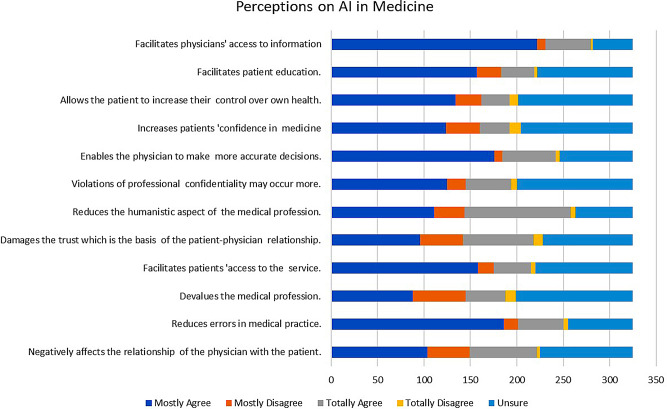
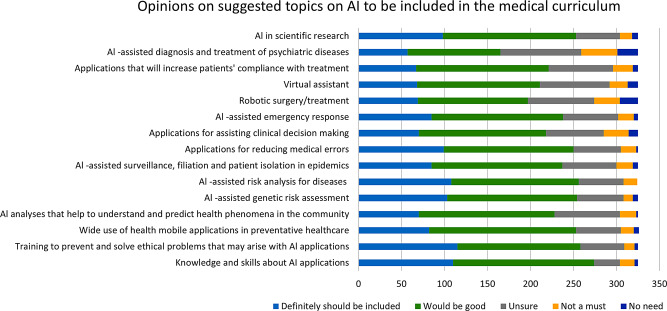
Background: As Artificial Intelligence (AI) becomes pervasive in healthcare, including applications like robotic surgery and image analysis, the World Medical Association emphasises integrating AI education into medical curricula. This study evaluates medical students’ perceptions of ‘AI in medicine’, their preferences for AI training in education, and their grasp of AI’s ethical implications in healthcare. Materials & methods: A cross-sectional study was conducted among 325 medical students in Kerala using a pre-validated, semi structured questionnaire. The survey collected demographic data, any past educational experience about AI, participants’ self-evaluation of their knowledge and evaluated self-perceived understanding of applications of AI in medicine. Participants responded to twelve Likert-scale questions targeting perceptions and ethical aspects and their opinions on suggested topics on AI to be included in their curriculum. Results & discussion: AI was viewed as an assistive technology for reducing medical errors by 57.2% students and 54.2% believed AI could enhance medical decision accuracy. About 49% agreed that AI could potentially improve accessibility to healthcare. Concerns about AI replacing physicians were reported by 37.6% and 69.2% feared a reduction in the humanistic aspect of medicine. Students were worried about challenges to trust (52.9%), patient-physician relationships (54.5%) and breach of professional confidentiality (53.5%). Only 3.7% felttotally competent in informing patients about features and risks associated with AI applications. Strong demand for structured AI training was expressed, particularly on reducing medical errors (76.9%) and ethical issues (79.4%). Conclusion: This study highlights medical students’ demand for structured AI training in undergraduate curricula, emphasising its importance in addressing evolving healthcare needs and ethical considerations. Despite widespread ethical concerns, the majority perceive AI as an assistive technology in healthcare. These findings provide valuable insights for curriculum development and defining learning outcomes in AI education for medical students.
Overview
The claims and statistics of this paper haven’t been checked yet.
Run the check — free, no account needed. It reads the open-access text and checks the sources it cites.
Integrity signals
Registry
Cites
Statistics
Figures
Verification
Claims the paper makes
The claims and statistics of this paper haven’t been checked yet.
Run the check — free, no account needed. It reads the open-access text and checks the sources it cites.
Claims other papers make about this one
Each is checked against this paper’s own text: does it say what the citing paper says it does?
The source backs part of the claim, not all of it — or backs it for a different population, condition or comparison.
In the citing paper
“Structured AI training was highly valued, with 243 out of 325 respondents (74.8%) highlighting its role in reducing medical errors”
From Is it time to introduce an artificial intelligence curriculum in undergraduate medical education? medical students’ perspectives: a systematic review and meta-analysis (2026) · cites this paper as [46]
Experimental — accuracy not yet measuredThe source backs part of the claim, not all of it — or backs it for a different population, condition or comparison.
In the citing paper
“AI’s perceived potential to reduce diagnostic errors (57.2% in India) [46]”
From Is it time to introduce an artificial intelligence curriculum in undergraduate medical education? medical students’ perspectives: a systematic review and meta-analysis (2026) · cites this paper as [46]
Experimental — accuracy not yet measuredThe cited source says what the claim attributes to it.
In the citing paper
“258 out of 325 respondents (79.4%) emphasizing its relevance to ethical decision-making [46].”
Self-check
Percentages, sums and reported differences re-computed from the paper’s own numbers.
The self-check needs the paper’s full text.
Citations
Cites
Dermatologist-level classification of skin cancer with deep neural networks
Esteva, A., Kuprel, B., Novoa, R. A., Ko, J., Swetter, S. M., Blau, H. M., & Thrun, S. (2017) · Nature · doi:10.1038/nature21056 · Cited by 14,362
Gulshan, V., Peng, L., Coram, M., Stumpe, M. C., Wu, D., Narayanaswamy, A., Venugopalan, S., Widner, K., Madams, T., Cuadros, J., et al. (2016) · JAMA · doi:10.1001/jama.2016.17216 · Cited by 7,697
Convolutional neural networks: an overview and application in radiology
Yamashita, R., Nishio, M., Do, R. K. G., & Togashi, K. (2018) · Insights into Imaging · doi:10.1007/s13244-018-0639-9 · Cited by 4,682 · cited 2×
“Many of the medical students interviewed in this study said that the anxiety they felt about being “dis-placed” by AI technologies in radiology would discourage them from considering the field for specialisation [14, 31–33].”
BackgroundArtificial intelligence in radiology
Hosny, A., Parmar, C., Quackenbush, J., Schwartz, L. H., & Aerts, H. J. W. L. (2018) · Nature Reviews Cancer · doi:10.1038/s41568-018-0016-5 · Cited by 3,803
The potential for artificial intelligence in healthcare
Davenport, T., & Kalakota, R. (2019) · Future Healthcare Journal · doi:10.7861/futurehosp.6-2-94 · Cited by 3,800
Ehteshami Bejnordi, B., Veta, M., Johannes van Diest, P., van Ginneken, B., Karssemeijer, N., Litjens, G., van der Laak, J. A. W. M., and the CAMELYON16 Consortium, Hermsen, M., Manson, Q. F., et al. (2017) · JAMA · doi:10.1001/jama.2017.14585 · Cited by 3,293
Ethics Guidelines for Trustworthy AI
Cannarsa, M. (2021) · The Cambridge Handbook of Lawyering in the Digital Age · doi:10.1017/9781108936040.022 · Cited by 2,095
Privacy and artificial intelligence: challenges for protecting health information in a new era
Murdoch, B. (2021) · BMC Medical Ethics · doi:10.1186/s12910-021-00687-3 · Cited by 991
(1983) · Springer eBooks · doi:10.1007/978-3-662-12405-5 · Cited by 758
Medical students' attitude towards artificial intelligence: a multicentre survey
Pinto dos Santos, D., Giese, D., Brodehl, S., Chon, S. H., Staab, W., Kleinert, R., Maintz, D., & Baeßler, B. (2019) · European Radiology · doi:10.1007/s00330-018-5601-1 · Cited by 754
Research works printed but not linked: 3
- Turing AM. Computing Machinery and Intelligence. Parsing the Turing Test. Dordrecht: Springer Netherlands; 2009;23–65.
- Artificial intelligence in medical applications and ethical problems: knowledge and thoughts of medical students Survey form used in: Civaner MM, Uncu Y, Bulut F, Chalil EG, Tatlı A. Artificial intelligence in medical education: a cross-sectional needs assessment. BMC Medical Education. 2022;22(1):772. mcivaner@gmail.com. · DOI · Paper page
- Augmented Intelligence in Health Care. AMA AI, Board Report. 2018. https://www.ama-assn.org/system/files/2019-08/ai-2018-board-report.pdf.
Cited by
Sorted by citations
Medical students’ attitudes toward AI in education: perception, effectiveness, and its credibility
Sami, A., Tanveer, F., Sajwani, K., Kiran, N., Javed, M. A., Ozsahin, D. U., Muhammad, K., & Waheed, Y. (2025) · BMC Medical Education · doi:10.1186/s12909-025-06704-y · Cited by 183
Issa, W. B., Shorbagi, A., Al-Sharman, A., Rababa, M., Al-Majeed, K., Radwan, H., Refaat Ahmed, F., Al-Yateem, N., Mottershead, R., Abdelrahim, D. N., et al. (2024) · BMC Medical Education · doi:10.1186/s12909-024-06076-9 · Cited by 78
“…a cross-sectional study of medical students ( N = 325) from India showed that 37.6% of participants were concerned about the negative impact of AI on their future; they believed that AI would decrease the need for physicians, leading to unemployment and replacing healthcare professionals [17].”
BackgroundResultInfluentialIntegrating AI and Assistive Technologies in Healthcare: Insights from a Narrative Review of Reviews
Giansanti, D., & Pirrera, A. (2025) · Healthcare · doi:10.3390/healthcare13050556 · Cited by 89
Shishehgar, S., Murray‐Parahi, P., Alsharaydeh, E., Mills, S., & Liu, X. (2025) · International Nursing Review · doi:10.1111/inr.70045 · Cited by 81
Tran, M., Balasooriya, C. D., Jonnagaddala, J., Leung, G., Mahboobani, N. R., Ramani, S., Rhee, J., Schuwirth, L., Najafzadeh-Tabrizi, N. S., Semmler, C., et al. (2025) · npj Digital Medicine · doi:10.1038/s41746-025-01721-z · Cited by 61
Metadata
- Authors
- Jackson, P., Ponath Sukumaran, G., Babu, C., Tony, M. C., Jack, D. S., Reshma, V. R., Davis, D., Kurian, N., & John, A.
- Affiliations
- Pushpagiri Medical College (IN)
- Venue
- BMC Medical Education
- Published
- 2024-07-27
- Volume
- 24
- Issue
- 1
- Pages
- 804-804
- ISSN
- 1472-6920 (ISSN-L)
- PMC
- PMC11283685
- OpenAlex
- W4401046213
- Cited by
- 185
- References
- 35
- Citations by year
- 2026: 110 · 2025: 63 · 2024: 12
- FWCI
- 17.30
- Type
- journal article
- Language
- en
- Open access
- gold
- doi.org
- Locations
- BMC Medical Education (publishedVersion, cc-by)
- Research Square (acceptedVersion, cc-by)
- PubMed Central (publishedVersion, cc-by)
- PubMed (publishedVersion)
- DOAJ (DOAJ: Directory of Open Access Journals) (submittedVersion, cc-by-sa)
- Topics
- Health Sciences › Medicine › Health Informatics › Artificial Intelligence in Healthcare and Education
- Social Sciences › Education › Innovations in Medical Education
- Social Sciences › Education › Artificial Intelligence in Education
- Keywords
- artificial intelligence in healthcare, medical students' perceptions, ethics of AI in healthcare, medical errors, physician-patient trust, professional secrecy, AI training needs, undergraduate medical education
- MeSH terms
- Adult, Artificial Intelligence, Attitude of Health Personnel, Cross-Sectional Studies, Curriculum, Education, Medical, Education, Medical, Undergraduate, Female, Humans, India, Male, Surveys and Questionnaires, Students, Medical, Young Adult
About these checks
Registry, retraction, Cites and statistics results are computed, not judged, with one exception: a printed reference that no index lists is read once by a model before it counts as a citation error. Claims are extracted by a model and kept only when their quote appears verbatim in the text; each cited source is then checked, with a model’s help, for whether it says what the claim relies on. Those verdicts can be wrong — read the claim’s quote and the cited source before relying on one.
Statistics and arithmetic are recomputed, not judged.
Confidence bands are shown only for fields calibrated on our annotated test set. None is calibrated yet, so no band is shown.
What counts as a claim ›How we measure confidence ›How we check this ›
Are you an author, or do you see a problem with this page? Request a review
