

The DOI matches its Crossref record; 53 of the 53 references it cites were found in a registry or an index.
Global cross-sectional student survey on AI in medical, dental, and veterinary education and practice at 192 faculties
Open accessPublished version of a preprint
Abstract
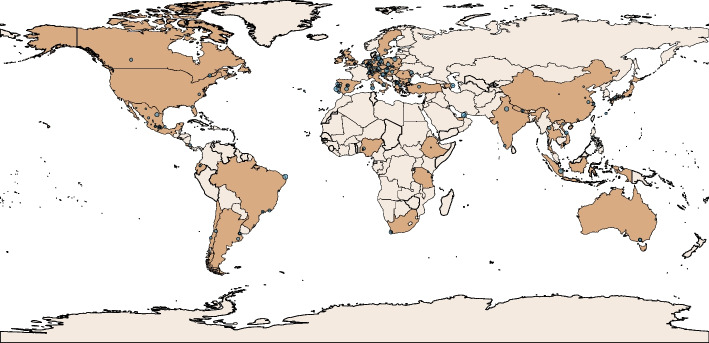
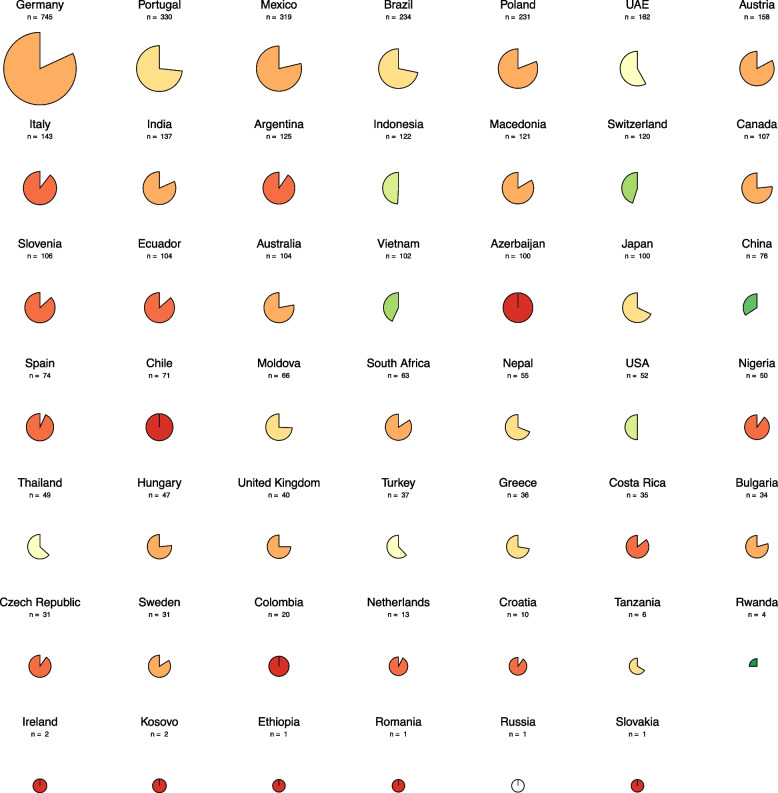
Background: The successful integration of artificial intelligence (AI) in healthcare depends on the global perspectives of all stakeholders. This study aims to answer the research question: What are the attitudes of medical, dental, and veterinary students towards AI in education and practice, and what are the regional differences in these perceptions? Methods: An anonymous online survey was developed based on a literature review and expert panel discussions. The survey assessed students' AI knowledge, attitudes towards AI in healthcare, current state of AI education, and preferences for AI teaching. It consisted of 16 multiple-choice items, eight demographic queries, and one free-field comment section. Medical, dental, and veterinary students from various countries were invited to participate via faculty newsletters and courses. The survey measured technological literacy, AI knowledge, current state of AI education, preferences for AI teaching, and attitudes towards AI in healthcare using Likert scales. Data were analyzed using descriptive statistics, Mann–Whitney U-test, Kruskal–Wallis test, and Dunn-Bonferroni post hoc test. Results: The survey included 4313 medical, 205 dentistry, and 78 veterinary students from 192 faculties and 48 countries. Most participants were from Europe (51.1%), followed by North/South America (23.3%) and Asia (21.3%). Students reported positive attitudes towards AI in healthcare (median: 4, IQR: 3–4) and a desire for more AI teaching (median: 4, IQR: 4–5). However, they had limited AI knowledge (median: 2, IQR: 2–2), lack of AI courses (76.3%), and felt unprepared to use AI in their careers (median: 2, IQR: 1–3). Subgroup analyses revealed significant differences between the Global North and South ( r = 0.025 to 0.185, all P < .001) and across continents ( r = 0.301 to 0.531, all P < .001), with generally small effect sizes. Conclusions: This large-scale international survey highlights medical, dental, and veterinary students' positive perceptions of AI in healthcare, their strong desire for AI education, and the current lack of AI teaching in medical curricula worldwide. The study identifies a need for integrating AI education into medical curricula, considering regional differences in perceptions and educational needs. Trial registration: Not applicable (no clinical trial).
Overview
The claims and statistics of this paper haven’t been checked yet.
Run the check — free, no account needed. It reads the open-access text and checks the sources it cites.
Integrity signals
Registry
Cites
Statistics
Figures
Verification
Claims the paper makes
The claims and statistics of this paper haven’t been checked yet.
Run the check — free, no account needed. It reads the open-access text and checks the sources it cites.
Claims other papers make about this one
Each is checked against this paper’s own text: does it say what the citing paper says it does?
The source backs part of the claim, not all of it — or backs it for a different population, condition or comparison.
In the citing paper
“Global South students report substantially less AI integration in curricula and lower preparedness levels (Busch et al., 2024; Rincón et al., 2025).”
From Reimagining writing assessment for the AI era: a systematic review on balancing AI support and authentic skill growth (2026) · cites this paper as Busch et al., 2024
Experimental — accuracy not yet measured
Self-check
Percentages, sums and reported differences re-computed from the paper’s own numbers.
The self-check needs the paper’s full text.
Citations
Cites
Statistical Power Analysis for the Behavioral Sciences
Muller, K. E., & Cohen, J. (1989) · Technometrics · doi:10.2307/1270020 · Cited by 99,603
Harris, P. A., Taylor, R., Thielke, R., Payne, J., Gonzalez, N., & Conde, J. G. (2009) · Journal of Biomedical Informatics · doi:10.1016/j.jbi.2008.08.010 · Cited by 51,384
The REDCap consortium: building an international community of software platform partners
Harris, P. A., Taylor, R., Minor, B. L., Elliott, V., Fernandez, M., O'Neal, L., McLeod, L., Delacqua, G., Delacqua, F., Kirby, J., et al. (2019) · Journal of Biomedical Informatics · doi:10.1016/j.jbi.2019.103208 · Cited by 24,013 · cited 1×
“…– University Medicine Berlin, the English survey was subsequently disseminated through the medical student newsletter at Charité and deac-tivated after receiving responses from 50 medical students who served as the pilot study group and were not included in the final participant pool [26, 27].”
MethodWickham, H., Averick, M., Bryan, J., Chang, W., McGowan, L., François, R., Grolemund, G., Hayes, A., Henry, L., Hester, J., et al. (2019) · Journal of Open Source Software · doi:10.21105/joss.01686 · Cited by 22,138
Vandenbroucke, J. P., von Elm, E., Altman, D. G., Gøtzsche, P. C., Mulrow, C. D., Pocock, S. J., Poole, C., Schlesselman, J. J., Egger, M., & Initiative, F. T. S. (2007) · PLoS Medicine · doi:10.1371/journal.pmed.0040297 · Cited by 8,613
“Why Should I Trust You?”: Explaining the Predictions of Any Classifier
Ribeiro, M., Singh, S., & Guestrin, C. (2016) · Proceedings of the 2016 Conference of the North American Chapter of the Association for Computational Linguistics: Demonstrations · doi:10.18653/v1/n16-3020 · Cited by 6,682
Artificial intelligence in healthcare: past, present and future
Jiang, F., Jiang, Y., Zhi, H., Dong, Y., Li, H., Ma, S., Wang, Y., Dong, Q., Shen, H., & Wang, Y. (2017) · Stroke and Vascular Neurology · doi:10.1136/svn-2017-000101 · Cited by 4,837
Simple Features for R: Standardized Support for Spatial Vector Data
Pebesma, E. (2018) · The R Journal · doi:10.32614/rj-2018-009 · Cited by 4,041
The potential for artificial intelligence in healthcare
Davenport, T., & Kalakota, R. (2019) · Future Healthcare Journal · doi:10.7861/futurehosp.6-2-94 · Cited by 3,800
Research works printed but not linked: 3
- Chan KS, Zary N. Applications and challenges of implementing artificial intelligence in medical education: integrative review. JMIR Med Educ. 2019;5(1):e13930. · DOI · Paper page
- Schinkel K, Nannan M, Panday R, Car J. Introducing Artificial Intelligence Training in Medical Education. JMIR Med Educ. 2019;5(2):e16048. https://doi.org/10.2196/16048. · DOI · Paper page
- Lundberg SM, Lee S-I. A unified approach to interpreting model predictions. Adv Neural Inf Process Syst. 2017;30:4768–77.
Cited by
Sorted by citations
Issa, W. B., Shorbagi, A., Al-Sharman, A., Rababa, M., Al-Majeed, K., Radwan, H., Refaat Ahmed, F., Al-Yateem, N., Mottershead, R., Abdelrahim, D. N., et al. (2024) · BMC Medical Education · doi:10.1186/s12909-024-06076-9 · Cited by 78
Li, J., Yin, K., Wang, Y., Jiang, X., & Chen, D. (2025) · BMC Medical Education · doi:10.1186/s12909-025-07750-2 · Cited by 64
Artificial intelligence in medical education: promise, pitfalls, and practical pathways
Saroha, S. (2025) · Advances in Medical Education and Practice · doi:10.2147/amep.s523255 · Cited by 53
Dai, Q., Li, M., Yang, M., Shi, S., Wang, Z., Liao, J., Li, Z., Weinan, E., Tao, L., & Tang, Y. (2025) · Journal of Medical Internet Research · doi:10.2196/75343 · Cited by 58
Using ChatGPT for medical education: the technical perspective
Chan, K. Y., Yuen, T. H., & Co, M. (2025) · BMC Medical Education · doi:10.1186/s12909-025-06785-9 · Cited by 34
Metadata
- Authors
- Busch, F., Hoffmann, L., Truhn, D., Ortiz-Prado, E., Makowski, M. R., Bressem, K. K., Adams, L. C., COMFORT Consortium, Abdala, N., Navarro, Á. A., Aerts, H. J. W. L., Águas, C., Aineseder, M., Alomar, M., Angkurawaranon, S., Angus, Z. G., Asouchidou, E., Bakhshi, S., Bamidis, P. D., Barbosa, P. N. V. P., Bayramov, N. Y., Billis, A., Bitencourt, A. G. V., Becerra, A. J., Busomoke, F., Capela, A., Cau, R., Clements, W., Corlateanu, A., Cuocolo, R., Cương, N. N., Gama, Z., de Medeiros, P. J., de Velasco, G., Desai, V. B., Dhakal, A. K., Dignum, V., Domitrz, I., Ferrarotti, C., Fułek, K., Ganguly, S., García-Juárez, I., Savevska, C. G., Radovikj, M. G., Gorelik, N., Gorelik, V., Gorospe, L., Griffin, I., Grzybowski, A., Hering, A., Hide, M., Hochhegger, B., Hofstaetter, J. G., Huseynova, M. R., Iaconi, O.-S., Torres, P. I., Ivanova, N. G., Izquierdo-Condoy, J. S., Jackson, A. B., Jha, A. K., Jha, N., Jiang, L., Kader, R., Kaul, P., Kaya, G., Kępczyńska, K., Kolawole, I. K., Kolostoumpis, G., Koshy, A., Kruger, N. A., Loeser, A., Lucijanic, M., Maihoub, S., McFadden, S., Avila, M. C., Mihalčin, M., Miyake, M., Mogami, R., Molnár, A., Morakote, W., Ngabonziza, I., Ngo, T. Q., Nguyen, T. T., Nortje, M., Palaian, S., de Almeida, R. P., Perić, B., Pilko, G., Bates, M. L., Purwoko, M., Rainey, C., Ribeiro, J. C., Rodriguez-Granillo, G. A., Agudelo, N. R., Saba, L., Sadasivan, S., Sado, K., Saidman, J. M., Saturno-Hernandez, P. J., Schwarz, G. M., Solis-Barquero, S. M., Pérez-Olivares, J. S., Sountoulides, P., Stanzione, A., Tabakova, N. G., Takeda, K., Tanioka, S., Thulesius, H. O., Toapanta-Yanchapaxi, L. N., Truong, M. H., Tuncel, M., van Dijk, E. H. C., van Wijngaarden, P., Xu, L., Zatoński, T., & Zhang, L.
- Affiliations
- TUM Klinikum (DE)
- Humboldt-Universität zu Berlin (DE)
- Universitätsklinikum Aachen (DE)
- Deutsches Herzzentrum München (DE)
- Ss. Cyril and Methodius University in Skopje (MK)
- Hue University (VN)
- Corresponding author
- Busch, Felix
- ORCID
- Busch, Felix
- Hoffmann, Lena
- Truhn, Daniel
- Makowski, Marcus R.
- Bressem, Keno K.
- Adams, Lisa C.
- Alomar, Muaed
- Angus, Zachary G.
- Bayramov, Nuru Y.
- Capela, Andreia
- Cau, Riccardo
- Cuocolo, Renato
- Domitrz, Izabela
- Griffin, Ian
- Iaconi, Oana-Simina
- Kader, Rawen
- Kaya, Gürsan
- Kępczyńska, Katarzyna
- Mogami, Roberto
- Morakote, Wipawee
- Rainey, Clare
- Solis-Barquero, Sergio M.
- Venue
- BMC Medical Education
- Published
- 2024-09-28
- Volume
- 24
- Issue
- 1
- Pages
- 1066-1066
- ISSN
- 1472-6920 (ISSN-L)
- PMC
- PMC11439199
- OpenAlex
- W4402945053
- Cited by
- 108
- References
- 53
- Citations by year
- 2026: 65 · 2025: 38 · 2024: 5
- FWCI
- 10.10
- Type
- journal article
- Language
- en
- Open access
- gold
- doi.org
- Locations
- BMC Medical Education (publishedVersion, cc-by)
- medRxiv (acceptedVersion, cc-by)
- PubMed Central (publishedVersion, cc-by)
- PubMed (publishedVersion)
- UNICA IRIS Institutional Research Information System (University of Cagliari) (submittedVersion, cc-by)
- Open Repository and Bibliography (University of Luxembourg) (submittedVersion, cc-by)
- Cork Open Research Archive (University College Cork, Ireland) (submittedVersion, cc-by)
- DOAJ (DOAJ: Directory of Open Access Journals) (submittedVersion)
- mediaTUM (Technical University of Munich) (submittedVersion)
- RWTH Publications (RWTH Aachen) (submittedVersion, other-oa)
- Portuguese National Funding Agency for Science, Research and Technology (RCAAP Project by FCT) (submittedVersion, cc-by)
- RWTH Publications (RWTH Aachen)
- Funders
- HORIZON EUROPE Framework Programme (101079894)
- Charité - Universitätsmedizin Berlin
- Topics
- Health Sciences › Medicine › Health Informatics › Artificial Intelligence in Healthcare and Education
- Social Sciences › Education › Innovations in Medical Education
- Social Sciences › Education › Artificial Intelligence in Education
- Keywords
- artificial intelligence in healthcare, medical students, dental students, veterinary students, student attitudes toward AI, artificial intelligence in education, AI knowledge, technological literacy, regional variation, Global North and Global South, medical curriculum, dental curriculum, veterinary curriculum, clinical implementation of AI
- MeSH terms
- Adult, Artificial Intelligence, Attitude of Health Personnel, Cross-Sectional Studies, Curriculum, Education, Dental, Education, Medical, Education, Veterinary, Female, Humans, Male, Surveys and Questionnaires, Students, Dental, Students, Medical, Young Adult
About these checks
Registry, retraction, Cites and statistics results are computed, not judged, with one exception: a printed reference that no index lists is read once by a model before it counts as a citation error. Claims are extracted by a model and kept only when their quote appears verbatim in the text; each cited source is then checked, with a model’s help, for whether it says what the claim relies on. Those verdicts can be wrong — read the claim’s quote and the cited source before relying on one.
Statistics and arithmetic are recomputed, not judged.
Confidence bands are shown only for fields calibrated on our annotated test set. None is calibrated yet, so no band is shown.
What counts as a claim ›How we measure confidence ›How we check this ›
Are you an author, or do you see a problem with this page? Request a review
