

The ethical requirement of explainability for AI-DSS in healthcare: a systematic review of reasons
Open accessThe DOI matches its Crossref record; 55 of the 55 references it cites were found in a registry or an index.
Abstract
Background: Despite continuous performance improvements, especially in clinical contexts, a major challenge of Artificial Intelligence based Decision Support Systems (AI-DSS) remains their degree of epistemic opacity. The conditions of and the solutions for the justified use of the occasionally unexplainable technology in healthcare are an active field of research. In March 2024, the European Union agreed upon the Artificial Intelligence Act (AIA), requiring medical AI-DSS to be ad-hoc explainable or to use post-hoc explainability methods. The ethical debate does not seem to settle on this requirement yet. This systematic review aims to outline and categorize the positions and arguments in the ethical debate. Methods: We conducted a literature search on PubMed, BASE, and Scopus for English-speaking scientific peer-reviewed publications from 2016 to 2024. The inclusion criterion was to give explicit requirements of explainability for AI-DSS in healthcare and reason for it. Non-domain-specific documents, as well as surveys, reviews, and meta-analyses were excluded. The ethical requirements for explainability outlined in the documents were qualitatively analyzed with respect to arguments for the requirement of explainability and the required level of explainability. Results: The literature search resulted in 1662 documents; 44 documents were included in the review after eligibility screening of the remaining full texts. Our analysis showed that 17 records argue in favor of the requirement of explainable AI methods (xAI) or ad-hoc explainable models, providing 9 categories of arguments. The other 27 records argued against a general requirement, providing 11 categories of arguments. Also, we found that 14 works advocate the need for context-dependent levels of explainability, as opposed to 30 documents, arguing for context-independent, absolute standards. Conclusions: The systematic review of reasons shows no clear agreement on the requirement of post-hoc explainability methods or ad-hoc explainable models for AI-DSS in healthcare. The arguments found in the debate were referenced and responded to from different perspectives, demonstrating an interactive discourse. Policymakers and researchers should watch the development of the debate closely. Conversely, ethicists should be well informed by empirical and technical research, given the frequency of advancements in the field.
Overview
The claims and statistics of this paper haven’t been checked yet.
Free: it reads the open-access text and checks the first 5 claims that cite a source we can check. Create a free account to check every claim.
Integrity signals
Registry
Cites
Statistics
Figures
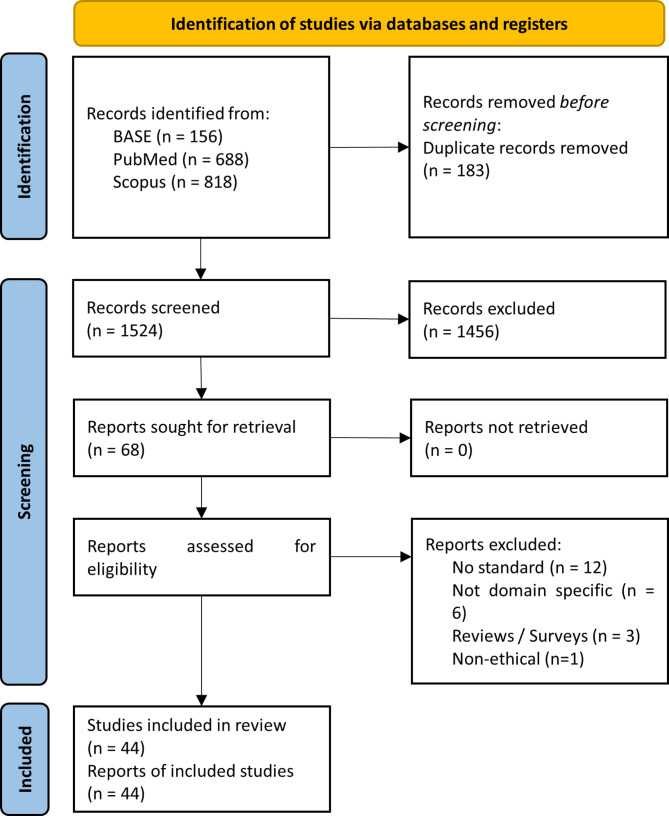
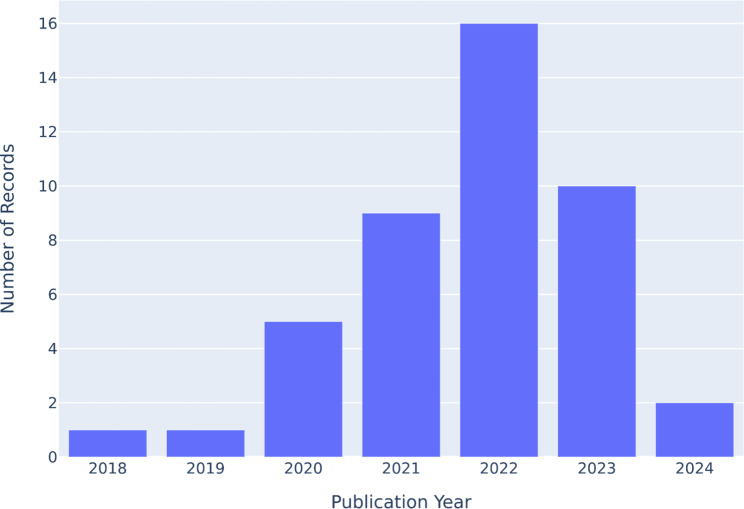
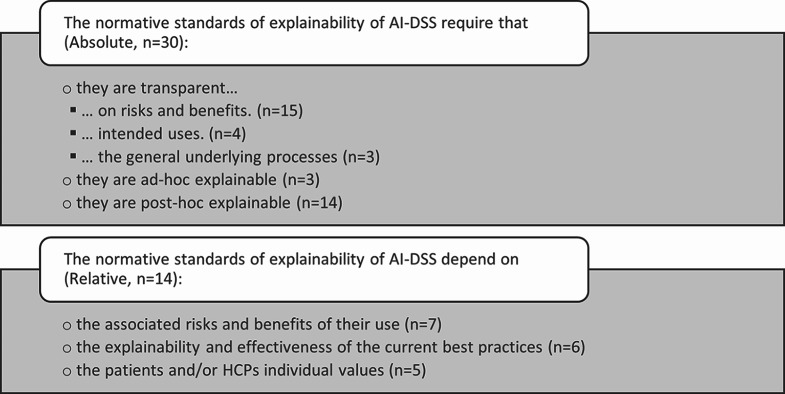
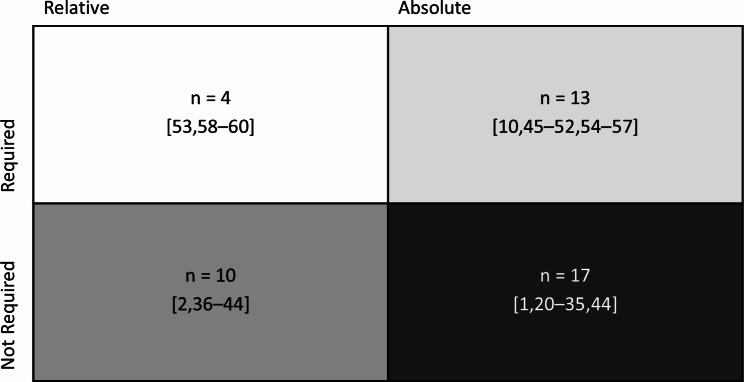
Verification
Claims the paper makes
The claims and statistics of this paper haven’t been checked yet.
Free: it reads the open-access text and checks the first 5 claims that cite a source we can check. Create a free account to check every claim.
Self-check
Percentages, sums and reported differences re-computed from the paper’s own numbers.
The self-check needs the paper’s full text.
Citations
Cites
The PRISMA 2020 statement: An updated guideline for reporting systematic reviews
Page, M. J., McKenzie, J. E., Bossuyt, P. M., Boutron, I., Hoffmann, T. C., Mulrow, C. D., Shamseer, L., Tetzlaff, J. M., Akl, E. A., Brennan, S. E., et al. (2021) · BMJ · doi:10.1136/bmj.n71 · Cited by 108,283
Rayyan-a web and mobile app for systematic reviews.
Ouzzani, M., Hammady, H., Fedorowicz, Z., & Elmagarmid, A. (2016) · Systematic Reviews · doi:10.1186/s13643-016-0384-4 · Cited by 26,092 · cited 1×
“We conducted the literature screening using Rayyan 2 for abstract screening and duplicate detection [16].”
MethodPage, M. J., Moher, D., Bossuyt, P. M., Boutron, I., Hoffmann, T. C., Mulrow, C. D., Shamseer, L., Tetzlaff, J. M., Akl, E. A., Brennan, S. E., et al. (2021) · BMJ · doi:10.1136/bmj.n160 · Cited by 13,262 · cited 2×
“We conducted a systematic review of reasons to characterize key presumptions and motivations in the debate and to identify the normative standards of explainability according to the PRISMA standards [13, 14].”
MethodFloridi, L., Cowls, J., Beltrametti, M., Chatila, R., Chazerand, P., Dignum, V., Luetge, C., Madelin, R., Pagallo, U., Rossi, F., et al. (2018) · Minds and Machines · doi:10.1007/s11023-018-9482-5 · Cited by 4,774 · cited 1×
“While formerly mostly a matter of debate for the philosophy of science, the ethical debate around this concern most famously took off with the AI4People framework by Floridi et al. in 2018, introducing the principle of explicability in the AI-ethics context [8].”
BackgroundGusenbauer, M., & Haddaway, N. R. (2020) · Research Synthesis Methods · doi:10.1002/jrsm.1378 · Cited by 2,379 · cited 1×
“The literature databases used are the Bielefeld Academic Search Engine (BASE), PubMed, and Scopus, as they cover the relevant domains and offer transparent and reproducible search options and results [15].”
MethodExplainability for artificial intelligence in healthcare: a multidisciplinary perspective
the Precise4Q consortium, Amann, J., Blasimme, A., Vayena, E., Frey, D., & Madai, V. I. (2020) · BMC Medical Informatics and Decision Making · doi:10.1186/s12911-020-01332-6 · Cited by 2,203
Liu, X., Faes, L., Kale, A. U., Wagner, S. K., Fu, D. J., Bruynseels, A., Mahendiran, T., Moraes, G., Shamdas, M., Kern, C., et al. (2019) · The Lancet Digital Health · doi:10.1016/s2589-7500(19)30123-2 · Cited by 1,883 · cited 1×
“Deep-learning-based AI-DSS impress with performance [3].”
Machine learning in medicine: Addressing ethical challenges
Vayena, E., Blasimme, A., & Cohen, I. G. (2018) · PLOS Medicine · doi:10.1371/journal.pmed.1002689 · Cited by 912 · cited 1×
“…duty to explain risks and benefits is satisfiable by the disclosure of risks inherited by the AI-DSS at use [36, 38], or the rationale for adopting AI-DSS in general [39], contradicting Vayena, who claims that the communication meaningful details was “fundamental tenet of medical ethics” [62].”
BackgroundArtificial Intelligence and Black‐Box Medical Decisions: Accuracy versus Explainability
London, A. J. (2019) · Hastings Center Report · doi:10.1002/hast.973 · Cited by 801 · cited 6×
“With an outcome-oriented perspective in favor of clinical benefits, this is a reason for some to avoid explainability as a default requirement [1, 24, 31].”
BackgroundInfluentialMittelstadt, B., Russell, C., & Wachter, S. (2019) · Proceedings of the Conference on Fairness, Accountability, and Transparency · doi:10.1145/3287560.3287574 · Cited by 794 · cited 1×
“In the literature, different types of explanations in scientific context were elaborated by philosophers of science for centuries [18, 19].”
Background
Research works printed but not linked: 6
- Kempt H, Heilinger JC, Nagel SK. I’m afraid I can’t let you do that, Doctor: meaningful disagreements with AI in medical contexts. AI Soc. 2022; https://www.scopus.com/inward/record.uri?eid=2-s2.0-85126268667&doi=10.1007%2fs00146-022-01418-x&partnerID=40&md5=1119b36454a9397335a9731ba4fe1b50 · DOI · Paper page
- Funer F. Accuracy and Interpretability: Struggling with the Epistemic Foundations of Machine Learning-Generated Medical Information and Their Practical Implications for the Doctor-Patient Relationship. Philos Technol. 2022;35(1). https://www.scopus.com/inward/record.uri?eid=2-s2.0-85124017187&doi=10.1007%2fs13347-022-00505-7&partnerID=40&md5=7537e359b13d6a783c60e4d4e5141902 · DOI
- Durán JM. Dissecting scientific explanation in AI (sXAI): A case for medicine and healthcare. Artif Intell. 2021;297. https://www.scopus.com/inward/record.uri?eid=2-s2.0-85102628246&doi=10.1016%2fj.artint.2021.103498&partnerID=40&md5=4019df5e11a4bb3dbb783e60842645cd · DOI · Paper page
- Grote T. Machine learning in healthcare and the methodological priority of epistemology over ethics. Inq U K. 2024; https://www.scopus.com/inward/record.uri?eid=2-s2.0-85184172601&doi=10.1080%2f0020174X.2024.2312207&partnerID=40&md5=a7294806595ee3e2c7bcbd73c98c4883 · DOI
- Riva G, Sajno E, Pupillo DEGASPARIS. C. Navigating the Ethical Crossroads: Bridging the gap between Predictive Power and Explanation in the use of Artificial Intelligence in Medicine. 2023; https://hdl.handle.net/10807/272879
- Herzog C. On the Ethical and Epistemological Utility of Explicable AI in Medicine. Philos Technol. 2022;35(2). https://www.scopus.com/inward/record.uri?eid=2-s2.0-85130962516&doi=10.1007%2fs13347-022-00546-y&partnerID=40&md5=1a6344516eecfe891b59b2a32d0095f0 · DOI
Cited by
Abbas, Q., Jeong, W., & Lee, S. W. (2025) · Healthcare · doi:10.3390/healthcare13172154 · Cited by 236
“Furthermore, explainability can improve model debugging and development, helping researchers and engineers identify biases, data quality issues, and unintended outcomes [21].”
Blackman, J. T., & Veerapen, R. J. (2025) · BMC Medical Informatics and Decision Making · doi:10.1186/s12911-025-02891-2 · Cited by 48
“However, a recent systematic review concluded that there is no definitive agreement on the requirement of explainability in the literature [12].”
Artificial intelligence-driven transformative applications in disease diagnosis technology
Zhou, J., Park, S., Dong, S., Tang, X., & Wei, X. (2025) · Medical Review · doi:10.1515/mr-2024-0097 · Cited by 56
“In March 2024, the European Union ’ s AI Act (AIA) mandated that medical AI decision-support systems must include explainability features to ensure that healthcare providers can understand the reasoning behind AI decisions [73].”
Ouhmouk, M., Baichoo, S., & Abık, M. (2025) · Informatics in Medicine Unlocked · doi:10.1016/j.imu.2025.101679 · Cited by 35
Shiddik, M. A. B. (2026) · Health Science Reports · doi:10.1002/hsr2.72172 · Cited by 25
Towards Explainable Deep Learning in Computational Neuroscience: Visual and Clinical Applications
Mehmood, A., Mehmood, F., & Kim, J. (2025) · Mathematics · doi:10.3390/math13203286 · Cited by 17
Opportunities for Artificial Intelligence in Oncology: From the Lens of Clinicians and Patients
Pandav, K. B., Nasser, S. A., Kimball, K. H., Higgins, K. A., & Madabhushi, A. (2025) · JCO Oncology Practice · doi:10.1200/op-24-00797 · Cited by 13
Holistic AI in medicine; improved performance and explainability
Petridis, P., Margaritis, G., Stoumpou, V., & Bertsimas, D. (2026) · npj Digital Medicine · doi:10.1038/s41746-025-02298-3 · Cited by 17
“Twoofthekey factors limiting the deployment of machine learning modelsinmedicalsettingsareinadequatepredictiveperformance 14 andlack of explainability 10,15,16 , both of which reduce the credibility of these models among practitioners.”
Al-Jebrni, A. H., Jiang, Z., Qin, Y., Qiu, Y., Jiang, N., Li, G., Zheng, Y., Wong, T. Y., Kim, S., Jung, Y., et al. (2026) · Computational Visual Media · doi:10.26599/cvm.2026.9450530 · Cited by 11
When is black-box AI justifiable to use in healthcare?
Prince, S., & Savulescu, J. (2025) · Big Data & Society · doi:10.1177/20539517251386037 · Cited by 10
“Freyer et al. (2024) conducted a systematic review of the reasons and motivations for and against the use of explainable AI in medical decision making, and found that the debate is still un-settled – 27 papers argued against requiring explainability but 17 argued for explainability requirements.”
The ethics of non-explainable artificial intelligence: an overview for clinical nurses
Wynn, M. O. (2025) · British Journal of Nursing · doi:10.12968/bjon.2024.0394 · Cited by 11
Chatzara, A., Maliagkani, E., Mitsopoulou, D., Katsimpris, A., Apostolopoulos, I. D., Papageorgiou, E. I., & Georgalas, I. (2025) · Bioengineering · doi:10.3390/bioengineering12050475 · Cited by 12
“Addressing the current limitations will be essential for unlocking the full potential of AI in ophthalmology and facilitating its meaningful adoption in clinical care.”
Duke, S. A., Sandøe, P., Lund, T. B., Abenavoli, E. M., Beyer, T., Ferrara, D., Frille, A., Grünert, S., Sabri, O., Sciagrà, R., et al. (2025) · AI and Ethics · doi:10.1007/s43681-025-00837-y · Cited by 4
“A central problem in answering this question is the limited empirical research on explain-ability schemes in concrete contexts, which explains the repeated calls in the field for more such empirical examina - tions [3, 9, 25, 43].”
InfluentialFernicola, A., Parmeggiani, D., Crocetto, F., Shafeea, M. S., Cece, A., Calogero, A., Cicatiello, A. G., Benassai, G., Quarto, G., & Santangelo, M. L. (2025) · Journal of Basic and Clinical Physiology and Pharmacology · doi:10.1515/jbcpp-2025-0184 · Cited by 4
“Recent frameworks such as the EU AI Act and FDA guidance explicitly require transparent models and bias audits [36].”
Andrianos, C. C., Kostopoulos, S. A., Kalatzis, I. K., Glotsos, D. T., Asvestas, P. A., Cavouras, D., & Athanasiadis, E. I. (2025) · Journal of Imaging · doi:10.3390/jimaging11100343 · Cited by 4
“In recognition of this, the European Union introduced the Artificial Intelligence Act (AAI), which emphasizes the necessity of explainability, either through intrinsic interpretability or post hoc explanation methods [27].”
Monkam, P., Wang, X., Liu, S., Qian, W., Yao, Y., Shi, X., & Qi, S. (2025) · Annals of Biomedical Engineering · doi:10.1007/s10439-025-03944-3 · Cited by 6
Glarcher, M., & Vaismoradi, M. (2026) · Risk Management and Healthcare Policy · doi:10.2147/rmhp.s572893 · Cited by 4
“31 Several tools according to HBM have been developed to assess health behaviors across various domains, including HIV prevention, vaccine uptake, 32 sharp injures, 31 and hand hygiene, 10”
Nguyen, H., Rahimi, A., Whitford, V., Fournier, H., Kondratova, I., Richard, R., & Cao, H. (2026) · ACM Transactions on Computing for Healthcare · doi:10.1145/3788686 · Cited by 20
Durdova, N., Groß, D., Schmidt, M., Schröder, H., Felzen, M., Irrgang, M., & Wilhelmy, S. (2026) · Digital Health · doi:10.1177/20552076251411230 · Cited by 4
“7 For ethical education among tele-EMS physicians in this context, curricula should address the shifting role of AI in decision-making, emphasise physicians ’ responsibility for interpreting and validating AI output, and build competence in digital literacy and bias mitigation.”
Self-citationGenerative Artificial Intelligence in Academic Research: Transformations, Challenges, and Futures
Arbabi, M. A., Monib, W. K., Abubakari, M. S., & Shafik, W. (2026) · Advances in computational intelligence and robotics book series · doi:10.4018/979-8-3373-4982-4.ch003 · Cited by 2
Egbunu, A. S., & Okedoye, A. M. (2026) · Journal of Computing Theories and Applications · doi:10.62411/jcta.15367 · Cited by 3
“Moreover, although explainable AI (XAI) has received increasing attention, many reviews treat explainability as a purely technical add-on rather than as a socio-clinical requirement embedded within medical accountability structures [14], [21].”
Deep Learning and Cardiovascular Diseases: An Updated Narrative Review
Myśliwiec, A., Bartusik‐Aebisher, D., Xavierselvan, M., Paul, A., & Aebisher, D. (2026) · Journal of Clinical Medicine · doi:10.3390/jcm15083053 · Cited by 7
Health literacy and attitudes toward clinical AI: a cross-sectional study in Istanbul
SÖNMEZ, K. (2026) · Frontiers in Digital Health · doi:10.3389/fdgth.2026.1771286 · Cited by 3
“Reviews of explainable AI in clinical settings converge on the conclusion that user-comprehensible rationales, calibrated uncertainty communication, and clear role delineation for human oversight can improve confidence without inflating unwarranted certainty (19, 21, 42).”
Informed consent and ethical considerations in AI for dentistry and medicine: a scoping review
Allende, A. B., Ehsani, S., Eber, P., Ullah, A. I., Kosan, E., Saif, N., Alimohammadi, M., Onyeloili, M., Kientega, F. D., Galrao, T., et al. (2026) · International Journal of Medical Informatics · doi:10.1016/j.ijmedinf.2026.106576 · Cited by 4
Hansen, W., Munir, B., & Jarvis, E. E. (2026) · SN Comprehensive Clinical Medicine · doi:10.1007/s42399-026-02253-7 · Cited by 1
Andersen, F., Løkkeberg, S. E. T., Hardeland, C., & Leonardsen, A. L. (2026) · Journal of Primary Care & Community Health · doi:10.1177/21501319251408672 · Cited by 2
“28,29 Traditionally, clinicians have had to answer for decisions made in clinical encounters.”
Evidence over explanations: put medical AI to the test
Pesapane, F., Rotili, A., Penco, S., Nicosia, L., & Cassano, E. (2026) · npj Artificial Intelligence · doi:10.1038/s44387-026-00092-4 · Cited by 5
Bergonzo, S., Mouchabac, S., Auxéméry, Y., Kulakovskyi, A., Altunlu, E., Leboyer, M., Bonnot, O., Bourla, A., Koutsouleris, N., & Frileux, S. (2026) · L Encéphale · doi:10.1016/j.encep.2026.08.007 · Cited by 2
Iniesta, R., Ge, Y., Luo, L., Naeem, N., Ramsay, Z., Olabintan, O., Armayones, M., Isewon, I., Pathak, J., de Pablo, G. S., et al. (2026) · JMIR Medical Education · doi:10.2196/preprints.94717 · Cited by 1
Tworek, P., Szczypka, M., Kahan, J., Mikołajczyk, M., Lewandowski, R. A., & Sousa, J. (2025) · Lecture notes in computer science · doi:10.1007/978-3-031-95838-0_44
A Unifying Approach for Digital Twins in Healthcare: Perspectives and Experiences
Fazio, R. D., Nespolino, C., Marrone, S., & Verde, L. (2025) · Intelligent systems reference library · doi:10.1007/978-3-031-95044-5_8
Tseng, T.-L., Chen, Y., Hsieh, Y., Wu, Y., & Chiang, Y.-M. (2025) · International Conference on Advanced Machine Learning and Data Science (AMLDS) · doi:10.1109/amlds63918.2025.11159453
Paté‐Cornell, M. E. (2025) · Decision Analysis · doi:10.1287/deca.2025.0355
Marjanović, M., & Latinović, L. (2026) · Serbian Journal of Engineering Management · doi:10.5937/sjem2600076m
Ethical and Regulatory Considerations in AI-Driven Healthcare
Sah, A. K., Kumar, R., Patel, S., Mishra, P. S., Doshi, H., & Mishra, R. (2026) · Advances in computational intelligence and robotics book series · doi:10.4018/979-8-3373-3121-8.ch009
Evolving and novel applications of artificial intelligence in interventional oncology
Almashni, S. Y., Fayek, F. B., Javens, D. C., Boulis, M. T., & Makary, M. S. (2026) · World Journal of Clinical Oncology · doi:10.5306/wjco.v17.i3.113226
Towards Transparent Diagnostics: Explainable AI Across Biomedical Signals
Alqudah, A. M., & Moussavi, Z. (2025) · International Conference on Innovation and Intelligence for Informatics, Computing, and Technologies (3ICT) · doi:10.1109/3ict68299.2025.11442144 · Cited by 1
“As AI becomes increasingly embedded in healthcare, regulatory agencies are beginning to emphasize the importance of explainability and transparency [14].”
Asl, M. M. B., & Spiotta, A. M. (2026) · The Joint Commission Journal on Quality and Patient Safety · doi:10.1016/j.jcjq.2026.03.011
Explainable Artificial Intelligence in Smart Healthcare
Mondal, R., Ghosh, S. K., & Ponnalagu, R. N. (2026) · Springer optimization and its applications · doi:10.1007/978-3-032-15092-9_2 · Cited by 1
Management and Prediction of Acute Pancreatitis Severity Using AI: A Surgical Perspective
Dumitrascu, I., Zărnescu, N. O., Marchegiani, G., Ilie, A., Zarnescu, E. C., & Costea, R. (2026) · Diagnostics · doi:10.3390/diagnostics16091350
“Transparent policies and accountable protocols ensure that patient data are protected and that algorithmic outputs can be audited, supporting both safety and ethical integrity [71,77,78].”
The Role of Digital Technologies in Mental Health Care
(2026) · Advances in computational intelligence and robotics book series · doi:10.4018/979-8-3373-4997-8.ch001
Nord-Bronzyk, A., Ng, B. P. S., Lan, T., Schaefer, G. O., & Takahashi, S. (2026) · Journal of Clinical Medicine · doi:10.3390/jcm15103576
“…Intelligence-https://doi.org/10.3390/jcm15103576 based Decision Support Systems (AI-DSS) in particular, explainability describes “the ability of either the AI-DSS to give explanations for its decision-making or an agent to explain the decision-making of an AI-DSS to a certain degree” [18].”
InfluentialBurlacu, A., Olariu, M., Geman, O., Iftene, A., Goroftei, E. R. B., & Brinza, C. (2026) · Frontiers in Computer Science · doi:10.3389/fcomp.2026.1847389
Anywar, M., Maron, E., & Ross, P. (2026) · doi:10.2196/preprints.101569
Chieregato, M., Spatola, G., Morassi, M., Migliorati, K., Cobelli, M., Giudice, L., Redolfi, N., Bassetti, C., D’Arrigo, C., Giorgi, C., et al. (2026) · Research Square · doi:10.21203/rs.3.rs-9640465/v1
Adopting AI in medical ethics review: A configurational fsQCA study of practitioners’ willingness
Zhang, A., Sheng, A., Chen, H., Hu, N., Li, R., & Yu, Z. (2026) · Digital Health · doi:10.1177/20552076261455240 · Cited by 1
“9 Furthermore, biased training datasets may replicate or exacerbate existing ethical inequities.”
Voigt, I., Inojosa, H., Pawlitzki, M., Masanneck, L., Meuth, S. G., & Ziemssen, T. (2026) · Fortschritte der Neurologie · Psychiatrie · doi:10.1055/a-2890-0999
ARTIFICIAL INTELLIGENCE IN MEDICAL DIAGNOSTICS – SOCIAL AND ETHICAL IMPLICATIONS
Ignarska, J., `Mzabi, S. K., Piech, B., Judzińska, A., Sobczyńska, K., Terbosh, M., Trojanowska, E., Dubaj, M., Kwolek, M., & Osipowska, J. (2026) · International Journal of Innovative Technologies in Social Science · doi:10.31435/ijitss.2(50).2026.5599
姚利萍, Wang, H., Liu, J., & Song, C. (2026) · Frontiers in Public Health · doi:10.3389/fpubh.2026.1884728
“This is consistent with the research results of Freyer et al. (34).”
Mittal, P., Chauhan, J., & Singh, P. P. (2026) · Health Policy and Technology · doi:10.1016/j.hlpt.2026.101288
Bardou, D., Lv, L., Rahab, H., Baños, O., & Zhang, T. (2025) · IEEE International Conference on Advanced Healthcare Systems (ICAHS) · doi:10.1109/icahs66950.2025.11553100
“First, ongoing research should prioritize developing explainable AI systems that are straightforward to comprehend, which will help build the trust necessary for adopting Green AI solutions [81], [82].”
Ziegfeld, L., van Drie, R. A. N., Adhikari, A., & van der Waa, J. (2026) · Lecture notes in computer science · doi:10.1007/978-3-032-35387-0_34
Tang, J. (2026) · International Conference on Bioinformatics and Intelligent Computing (BIC) · doi:10.1145/3809986.3810060
Moral Residue After Algorithmic Advice
Zhang, W., Hui, C., & Tan, M. (2026) · Asian Journal of Ethics in Health and Medicine · doi:10.51847/z27fe6xlxk
Fawad, M., Usmani, I. A., Aamir, M., Alduailij, M. A., Marzougui, M., & Nawaz, R. (2026) · Frontiers in Neuroinformatics · doi:10.3389/fninf.2026.1902549
Yousefi, R., Charow, R., Scane, K., Jaffer, A. M., Kim, H., McClure, S., Mohan, A., Abdulrahman, S. T., Williams, L., & Wiljer, D. (2026) · doi:10.2196/preprints.110832
Beyond Transparency: Reframing Ethical Explainability in Human–AI Teams
Shirazi, H. P., Al-Asfour, A. A., Ahmadie, S. E., & Yılmaz, S. (2026) · Systems · doi:10.3390/systems14091088
Blacio, M. V. F., Rivera, N. E. A., Alava, J. P. T., & Ocampo, G. G. L. (2026) · VitalyScience Revista Científica Multidisciplinaria · doi:10.56519/05rf9726
“De hecho, de acuerdo con los autores, el nivel de explicabilidad podría depender del contexto de uso y de las particularidades de la decisión clínica que se intentara resolver (22).”
InfluentialCalabrò, R. S., Crespantini, A., Calderone, A., & Troncone, S. (2026) · Healthcare · doi:10.3390/healthcare14183101
“Safe healthcare applications require evaluation before deployment, and reviews of explainability, validation, and ethical requirements in medical AI emphasize accountability, transparency, non-maleficence, and protection from hidden bias [84–87].”
ÇAYIRTEPE, Z., & Demir, B. (2026) · Hacettepe sağlık idaresi dergisi · doi:10.61859/hacettepesid.1922869
Forensic imaging: what’s next? About some new challenges
Dédouit, F., & Ducloyer, M. (2026) · Forensic Sciences Research · doi:10.3788/tfsr20260033
“Forensic professionals must define and enforce ethical standards governing AI algorithm development, database utilization, and evidence presentation practices, while advocating for necessary research funding, equitable resource allocation, and productive inter-institutional cooperation [92].”
Brobbey, A. A., Bhosale¹, N., & Ackom, J. (2026) · Frontiers in Artificial Intelligence · doi:10.3389/frai.2026.1864565
“A comprehensive 2025 review following PRISMA guidelines included 170 core references across clinical XAI domains (Salimparsa et al., 2025; Aravindkumar et al., 2026; Ratz et al., 2025; Freyer et al., 2024).”
InfluentialG, K. T., Manasa, M., Kanavalli, P., Harini, S., Mehta.S, S., & Bharath, B. (2026) · International Conference on Soft Computing for Security Applications (ICSCSA) · doi:10.1109/icscsa69367.2026.11708211
“Medical AI-based decision support systems are now required by the EU Artificial Intelligence Act to be post-hoc explainable [16].”
Ruiz-Bailén, M., & Ruiz-Iniesta, M. D. C. (2026) · Journal of Evaluation in Clinical Practice · doi:10.1111/jep.70673
Andrianos, C. C., Kostopoulos, S. A., Kalatzis, I. K., Glotsos, D. T., Asvestas, P. A., Cavouras, D. A., & Athanasiadis, E. I. (2026) · Journal of Imaging · doi:10.3390/jimaging12110527
Schneider, M., & Steimers, A. (2026) · Research Square · doi:10.21203/rs.3.rs-11331305/v1
Metadata
- Authors
- Freyer, N., Groß, D., & Lipprandt, M.
- Affiliations
- RWTH Aachen University (DE)
- Corresponding author
- Freyer, Nils
- Venue
- BMC Medical Ethics
- Published
- 2024-10-01
- Volume
- 25
- Issue
- 1
- Pages
- 104-104
- ISSN
- 1472-6939 (ISSN-L)
- PMC
- PMC11443763
- OpenAlex
- W4403039509
- Semantic Scholar
- 8135f7dd37df7cf4ad61756fc1152c792be3d821
- Cited by
- 67
- References
- 53
- Citations by year
- 2026: 48 · 2025: 19
- FWCI
- 2.27
- Type
- journal article
- Language
- en
- Open access
- gold
- doi.org
- Licence
- cc-by
- creativecommons.org/licenses/by/4.0 (tdm)
- creativecommons.org/licenses/by/4.0 (vor)
- Locations
- BMC Medical Ethics (publishedVersion, cc-by)
- PubMed Central (publishedVersion, cc-by)
- PubMed (publishedVersion)
- RWTH Publications (RWTH Aachen) (submittedVersion, cc-by)
- DOAJ (DOAJ: Directory of Open Access Journals) (submittedVersion, cc-by-sa)
- RWTH Publications (RWTH Aachen)
- Funders
- Universitätsklinikum RWTH Aachen
- Topics
- Physical Sciences › Computer Science › Artificial Intelligence › Explainable Artificial Intelligence (XAI)
- Health Sciences › Medicine › Health Informatics › Artificial Intelligence in Healthcare and Education
- Physical Sciences › Computer Science › Artificial Intelligence › Ethics and Social Impacts of AI
- Keywords
- explainable AI, AI decision support systems, health care, epistemic opacity, post-hoc explanation, EU AI Act, ethical requirements
- MeSH terms
- Artificial Intelligence, Delivery of Health Care, European Union, Humans, Decision Support Systems, Clinical
About these checks
Registry, retraction, Cites and statistics results are computed, not judged, with one exception: a printed reference that no index lists is read once by a model before it counts as a citation error. Claims are extracted by a model and kept only when their quote appears verbatim in the text; each cited source is then checked, with a model’s help, for whether it says what the claim relies on. Those verdicts can be wrong — read the claim’s quote and the cited source before relying on one.
Statistics and arithmetic are recomputed, not judged.
Confidence bands are shown only for fields calibrated on our annotated test set. None is calibrated yet, so no band is shown.
What counts as a claim ›How we measure confidence ›How we check this ›
Are you an author, or do you see a problem with this page? Request a review
Data sources
Bibliographic data: Semantic Scholar, OpenAlex, Crossref.
Contains information from the Semantic Scholar Academic Graph Datasets, made available under the ODC Attribution License (ODC-BY 1.0).
Semantic Scholar’s data is described in: Kinney, R., et al. (2023). The Semantic Scholar Open Data Platform. arXiv:2301.10140.
